Best Montessori Toys for 3-4 Year Olds: What Actually Works
What’s Happening at 3-4 Years Old
This age is a leap. Children at three and four are:
- Building complex structures — not just stacking, but planning and designing
- Developing rich pretend play — scenarios with characters, storylines, and roles
- Refining fine motor control — scissors, pencils, threading small beads
- Grasping early maths — counting with meaning, comparing quantities, simple patterns
- Asking “why?” constantly — curiosity about how the world works is at full throttle
- Working with others — cooperative play becomes more common
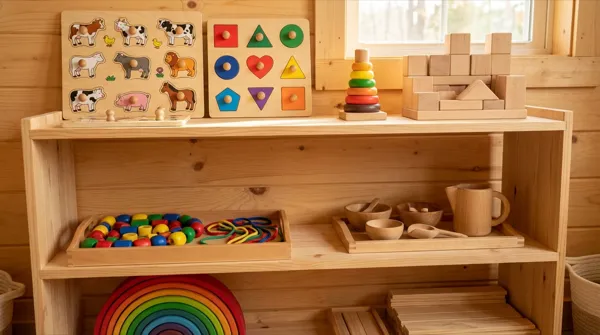
The toys that serve this age well are more complex than toddler materials, but still open-ended. The shift is from simple exploration to purposeful creation.
[For younger children, see: Best Montessori Toys for 2-Year-Olds]
Construction: Building Gets Serious
Kapla Blocks (200-Piece Box)
Price: ~$45 | Ages: 3–12+ | Materials: Pine planks, uniform size
Two hundred identical pine planks. Same length, same width, same thickness. No connectors, no instructions, no gimmicks. Just precision-cut wood and gravity.
What we like:
- The uniformity is the genius — children learn proportion, balance, and engineering through the constraints of a single shape
- Structures can get genuinely impressive (look up Kapla towers — adults get hooked too)
- Quiet play — planks don’t crash as loudly as blocks
- Encourages patience and fine motor precision
- The 200-piece box is enough for meaningful building
What we don’t:
- Requires more patience than chunky blocks — frustration-prone children may need time to adjust
- At ~$45 for wooden planks, it can feel expensive (though the longevity justifies it)
- You’ll inevitably want more — 200 pieces is a starting point, not an endpoint
Budget alternative: Popsicle sticks and white glue. Seriously. They introduce similar planning and construction principles. Or look for generic plank block sets on Amazon ($20-30).
Magna-Tiles (100-Piece Set)
Price: ~$100 | Ages: 3–8+ | Materials: ABS plastic, magnets
If your child already has the 32-piece starter set, this is the upgrade that unlocks real building potential. At 100 pieces, children can build houses, castles, vehicles, and abstract structures with enough variety to sustain long play sessions.
What we like:
- Magnetic connection makes building accessible — structures feel “solid”
- Introduces geometry intuitively (which shapes tile together? how do 2D shapes fold into 3D?)
- Cooperative play works naturally — two children can build together without competing for pieces
- Still going strong at ages 7-8
What we don’t:
- Plastic, which some families prefer to avoid
- $100 is a commitment — though cost per year of use is actually quite low
- Off-brand alternatives (Picasso Tiles, ~$55 for 100 pieces) offer similar play value
Budget alternative: Picasso Tiles 100-piece set (~$55) — widely reviewed as comparable quality at nearly half the price.
Art Materials: Real Tools, Not Toy Versions
Three and four-year-olds are ready for proper art materials — not the chunky toddler versions, but real tools scaled for small hands.
Stockmar Beeswax Stick Crayons (Set of 16)
Price: ~$22 | Ages: 3+ | Materials: Beeswax, non-toxic pigments
The step up from the block crayons we recommended for two-year-olds. Stick-shaped for more detailed drawing, but still thick enough for a developing grip. Same gorgeous beeswax formula.
What we like:
- Rich, blendable colour — leagues ahead of standard wax crayons
- Durable — they don’t snap under pressure the way cheap crayons do
- 16 colours is enough range for expressive work
- Still non-toxic for the occasional taste test
- Transition tool — between block crayons and coloured pencils
What we don’t:
- $22 for crayons feels steep until you use them
- They do get shorter with use (obviously), and replacement sets cost the same
Budget alternative: Crayola Jumbo Crayons (~$5 for 8) aren’t as rich in colour, but they’re accessible and functional. Or try beeswax crayon blocks from lesser-known brands ($8-12).
Fiskars Kids Scissors (Blunt Tip)
Price: ~$4 | Ages: 3+ | Materials: Stainless steel, plastic handles
Real scissors that actually cut. Not the plastic “safety” scissors that frustrate children because they can’t cut anything. Blunt-tipped for safety, but genuinely functional.
What we like:
- They work — children can actually cut paper, which builds the intrinsic motivation to keep practising
- Affordable enough to have a few pairs
- Both right and left-handed versions available
- Squeezing scissors strengthens hand muscles needed for writing
What we don’t:
- They cut things. Including hair, clothing, and important documents. Supervision and clear boundaries matter.
- Plastic handles aren’t the most durable
Budget alternative: Honestly, at $4, these are the budget option. Don’t waste money on plastic scissors that don’t cut — they teach children that scissors are frustrating, not useful.
Liquid Watercolours or a Quality Watercolour Set
Price: ~$12-18 | Ages: 3+ | Materials: Non-toxic pigments
A basic watercolour palette or a set of liquid watercolours opens up a new medium beyond crayons. Children learn about water control, colour mixing, and a completely different mark-making process.
What we like:
- Watercolours teach process — you can’t rush them
- Colour mixing is scientific experimentation disguised as art
- Minimal materials needed: paint, water, paper, brush
- Clean-up is genuinely easy (unlike acrylics)
What we don’t:
- Cheap watercolour sets produce washed-out colours that disappoint children
- Water gets everywhere. Accept this.
Budget alternative: Food colouring mixed with water in ice cube trays. Free (you already have it), and the colour mixing is identical. Stains hands and surfaces temporarily, so use old clothes and a covered table.
👉 Check price on Amazon (Crayola washable watercolours — decent quality, affordable)
DIY art station: You don’t need a fancy art cart. A low shelf or a cleared section of table with paper, crayons, scissors, glue stick, and a few stamps or stencils is plenty. The key is accessibility — when art materials are always available, children use them regularly rather than waiting for “art time.”
Pretend Play: The Real Deal
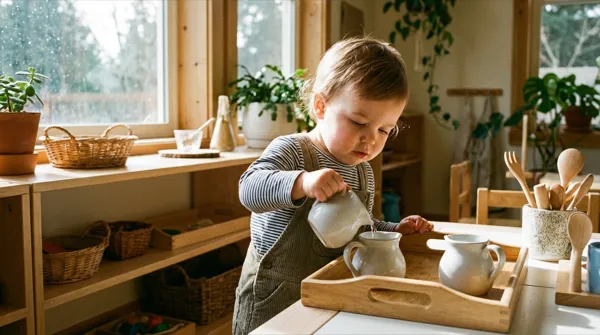
At three and four, pretend play becomes rich and complex. And the best pretend play materials aren’t highly detailed — they’re suggestive, leaving room for imagination to fill in the details.
A Simple Wooden Play Kitchen (or a Real Kitchen Setup)
Price: $50-150 for a toy kitchen, or free if you use your actual kitchen | Ages: 2-6
Here’s an honest question: do you need a play kitchen, or can your child just cook with you in the real kitchen?
A learning tower or step stool at the counter, a few child-safe utensils, and real ingredients beats any play kitchen for developmental value. Your child learns actual cooking skills, practises measurement, and contributes meaningfully to family life.
That said, a play kitchen does allow for independent pretend play when you’re not cooking, and many children adore them.
What we like about play kitchens:
- Extended independent play — children can “cook” for 30+ minutes
- Rich language development through role-playing scenarios
- Social play — two or more children can cook “together”
What we don’t:
- Most are overpriced for what they are — particle board and plastic accessories
- They take up significant space
- Children often prefer real kitchen access anyway
Budget alternative: A cardboard box with drawn-on burners and a few real kitchen items (wooden spoons, a small pot, an oven mitt). Cost: whatever you’d spend on recycling day. Or check local marketplaces — play kitchens are among the most commonly resold children’s items.
👉 IKEA DUKTIG Play Kitchen (~$90) — simple, hackable, and more durable than many pricier alternatives.
Dress-Up Materials
Forget character costumes. The most versatile dress-up materials are:
- Large scarves and pieces of fabric (a cape? a skirt? a turban? a baby sling? all of the above)
- Old adult clothing — shirts, hats, bags
- A few specific items: a stethoscope, a magnifying glass, a set of play keys
Open-ended dress-up materials get used far more than a Spider-Man costume that’s only ever Spider-Man.
Cost: Raid your wardrobe and your nearest charity shop. Budget: $0-10.
Puzzles: Stepping Up Complexity
Jigsaw Puzzles (24-48 Pieces)
Price: ~$8-15 each | Ages: 3-5
Three-year-olds who’ve graduated from knob puzzles are typically ready for 12-24 piece jigsaws. By four, many children handle 24-48 pieces confidently.
What we like:
- Puzzles build problem-solving, spatial reasoning, and persistence
- Clear self-correction — pieces fit or they don’t
- Quiet, focused activity — excellent for concentration
- Completed puzzles provide genuine satisfaction
What we don’t:
- Single-use in a sense — once mastered, a puzzle loses its challenge
- Pieces get lost (accept this as inevitable)
Budget alternative: Charity shops are goldmines for puzzles. Missing a piece or two? That’s real life. Or print images and cut them into puzzle pieces yourself — customised, free, and oddly satisfying.
👉 Ravensburger Floor Puzzles (~$12) — durable, well-cut, with satisfying piece-fit.
Tangrams
Price: ~$8-12 | Ages: 3-8+ | Materials: Wood or plastic
Seven geometric pieces that combine to create hundreds of shapes and figures. Comes with pattern cards showing silhouettes to recreate.
What we like:
- Genuinely challenging — adults find them tricky too
- Builds spatial reasoning and geometric thinking
- Portable — great for restaurants and travel
- Longevity is exceptional — a four-year-old and an eight-year-old can both be challenged
What we don’t:
- Can be frustrating without pattern cards to start
- Small pieces — not ideal if younger siblings are around
Budget alternative: Cut tangram shapes from cardboard. Templates are available free online. The play value is identical.
Early Maths: Concrete Before Abstract
A Simple Balance Scale
Price: ~$15-25 | Ages: 3-7 | Materials: Plastic (usually)
A bucket balance where children place objects in each side to explore weight, equality, and early addition. Simple, visual, and deeply mathematical.
What we like:
- “Heavier” and “lighter” become tangible, not theoretical
- Natural extension of play: “Which is heavier — a pinecone or a rock?”
- Introduces equality and balance — the foundation of algebraic thinking (yes, really)
- Leads naturally to counting: “How many bears balance one block?”
What we don’t:
- Most affordable versions are plastic (wooden versions exist but cost $40+)
- Accuracy can be imprecise on cheaper models
Budget alternative: Build one from a coat hanger and two small containers (yoghurt pots work). Hang it from a doorknob. It wobbles, but the principle is clear.
Counting Bears or Loose Parts
Price: ~$12 for a set | Ages: 2-6
Small, colourful bears (or similar objects) for sorting by colour, counting, patterning, and basic addition/subtraction.
What we like:
- Versatile — sorting, counting, patterning, pretend play
- Concrete maths — moving real objects beats pointing at numbers on a page
- Pairs well with the balance scale
- Colours invite sorting and classification
What we don’t:
- They’re plastic and not exactly beautiful
- The concept is simple enough that you don’t strictly need a branded set
Budget alternative: Buttons, pebbles, pasta shapes, acorns — any collection of small objects works for counting and sorting. Raid the junk drawer and nature. Free, and arguably more interesting than identical plastic bears.
Number Rods or DIY Number Line
Montessori number rods (red and blue alternating sections, increasing in length from 1 to 10) are a classic material for understanding quantity. A full set costs $30-50. But you can make a version with ten sticks of increasing length — dowels from a hardware store, painted in alternating colours. Cost: about $8 in materials.
The key concept: each number is a physical length. Three isn’t just a symbol — it’s three units long. This concrete understanding makes abstract maths far more intuitive later.
What You Don’t Need to Buy
A quick list of things that are free and deeply Montessori for this age group:
- Cooking together — measuring, pouring, stirring, following sequences
- Gardening — planting seeds, watering, observing growth
- Sorting laundry — by colour, by family member, by type
- Setting the table — one-to-one correspondence (one plate per person = early maths)
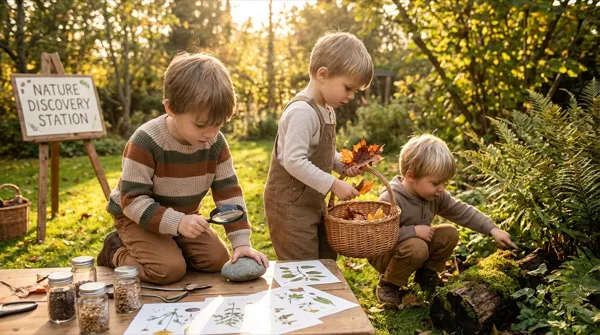
- Walking in nature — collecting, classifying, observing, questioning
- Building with cardboard boxes — engineering with recycling
- Drawing from observation — looking at a flower and drawing what you see
The best “toy” for a three or four-year-old is often a real task, done alongside a patient adult.
The Bottom Line
If we were setting up a shelf for a 3-4 year old with a limited budget, we’d choose:
- Kapla Blocks ($45) — construction
- Stockmar stick crayons + real scissors (~$26) — art
- A set of jigsaw puzzles (~$12) — cognitive challenge
- Counting bears or loose parts ($12 or free from nature) — maths
Total: around $80-95, plus free practical life and pretend play from things already in your home.
If budget is tighter, skip the branded items entirely: cardboard construction, kitchen crayons, charity shop puzzles, and buttons for counting. Total: under $10. The learning is in the doing, not the buying.
[For the philosophy behind these choices: What Is Montessori? A No-Nonsense Guide]
Exploritori Rating
Best Montessori Toys for 3-4 Year OldsFAQ
What’s the biggest developmental leap between 2 and 4?
Pretend play and cooperative play. Two-year-olds explore materials. Three and four-year-olds create narratives and build with other children. Toys that support storytelling and collaboration become much more valuable at this age.
Should I still rotate toys at this age?
Yes, though rotation can slow down. Three and four-year-olds often have longer-term projects (an ongoing block construction, a puzzle they’re working through) that should stay out. Rotate supporting materials around these anchors.
My child only wants to play with one thing. Is that a problem?
No — it’s a feature, not a bug. Deep engagement with a single material is exactly what Montessori values. If your child builds with blocks for an hour every day, they’re developing concentration, spatial reasoning, and persistence. Don’t interrupt it to enforce variety.
When should I introduce reading and writing materials?
When your child shows interest. Some three-year-olds are fascinated by letters; others aren’t ready until five. Sandpaper letters, a moveable alphabet, and environmental print (labels, signs, book titles) support early literacy without pressure. Follow the child.
Are battery-operated “educational” toys ever worth it?
Rarely at this age. Most electronic toys direct the play rather than letting the child lead. A toy that quizzes a child on colours is less valuable than a box of crayons that lets them explore colour independently. The child who uses crayons learns colour and fine motor control and creative expression.
Where curiosity leads, learning follows. ✨
 Get weekly Montessori tips
Honest reviews, activity ideas, and budget-friendly picks — no spam, just what works.
Subscribe Free