Lovevery vs DIY: Is the Subscription Worth It?
Lovevery has become the default answer to “how do I do Montessori at home?” — a subscription box that delivers age-appropriate play kits to your door every 2-3 months. Beautiful packaging, thoughtfully designed materials, Instagram-ready aesthetic.
But at €36-40 per month, it’s a serious investment. And the whole premise of Montessori is that children learn from simple, real-world materials — many of which you can make or source yourself for a fraction of the cost.
So which path makes more sense? We’ve tried both. Here’s the honest breakdown.
What You Get with Lovevery
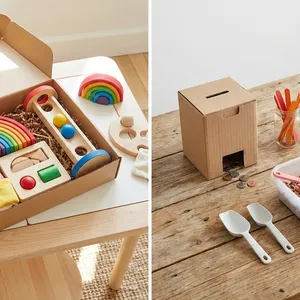
Lovevery’s Play Kits arrive every 2-3 months, tailored to your child’s age. Each kit includes:
- 5-7 toys/materials designed for specific developmental milestones
- A play guide explaining what each item develops and how to use it
- A stage-specific book
- High-quality packaging and presentation
The materials are genuinely well-made. Solid wood, non-toxic finishes, thoughtful design. The posting box has perfectly sized shapes. The puzzles have satisfying knobs. The fabric items are soft and durable. You can tell these were designed by people who understand child development.
Lovevery pricing (2026):
| Plan | Cost per kit | Kits per year | Annual cost |
|---|---|---|---|
| Pay per kit | ~€80 | 4-6 | €320-480 |
| Prepaid annual | ~€70/kit | 4-6 | €280-420 |
Over the first two years, you’ll receive roughly 8-10 kits, totalling €560-800 depending on your plan and your child’s age range.
That’s a significant amount of money. Let’s see what the DIY path looks like.
The DIY Alternative
“DIY Montessori” doesn’t mean building everything from scratch in a woodworking shop (though you can). It means sourcing equivalent materials yourself — from shops, thrift stores, online retailers, and your own kitchen.
What you’d buy to match a typical Lovevery kit:
Let’s take a real example. The Lovevery “The Explorer” kit (months 7-8) includes:
- Wooden ball drop
- Object permanence box
- Fabric pull toy
- Textured balls
- Board book
- Play guide
DIY equivalent:
- Wooden ball drop (Montessori Object Permanence Box) (~$18)
- Simple posting box (~$18, or make one from a shoebox — free)
- Fabric ribbon tied to a wooden ring: ~€3
- Textured balls sensory set (~$7)
- Board book from library or secondhand: €0-5
- Development info: free via blogs, books, or apps like Hatch
DIY total: ~€46-51 vs Lovevery’s ~€80
That’s roughly 40-50% savings. Multiply across 8-10 kits over two years, and you’re looking at saving €250-400.
But the savings come with costs of their own.
The Real Comparison
Quality
Lovevery wins. Not by a huge margin, but noticeably. Their materials are cohesive — the wood grain matches, the colours coordinate, the sizes are precisely calibrated. A Lovevery posting box feels premium. A budget Amazon posting box feels… fine. Both work. But one is nicer to look at and handle.
That said, “nicer” matters more to parents than to children. A child learning to post shapes through holes doesn’t care whether the box cost €15 or is part of an €80 kit. They care whether the circle fits through the circle hole. It does, either way.
Verdict: Lovevery quality is excellent. DIY quality is adequate to good. Children don’t notice the difference.
Developmental Appropriateness
Lovevery wins, slightly. Their kits are designed by child development experts and timed to specific developmental windows. You don’t have to research what your 9-month-old needs — they’ve done it for you.
With DIY, you need to do this research yourself. It’s not hard — there are excellent free resources — but it takes time. And there’s a risk of buying things that are too advanced or too simple for your child’s current stage.
Verdict: Lovevery removes the guesswork. DIY requires some homework.
Cost
DIY wins, clearly. Even buying high-quality wooden alternatives, you’ll spend 40-60% less than Lovevery. If you’re willing to make some materials yourself or source secondhand, the savings are even greater.
| Approach | 0-2 years estimated cost |
|---|---|
| Lovevery (prepaid) | €560-700 |
| DIY (buying new) | €250-400 |
| DIY (mix of new + secondhand + homemade) | €100-200 |
| Pure DIY (household items + homemade) | €20-50 |
That last row isn’t a joke. A wooden spoon, some containers, a cardboard box with a hole cut in it, fabric scraps, and items from your kitchen provide genuinely rich Montessori experiences for babies and toddlers.
Verdict: DIY saves real money. The more creative you are, the more you save.
Time Investment
Lovevery wins. A box arrives. You open it. You read the guide. You put the materials on a shelf. Total time: 15 minutes.
DIY requires research (what does my child need now?), sourcing (where do I find a good wooden egg cup?), assembly (cutting that shoebox), and curation (which of these 12 items should go on the shelf?). For each “kit equivalent,” budget 2-4 hours of research and sourcing, spread over a few weeks.
If your time is scarce — and whose isn’t? — that’s a meaningful difference.
Verdict: Lovevery saves significant time. DIY costs hours.
Sustainability and Waste
Mixed. Lovevery materials themselves are high quality and durable, but there’s packaging involved in shipping kits internationally. DIY lets you source locally, buy secondhand, and repurpose household items — potentially a smaller environmental footprint.
On the other hand, Lovevery’s items last and can be passed on to other families. Budget DIY alternatives sometimes don’t hold up as well and end up discarded sooner.
Verdict: Depends on your approach. Thoughtful DIY can be more sustainable; lazy DIY with cheap imports isn’t necessarily better than Lovevery.
The Intangible Factor
There’s something Lovevery provides that’s hard to quantify: confidence. For parents who are new to Montessori (which is most people), having a curated box arrive with a guide that says “here’s exactly what to do and why” reduces anxiety. You feel like you’re doing it right.
DIY requires more confidence in your own judgement. You have to decide: is this the right toy? Is this the right time? Am I doing enough? For some parents, that uncertainty is stressful. For others, the research and curation process is genuinely enjoyable.
Neither is wrong. Know yourself.
Our Verdict
Choose Lovevery if:
- Budget isn’t the primary concern. You can afford €80 per kit without stress.
- Time is your scarcest resource. You want developmentally appropriate materials without research.
- You’re new to Montessori. The guides and curation build confidence. (If you want to learn the basics first, our no-nonsense Montessori guide is a good starting point.)
- You value premium quality and aesthetics. The materials are beautiful.
- You like the gifting aspect. Many grandparents or family members buy Lovevery subscriptions as gifts.
Choose DIY if:
- Budget matters. You can achieve 80% of the value for 40% of the cost.
- You enjoy the process. Researching, sourcing, and making materials is fun for you.
- You already know what your child needs. You’ve read about Montessori development and feel confident selecting materials. Our complete guide to Montessori toys by age can help with that. Consider starting with classics like the Melissa & Doug Shape Sorting Cube (
$18) and Hape Pound & Tap Bench ($30). - You prefer to customise. Your child has specific interests that a standardised kit won’t address.
- You have access to good secondhand markets. Thrift stores, Facebook Marketplace, and hand-me-downs dramatically reduce costs.
The hybrid approach (what we actually recommend):
Do a few Lovevery kits early on, then transition to DIY. The first year is when the guidance is most valuable — you’re learning alongside your child. Once you understand the principles and your child’s rhythms, you’ll find it natural to source and select materials yourself.
Alternatively, pick the specific Lovevery kits that cover ages you feel less confident about, and DIY the rest. Budget alternatives like the Rainbow Stacker ($16), Jumbo Knob Puzzle ($12), and Fat Brain Toys Tobbles Neo (~$25) offer Lovevery-level quality at DIY prices. Not everything has to be all-or-nothing.
Frequently Asked Questions
Can I buy individual Lovevery toys without the subscription?
Yes, Lovevery has started selling some items individually through their website. Prices are higher per item than the kit price, but it lets you cherry-pick specific materials you want.
Is Lovevery available in Europe?
Yes, Lovevery ships internationally, including to Europe. Be aware of potential customs charges and longer delivery times. The prices quoted above include typical EU pricing. If shipping costs or wait times are prohibitive, consider building your own kit with Kinetic Sand (~$12) and other Amazon essentials available locally.
What free resources can I use for DIY Montessori guidance?
There are excellent free resources: The Hapa Family blog, Montessori in Real Life, and @themontessorinotebook on Instagram all provide age-by-age activity ideas. Your local library likely has books on Montessori at home. You don’t need to pay for information. Pair these with budget-friendly sensorial toys like the Hape Double Bubble Bead Maze (~$22) for hands-on learning without subscription cost.
What if I start with Lovevery and want to cancel?
You can cancel your subscription at any time. There’s no penalty for stopping. You keep all the kits you’ve received.
Are Lovevery materials safe?
Yes. Lovevery materials are tested to meet US (CPSC), EU (EN 71), and other international safety standards. They use non-toxic finishes and sustainable wood. Safety is one area where they genuinely excel.
Is Lovevery actually Montessori?
Lovevery is Montessori-inspired. Their materials align with Montessori developmental principles, but they’re not official Montessori classroom materials (those come from specialised suppliers like Nienhuis). For home use, Lovevery’s approach is solid. Montessori purists might quibble with some design choices, but for most families, it’s an excellent starting point. Similar quality at lower cost can be found with curated alternatives like the Grimm’s Large Rainbow ($55) and Fat Brain Toys Squigz ($35).
 Get weekly Montessori tips
Honest reviews, activity ideas, and budget-friendly picks — no spam, just what works.
Subscribe Free