10 Montessori Activities for 18-Month-Olds (No Special Toys Needed)
Here’s a secret that the Montessori toy industry doesn’t love: some of the best learning activities for your 18-month-old are sitting in your kitchen right now.
At 18 months, children are in a developmental sweet spot. They’re walking (or close to it), their fine motor skills are exploding, they’re beginning to understand cause and effect, and they desperately want to do what you’re doing. They don’t need a €50 wooden toy to learn. They need a wooden spoon, a bowl, and ten minutes of your attention.
Here are 10 activities you can set up today with things you already have.
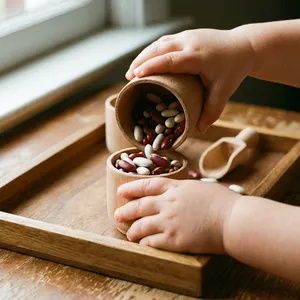
1. Transferring with a Spoon
What you need:
- Two small bowls
- A spoon (wooden or metal — avoid plastic, it’s too light)
- Something to transfer: dried pasta, large beans, rice (for more advanced children), or cereal
How to do it:
Place the two bowls side by side on a tray or placemat. Fill one bowl with the material. Show your child — slowly, without talking too much — how to scoop from one bowl and transfer to the other. Then hand them the spoon and let them try.
There will be spills. That’s fine. Part of the activity is learning to clean up afterward (give them a small brush or cloth).
What it develops:
Fine motor control, hand-eye coordination, concentration, independence. This is also an early practical life skill — they’re learning the movements they’ll use when eating independently.
Tips:
Start with larger items (big pasta shapes) and a deep spoon. As they master it, move to smaller items and eventually a smaller spoon. Rice is the final boss — it’s harder than it looks.
2. Posting Objects into a Container
What you need:
- A container with a lid (a shoebox, tissue box, or coffee tin with a plastic lid)
- Objects to post: large wooden blocks, clothespins, pompoms, or bottle caps
- A craft knife (for you, to cut the hole)
How to do it:
Cut a hole in the lid that’s large enough for the objects to fit through. Show your child how to push an object through the hole. Open the container, take the objects out, and do it again.
That’s it. Your child will do this approximately 47 times in a row and be completely absorbed.
What it develops:
Object permanence (the block still exists even though I can’t see it), fine motor skills, cause and effect, problem-solving (rotating objects to fit through the hole).
Tips:
Make different shaped holes for different objects as your child advances. A circular hole for balls, a rectangular slot for flat blocks. This is essentially a DIY version of the Montessori object permanence box — though the homemade version works just as well.
3. Peeling a Banana
What you need:
- A banana (slightly overripe ones are easier to peel)
How to do it:
Start the peel for your child by pulling back one strip about halfway. Hand it to them and let them pull the strip down the rest of the way. Over time, show them how to start the peel themselves (pinching the top and pulling — this is genuinely challenging fine motor work).
Then they eat the banana. Activity complete.
What it develops:
Fine motor skills (peeling requires grip strength and coordination), independence (preparing their own food), practical life skills, hand strength. Also: nutrition.
Tips:
This is a confidence-builder. When an 18-month-old successfully peels their own banana, they light up. Start with pre-started peels and let them do progressively more of the work over weeks.
4. Water Pouring
What you need:
- Two small jugs, cups, or measuring cups
- Water
- A tray to contain the mess
- A small sponge or cloth for cleanup
How to do it:
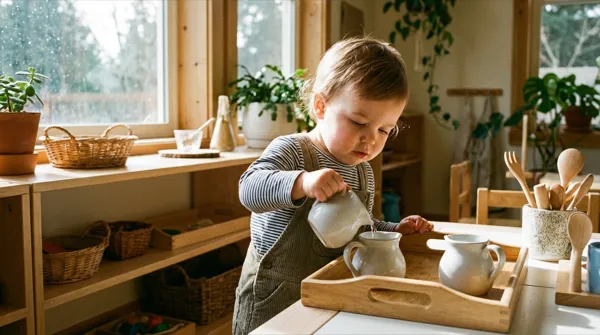
Fill one container about one-third full with water. Show your child how to lift it with both hands and slowly pour into the other container. Then pour it back. When they spill (they will), show them how to use the sponge to wipe it up.
What it develops:
Fine motor control, bilateral coordination (using both hands together), concentration, practical life skills, early understanding of volume and quantity.
Tips:
Do this in the kitchen or bathroom where spills don’t matter. Use a tray with raised edges to contain the water. Start with very small amounts — a few tablespoons is plenty. Coloured water (a drop of food colouring) makes it more visually engaging.
5. Matching Socks
What you need:
- 3-4 pairs of distinctly different socks (different colours or patterns)
How to do it:
Mix up the socks in a small basket. Take one sock out and lay it on the floor. Ask your child to find the one that looks the same. At 18 months, start with very obvious differences (a red sock and a blue sock). Make the pairs progressively more similar as they get better.
What it develops:
Visual discrimination, matching and pairing (a pre-mathematical skill), language (naming colours, describing patterns), practical life skills (laundry!).
Tips:
This works especially well if you make it part of your actual laundry routine. Fold your laundry together, and give your child the socks to sort. They’re participating in real household work, which is exactly what Montessori practical life is about.
6. Stacking and Knocking Down
What you need:
- Blocks, boxes, or stacking cups (you can use food containers, small boxes, or actual wooden blocks)
How to do it:
Build a small tower (3-4 blocks). Let your child knock it down. Then invite them to build their own. At 18 months, most children can stack 2-4 blocks independently.
Don’t build elaborate towers for them to destroy — the goal is for them to build, not just demolish. If they’re only interested in knocking down, try building together: you place one, they place one.
What it develops:
Hand-eye coordination, spatial awareness, fine motor control, understanding of balance and gravity, cause and effect, early mathematical thinking (more, taller, bigger).
Tips:
Use blocks of the same size for stacking practice — it’s easier than mixed sizes. Nesting cups are good because they can stack AND nest, providing two activities in one. If you want a dedicated stacking toy, the Melissa & Doug Rainbow Stacker ($16) is a classic, or the Fat Brain Toys Tobbles Neo ($25) adds a satisfying wobble element.
7. Opening and Closing Containers
What you need:
- 4-5 containers with different closures: a screw-top jar, a box with a hinged lid, a zip-lock bag, a container with a snap lid, a small purse with a clasp
How to do it:
Place a small interesting object inside each container (a wooden bead, a small figurine, a button — nothing that’s a choking hazard for your child). Present the containers on a tray. Your child’s job is to open each one, find what’s inside, then close it again.
What it develops:
Fine motor skills (each closure type uses different hand movements), problem-solving, persistence, hand strength. Different closures develop different grip patterns: screw lids use wrist rotation; snap lids use pinching; zippers use pincer grip.
Tips:
Start with easy closures (lift-off lids) and progress to harder ones (screw tops, clasps). Loosening screw lids slightly before presenting them helps build confidence before asking for full unscrewing. A wooden shape sorting cube (~$18) combines opening/closing with shape matching if you want a dedicated version of this activity.
8. Tearing Paper
What you need:
- Sheets of paper (newspaper, old magazines, or coloured construction paper)
- A small basket or tray
How to do it:
Show your child how to hold the paper with both hands and tear it. That’s it. Let them rip paper to their heart’s content. When they’re done, they can put the scraps in the basket. Later, you can use the scraps for collage, or they can practise scrunching them into balls and tossing them into a container.
What it develops:
Bilateral coordination (each hand does something different — one holds, one pulls), fine motor strength, sensory experience (the sound and feel of tearing paper), concentration.
Tips:
Different papers provide different difficulty levels. Tissue paper is easiest. Magazine paper is medium. Card stock is a challenge. Let them experience the difference. And yes, designate which papers are okay to tear — setting boundaries is part of the learning.
9. Wiping a Table
What you need:
- A small sponge or cloth
- A spray bottle with water (set to a gentle spray)
- A table or tray at child height
How to do it:
Spray a small amount of water on the table. Show your child how to wipe from left to right across the surface. Then let them spray (they’ll love the spray bottle) and wipe. Demonstrate wringing the cloth out over a small bowl.
This is a real Montessori classroom exercise, and children take it incredibly seriously. Don’t be surprised if your 18-month-old wants to wipe every surface in the house.
What it develops:
Practical life skills, left-to-right hand movement (pre-reading skill!), hand strength (wringing), concentration, sense of order and cleanliness.
Tips:
Left-to-right wiping matters — it prepares the hand and eye for the left-to-right movement used in reading and writing. Don’t correct their direction constantly, but do model it consistently.
10. Dropping Objects into Water
What you need:
- A clear bowl or container filled with water
- Small objects: a stone, a cork, a wooden block, a metal spoon, a leaf, a small plastic toy
How to do it:
Set up the bowl of water on a tray. Place the objects in a small basket beside it. Your child drops each object in and watches what happens. Some sink. Some float. Some splash. All of it is fascinating.
Name what happens: “The stone sank to the bottom. The cork is floating on top!” Don’t quiz them — just narrate.
What it develops:
Early scientific thinking (observation, prediction, cause and effect), vocabulary (sink, float, heavy, light, splash), sensory experience, fine motor skills (picking up and releasing objects).
Tips:
This activity is endlessly repeatable because you can change the objects each time. Introduce new items and ask “what do you think will happen?” Even before they can answer verbally, they’ll begin to anticipate outcomes — that’s scientific thinking in action.
Setting Up for Success
A few principles that make all these activities work better:
Go slow. When you demonstrate an activity, move your hands deliberately and slowly. Children learn by watching your movements, and fast demonstrations are hard to follow.
Talk less. This is counterintuitive, but too much verbal instruction actually interferes with concentration. Show more, explain less. Let the materials teach.
Let them struggle. If your child is trying to fit a block through a hole and it’s not working, wait. Give them time to figure it out. Jumping in too quickly robs them of the satisfaction of solving the problem themselves.
Follow their interest. If your child does an activity “wrong” — uses the spoon to bang on the bowl instead of transferring beans — that’s fine. They’re exploring the material their way. Redirect gently if needed, but don’t insist on the “correct” use.
Keep it short. At 18 months, concentration spans are 3-10 minutes. If they walk away after two minutes, that’s a successful activity. Don’t push for longer engagement.
If you do want a few good toys to complement these activities, we’d suggest the Hape Pound & Tap Bench ($30) for cause-and-effect play and the Melissa & Doug Jumbo Knob Puzzle ($12) for shape recognition — both are excellent at this age and last well beyond 18 months.
Set up a shelf. Having a dedicated, child-accessible space for activities makes a huge difference. See our guide to setting up a Montessori shelf for step-by-step instructions. And if you’re looking for toys to complement these activities, our complete Montessori toys by age guide covers the 12–18 month stage in detail.
Frequently Asked Questions
How long should an 18-month-old focus on one activity?
Typically 2-10 minutes, though some children will repeat a favourite activity for much longer. Don’t interrupt focused concentration, even if it seems like they’re “just” pouring water back and forth. That repetition is building neural pathways.
What if my child has no interest in these activities?
Try presenting them at different times of day. Energy levels matter — a child who’s hungry, tired, or overstimulated won’t engage. Also, observe what your child naturally gravitates toward. If they love water play but ignore the stacking, lean into the water play and try stacking again in a few weeks.
Are these safe for children who still put everything in their mouths?
Most of these activities are fine with supervision. Avoid small items that are choking hazards (small beans, buttons, beads) and substitute with larger alternatives. The banana peeling, water pouring, sock matching, and table wiping activities have no choking risk at all.
How many activities should I offer at once?
Two to three options is plenty. Set up a couple on a low shelf or tray and let your child choose. Offering too many options leads to the same overwhelm as a stuffed toy box.
Can I do these with older or younger children?
Absolutely. For younger children (12-15 months), simplify — larger objects, fewer steps, more demonstration. For older children (2-3 years), add complexity — smaller objects, more steps, less help. The core activities scale beautifully.
My child just makes a mess. Is that normal?
Yes. Mess is part of the process, not a sign of failure. The spilled water, scattered beans, and torn paper are evidence of learning. Include cleanup as part of every activity — a small brush, sponge, or cloth nearby signals that tidying up is part of the work, not a punishment afterward.
 Get weekly Montessori tips
Honest reviews, activity ideas, and budget-friendly picks — no spam, just what works.
Subscribe Free