Montessori Life Cycle Activities for Toddlers: Butterfly, Frog, Flower & More
This post contains affiliate links. If you purchase through these links, we may earn a small commission at no extra cost to you. We only recommend products we genuinely believe in. Read our full affiliate policy
Spring is when everything is in the middle of becoming something else.
The caterpillar in the jar. The tadpoles in the pond. The bulb pushing a green spike through the soil. If you’ve ever watched a two-year-old notice a caterpillar for the first time — the absolute stillness, the concentration — you already know these moments are doing something important.
Montessori life cycle activities take that natural fascination and give it structure. Not worksheet-and-poster structure. Real structure: sequencing cards a toddler can hold and rearrange, three-dimensional figures representing each stage, live observations connected to what the cards show. The abstract and the real, stitched together by a child’s hands.
This guide covers four life cycles — butterfly, frog, flowering plant, and seed-to-tree — plus how to set up each one, what materials are worth buying versus making, and what to do when you can observe the real thing in the garden.
For the broader spring activity picture, see our Montessori Spring Activities guide. For outdoor science work, Outdoor Montessori Nature Activities is the natural companion. For sensory exploration of spring materials, see Montessori Sensory Activities for Toddlers.
Why Life Cycles Are a Montessori Natural
Maria Montessori designed her curriculum around what she called the “cosmic curriculum” — the idea that children benefit from understanding how living things connect, depend on each other, and change over time. Life cycles are among the most direct expressions of that idea.
But there’s a simpler reason too. Life cycles contain something that young children find irresistible: transformation. A tiny egg becomes a caterpillar becomes something entirely different. That doesn’t feel like science — it feels like magic. Montessori materials just give the child vocabulary and sequence for magic they’ve already noticed.
What makes a good life cycle activity:
- Concrete before abstract. Show the real thing (caterpillar, tadpole) before the card. Connect the card to something they’ve held or watched.
- Let them sequence independently. Lay out the cards and step back. If they get the order wrong, that’s fine. They’ll self-correct when you tell the story together.
- Use three-part cards. Montessori three-part cards (image only, label only, image + label) extend the activity into language and early reading work.
- Return to it. Life cycle trays work best when they stay accessible for a few weeks, not as a one-off.
The Butterfly Life Cycle
Minimum age: 2 years
Time investment: 20–30 minutes initial setup; ongoing observation
Indoors / outdoors: Both
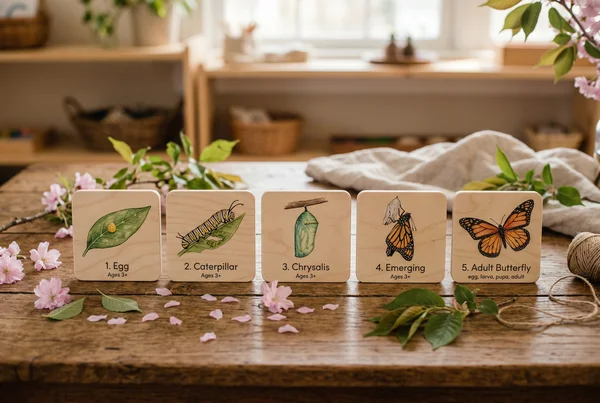
The butterfly is the entry point for most toddlers — probably because the transformation is so dramatic. Egg to caterpillar to chrysalis to butterfly is a story arc even a two-year-old can follow.
Setting it up
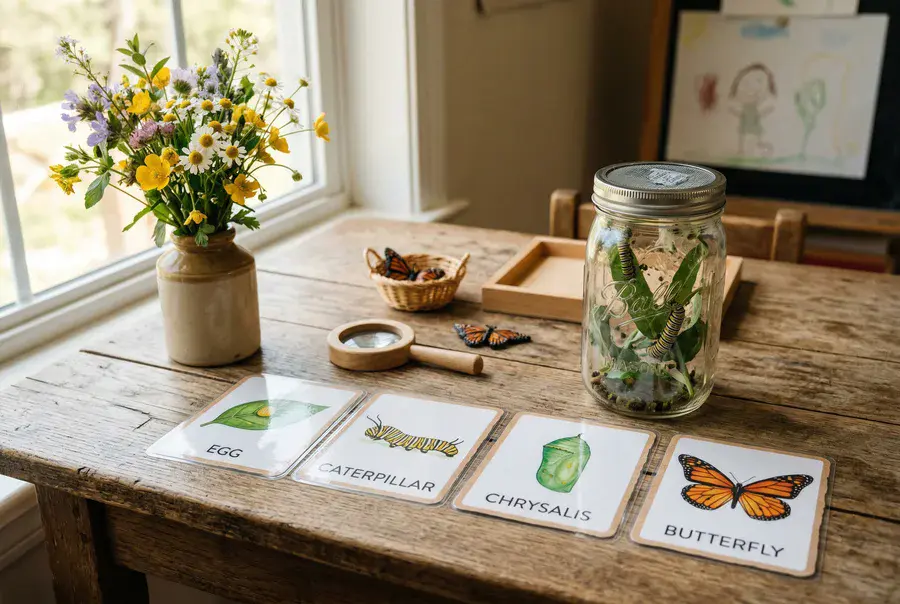
The four stages: egg — caterpillar (larva) — chrysalis (pupa) — butterfly (adult)
What to collect or buy:
The best home resource for the butterfly life cycle remains the Insect Lore Butterfly Garden (approx. $25, caterpillars ordered separately for approx. $18). You receive five caterpillars, which you observe eating and growing for 10–14 days, then watch form chrysalises, then hatch as painted lady butterflies. The final release is a genuine ceremony. Nothing matches the learning of watching the real cycle unfold.
For sequencing cards and figurines:
The Safari Ltd. Painted Lady Butterfly Life Cycle (approx. $8) includes four-stage plastic figures sized right for toddler hands — small enough to arrange on a tray, durable enough to survive daily handling. These connect directly to the Insect Lore kit: the child can match the plastic stage to the live stage in the jar.
For printed cards, the Montessori Print Shop Butterfly Life Cycle 3-Part Cards (downloadable, ~$3) are excellent — realistic illustrations, correct terminology, both image-only and labelled versions.
Tray setup:
- A wooden tray or shallow basket
- The four figurines in a row from left to right (egg to butterfly)
- Cards face-down in a stack (child sequences them after hearing the story once)
- If the Insect Lore kit is running: a photo of the current stage to match to the tray
Telling the story
The sequence is everything. Tell it slowly and in order, once:
“The butterfly lays a tiny egg on a leaf. The egg hatches into a caterpillar. The caterpillar eats and eats and grows and grows — until it wraps itself in a chrysalis. Inside the chrysalis, it completely changes. Then it opens, and out comes a butterfly.”
That’s it. No extra information. No quiz. Let the child arrange the stages themselves after hearing it.
Extending the activity
- Hunt for caterpillars on garden plants in spring (nettles, cabbages, and buddleia are good spots in the UK and Europe)
- Observe butterfly wings under a magnifying glass — the scales are visible
- Draw each stage in a simple nature journal (even pre-writing toddlers can make marks representing each)
- For older children (4+): introduce the vocabulary cards — larva, pupa, metamorphosis, chrysalis
The Frog Life Cycle
Minimum age: 2.5 years
Time investment: 20 minutes; ongoing if near a pond
Indoors / outdoors: Both (best with real pond visit)
The frog life cycle adds something the butterfly doesn’t: the transformation happens in water. That’s interesting. And tadpoles are findable in most British and European ponds from March onwards.
The four stages
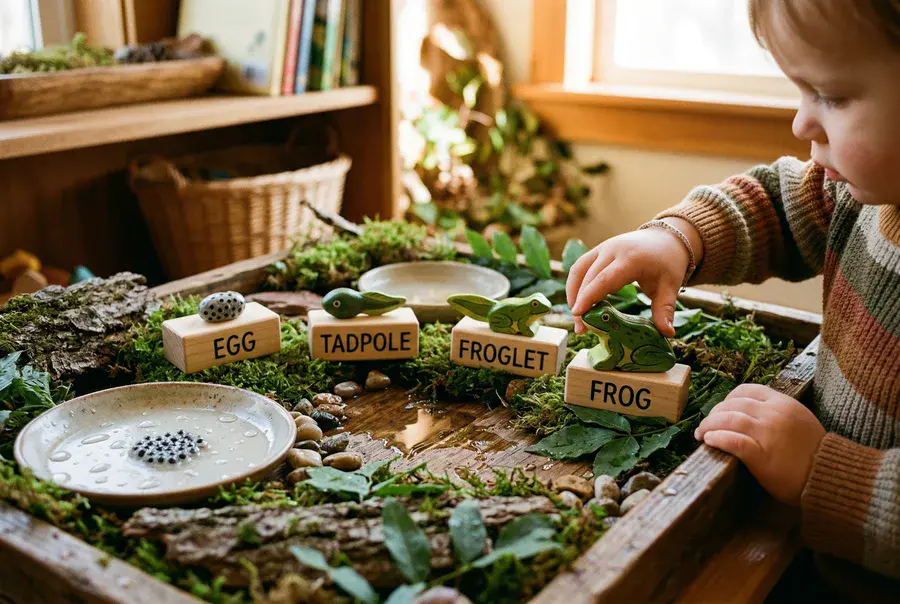
Egg (frogspawn) — tadpole — froglet — frog
The froglet stage — when back legs appear but the tail is still present — is the one most children find astonishing. The transition is literal: the animal exists in two forms simultaneously.
Materials
The Safari Ltd. Frog Life Cycle Figurines (approx. $8) include five stages (egg mass, tadpole, two-legged tadpole, froglet, adult frog) and are well-sculpted — the froglet stage, with its half-tail, is correctly represented. Good for hands-on sequencing and for matching to real pond observations.
For a more complete set with nomenclature cards, Nienhuis Montessori produces a premium three-part card set with the correct stages — these last years and work with the full three-part card lesson if you want to introduce reading vocabulary.
The pond visit
Spring is when this activity becomes unforgettable. Frogspawn appears in still, shallow ponds from late February (UK/Spain). By March, tadpoles are visible. By April, froglets.
Take a jar. Collect a small scoop of pond water with a tadpole (or photograph if the pond is protected). Observe for 24 hours. Release back into the same pond. The connection between the tray figurine and the thing in the jar does something no card can replicate.
Tray setup
- Figurines in sequence on a wooden tray
- A small bowl of water in the tray (optional) as a visual cue for the aquatic stages
- Printed cards below each figurine once the child knows the sequence
- Optional: a flat stone and a piece of moss for the “adult frog” habitat
The Flowering Plant Life Cycle
Minimum age: 18 months (simplified) / 2.5 years (full cycle)
Time investment: Ongoing — this one takes weeks
Indoors / outdoors: Both
This is the most actionable life cycle activity — because you can do all of it at home, in real time, with a packet of sunflower seeds.
The five stages
Seed — germination — seedling — flowering plant — seed dispersal / new seeds
The bean-in-a-bag window experiment covers the germination stage in a way toddlers can observe daily. The full plant life cycle tray adds language and sequence to what they’re already watching.
Materials
For figurines, the Learning Resources Plant Life Cycle Figures (approx. $12) are excellent — six detailed stages from seed to mature plant with seeds. Correctly sequenced, durable, and priced well. Good for matching to the real stages of whatever you’re growing on the windowsill.
For three-part cards, many Montessori printable shops (Montessori Print Shop, Teachers Pay Teachers) offer sunflower or bean plant cycles with photo-realistic illustrations.
Making it real
The plant life cycle is unusual among the four because children can participate in it:
- Start a sunflower or bean seed in a pot (see seed planting in our Spring Activities guide)
- The child becomes the agent of germination — they watered that seed
- Check the tray together each week: “Which stage are we on now?”
- When the plant produces seeds at the end, collect them, let the child plant one more — closing the cycle in their hands
The feedback loop here is months long, which is unusual for toddler activities. It’s worth it. Children who’ve seen a seed become a plant become seeds again have experienced something that sticks.
Life Cycle Activity Summary
Life Cycle Activities at a Glance
| Life Cycle | Min Age | Stages | Real Observation? | Spring Timing |
|---|---|---|---|---|
| ð¦ Butterfly | 2y | 4 stages | Yes — garden plants | — Peak now |
| ð¸ Frog | 2.5y | 5 stages | Yes — local pond | — Peak now |
| ð» Flowering plant | 18m | 5–6 stages | Yes — windowsill | — Plant now |
| ð³ Tree/seed | 3y | 4 stages | Yes — autumn/spring | ð¡ Late spring |
Recommended Materials: Quick Reference
Life Cycle Materials Worth Buying
| Product | Price | Best For |
|---|---|---|
| Insect Lore Butterfly Garden | approx. $25 | Live butterfly observation (best purchase on this list) |
| Safari Ltd Butterfly Cycle Figures | approx. $8 | Sequencing tray, small hands, durable |
| Safari Ltd Frog Cycle Figures | approx. $8 | Frog cycle with froglet stage correctly shown |
| Learning Resources Plant Cycle Figures | approx. $12 | Plant cycle, pairs perfectly with real windowsill growing |
The Tree Life Cycle: For Slightly Older Children
Minimum age: 3 years
Time investment: 20 minutes; seasonal observation over months
Indoors / outdoors: Both
The tree life cycle is slightly more abstract than butterfly or frog — the transformations are slower and less dramatic in the short term. But for children ages 3–5, it opens up interesting vocabulary (sapling, trunk, canopy, seed dispersal) and connects to any tree they can see from a window.
The four stages
Seed — seedling — young tree (sapling) — mature tree — seed dispersal
For a visual set, the Ostheimer Wooden Tree Life Cycle (approx. $28) is beautiful — hand-painted, open-ended, warm natural aesthetic. Slightly pricier than the Safari Ltd sets but significantly more beautiful as objects on a shelf. Pairs well with the Grimm’s nature table concept for families who enjoy that aesthetic.
Activity extension
The tree cycle lends itself to seasonal connection: in autumn, collect seeds (acorns, winged maple seeds, conkers). Keep them over winter. Plant in spring. Watch the seedling emerge. Match it to the tray.
How to Set Up a Life Cycle Shelf
If you’re implementing this properly, here’s how to think about the shelf rotation:
March–April:
- Butterfly + frog cycles (peak observational opportunity)
- Flowering plant cycle (plant your seed now — the tray tracks real progress)
May–June:
- Plant cycle + tree cycle
- Rotate butterfly out if the Insect Lore kit has completed
Year-round:
- Keep one cycle tray out at a time
- Rotate every 4–6 weeks as interest wanes
- Always pair with a real observation opportunity if possible
The goal isn’t to teach life cycles as content. It’s to give children the vocabulary and sequence to describe transformations they’re already noticing in the natural world.
FAQ
What age can toddlers understand life cycles?
Most children begin to grasp basic sequencing — what comes first, what comes next — around 2 to 2.5 years. A simplified butterfly cycle (just four stages with figurines) is accessible from 2 years with adult narration. More complex cycles (plant, tree) work best from 2.5–3+. The key isn’t comprehension in the adult sense — it’s the child handling the stages, hearing the story repeatedly, and gradually internalising the sequence.
Do I need the real thing, or will cards and figurines work?
Both are valuable, and they work best together. Figurines and cards give the child something to handle, sequence, and return to. Real observation — a tadpole in a jar, a caterpillar on a leaf, a bean sprouting in a window bag — gives the abstract a living reference. The most powerful learning happens when a child can point to the figurine and say “that’s what that was” about something they’ve actually held or watched.
How long should a life cycle tray stay out?
Four to six weeks is a good rotation. Long enough for the child to return to it repeatedly and deepen their engagement; short enough that it doesn’t become invisible furniture. If you’re running the Insect Lore kit alongside it, keep the butterfly tray out for the full three to four weeks of the kit, then rotate after the butterflies are released.
Is it okay if my toddler just plays with the figurines instead of sequencing them?
Completely fine. A toddler who makes the caterpillar “walk” along the table or has the butterfly “fly” above the chrysalis is engaging deeply with the materials on their own terms. Introduce the sequencing narrative gently, once, and let them return to it in their own way. The sequence absorbs over multiple exposures — not in one structured lesson.
Can I make life cycle cards myself?
Yes, and it’s worth doing if you prefer photographic realism over illustrations. Search for public domain natural history photographs of each stage and print at A6 size, laminated. Hand-drawn cards by parent and child together can also be meaningful — the process of drawing each stage is a narration of the cycle itself.
Do life cycle activities work for children with shorter attention spans?
The figurine-based setup tends to hold attention better than cards alone for children who find it hard to focus. Three-dimensional objects offer more sensory engagement — they can be picked up, arranged, knocked over and reset. Keep the narration short (under 60 seconds for the first pass) and don’t expect completion of the sequence on the first try. Consistent access over time matters more than any single session.
Where curiosity leads, learning follows. ✨
 Get weekly Montessori tips
Honest reviews, activity ideas, and budget-friendly picks — no spam, just what works.
Subscribe Free