The Complete Guide to Montessori Toys by Age: 0–6 Years
If you’ve ever stood in a toy shop feeling completely overwhelmed — or scrolled through Amazon wondering which wooden thing is actually worth the money — you’re not alone. The Montessori toy market has exploded, and not everything labelled “Montessori” actually aligns with the philosophy.
Here’s what does matter: choosing toys that match your child’s developmental stage, encourage hands-on exploration, and get out of the way so your child can actually do the thing themselves.
Let’s break it down, age by age.
What Makes a Toy “Montessori”?
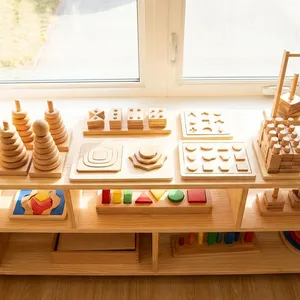
Before we dive in, a quick gut-check. A Montessori-aligned toy generally:
- Has a clear purpose — it does one thing well, not twenty things poorly
- Uses natural materials — wood, metal, cotton, silk (though this isn’t a strict rule)
- Is child-sized — small hands should be able to use it independently
- Offers real feedback — the child can see whether they’ve done it correctly without an adult saying “good job!”
- Grows with the child — open-ended materials get more complex as skills develop
There’s no official “Montessori-approved” certification, despite what some marketing might suggest. Use these principles as a filter, not a checklist.
0–6 Months: The Observer Stage
Newborns are taking in the world. They don’t need much — just the right things at the right time.
What’s happening developmentally
- Visual tracking develops (high contrast → colour)
- Grasping reflex transitions to intentional reaching
- Tummy time builds core and neck strength
What to look for
- High-contrast visuals — black and white Munari mobiles, Gobbi mobiles, or the High Contrast Black & White Soft Book (~$11) which doubles as a tummy time prop
- Simple graspers — lightweight, easy to hold, safe to mouth
- Rattles — something that makes a gentle sound when moved, like the Baby Paper Crinkle Sensory Toy (~$7) with its black-and-white patterns
Our picks
| Toy | Approx. Price | Why it works |
|---|---|---|
| Munari mobile (DIY or purchased) | €10–25 | First visual tracking — high contrast, gentle movement |
| Gobbi mobile | €15–30 | Introduces colour gradation as vision matures |
| Wooden ring rattle | €8–15 | Light enough for early grasping, satisfying sound |
| Interlocking discs | €8–12 | Two hands working together — early bilateral coordination |
Budget alternatives & DIY
- DIY Munari mobile: Print free templates online, use cardstock and fishing line. Total cost: under €5.
- Fabric scraps for texture exploration: Different fabrics (silk, cotton, wool) tied to a wooden ring.
- Honestly, at this stage, your face is the best “toy.” Babies are wired to study faces.
6–12 Months: The Mover
This is where things get exciting. Sitting, crawling, pulling up — everything is within reach (literally).
What’s happening developmentally
- Object permanence develops (peek-a-boo becomes thrilling)
- Pincer grip emerges (thumb and forefinger)
- Cause and effect understanding blooms
- First words may appear
What to look for
- Object permanence boxes — ball drops and reappears; the Montessori Object Permanence Box (~$18) is a solid wooden pick
- Stacking and nesting toys — simple, not too many pieces; the Hape Double Bubble Bead Maze (~$22) works well from 6 months
- Push/pull toys — for new walkers and cruisers
- Wooden rattles — the Natural Wooden Rattle Set (~$11) is a lovely two-piece beech wood option
- Containers and objects — putting things in and taking them out (their favourite activity, forever)
Our picks
| Toy | Approx. Price | Why it works |
|---|---|---|
| Object permanence box | €15–30 | Ball goes in, rolls out — mind = blown, every single time |
| Egg and cup set | €8–15 | Simple shape matching, satisfying to grasp |
| Stacking rings (wooden, natural) | €12–20 | Colour, size grading, fine motor coordination |
| Wooden ball tracker/ramp | €20–40 | Visual tracking + cause and effect |
| Simple shape sorter (1–2 shapes) | €10–20 | Start with circle only — success breeds confidence |
Budget alternatives & DIY
- DIY object permanence box: Cut a hole in a shoebox lid, use a tennis ball. Works beautifully.
- Kitchen basket exploration: Fill a basket with safe kitchen items — wooden spoon, small whisk, silicone cup. Free and endlessly entertaining.
- Nesting containers: Save different-sized food containers. Stacking and nesting for zero euros.
12–18 Months: The Explorer
Walking changes everything. Now they want to carry things, push things, and figure out how everything works.
What’s happening developmentally
- Walking and climbing
- Language explosion begins
- Sorting and categorising instinct kicks in
- Imitation of adult activities (practical life begins!)
What to look for
- Push toys (not ride-on yet — walking support comes first)
- Simple puzzles — single-piece knob puzzles; the Melissa & Doug Farm Animals Jumbo Knob Puzzle (~$12) is a favourite for this age
- Cause-and-effect instruments — like the Hape Pound & Tap Bench with Slide-Out Xylophone (~$30) which combines hammering and music
- Practical life tools — child-sized broom, watering can
- Posting and threading activities
Our picks
| Toy | Approx. Price | Why it works |
|---|---|---|
| Wooden push cart/walker | €30–60 | Supports confident walking, doubles as carrying vessel |
| Knob puzzles (3–5 pieces) | €10–20 | Large knobs train the pincer grip used later for writing |
| Coin drop box | €12–20 | Refined posting — thinner objects, narrower slots |
| Child-sized cleaning set | €15–25 | Practical life — they genuinely want to help at this age |
| Simple threading toy | €10–18 | Eye-hand coordination, concentration |
Budget alternatives & DIY
- DIY posting activity: Cut a slit in a container lid, use large wooden craft sticks or poker chips.
- Sock matching: Give them a pile of socks to pair up. Sorting + practical life.
- A spray bottle with water and a cloth — they’ll “clean” for ages. You might even get actual cleaning done. For more ideas like this, see our Montessori activities for 18-month-olds.
18 Months–2 Years: The Builder
Concentration deepens. They can focus on an activity for longer and start combining skills.
What’s happening developmentally
- Vocabulary accelerates rapidly
- Pretend play begins
- Fine motor skills refine
- Strong desire for independence (“me do it!”)
What to look for
- Stacking and building — blocks, simple construction; the Melissa & Doug Rainbow Stacker (~$16) is a classic that lasts for years
- Matching and sorting activities — colours, shapes, sizes; the Melissa & Doug Shape Sorting Cube (~$18) with 12 wooden shapes is ideal
- Art materials — chunky crayons, play dough
- Practical life extension — food preparation, dressing frames
Our picks
| Toy | Approx. Price | Why it works |
|---|---|---|
| Grimm’s Rainbow Stacker | €40–50 | Open-ended building — bridges, tunnels, patterns. Lasts for years |
| Unit blocks (basic set) | €25–45 | Foundational construction, spatial reasoning, early maths |
| Colour sorting bowls and objects | €15–25 | Matching colours — satisfying and calming |
| Beeswax crayons (Stockmar) | €10–15 | Safe, beautiful colours, encourages mark-making |
| Play dough (homemade or quality brand) | €0–10 | Finger strength, creativity, sensory input |
Budget alternatives & DIY
- DIY colour sorting: Use muffin tins and coloured pom-poms, buttons, or pasta you’ve dyed with food colouring.
- Homemade play dough: Flour, salt, water, oil, food colouring. Costs pennies. Lasts weeks in an airtight container.
- Cardboard boxes: The ultimate open-ended toy. Always have been, always will be.
2–3 Years: The Refiner
Fine motor skills sharpen. Language is taking off. They want to do real things, not toy versions.
What’s happening developmentally
- Sentences form, questions multiply
- Scissor skills and drawing emerge
- Counting and pattern recognition begin
- Strong sense of order (everything has a place — until it doesn’t)
What to look for
- More complex puzzles — 6–12 piece jigsaw puzzles
- Open-ended stacking — the Fat Brain Toys Tobbles Neo (~$25) stacking spheres wobble and balance in satisfying ways
- Practical life activities — pouring, spooning, food prep
- Craft materials — child-safe scissors, glue sticks, collage materials
- Early maths materials — number rods, counting bears
- Construction — more complex building sets
Our picks
| Toy | Approx. Price | Why it works |
|---|---|---|
| Wooden jigsaw puzzles (6–12 pieces) | €8–15 | Problem-solving, spatial awareness, persistence |
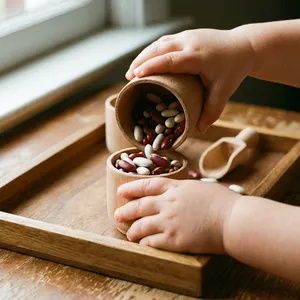
| Pouring and spooning set (jugs + beans) | €10–20 | Practical life — builds concentration and wrist control for writing |
| Child-safe scissors + cutting strips | €5–10 | Bilateral coordination, fine motor refinement |
| Magnetic tiles (Magna-Tiles or similar) | €35–60 | Open-ended construction, spatial reasoning, collaborative play |
| Sandpaper letters | €20–35 | Tactile letter learning — classic Montessori material |
Budget alternatives & DIY
- DIY pouring station: Two small jugs and dried rice or lentils. Set up on a tray for easy cleanup.
- Nature collections: Sticks, stones, leaves — sorting, counting, pattern-making. Free.
- Cutting practice: Print free cutting worksheets. All you need is paper and scissors.
[For a deep dive into this age, see our guide: Best Montessori Toys for 2-Year-Olds in 2026]
3–4 Years: The Questioner
“Why?” becomes the most-used word. Abstract thinking begins to emerge, and social play becomes important.
What’s happening developmentally
- “Why?” (about everything, constantly)
- Early reading and writing interest
- Number concepts solidify
- Cooperative play and negotiation
- Creative and imaginative play expands
What to look for
- Language materials — movable alphabet, reading readiness activities
- Maths materials — spindle box, number puzzles, counting chains
- Science and nature — magnifying glass, plant growing kits
- Complex construction — architecture sets, Kapla blocks
Our picks
| Toy | Approx. Price | Why it works |
|---|---|---|
| Movable alphabet | €20–35 | Pre-writing — building words physically before pencil skills mature |
| Spindle box | €15–25 | Concrete number understanding, including the concept of zero |
| Magnifying glass (real, not toy) | €8–15 | Real tools > toy tools. Encourages genuine scientific observation |
| Kapla blocks (200-piece box) | €35–50 | Engineering, patience, stunning builds |
| Watercolour paint set | €10–20 | Process-focused art, colour mixing, brush control |
Budget alternatives & DIY
- DIY movable alphabet: Print letter tiles on card, laminate them. Free templates widely available.
- Nature journal: A blank notebook + coloured pencils. Draw what you find outside.
- Cooking together: Measuring, counting, pouring, mixing — maths and practical life in one delicious package.
4–6 Years: The Reasoner
Abstract thinking develops. Reading, writing, and mathematical operations become possible. They’re ready for complexity.
What’s happening developmentally
- Reading and writing emerge (or are well underway)
- Mathematical operations (addition, subtraction)
- Map awareness, cultural curiosity
- Moral reasoning and fairness concepts
- Planning and executing multi-step projects
What to look for
- Reading and writing tools — word building, story creation
- Maths materials — golden beads, stamp game, bead chains
- Complex construction — the Hape Roller Derby Wooden Marble Racing (~$30) builds spatial reasoning and patience
- Pretend play — the Hape All Seasons Furnished Dollhouse (~$95) is a quality investment for imaginative and social play
- Geography and culture — puzzle maps, globe, cultural objects
- Science experiments — real kits, not toy versions
- Strategy games — chess, checkers (simpler versions)
Our picks
| Toy | Approx. Price | Why it works |
|---|---|---|
| Golden bead material | €25–45 | Makes the decimal system tactile — units, tens, hundreds, thousands |
| Puzzle map (continent or country) | €15–30 | Geography through hands-on manipulation |
| Microscope (beginner, real optics) | €25–50 | Genuine scientific tool. Flowers, leaves, fabrics — all fascinating |
| Snap Circuits (beginner set) | €25–40 | Electrical circuits made safe and comprehensible |
| Journal/diary + quality pencils | €10–15 | Writing for a real purpose — thoughts, stories, observations |
Budget alternatives & DIY
- Library card: Genuinely the best investment for this age. Free books, audiobooks, events.
- DIY bead chains: Thread beads in colour-coded groups of 10 for skip counting.
- Home science experiments: Baking soda volcanoes are a cliché for a reason — they work.
General Principles (Any Age)
A few things that hold true across all stages:
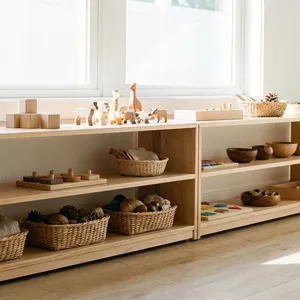
- Less is more. Rotate toys. 8–10 items on the shelf at a time is plenty. The rest goes in storage. Need help with this? Our Montessori shelf setup guide walks you through it step by step.
- Presentation matters. Place toys on low, open shelves — each item in its own space. Baskets and trays help.
- Follow the child. If they’re obsessed with opening and closing things, lean into that. The interest is the curriculum.
- Real over fake. A real whisk beats a plastic play kitchen whisk. Real tools teach real skills.
- You don’t need to spend a fortune. The most expensive toy in the world is worthless if it doesn’t match the child’s current interest and ability.
[New to Montessori? Start with our guide: What is Montessori? A No-Nonsense Guide for Curious Parents]
FAQ
How many Montessori toys does my child actually need?
Fewer than you think. A well-chosen rotation of 8–12 items on a low shelf is ideal. Too many choices overwhelm children (and adults, honestly). Store extras and rotate every 1–2 weeks based on what they’re drawn to.
Are Montessori toys always made of wood?
No. Wood is popular because it’s durable, beautiful, and gives natural sensory feedback (weight, temperature, texture). But Montessori is about the purpose of the material, not what it’s made of. Metal, fabric, glass (supervised), and yes — even some well-designed plastic items can align with Montessori principles.
Is it too late to start Montessori at age 3 or 4?
Absolutely not. There’s no “too late.” Children at any age benefit from purposeful materials, a prepared environment, and the freedom to follow their interests. Start where your child is, not where a chart says they should be.
Can I mix Montessori toys with regular toys?
Of course. This isn’t all-or-nothing. Many families blend Montessori materials with other toys their children enjoy. The key principles — simplicity, purpose, child-led exploration — can apply to how you organise and present any toys.
What’s the best budget Montessori toy for any age?
A set of open-ended wooden blocks. Useful from about 12 months through to 6+ years. They teach spatial reasoning, balance, creativity, and cooperation. A basic set of 30–50 blocks (€15–30) will outlast almost anything else you buy.
Where should I buy Montessori toys?
Specialist retailers like For Small Hands, Thinkamajigs, and Nienhuis carry authentic Montessori materials. For more affordable options, Hape, PlanToys, and Melissa & Doug offer solid choices on Amazon and local shops. Etsy has wonderful handmade options too. Just watch out for “Montessori” labelling on products that are really just wooden — the design matters more than the material.
Where curiosity leads, learning follows. ✨
 Get weekly Montessori tips
Honest reviews, activity ideas, and budget-friendly picks — no spam, just what works.
Subscribe Free