What Is Montessori? A No-Nonsense Guide for Curious Parents
You’ve probably heard the word “Montessori” attached to everything from nursery schools to Instagram-worthy playrooms to €50 wooden blocks. Maybe you’ve been told it’s the best thing you can do for your child. Maybe you’ve been told it’s an elitist fad. Maybe you’re just wondering why everyone’s suddenly so intense about shelf organisation.
Here’s the thing: Montessori is actually pretty straightforward once you strip away the marketing, the gatekeeping, and the aesthetic perfection. Let’s do that.
The Short Version
Montessori is an educational method developed by Dr. Maria Montessori, an Italian physician, in the early 1900s. After years of observing children — how they played, learned, and interacted with their environment — she developed an approach built on a few core ideas:
- Children are naturally motivated to learn. You don’t have to force it. You have to create the conditions.
- Learning is best when it’s hands-on. Abstract concepts stick when children can touch, manipulate, and experience them physically.
- Independence is essential. Children develop competence and confidence by doing things themselves — even imperfectly.
- Every child has their own timeline. Development isn’t a race. Children focus intensely on specific skills when they’re ready (Montessori called these “sensitive periods”).
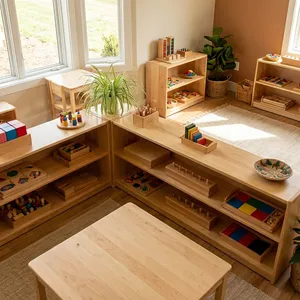
- The environment matters. A well-organised, child-accessible space supports learning without constant adult direction.
That’s it. That’s the philosophy. Everything else — the specific materials, the classroom structure, the shelving — is an implementation of these ideas, not the ideas themselves.
What Montessori Is NOT (Myths Debunked)
There’s a lot of misinformation floating around. Let’s clear some up.
❌ Myth: “Montessori means expensive wooden toys”
Wooden toys are popular in Montessori because they provide natural sensory feedback — weight, texture, temperature. But Montessori isn’t about what you buy. It’s about how children interact with their environment. A child pouring water between two jugs from the kitchen is doing Montessori. A child folding their own clothes is doing Montessori. A child stirring pancake batter is doing Montessori.
The most important “materials” are already in your home.
❌ Myth: “It’s only for wealthy families”
Maria Montessori developed her method working with disadvantaged children in Rome. The approach was never intended to be exclusive. While some Montessori schools and branded materials are expensive, the philosophy itself is free. A prepared environment can be a tidy corner with a few purposeful items — it doesn’t require a Pinterest-worthy renovation.
❌ Myth: “Children just do whatever they want”
This is probably the most common misconception. Montessori offers freedom within limits. Children choose their activities, but within a structured environment with clear boundaries. They’re free to select work from the shelf, but they’re expected to use materials respectfully, return them when finished, and follow community agreements.
It’s not chaos. It’s structured autonomy.
❌ Myth: “There’s no structure or curriculum”
Montessori classrooms follow a detailed scope and sequence covering five areas: Practical Life, Sensorial, Language, Mathematics, and Culture (science, geography, history, art, music). Materials are presented in a specific order, and children progress through them at their own pace. There’s more structure than many people realise — it’s just child-paced rather than teacher-paced.
❌ Myth: “It doesn’t work for all children”
Some children thrive immediately in Montessori environments. Others take time to adjust, especially if they’re used to more directed activities. But the core principles — respect for the child, hands-on learning, fostering independence — benefit all children. The approach can flex to meet different temperaments and needs.
❌ Myth: “You’re either Montessori or you’re not”
Montessori is not all-or-nothing. You can apply its principles selectively: a child-accessible shelf here, more independence at mealtimes there, following your child’s interests when choosing activities. Taking what works for your family and leaving the rest isn’t “doing it wrong.” It’s doing it thoughtfully.
The Five Key Areas of Montessori Learning
In a Montessori classroom (and at home, if you choose), learning is organised into five interconnected areas:
1. Practical Life
Activities drawn from everyday living: pouring, sweeping, buttoning, food preparation, caring for plants and animals. These aren’t busywork — they build concentration, coordination, independence, and a sense of responsibility. Sensory-rich materials like Kinetic Sand (~$12) add engaging alternatives to traditional practical life.
At home: Let your child help with real tasks. Setting the table, washing vegetables, watering plants, folding laundry. Will it take longer? Yes. Will they spill? Probably. But the learning is in the process, not the outcome. For specific ideas, see our Montessori activities for 18-month-olds — most use things already in your kitchen.
2. Sensorial
Materials designed to refine the senses: touch, sight, sound, smell, taste. Think colour grading, texture matching, sound cylinders, and geometric solids. Products like Fat Brain Toys Squigz (~$35) offer excellent tactile exploration. These aren’t “play” in the traditional sense — they’re systematic exploration of how the world is organised.
At home: Sort objects by colour, size, or texture. Do blindfolded taste tests. Compare the sounds different materials make when you tap them. Your kitchen is a sensorial laboratory.
3. Language
From spoken language to writing to reading — Montessori follows a specific progression. Children typically learn to write before they read (they build words with a moveable alphabet before they decode words on a page). Stories, conversation, and rich vocabulary exposure are woven throughout the day.
At home: Talk to your child. A lot. Name things specifically (“That’s an oak tree,” not “That’s a tree”). Read together daily. For older toddlers, try sandpaper letters or a simple moveable alphabet.
4. Mathematics
Montessori maths is concrete before it’s abstract. Children handle bead chains, golden bead materials, spindle boxes, and number rods — physically experiencing quantity before writing equations. This concrete foundation makes abstract maths far more intuitive later.
At home: Count real things. Share food equally (fractions!). Measure ingredients when cooking. Use blocks to explore addition and subtraction. Maths is everywhere once you start looking.
5. Culture
A broad category encompassing geography, science, history, art, and music. Globe work, puzzle maps, nature studies, and cultural celebrations all fall here. The goal is to connect children to the wider world and cultivate respect for diversity.
At home: Explore nature. Grow something. Look at maps together. Cook food from different cultures. Visit museums, markets, and parks. The world is the curriculum.
Starting Montessori at Home: Practical Tips
You don’t need to transform your home. Start small, observe your child, and adjust.
1. Create one child-accessible area
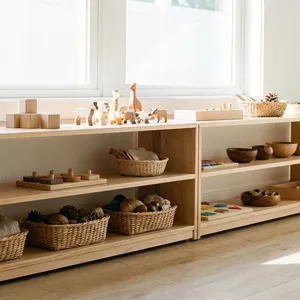
Pick one space — a shelf in the living room, a low cupboard in the kitchen, a corner of the bedroom. Put 6–8 purposeful items there, arranged neatly. This is your child’s “workspace.”
Rotate items every 1–2 weeks based on what your child gravitates toward. (For a step-by-step walkthrough, see our Montessori shelf setup guide.)
2. Get low — literally
See your home from your child’s height. Can they reach their own cup? Their coat? Their shoes? A towel to dry their hands? The more they can access independently, the more they can do independently.
A small step stool is one of the most impactful “Montessori” purchases you can make. €10, life-changing.
3. Involve them in real life
The biggest shift in Montessori at home isn’t buying special materials — it’s including your child in daily tasks. Let them:
- Pour their own water (a small jug helps)
- Help prepare food (banana cutting with a butter knife is a classic starter)
- Choose their clothes (offer two options to start)
- Clean up spills (keep child-sized cloths and a small spray bottle accessible)
- Set and clear the table
It’s slower. It’s messier. It’s worth it.
4. Observe before intervening
When your child is working on something, resist the urge to help immediately. Watch. Often they’ll figure it out. And the pride on their face when they do is worth the extra minutes of patience.
Montessori guides call this “stepping back.” It’s the hardest and most important skill for parents.
5. Less is more
Toys, activities, choices — simplify everything. Too many options overwhelm children (and adults). A few well-chosen items, rotated regularly, lead to deeper engagement than a playroom bursting at the seams.
6. Follow the child
This is the most-quoted Montessori principle, and it’s deceptively simple. It means: watch what your child is drawn to, what they repeat, what fascinates them — and lean into that. If they’re obsessed with opening and closing containers, give them more containers. If they want to pour water back and forth for thirty minutes, let them.
Their interest is the learning.
[Ready for specific toy recommendations? See our guide: Montessori Toys by Age: 0–6 Years]
How Do I Know If It’s Working?
Montessori isn’t measured in test scores (especially at the toddler and preschool level). Look for:
- Concentration — does your child focus on an activity for sustained periods?
- Independence — are they doing more for themselves?
- Confidence — do they approach new challenges willingly?
- Joy — are they engaged, curious, and content?
- Order — do they understand where things go and (mostly) put them back?
If you’re seeing these, you’re on the right track — regardless of whether you’re using “official” Montessori materials or a muffin tin and some pom-poms.
Montessori Resources We Actually Recommend
- Books: The Montessori Toddler by Simone Davies (practical, modern, and very readable), The Absorbent Mind by Maria Montessori (the original — dense but foundational)
- Podcasts: The Montessori Podcast, Good Inside with Dr. Becky Kennedy (not strictly Montessori, but deeply aligned)
- Online: The Montessori Notebook, Montessori in Real Life, and of course — everything here at Exploritori
- Local: Many cities have Montessori parent-child groups. Worth checking even if you’re not considering a Montessori school.
[Looking for specific products? Start with: Best Montessori Toys for 2-Year-Olds in 2026]
FAQ
What age should I start Montessori?
From birth, if you want to. Montessori principles apply from day one — a prepared environment for a newborn means a simple, calm space with high-contrast visuals, natural light, and a floor bed or low mattress for movement freedom. That said, you can start at any age. There’s no window that closes.
Do I have to send my child to a Montessori school?
No. Montessori at home and Montessori at school are complementary but not dependent on each other. Many families apply Montessori principles at home while their child attends a non-Montessori school, and it works beautifully. The philosophy is about how children learn, not where.
Is Montessori better than other educational approaches?
“Better” is a loaded word. Montessori is well-supported by child development research, and many of its principles (hands-on learning, mixed-age grouping, intrinsic motivation) are now considered best practice in education broadly. But Reggio Emilia, Waldorf, and well-run mainstream approaches also produce thriving children. The “best” approach is the one that fits your child and your family.
How much does Montessori at home cost?
As much or as little as you want. A step stool (€10), a few quality items from the kitchen, a set of wooden blocks (€20), and some intentional rearranging of your home can give you a solid start for under €50. The philosophy is free — the Instagram aesthetic is what costs money.
My child goes to nursery, not a Montessori school. Can I still do Montessori at home?
Absolutely. Children adapt to different environments remarkably well. Montessori at home — child-accessible spaces, real tools, independence at mealtimes, following their interests — complements any school setting. It’s not about consistency between home and school; it’s about respecting how your child learns in both.
Isn’t Montessori too strict? Or too permissive?
Neither. It’s both structured and flexible — “freedom within limits.” Children have choices (which activity, how long to spend on it) within clear boundaries (respectful behaviour, returning materials, community agreements). Think of it as a framework, not a rulebook.
Where curiosity leads, learning follows. ✨
Frequently Asked Questions
Is Montessori only for wealthy families?
No. Montessori principles are free — they’re about respecting children, following their interests, and creating prepared environments. You can practise Montessori at home with everyday household items. Many DIY alternatives work just as well as expensive branded materials.
What age should you start Montessori?
From birth. Montessori isn’t just about toys or schools — it starts with how you set up their environment and interact with them. A low floor bed, accessible materials, and following their cues can begin from day one.
Do Montessori children just do whatever they want?
No. This is one of the biggest misconceptions. Montessori provides “freedom within limits.” Children choose their activities from a prepared environment, but there are clear boundaries and expectations. It’s structured independence, not chaos.
Can you do Montessori without Montessori toys?
Absolutely. The most important Montessori materials are real-life objects: a small broom, a child-sized pitcher for pouring, cooking utensils, garden tools. Purpose-built Montessori materials can help, but they’re not required.
Is Montessori evidence-based?
Yes. Multiple studies have shown positive outcomes for Montessori-educated children in academic achievement, social skills, creativity, and executive function. Research from the University of Virginia and others supports the approach.
 Get weekly Montessori tips
Honest reviews, activity ideas, and budget-friendly picks — no spam, just what works.
Subscribe Free