7 Montessori Mistakes Even Enthusiastic Parents Make
You discovered Montessori. You read the books, watched the reels, maybe ordered a few things from Etsy at 1 a.m. You rearranged the playroom, labelled the shelves, and explained “freedom within limits” to your bewildered partner.
And now… something feels off. Your child is ignoring the beautifully curated shelf. The practical life tray sits untouched. You’re spending more time managing the setup than actually being with your kid.
Sound familiar? You’re not doing it wrong — you’ve just fallen into some very common traps. Nearly every Montessori-enthusiastic parent does. Here’s what they are and how to get back on track.
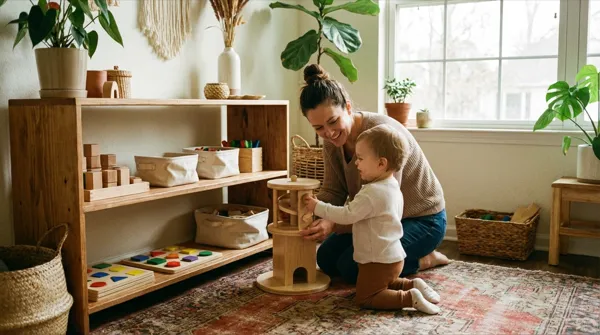
Mistake 1: Too Many Toys (Even If They’re All “Montessori”)
This is the big one. You replaced the plastic mountain with a wooden mountain. The playroom looks better, but the problem — overwhelm — hasn’t changed.
A shelf crammed with twelve beautiful wooden toys is still a shelf that overwhelms a two-year-old. The materials might be better quality, but the principle is the same: too many choices paralyse children (and adults, if we’re honest).
What to do instead
Aim for 6–8 items on the shelf. That’s it. Store the rest in a cupboard or box, out of sight. Rotate every one to two weeks based on what your child is actually gravitating towards — not what you think they should be interested in.
Quality classics like the Melissa & Doug Shape Sorting Cube ($18), Hape Pound & Tap Bench ($30), and Fat Brain Toys Tobbles Neo (~$25) work beautifully in rotation and don’t need constant presence to be valuable.
The hardest part isn’t buying less. It’s resisting the urge to put everything out at once because you spent good money on it. Those toys don’t lose value by sitting in a box. They gain it — because when they reappear, they’re fresh and exciting again.
The real shift: Montessori isn’t about having the right things. It’s about having the right amount of things, presented thoughtfully.
Mistake 2: Over-Correcting How Your Child Uses Materials
Your child is rolling the cylinder blocks across the floor instead of grading them by size. Your instinct screams: “No, that’s not how you use those!”
Hold that thought.
In Montessori classrooms, guides demonstrate the “intended” use of a material, and then step back. If a child explores it differently, that’s not wrong — it’s their developmental process at work. They might need to roll the cylinders before they’re ready to grade them. They might be exploring weight, or cause and effect, or just enjoying the sensory experience of wood on tile.
What to do instead
Demonstrate the material’s purpose once or twice. Then let go. Intervene only if the child is at risk of hurting themselves, damaging the material, or disturbing others. Everything else? Observation, not correction.
This is genuinely difficult. We’re wired to teach, to correct, to guide. But over-directing a child’s play undermines the very independence Montessori is built on. If they’re engaged and focused — even if they’re doing something “wrong” — they’re learning.
Exception: If a material is being used destructively (throwing wooden blocks at the wall, for instance), that’s a boundary issue, not a play issue. Calmly redirect: “Blocks are for building. If you want to throw, let’s go outside with a ball.”
Mistake 3: Buying Before Understanding
You bought the Pink Tower. The Brown Stair. The moveable alphabet. The knobbed cylinders. Your home looks like a miniature Montessori classroom.
But here’s the thing: those materials were designed for trained guides in classroom settings. Each one has a specific presentation sequence, comes at a particular developmental stage, and fits into a broader curriculum. Without understanding that context, they’re just expensive objects on a shelf.
What to do instead
Start with the philosophy, not the products. Read The Montessori Toddler by Simone Davies before you buy anything. Understand why Montessori materials work — isolation of difficulty, self-correction, sensorial exploration — and then you’ll be able to evaluate whether a specific material makes sense for your child right now.
Most of what young children need isn’t specialist Montessori equipment anyway. It’s a child-sized broom, a low stool to reach the sink, a small pitcher for pouring water, and the time and patience to let them practice. Budget: maybe €20. Developmental impact: enormous.
If you do want to invest in specific materials, pick one or two that match your child’s current interests and developmental stage. A set of knobbed cylinders for a child who’s obsessed with fitting things into holes? Great. A moveable alphabet for a 14-month-old? That can wait.
[Not sure where to start with toys? See our reviews for 2-year-olds and 3-4 year olds.]
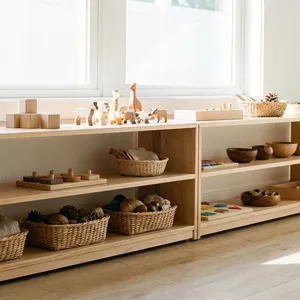
Mistake 4: Making Montessori a Rigid Set of Rules
“We don’t do fantasy play before age six.” “Only natural materials in this house.” “No colourful plastic — ever.”
Some families take Montessori principles and turn them into inflexible rules. And while the principles have solid reasoning behind them, applying them rigidly can create stress, guilt, and a home environment that feels more like a regulation than a way of life.
What to do instead
Treat Montessori as a framework, not a rulebook. Maria Montessori herself was a scientist — she observed, tested, and adapted. She’d probably be horrified by the idea of following her work dogmatically.
Fantasy play is a good example. Traditional Montessori delays it, prioritising real-world experience first. But if your three-year-old loves pretending to be a dog, that’s their developmental drive expressing itself. You don’t have to shut it down because a book said so.
Same with materials. Yes, wood offers better sensory feedback than plastic. But a well-designed plastic toy (Magna-Tiles, for instance) can have genuine educational value. Context matters more than material.
The goal: Take what resonates, leave what doesn’t, and build a home that works for your family — not for an Instagram ideal.
Mistake 5: Comparing Your Home to Instagram
Ah, Instagram Montessori. White shelves. Neutral tones. Each toy placed at a precise 45-degree angle on a woven mat. A child in linen clothing calmly transferring beans with a tiny spoon while golden hour light streams through the window.
It’s beautiful. It’s aspirational. And it’s about as representative of daily life with a toddler as a hotel brochure is of an actual holiday.
What to do instead
Unfollow accounts that make you feel inadequate. Follow ones that make you feel capable. The best Montessori environments for young children aren’t aesthetic showcases — they’re functional, slightly messy, and clearly used.
Your child doesn’t care whether the shelf is from IKEA or a boutique woodworker. They care whether they can reach it. They don’t care if the transfer activity uses artisanal chickpeas in a hand-thrown ceramic bowl. They care that they can pour something from one container to another.
The litmus test: Is your child engaged, independent, and (mostly) content? Then your setup is working — regardless of whether it’s photogenic.
If you find yourself spending more time styling the shelf than observing your child, that’s a signal. Put the phone down. Sit on the floor. Watch what they actually do. That’s the Montessori practice that matters most.
Mistake 6: Ignoring Practical Life
This one is ironic, because practical life is arguably the most important area of Montessori — yet it’s the most overlooked by parents at home.
Maybe it’s because practical life doesn’t photograph well. There’s no beautiful object to display. It’s just… a child sweeping the floor. Pouring their own water. Putting on their shoes. Folding a cloth. Unglamorous, slow, and profoundly developmental.
What to do instead
Make practical life the foundation, not an afterthought. Before you buy a single toy, ask yourself: can my child access their own water? Can they reach the sink to wash their hands? Can they put on and take off their shoes independently? Can they help with any part of meal preparation?
These aren’t “chores” for a toddler — they’re meaningful, purposeful work. They build concentration, fine motor skills, sequencing, and a sense of belonging in the family.
Quick wins:
- Put a small jug of water and a cup where your child can reach them
- Keep a child-sized dustpan and brush accessible
- Move their shoes and coat to a low hook
- Let them help wash vegetables, tear lettuce, stir batter
- Give them a cloth and let them wipe their own table after eating
No special purchases required. No shelf curation. Just inclusion in the real, daily rhythms of your home.
[Want more ideas? See our full guide: Montessori Practical Life: 15 Real Activities Your Toddler Can Do Today]

Mistake 7: Forgetting Outdoor Time
It’s easy to think of Montessori as an indoor activity. The iconic materials are indoor materials. The shelves are inside. The prepared environment is usually a room.
But Maria Montessori was emphatic about children spending time outdoors. Nature observation, gardening, animal care, free movement, sensory exploration — all central to her approach. Children who spend hours inside with beautiful wooden toys but rarely get muddy, climb trees, or examine bugs are missing a huge piece of the puzzle.
What to do instead
Get outside. Daily, if possible. It doesn’t need to be a structured activity or a nature lesson. A walk around the block where your child stops to examine every leaf, puddle, and ant is Montessori in action.
If you have outdoor space:
- A small patch of garden for planting (even a pot on a balcony works)
- A mud kitchen made from old pots and pans
- A bird feeder where your child can observe and eventually refill
- Rocks, sticks, and pinecones — the original open-ended toys
If you don’t have outdoor space:
- Parks and green spaces count
- Window boxes for growing herbs
- Nature walks with a small bag for collecting treasures
- Puddle jumping (the ultimate sensorial experience)
The principle: The outdoor world is an infinitely complex, constantly changing prepared environment. No shelf rotation needed — nature does it for you.
[For seasonal ideas: Outdoor Montessori: 20 Nature Activities by Season]
The Common Thread
All seven mistakes share a root cause: focusing on the aesthetics of Montessori rather than the principles. Buying the right toys, setting up the right shelf, following the right rules — all external. The actual work of Montessori is internal: patience, observation, trust in your child, and the willingness to step back.
None of this is easy. And if you’ve made some of these mistakes — welcome to the club. Every parent who cares enough to try Montessori has made at least three of them. The fact that you’re here, reading and reflecting, means you’re already course-correcting.
The best Montessori parents aren’t the ones with the most beautiful setups. They’re the ones who sit on the floor, watch their child, and ask: “What do you need from me right now?”
Usually the answer is: less.
FAQ
Is it too late to fix these mistakes?
Not at all. Children are remarkably adaptable. Simplify the shelf this weekend, step back during play tomorrow, and get outside today. Small changes compound quickly.
We’ve already bought loads of Montessori materials. What do we do with them?
Keep a few that match your child’s current interests. Store the rest and rotate them in over time. Sell or donate anything that was an impulse buy and doesn’t suit your child. Second-hand Montessori materials hold their value well.
How do I know if I’m “doing Montessori right”?
If your child is increasingly independent, able to concentrate, and generally content — you’re doing fine. There’s no certification for home Montessori, and there’s no single “right” way. Observe your child. They’ll tell you what’s working.
My partner thinks I’ve gone overboard with Montessori. Are they right?
Maybe. If Montessori has become a source of stress, rigidity, or family tension, it’s worth stepping back. The approach is supposed to make life with children better, not more complicated. Talk to your partner about what’s working and what isn’t. Their outside perspective is valuable.
Can I mix Montessori with other approaches?
Absolutely. Many families blend Montessori with elements of Reggio Emilia, RIE, or simply their own parenting instincts. There’s no purity test. Take the principles that serve your family and integrate them in a way that feels natural — not forced.
Where curiosity leads, learning follows. ✨
 Get weekly Montessori tips
Honest reviews, activity ideas, and budget-friendly picks — no spam, just what works.
Subscribe Free