Montessori Practical Life Activities: 15 Real Toddler Jobs, Setup Tips, and Age Guide
· Updated
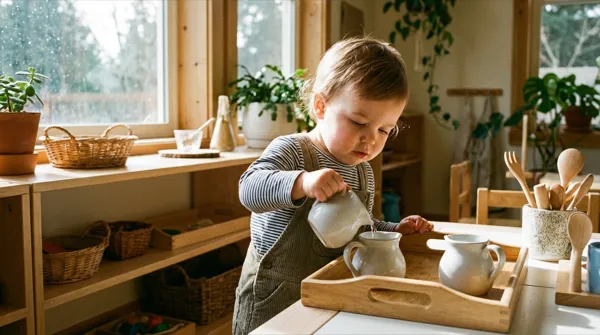
If you take one thing from Montessori and ignore everything else, make it practical life.
Not the pink tower. Not the wooden rainbow. Not the beautifully curated shelf. Practical life. The ordinary, unglamorous, deeply important work of daily living.
Maria Montessori observed that young children are irresistibly drawn to the real activities of the adults around them. Not toys that imitate work — actual work. Pouring, sweeping, folding, cutting, washing. These activities aren’t preparation for life. For a toddler, they are life. If you want a more focused water-work sequence, start with our Montessori water activities guide.
And here’s the beautiful part: you already have everything you need.
Why Practical Life Matters
Before we get to the activities, a quick note on why this matters so much. Practical life activities simultaneously develop:
- Fine motor control — the same hand movements used later for writing
- Concentration — sustaining focus on a multi-step task
- Independence — “I can do it myself”
- Sequencing — understanding order (first this, then that)
- Care of self and environment — responsibility and belonging
- Coordination — hand-eye, bilateral (using both hands together), and whole-body
No single toy develops all of these at once. Practical life does.
A note on mess: These activities involve water, food, dirt, and general chaos. That’s the point. Prepare the environment (a towel underneath, a smock on, a defined space), accept that spills will happen, and focus on the process. A child who pours water and spills some is learning more than a child who watches you pour it perfectly.
Quick Practical Life Chooser
Use this table when you have five minutes and a toddler who wants to help.
| If your child wants to… | Start with this activity | Keep it calm by… |
|---|---|---|
| Pour, dump, or splash | Pouring water or watering plants | using 2-3 tablespoons of water and keeping a cloth on the tray |
| Copy kitchen work | Washing produce or spreading food | offering one food, one tool, and one clear end point |
| Clean with you | Wiping a table or sweeping crumbs | giving a tiny area to clean instead of the whole room |
| Open every drawer | Opening and closing containers | choosing 4-6 containers with different closures |
| Dress themselves | Pulling socks, shoes, or trousers on and off | laying clothes in order and choosing easy fastenings |
| Sort and match | Laundry sorting or table setting | starting with one category, such as socks or plates |
Takeaway: choose the activity that matches the urge you already see. Practical life works best when it answers a real toddler need.
What Age Should You Start?
You can begin earlier than most parents think, but the version matters.
| Age/stage | Good first practical life work | What to avoid for now |
|---|---|---|
| 12-18 months | putting cloths in a basket, wiping with a damp sponge, carrying one item, pulling off socks | full pitchers, tiny tongs, fragile dishes, complicated sequences |
| 18-24 months | simple pouring, handwashing, table wiping, banana slicing, watering one plant | too many materials on one tray or tasks with several hidden steps |
| 2-3 years | sweeping to a tape square, setting a simple table, dressing practice, washing produce, peeling citrus | rushing the routine or correcting every small mistake |
| 3+ years | folding towels, polishing, matching socks, safe food prep, caring for breakable things with supervision | assuming independence means no supervision |
If your child is near 18 months, the 18-month Montessori activity guide has simpler starting points. If they are already handling sequences, the 24-30 month activity guide and 30-36 month guide add more challenge.
Takeaway: age is useful, but readiness is clearer. Watch the hands, the repetition, and the frustration level.
The Activities
1. Pouring Water
What you need: Two small jugs or cups. Water. A tray or towel underneath.
How it works: Fill one jug about halfway. Show your child how to pour from one to the other, slowly. Then let them try. Refill. Repeat. For twenty minutes, if they want.
Why it matters: Pouring develops wrist control, hand-eye coordination, and concentration. It’s also a gateway to independence — a child who can pour water can serve themselves a drink.
Progression: Start with dry materials (rice, lentils) if you want less mess. Move to water. Then try pouring into smaller containers — a muffin tin, an ice cube tray, individual cups.
Common worry: “They’ll waste water.” A small jug holds maybe 200ml. They’ll spill less than you think, and what they learn is worth a few puddles.
Setup reality: Start with far less water than the pitcher can hold. A heavy jug teaches frustration; a tiny amount of water teaches control.

2. Sweeping
What you need: A child-sized broom and dustpan. (If you don’t have one, cut a regular broom handle shorter, or use a hand brush.) For a fuller home setup, see our guide to Montessori cleaning tools for toddlers.
How it works: After a meal or activity, show your child how to sweep crumbs or debris into a pile, then into the dustpan. Demonstrate slowly. Let them practice.
Why it matters: Sweeping requires bilateral coordination (one hand sweeps, the other holds the dustpan), spatial awareness, and whole-body movement. It also builds a genuine sense of contribution — “I helped clean up.”
Tip: Tape a square on the floor with painter’s tape. The goal: sweep everything into the square. This gives a clear visual target, which helps enormously.
Make it easier: Start with large dry crumbs, pom-poms, or paper scraps. Fine dust is actually harder because the result is less visible.

3. Washing Fruit and Vegetables
What you need: A colander or bowl. Water. Produce that needs washing. A towel for drying.
How it works: Fill a bowl with water. Place vegetables or fruit in front of your child. Show them how to swish each item in the water, rub gently, and place it on the towel to dry. Sturdy items like potatoes, carrots, and apples work best.
Why it matters: It’s meaningful work with a real outcome — the food they wash appears at dinner. This connection between effort and result is deeply motivating for young children.
Bonus: Name each item as you wash it. “This is a courgette. Feel how smooth it is. And this is a potato — it’s rough.” Vocabulary building without flashcards.
Safety note: Use produce that cannot slip down the throat whole during the washing stage. Grapes, cherry tomatoes, and blueberries should be saved for adult-prepared snack time.
4. Spreading and Preparing Simple Food
What you need: Bread or crackers, a spreading knife (butter knife or child-safe knife), and something to spread — butter, cream cheese, hummus, jam.
How it works: Demonstrate spreading slowly: hold the bread, scoop a small amount, spread from the centre outward. Then hand over.
Why it matters: Spreading requires controlled pressure, bilateral coordination, and sequencing. And the reward is immediate: they eat what they made.
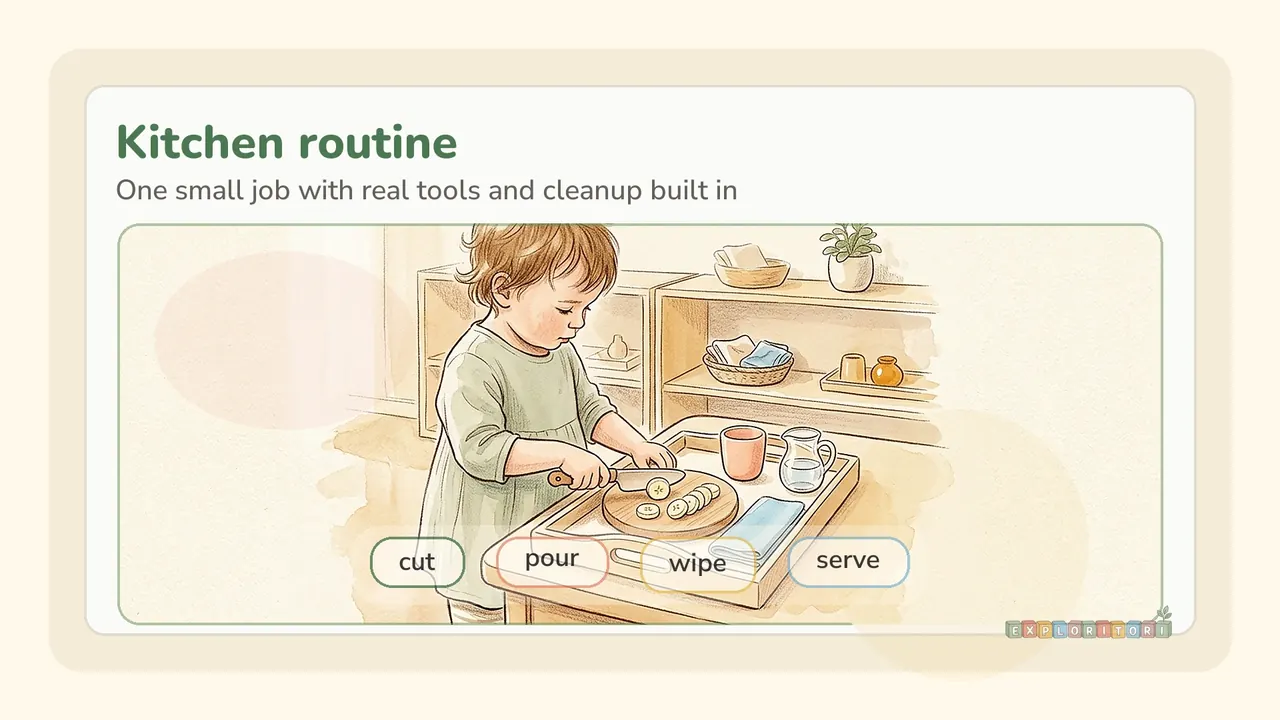
Progression: Once spreading is comfortable, try banana slicing (a butter knife cuts banana safely), cracker assembly (cheese + cracker), and eventually more complex prep like mixing a salad.
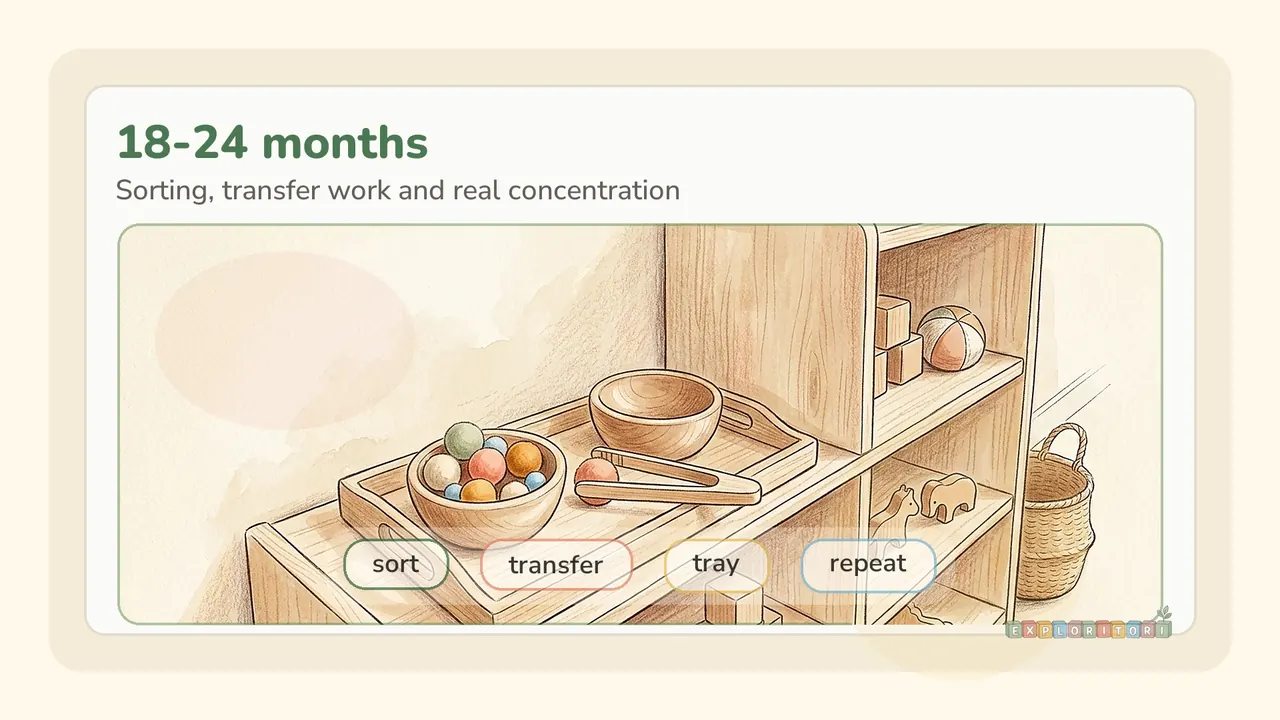
5. Transferring with Tongs or a Spoon
What you need: Two bowls, a pair of kitchen tongs or a large spoon, and items to transfer — cotton balls, pom-poms, pasta, small fruits.
How it works: Place the items in one bowl. Show your child how to grip the tongs, pick up an item, and place it in the other bowl. Repeat until all items are transferred.
Why it matters: Tongs strengthen the hand muscles used for writing (the same squeeze-and-release motion as a pencil grip). Spoon transfer develops scooping control — useful for self-feeding. If this is too hard, step back to spooning large pasta or moving cotton balls by hand before offering tongs.
Progression: Start with large items (cotton balls) and large tongs. Progress to smaller items (chickpeas) and smaller tools (tweezers for older children — age 4+).
6. Dressing and Undressing
What you need: Your child’s own clothing. That’s it.
How it works: This isn’t a single activity — it’s a daily practice. Start with the easiest elements: pulling off socks, stepping out of shoes, pulling a shirt over their head. Gradually move to putting things on: stepping into trousers, pulling up a zip, pushing buttons through holes.
Why it matters: Getting dressed is a complex multi-step task involving fine motor skills, body awareness, sequencing, and problem-solving. A child who can dress themselves gains enormous independence and confidence. For a full setup, use the Montessori dressing skills guide.
Tips:
- Lay clothes out in order (underwear on top, last item on bottom) so the sequence is visual
- Start with loose-fitting clothes — skinny jeans are hard for adults too
- Shoes with Velcro straps before laces
- Resist the urge to “fix” a backwards shirt. They’ll notice eventually. Or they won’t, and that’s fine too.
Buying tip: Choose clothes your child can manage independently. This means elasticated waistbands over buttons and belts for trousers, and pullover tops rather than fiddly fastenings. Independence starts with accessible design.
7. Wiping a Table
What you need: A small sponge or cloth, a spray bottle with water (add a tiny drop of vinegar if you like), and a dirty table.
How it works: After a meal or art activity, show your child how to spray the table (one or two sprays — they’ll want to empty the bottle), then wipe in circular motions or left-to-right strokes. Squeeze out the sponge, wipe again if needed.
Why it matters: Wiping a table develops arm strength, bilateral coordination, and awareness of a task being “complete” (is the table clean? check and wipe again). It also teaches care of the environment.
Tip: Let them spray the table before they wipe. The spray bottle itself is excellent for hand strength. Just accept that they’ll spray other things too. Walls. Windows. Water only in the bottle, please.
8. Watering Plants
What you need: A small watering can or jug. Plants. (If you don’t have plants, this is your excuse to get one.)
How it works: Show your child how much water a plant needs (demonstrate pouring slowly and stopping). Let them take over. Start with forgiving plants — herbs, pothos, spider plants — that survive enthusiastic watering.
Why it matters: Caring for a living thing builds responsibility and empathy. It also requires controlled pouring and observation (“Is the soil wet enough? Too wet?”).
Progression: Older toddlers can check soil moisture with their finger before watering (dry = water, damp = wait). This introduces observation and decision-making.
9. Sorting Laundry
What you need: A basket of clean laundry. Family members.
How it works: Sit with your child and sort laundry together. Start simple: “Can you find all the socks?” Then: “Let’s sort by who they belong to — Mummy’s pile, Daddy’s pile, your pile.” Then by colour, or by type (shirts, trousers, underwear).
Why it matters: Sorting is classification — a foundational mathematical and logical skill. Laundry sorting is real, meaningful classification with an immediate purpose.
Progression: Matching sock pairs is an excellent visual discrimination exercise. Folding comes next — start with face cloths and small towels (simple rectangles), then progress to t-shirts and trousers.
10. Setting the Table
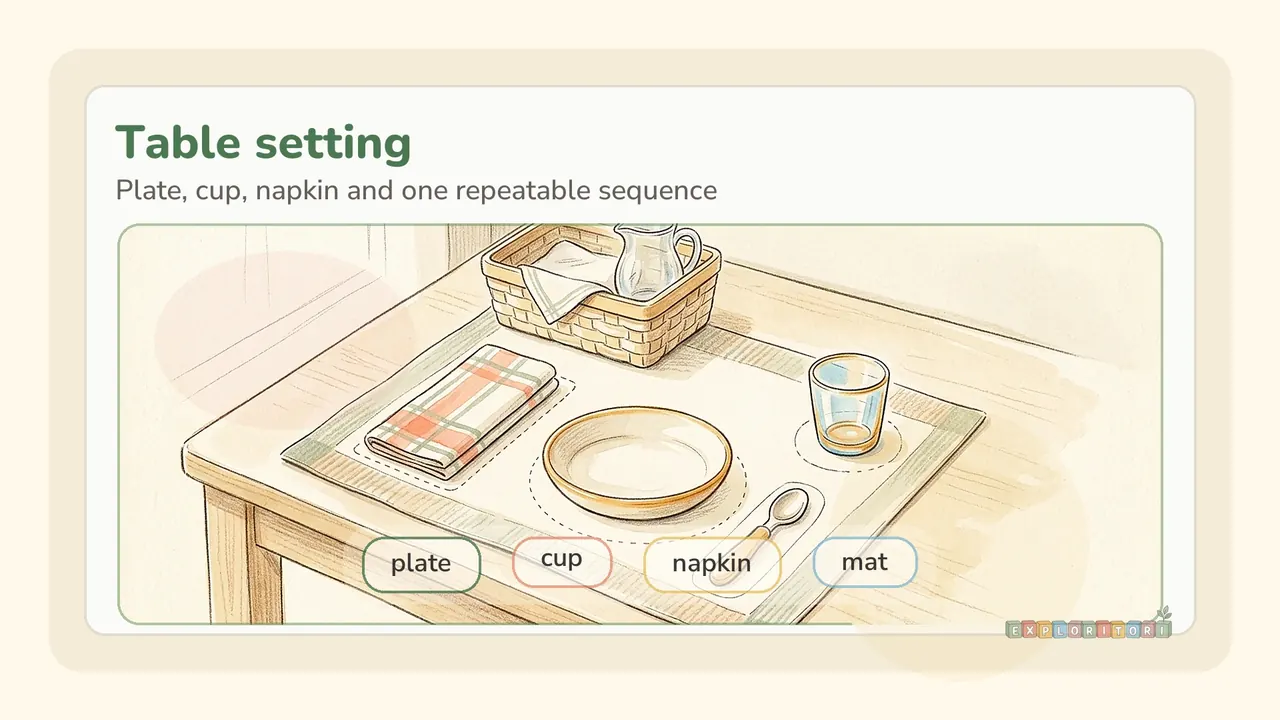
What you need: Plates, cups, cutlery, napkins. Optionally, a placemat template (trace the items onto a piece of paper so your child knows where each goes).
How it works: Before a meal, ask your child to set the table. Show them once: plate in the middle, fork on the left, knife on the right, cup above the plate. Use a placemat template if they need the visual guide.
Why it matters: Table setting involves counting (one plate per person = one-to-one correspondence), spatial organisation, and contributing to family routine. It’s practical maths disguised as everyday life.
Tip: Start with just plates and cups. Add cutlery and napkins as they master the basics. And yes, use real plates — children rise to the expectation of handling things carefully, and the occasional breakage is part of learning. (Keep especially precious crockery out of rotation.)
11. Washing Hands (Independently)
What you need: A step stool to reach the sink. Soap. A towel at their height.
How it works: Demonstrate the full sequence: turn on water, wet hands, apply soap, rub (sing a short song for timing), rinse, turn off water, dry on towel. Then step back and let them do it.
Why it matters: It sounds basic, but independent handwashing is a multi-step self-care routine that most toddlers can master by age two with practice. It builds independence, hygiene habits, and sequencing skills.
The key: Make it physically possible. If they can’t reach the tap, they can’t do it independently. A sturdy step stool is the single most useful item in a Montessori home.
12. Peeling Eggs or Oranges
What you need: Hard-boiled eggs, oranges, or clementines. A bowl for the peel.
How it works: Start a small tear in the peel and let your child take over. For eggs, show them how to tap, crack, and peel. For citrus, demonstrate starting the peel and then pulling.
Why it matters: Peeling requires careful fine motor control, patience, and sensory awareness (how hard to press, where to pull). And the reward — eating what they peeled — is immediate.
Progression: Citrus is easiest. Eggs are more challenging (and more satisfying). Eventually, try peeling cucumbers or carrots with a child-safe peeler.
13. Polishing
What you need: Something to polish (a mirror, a shoe, silverware, a wooden surface), a soft cloth, and a small amount of polish or just water and vinegar.
How it works: Apply a small amount of polish to the cloth (or let them do it). Show the circular rubbing motion. Polish until shiny. Admire the result.
Why it matters: Polishing is meditative. The circular motion, the gradual transformation from dull to shiny, the visible result — it’s deeply satisfying and builds concentration. In Montessori classrooms, polishing is one of the most popular practical life activities.
Start with: A small mirror and a damp cloth. No products needed. The feedback is immediate — they can see it getting clearer.
14. Opening and Closing Containers
What you need: A collection of containers with different mechanisms — screw lids, snap lids, flip tops, push buttons, Velcro, zips, clasps.
How it works: Present a tray of containers. Let your child explore each one, figuring out how to open and close them. You can demonstrate tricky ones, but let them puzzle through the easier ones independently.
Why it matters: Different closure mechanisms develop different hand movements and fine motor patterns. Screw lids develop wrist rotation. Snaps develop pinching strength. Zips develop bilateral coordination. It’s a workout for small hands.
Where to find them: Your kitchen, bathroom, and handbag are full of containers. Jam jars, cosmetic tubs, pencil cases, coin purses, tins with lids. Free.
15. Carrying Breakable Things
What you need: Something fragile. A glass. A ceramic bowl. A vase. Start with something inexpensive and easy to replace.
How it works: Show your child how to carry the object with both hands, walking slowly and carefully to the destination. Let them try. And yes — let them carry something that would actually break if dropped.
Why it matters: This one surprises parents, but it’s core Montessori. Children develop care, attention, and self-regulation when they handle real, breakable objects. The weight and fragility demand focus in a way that plastic never does.
When it breaks (and it will, eventually): Stay calm. “It broke. Let’s clean it up together.” No drama, no punishment. The natural consequence — the thing is broken — is the lesson. They’ll carry more carefully next time. And they’ll develop genuine respect for objects, not the artificial caution that comes from being told “be careful!” fifty times a day.
How to Set Up for Success
You don’t need to do all fifteen activities today. Start with two or three that fit naturally into your existing routine. Here are some principles that help:
Make it accessible. If your child can’t reach it, they can’t do it independently. Low hooks for coats, a step stool at the sink, a low shelf with their cup and plate — accessibility is the foundation of independence.
Demonstrate, then step back. Show the activity slowly and carefully. Then let them try. Resist correcting unless they’re in danger. The imperfect attempt is the learning.
Accept the mess. Water will spill. Food will fall. Sweeping will redistribute the crumbs before collecting them. This is normal. Prepare the environment (towels, trays, smocks) and let go of the outcome.
Let it take time. A toddler putting on shoes takes five minutes. You could do it in ten seconds. But those five minutes are building motor planning, persistence, and independence. Budget the time. It’s an investment, not a waste.
Don’t force it. If your child isn’t interested in an activity, put it away and try again in a few weeks. Forcing practical life defeats its purpose — the motivation should be intrinsic.
The 10-Minute Home Setup Checklist
Before you invite your child, set up the environment so the activity can actually succeed.
| Check | Why it matters |
|---|---|
| The tool fits your child’s hand | Oversized pitchers, brooms, and tongs make the work look like misbehaviour when it is really a tool problem |
| The activity has a clear boundary | A tray, towel, placemat, or tape square shows where the work begins and ends |
| Cleanup is visible from the start | A cloth, bowl for peels, or dustpan makes cleanup part of the sequence |
| The task has a real purpose | Washing a real apple usually holds attention longer than pretending to wash a toy |
| There is only one main challenge | Do not combine pouring, carrying, sorting, and wiping all on the first try |
| The adult has time to wait | Practical life falls apart when the schedule needs adult speed |
If this feels like too much, start with just one station: a low hook for a towel, a cloth beside the table, or a small basket for socks. Our Montessori on a budget guide has more small-space setup ideas, the IKEA Montessori hacks guide shows low-cost room-by-room setups, and the Montessori shelf setup guide helps if trays keep spreading across the room.
Takeaway: the environment should do half the teaching before you say a word.
Troubleshooting Practical Life at Home
| Problem | What it usually means | Try this next |
|---|---|---|
| Your child dumps everything immediately | Too many pieces or no visible work cycle | Offer fewer items and model taking one object at a time |
| Pouring turns into puddle play | Too much water or the cleanup role is unclear | Use a tiny pour line and place the cloth on the tray first |
| Sweeping spreads crumbs everywhere | The target is invisible | Use painter’s tape to mark a square or sweep larger scraps first |
| They refuse the child tool and grab yours | They want the real adult job | Let them use a safe real version where possible, such as a small cloth or hand brush |
| You keep stepping in | The task is too slow for the moment | Choose practical life when you have time, not during the rushed part of the day |
| They repeat one activity for days | The activity is meeting a developmental need | Leave it available and make only one small change when interest fades |
For water-specific challenges, the Montessori water practical life guide gives more structure. If the struggle is dressing, use the dressing skills guide rather than turning the whole morning into a battle.
Takeaway: most failed practical life activities need simplification, not replacement.
The Big Picture
Practical life isn’t a stepping stone to “real” learning. It is real learning. A child who can pour their own water, sweep a floor, dress themselves, and prepare a simple snack has developed concentration, coordination, independence, and self-confidence — the foundations for everything that follows. If hand strength is the sticking point, our fine motor activities for toddlers guide breaks that work into smaller steps.
And it didn’t cost a cent.
The most expensive Montessori toy on any shelf does less for development than a child standing on a stool, washing their own hands, and drying them on a towel they can reach. That’s not a criticism of toys. It’s a reminder that the most powerful Montessori materials are the ones you already own.
Want to add a few toys to the mix? Start with age-fit picks rather than a huge shelf: our guides for 1-year-olds, 2-year-olds, and 3-4 year olds keep the buying side connected to the practical-life work your child is actually ready for.
How We Chose These Activities
This guide prioritises everyday tasks that toddlers can repeat in real homes: pouring, wiping, washing, dressing, sorting, carrying, and preparing simple food. The list is based on Montessori practical-life principles, common home setup patterns, and the developmental fit of each activity for toddlers who are building coordination, order, independence, and concentration.
We favour activities that use household materials, have a visible purpose, and can be made easier or harder without buying a new product. Some links on Exploritori are affiliate links, but practical life should not depend on shopping; a sturdy step stool, reachable cloth, child-manageable clothing, and patient adult timing matter more than a branded kit.
Takeaway: this is a usefulness-first guide. Buy less, set up better, and let the real work do its job.
FAQ
What age can toddlers start practical life activities?
From about 12 months, children can begin simple activities: putting objects in a container, wiping with a cloth, pulling off socks. By 18 months, pouring, sweeping, and simple food prep are accessible. By 2-3, most activities on this list are within reach.
My child makes a huge mess. Is that normal?
Yes. The mess is part of the learning process. A child who spills water while pouring is developing motor control through practice — the same way they learned to walk by falling. Prepare the space (towels, trays), involve them in cleanup, and remember that competence comes from practice, not perfection.
Should I correct my child when they do an activity “wrong”?
Generally, no. If the result is functional (they got water in the cup, even if some spilled), let it be. If they’re genuinely stuck or frustrated, offer gentle help: “Would you like me to show you?” rather than taking over. Self-correction through practice is more lasting than adult correction.
How do I get my partner on board with the mess?
This is one of the most common challenges. Frame it practically: “The ten minutes of mess now saves us years of doing everything for them.” Start with low-mess activities (sorting laundry, carrying items, dressing) and build from there. When your partner sees the independence it builds, the mess becomes easier to accept.
Do I need to buy child-sized tools?
It helps, but it’s not required. A regular sponge cut in half, a hand brush instead of a child’s broom, a butter knife for spreading — you can adapt what you have. If you want to buy one thing, make it a sturdy step stool. It unlocks more independence than almost any single purchase because it makes handwashing, food prep, and sink cleanup physically possible.
Where curiosity leads, learning follows. ✨
 Get weekly Montessori tips
Honest reviews, activity ideas, and budget-friendly picks — no spam, just what works.
Subscribe Free