Montessori Activities for 9-12 Months: Simple Ideas That Match How Your Baby Learns
· Updated
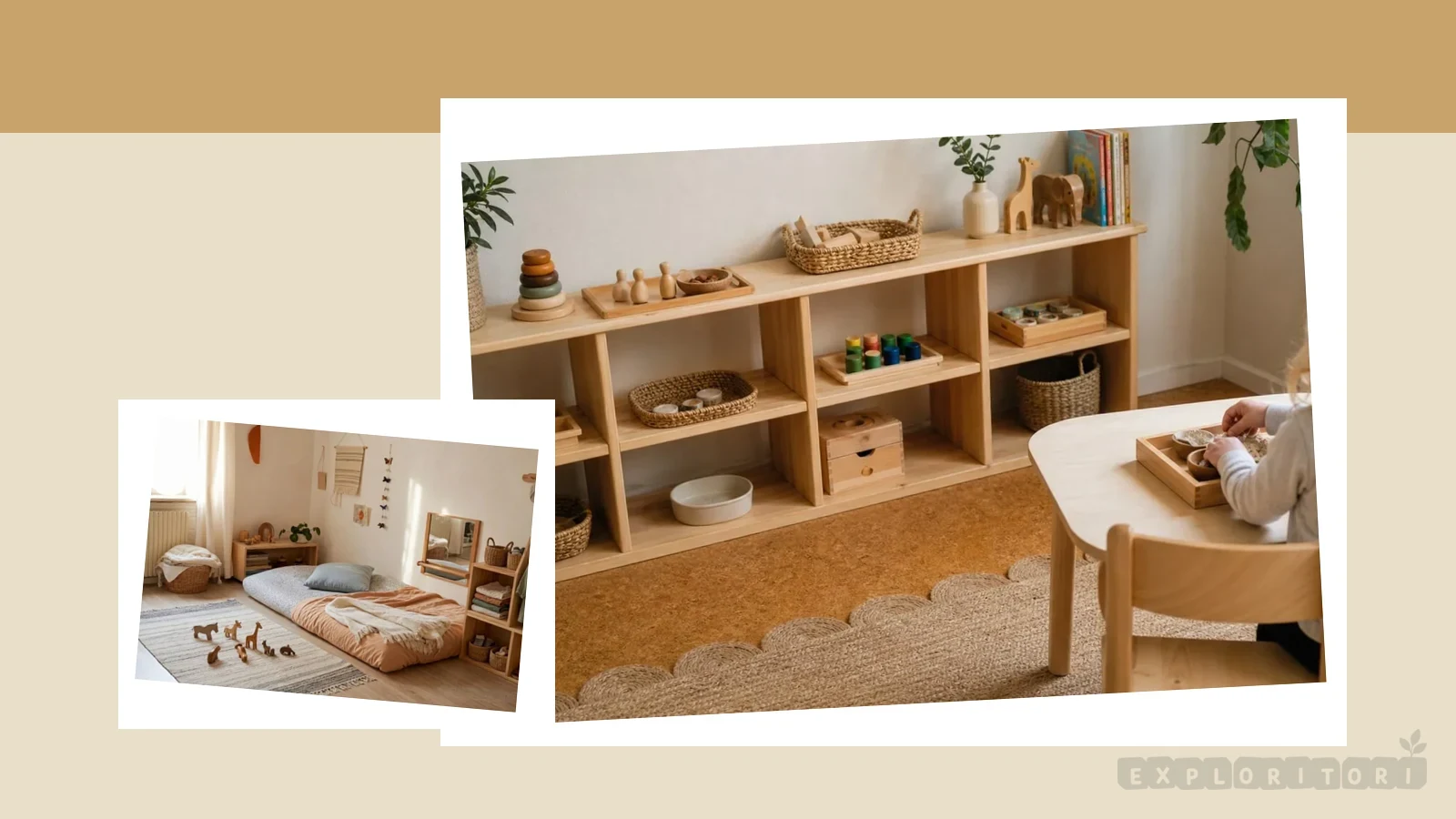 If your baby is between 9 and 12 months, you are in one of the most delightful and slightly chaotic Montessori stages.
This is the age of crawling with purpose, dropping things repeatedly, hunting for hidden objects, pulling every basket off the shelf, and studying a wooden spoon like it contains the secrets of the universe.
It is also the age when many parents start wondering what activities actually make sense.
Not flashy toys. Not battery-powered plastic chaos. Just simple Montessori activities for 9-12 months that match what your baby is truly working on right now.
And that is the key.
At this age, your baby does not need entertainment. Your baby needs chances to move, repeat, compare, explore, and figure things out with their own hands and body.
That is where Montessori shines.
If you are planning the whole first-year shelf, pair this with our Montessori toys for babies 0-12 months guide. For the next stage, keep the 12-18 month activity guide nearby so you can move up when your baby is ready, not just when the calendar changes.
Quick choice guide
| What your baby keeps doing | Best starting point | Keep it simple by |
|---|---|---|
| Crawling toward everything | Movement invitation | placing one familiar object just out of reach on a safe floor |
| Dropping and retrieving | Put-in take-out basket | using 3-5 large objects and one open container |
| Searching under cloths | Object permanence game | hiding one partly visible object, then waiting |
| Mouthing and comparing textures | Treasure basket | choosing 5-8 safe, washable, high-contrast materials |
| Banging, shaking, and listening | Cause-and-effect play | offering one quiet rattle, cup, or spoon setup |
| Watching your face and hands | Language basket | naming 2-3 real objects during a warm routine |
Quick rule: choose the activity that matches the behaviour your baby is already repeating. Montessori works better when it follows observation instead of a shopping list.
🌱 What changes between 9 and 12 months?
Around this stage, many babies are moving from mostly observing the world to actively chasing it.
Your baby may be:
- crawling or working hard toward it
- sitting steadily and reaching further
- transferring objects between hands
- dropping, releasing, and retrieving on purpose
- looking for things that disappeared
- babbling more clearly and responding to familiar words
- wanting to inspect every real object in your house except the expensive toy you just bought
That is not random.
These are developmental clues.
Montessori at 9-12 months works best when you build around those clues instead of guessing what looks “educational.” The strongest activities at this age usually support five big jobs:
- movement
- object permanence
- in-and-out and put-in take-out play
- sensory discrimination
- early language and cause-and-effect
Takeaway: if an activity supports one of those jobs clearly and simply, you are probably on the right track.
🧺 How to set up Montessori activities for 9-12 months at home
Before we talk about the actual activities, the setup matters more than most parents expect.
A baby this age does not need a packed toy shelf. In fact, too many materials can make the space feel noisy.
Keep it simple
Offer 3 to 5 activities at a time. That is enough.
Prioritise floor space
For 9-12 months, open movement space matters more than having more stuff. If your baby is working on crawling, cruising, or pivoting, the room itself is part of the activity.
Use low baskets and trays
A small open basket makes materials easier to see and reach. That matters because your baby is learning to choose and return attention, even before they can tidy anything independently.
Choose real, safe, interesting objects
At this age, a metal whisk, a silicone teether, a wooden ring, or a textured ball can be more useful than a loud toy with ten buttons.
Rotate from observation, not boredom
If your baby keeps returning to one activity, that is not a sign to replace it. It is a sign the activity is working.
If you want a simple foundation, an open baby shelf, a soft crawling play mat, and a few small woven baskets go much further than a toy bin full of random clutter.
If your shelf already feels busy, the principles in our Montessori toy rotation guide still apply for babies: fewer choices, clearer spacing, and rotation based on observation. The weekly shelf rotation planner can also help you keep a small set visible instead of drifting into a crowded shelf.
Takeaway: for 9-12 months, the best environment is open, calm, safe, and easy to understand at a glance.
Safety and readiness check before you start
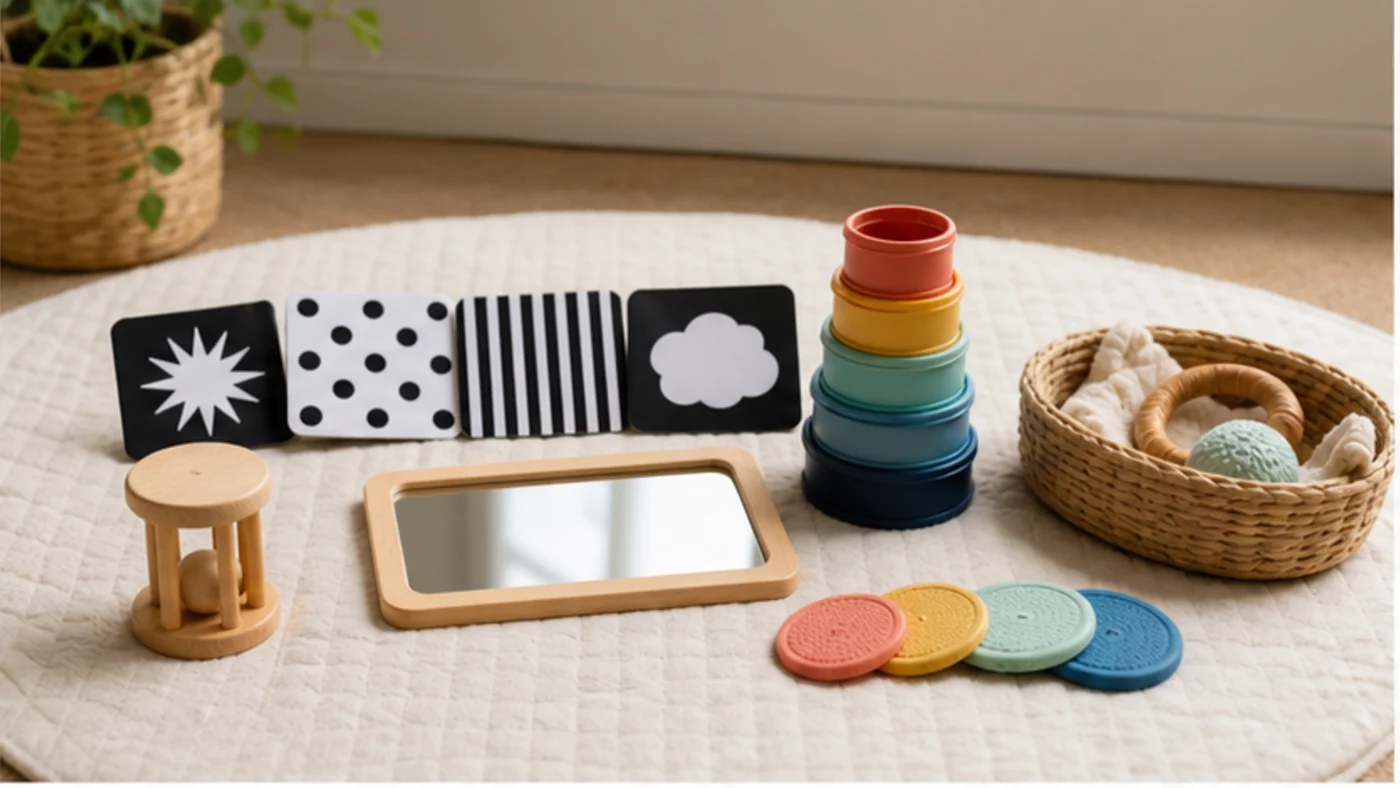
Nine- to twelve-month-olds explore with their mouths, their whole bodies, and very little respect for your interior design plans. Before any activity, run this quick check.
| Check | What it means in real life |
|---|---|
| Choking safety | Nothing small enough to fit fully in your baby’s mouth; no loose beads, caps, coins, button batteries, or detachable parts |
| Mouthing safety | Objects are clean, non-toxic, smooth, and able to handle saliva |
| Movement safety | The floor is clear, cords are out of reach, furniture is stable, and cushions do not create a trapping risk |
| Frustration level | The activity can be repeated successfully at least part of the time |
| Supervision | Real household objects stay within arm’s-reach supervision, especially metal, fabric, or kitchen items |
Skip an activity for now if your baby is tired, hungry, recovering from illness, or mainly wants connection. Montessori is not a daily checklist to complete. Some days the best activity is floor time with you nearby.
Takeaway: safe, repeatable, slightly interesting beats clever every time.
👶 1. Treasure baskets for sensory exploration

If I had to pick one classic Montessori-style activity for 9-12 months, it would be the treasure basket.
A treasure basket is simply a small basket filled with safe, real, varied objects that your baby can take out, inspect, mouth, bang, compare, and drop.
That might sound almost too simple, but that is the point.
At this age, babies learn through contrast. Smooth vs rough. Cool metal vs warm wood. Soft fabric vs firm silicone. Light vs heavy. Quiet object vs clinky object.

A strong treasure basket might include:
- a large wooden ring
- a silicone teether
- a soft brush
- a metal measuring spoon
- a clean sponge
- a small whisk
- a fabric pouch
- a large napkin ring
Five to eight objects is usually enough.
You do not want a junk drawer in basket form. The basket should look inviting and legible.
If you prefer ready-made options, you can search for a Montessori treasure basket set, but honestly, most families can build a better one at home with carefully chosen objects.
Safety matters here. Avoid choking hazards, sharp edges, breakable items, toxic finishes, and anything that cannot handle mouthing.
Takeaway: a good treasure basket gives your baby real sensory information without overstimulation.
🫙 2. Put-in take-out and container play
Between 9 and 12 months, many babies become deeply interested in a very serious scientific question:
What happens if I put this in a container, take it out, and do it again 47 times?
This repetition is not silly. It is real developmental work.
Container play supports:
- hand control
- intentional release
- visual tracking
- simple problem-solving
- understanding of in, out, empty, and full
Easy ideas include:
- balls or scarves in a basket
- wooden rings in a bowl
- large blocks moved from tray to basket
- cloths pulled from a small pouch
- large pom-poms transferred under close supervision if size is safe
You can also offer a simple posting-style setup, as long as it is age-appropriate and not frustrating. Think a wide opening, a soft ball, and a visible result.
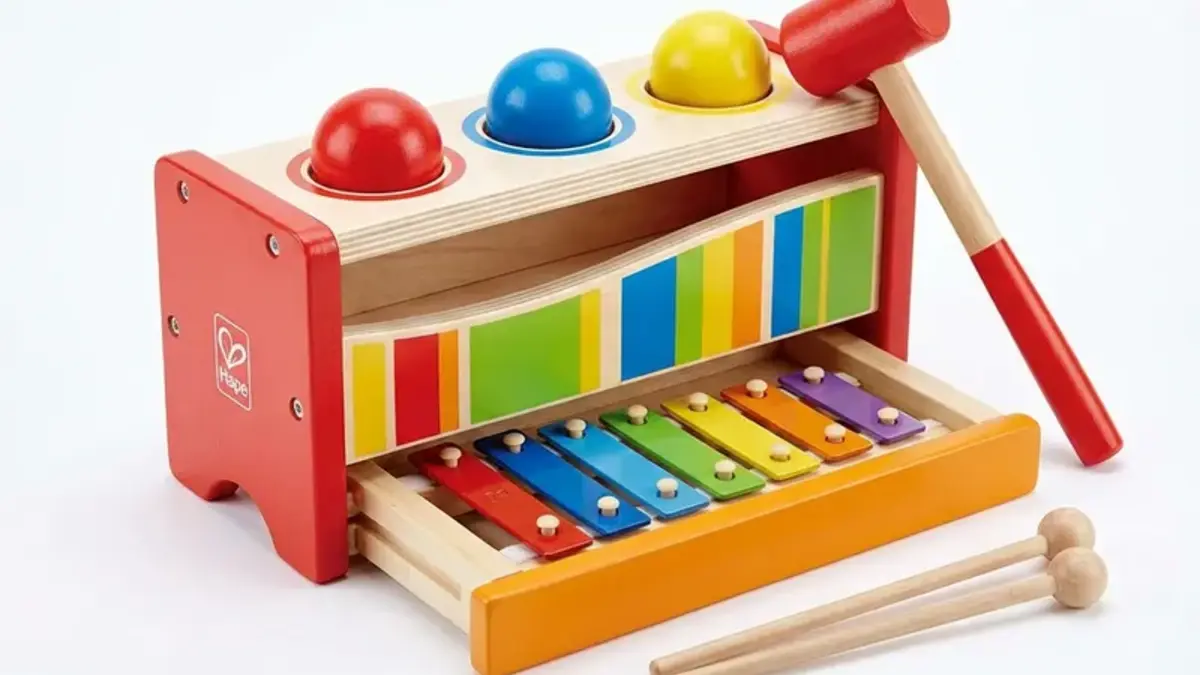
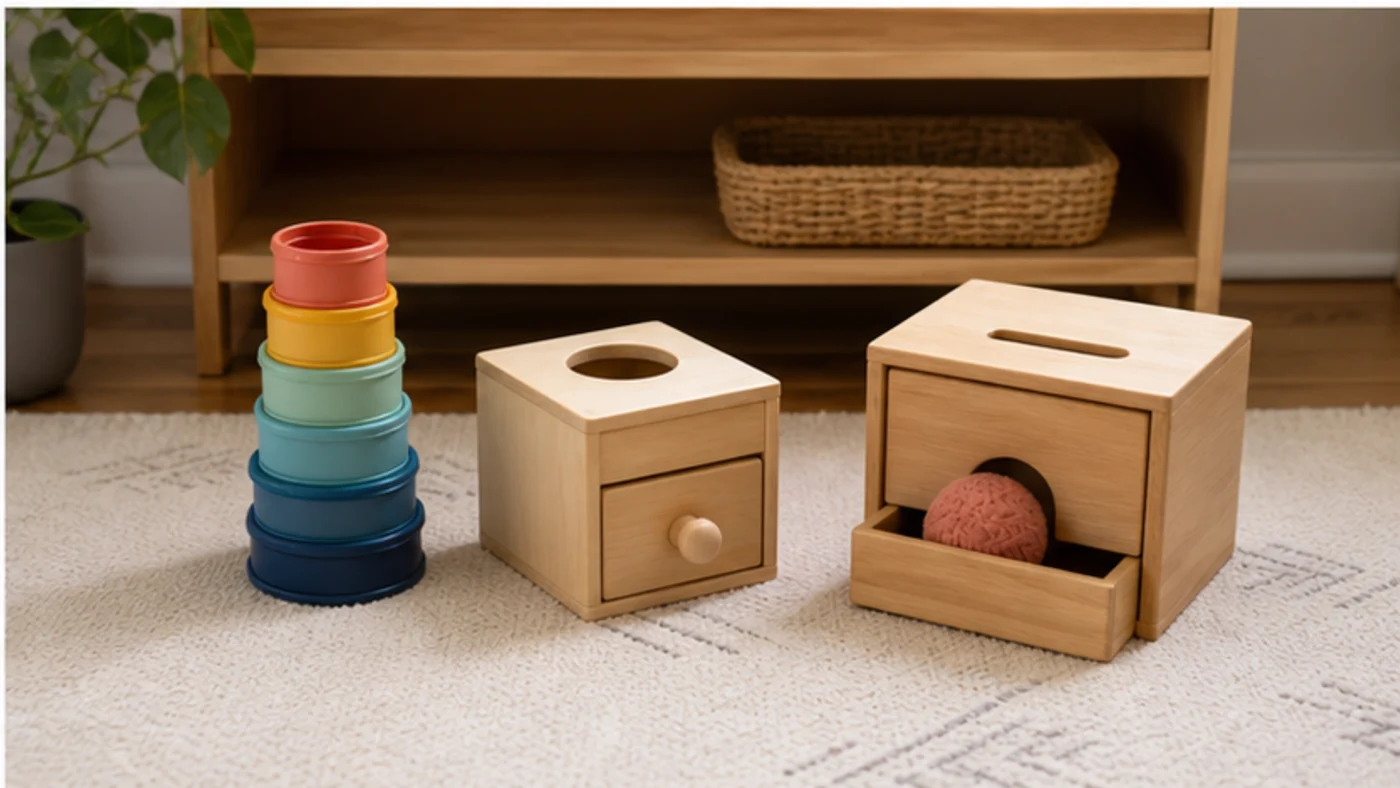
A ball drop toy for babies can work well here if it is simple and easy to repeat. A wooden object permanence box can also be lovely toward the later end of this stage.
DIY works beautifully too. A bowl and a few wooden rings can hold attention for ages.
Takeaway: if your baby wants to dump and refill containers all day, that is not a weird phase to interrupt. It is exactly the kind of focused repetition Montessori wants to protect.
🫣 3. Object permanence and hide-and-find games
This is the age when “where did it go?” becomes a thrilling mystery.
Object permanence means your baby is learning that things still exist even when they cannot see them. It is a huge cognitive shift, and simple games can support it beautifully.
Try:
- hiding a ball under a cloth and letting your baby find it
- partly covering a familiar object and waiting
- playing peekaboo slowly with a scarf
- placing an object inside a small box, then opening it together
- rolling a ball so it disappears briefly behind furniture and reappears
The key is not to overcomplicate it.
Your baby does not need a giant flashy toy for this. Often a silk play scarf set or a few soft cloths are enough. If you want a purpose-built option, a Montessori object permanence box is one of the few baby materials that really earns its place when your child is ready.
Go slowly. Let your baby do the discovering.
If you reveal the hidden object immediately every time, you accidentally steal the best part.
Takeaway: the power of hide-and-find games is not the surprise. It is your baby realising, “I can search, remember, and solve this.”
🚼 4. Movement activities that make crawling worth it
One of the biggest Montessori mistakes with babies is focusing too much on seated toy play and not enough on movement.
At 9-12 months, movement is the curriculum.
If your baby is learning to crawl, pull up, pivot, or cruise, the environment should gently invite those efforts.
Simple movement ideas:
- place a favourite object just out of reach
- create a safe floor path with a few cushions to navigate
- use a low mirror for movement observation
- roll a ball a short distance away
- place a basket near a stable support so your baby can pull up to reach it
This is where a calm “yes space” helps so much. Instead of constantly moving your baby away from danger, you prepare an area where exploration is possible.
Useful setup tools might include a baby floor mirror, a foam climbing block set, or a soft sensory ball set. But again, the magic is not the product. The magic is giving movement a reason.
Do not rush standing if your baby is still obsessed with crawling. Crawling is incredibly valuable. It builds coordination, strength, body awareness, and cross-body movement.
Takeaway: a great 9-12 month activity is often just a safe setup that makes your baby want to move.
🗣️ 5. Early language activities rooted in real life
Language work at this age should feel warm, concrete, and connected to what your baby can actually see and touch.
You do not need flashcards as your main strategy.
You need real objects, repeated words, songs, naming routines, and face-to-face interaction.
Simple Montessori-friendly language ideas:
- name objects during play: “spoon,” “ball,” “brush”
- repeat and respond to babbling sounds
- sing the same simple songs every day
- use short phrases tied to actions: “You dropped it.” “You found the ball.”
- make small themed baskets with 2 to 3 familiar objects
For example, a kitchen basket might have a spoon, whisk, and tiny bowl. A bathroom basket might have a washcloth, hairbrush, and toothbrush.
At this age, your baby is building meaning long before clear speech shows up.
Board books matter too, especially realistic ones with one object or animal per page. A small set of real-image baby board books can be lovely if you want to support naming and recognition without visual overload.
Takeaway: early language grows best from relationship, repetition, and real objects, not from trying to make your baby perform words on cue.
🪵 6. Cause-and-effect play without battery chaos
Babies between 9 and 12 months are natural tiny scientists.
They want to know:
- what happens when I drop this?
- what happens when I shake this?
- what sound does this make?
- what changes when I push, bang, or release?
Montessori does not avoid cause-and-effect. It just prefers cause-and-effect that stays in the child’s hands.
Good options include:
- a simple bell shaker
- a wooden rattle
- a ball track with one visible path
- a metal cup and wooden spoon
- stacking cups that can be knocked down and rebuilt
A wooden baby rattle set or stacking cups for babies can work well here.
The difference from many mainstream toys is subtle but important. The toy should not overwhelm your baby with automatic sounds and lights. It should reward your baby’s own action.
That keeps the feedback loop clean.
Takeaway: the best cause-and-effect toys are quiet enough that your baby stays the main event.
🛋️ A simple Montessori shelf for 9-12 months
If I were setting up a shelf for this exact age tomorrow, I would start here:
- one treasure basket
- one container play activity
- one hide-and-find or object permanence activity
- one movement invitation, like a ball or reachable basket
- one simple language basket or board book
That is already enough.
You do not need ten toys per week.
A low baby toy shelf, a few wooden trays or baskets, and a calm floor area can create a much stronger setup than a fully loaded nursery.
If your baby is especially interested in movement, I would invest in the environment first. If your baby loves handling and comparing objects, I would improve the treasure basket first.
Follow the child, not the algorithm.
Takeaway: a strong shelf for this age is small, clear, and built around real developmental needs.
A first-week rhythm that does not overdo it
Use this as a starting point, then adjust from observation.
| Day | Offer | What to watch |
|---|---|---|
| Monday | Treasure basket plus open floor space | Which object gets repeated attention? |
| Tuesday | Put-in take-out basket | Can your baby release objects intentionally, or is hand transfer enough? |
| Wednesday | Object hidden under a cloth | Does your baby search, wait, or need the object partly visible? |
| Thursday | Ball or basket just out of reach | Is the distance motivating or frustrating? |
| Friday | Language basket with 2-3 real objects | Which words or sounds get a response? |
| Weekend | Repeat the two strongest activities | Repetition tells you what is working |
You do not need a fresh activity every day. If one setup gets used deeply, keep it. If your baby ignores something for several days, simplify it or put it away for a week.
For the next shelf step, the Montessori shelf ideas by age guide gives a broader 6-36 month view so you can see what is coming without crowding the current shelf.
❌ Common mistakes with Montessori activities for 9-12 months
A few things tend to go wrong at this stage.
1. Offering too much
A large pile of toys is not richer. It is just louder.
2. Buying toys that do all the work
If the toy lights up, sings, and performs with very little effort from your baby, it usually shortens concentration instead of deepening it.
3. Keeping babies seated too much
This age needs floor freedom. Movement is not extra.
4. Rotating too quickly
Repetition is the point. If your baby is still interested, keep the activity.
5. Confusing “Montessori” with beige decor
A material is not Montessori because it is wooden or neutral-coloured. It is Montessori if it helps your baby explore actively and independently.
6. Ignoring safety in the name of “real objects”
Yes, Montessori loves real materials. No, that does not mean anything from the kitchen is automatically safe for a mouthing baby.
Takeaway: simple works, but only when it is thoughtful, safe, and genuinely matched to your baby.
Troubleshooting: when the activity is not working
| Problem | Try this instead |
|---|---|
| Your baby dumps everything and crawls away | Offer one basket with only 3 objects, then sit nearby without demonstrating too much |
| The object permanence game causes frustration | Leave the object half visible or switch back to peekaboo with your face |
| Container play turns into chewing only | Choose mouthing-safe rings, cups, or teethers and treat chewing as part of exploration |
| Movement invitations lead to tears | Move the object closer, remove obstacles, or return to open floor play |
| The shelf is ignored | Put away half the materials and leave one familiar favourite visible |
| You feel pressure to buy more | Check whether a bowl, cloth, basket, spoon, ball, or board book already answers the developmental need |
If your baby is closer to walking, carrying, and posting with more control, start blending in ideas from Montessori activities for 12-18 months. If your child is already firmly toddler-like, our Montessori activities using things you already have guide keeps the same low-cost spirit.
The bottom line
Montessori activities for 9-12 months do not need to be elaborate to be powerful.
This stage is about movement, discovery, repetition, and the first sparks of problem-solving. Your baby is learning through hands, mouth, body, eyes, and relationship all at once.
That is why the best activities are often beautifully ordinary.
A basket of interesting objects. A cloth hiding a ball. A reachable item that motivates crawling. A bowl to fill and empty. A parent who slows down enough to notice what the child is already trying to practise.
If you remember one thing, let it be this:
At 9-12 months, Montessori is less about teaching your baby something new and more about preparing a space where your baby can do the work they are already driven to do.
And honestly, that is a relief.
Because it means you do not need to become a cruise director for infant entertainment.
You just need to make the next good exploration possible.
How we reviewed this guide
This guide was refreshed against current Exploritori Montessori baby content, related age-stage guides, and practical parent setup criteria: safety for mouthing babies, repeatability, low clutter, movement freedom, and whether the child does the meaningful work. It is educational guidance, not medical or developmental diagnosis. If you are worried about feeding, movement, vision, hearing, or delayed milestones, speak with your paediatrician or local child-development professional.
Some product links are affiliate links, which means Exploritori may earn a small commission if you buy through them. The recommendations still prioritise simple, open-ended, age-fit materials; most activities here can be done with safe household objects.
Frequently Asked Questions
What are the best Montessori activities for 9-12 months?
The best Montessori activities for 9-12 months are simple, hands-on invitations that support movement, object permanence, sensory exploration, container play, and early language. Good options include treasure baskets, ball rolling, put-in take-out activities, cloth hide-and-find games, and safe crawling challenges.
How many Montessori activities should I offer a 9-12 month old?
Most babies do best with around 3 to 5 simple choices at a time. Too many materials can make the shelf feel cluttered and reduce focus.
Do I need special Montessori toys for 9-12 months?
No. Many excellent Montessori activities for this age use simple household items like bowls, baskets, scarves, wooden rings, brushes, and spoons, as long as they are safe and thoughtfully presented.
What skills are babies developing between 9 and 12 months?
Many babies in this stage are developing crawling, pulling up, cruising, grasping, transferring objects, intentional release, object permanence, sensory discrimination, and stronger receptive language.
What is a Montessori treasure basket?
A Montessori treasure basket is a small basket filled with safe, real, varied objects that invite your baby to explore texture, weight, sound, shape, and material through self-directed play.
 Get weekly Montessori tips
Honest reviews, activity ideas, and budget-friendly picks — no spam, just what works.
Subscribe Free