Montessori Floor Bed: Everything You Need to Know
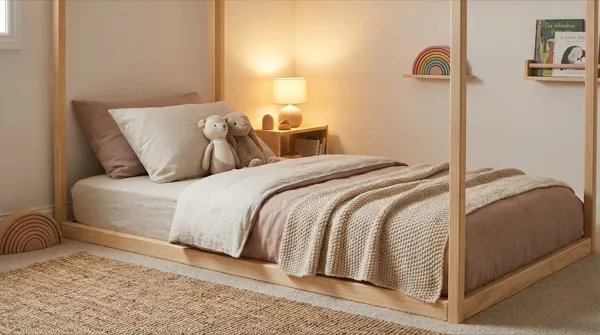
What Is a Montessori Floor Bed?
At its simplest, a Montessori floor bed is exactly what it sounds like: a bed at floor level. No crib bars. No containment. Your child can get in when they’re tired and get out when they wake up, independently.
The concept comes from Montessori’s emphasis on freedom of movement and independence. A crib says “you stay here until I come get you.” A floor bed says “this is where you sleep, and you can choose when to go there.”
It sounds radical in a culture that’s built around cribs, but Montessori families have been doing this for decades. Here’s what actually works.
When to Start
The Honest Answer
There is no single correct age. Common starting points:
-
From birth (0-3 months): Some families use a floor bed from day one, often with a small mattress or firm pad. This is purist Montessori, and it can work — but many parents prefer a bassinet or co-sleeping arrangement for the newborn months, and that’s completely reasonable.
-
6-10 months (most popular): By this age, most babies can roll both ways and may be starting to crawl or pull up. They’re developmentally ready to have some freedom of movement during sleep.
-
12-18 months: Very common transition point, especially for families moving from a crib. The child is walking, more aware of their body, and able to understand basic sleep boundaries.
-
2+ years: If your child is climbing out of their crib, that’s your child telling you they’re ready. Don’t wait for them to fall out.
When NOT to Start
- If your child can’t roll both ways yet and you won’t be supervising closely
- During a major disruption (new sibling, house move, illness) — one big change at a time
- If you haven’t baby-proofed the bedroom (this one is non-negotiable)
How to Set Up a Floor Bed Safely
The Mattress
Option 1: Mattress directly on the floor. The simplest approach. Use a firm crib mattress or a thin futon-style mattress. Avoid adult mattresses for babies under 12 months — they’re too soft and pose a suffocation risk.
Option 2: A floor bed frame. Low wooden frames (often house-shaped or simple platforms) lift the mattress 5-10cm off the floor. This improves airflow under the mattress (reducing mould risk) while staying accessible. Price range: €80-250 depending on style and material. We went with a natural wood boat-style frame (~€235) — solid construction, includes slatted base, and the low sides give just enough barrier without making it feel like a crib.
What to avoid: Bed frames with gaps where a child’s head could get stuck, frames higher than 15-20cm, and anything with sharp corners.
The Room
This is where the real work happens. The bedroom needs to be completely safe for an unsupervised, mobile child:
- Furniture anchored to walls — bookcases, dressers, anything that could tip
- Outlets covered — socket protectors on every outlet
- Blind cords removed or secured — strangulation hazard (this one is critical)
- No small objects within reach — choking hazards
- Door secured — a baby gate at the door or a childproof door handle, so your child can move freely in the room but not wander the house at 3am
- Minimal distractions — keep toys in another room if possible; the bedroom should signal “this is where we sleep”
Temperature and Bedding
For babies under 12 months, follow safe sleep guidelines: firm mattress, fitted sheet, no loose blankets, pillows, or stuffed animals. A quality sleep sack (like a weighted or transitional option) is your best friend for temperature regulation.
For toddlers 12+ months, you can introduce a small pillow and a light blanket. Keep it simple — a cotton duvet or organic blanket works well.
The First Two Weeks: What to Expect
Let’s be honest. The transition is not usually smooth on night one. Here’s the typical pattern:
Days 1-3: Your child will be excited about the novelty. They might get out of bed. A lot. They might fall asleep on the floor next to the bed. They might play instead of sleeping. This is normal.
Days 4-7: Some children start to settle. Others escalate the testing. Both responses are normal. Consistency is key — calmly, quietly return them to bed. No drama, no long explanations, no negotiations.
Days 8-14: Most children have developed a routine by now. They know where the bed is, they know the sleep cues, and they (usually) stay in bed. Not always. But usually.
What helps:
- A very consistent bedtime routine (same steps, same order, every night)
- A dim nightlight so they can see the bed if they wake up
- Boring responses to getting out of bed (“it’s sleep time” + guide back to bed)
- Patience that borders on superhuman
What doesn’t help:
- Getting angry (they’re not misbehaving; they’re exploring a new freedom)
- Giving up after three nights
- Putting stimulating toys in the bedroom
Age-by-Age Guide
0-6 Months
- Use a firm mattress on the floor, following safe sleep guidelines
- Supervise closely or use a monitor
- The room should be very simple: bed, mirror at floor level, one or two mobiles overhead
- Some parents prefer a bassinet for this phase — that’s OK
6-12 Months
- Transition from bassinet/crib if you haven’t already
- Baby-proof aggressively — they’re mobile now
- Keep a few board books near the bed for when they wake
- A low mirror they can see themselves in helps with the “this is my space” feeling
12-24 Months
- The sweet spot for most transitions
- Add a low shelf with 1-2 quiet activities (books, a puzzle) for independent wake-up time — try classic wooden options like the Melissa & Doug Jumbo Knob Puzzle (~$12)
- Establish clear sleep boundaries (“you can look at books, but we stay in the room”)
- A clock that changes colour at wake-up time is helpful for toddlers who don’t understand “it’s too early”
2-4 Years
- Most children are fully adapted by now
- The floor bed becomes their space — they take pride in it
- You can involve them in making the bed (practical life skill!)
- Gradual transition to a regular low bed whenever it feels right
The Trade-Offs Nobody Talks About
Mould Risk
A mattress directly on the floor doesn’t get airflow underneath. In humid climates or poorly ventilated rooms, this can mean mould. Solutions: stand the mattress up during the day, use a frame with slats, or place a breathable mattress pad underneath. Check under the mattress weekly.
Dust
Floor level means dust level. Vacuum and clean the bedroom floor more frequently than you might with a crib setup. A non-carpeted floor is easier to maintain.
They Will Get Out of Bed
This is a feature, not a bug — but at 5:30am it feels like a bug. Some mornings your toddler will appear at your bedside at an hour you didn’t know existed. The colour-changing clock helps. Having a few books near the bed helps. Accepting that early mornings are a phase helps most of all.
It’s Not for Every Family
Co-sleeping families, families in very small apartments, families with safety concerns they can’t fully address — there are legitimate reasons to use a crib or a regular bed. Montessori is about principles, not specific furniture. If a floor bed doesn’t work for your situation, your child will not be developmentally damaged. Promise.
What You Actually Need
Minimum setup (under €50):
- A firm crib mattress (you probably already have one)
- A fitted sheet
- A sleep sack (for under 12 months) or light blanket
- Socket covers and furniture anchors (if not already installed)
Nice to have (€50-250 additional):
- A low bed frame for airflow — we use the Montessori Boat Bed in natural wood (~€235, 90×190cm). Good quality solid wood, includes slatted frame and a low barrier on the sides. Not the fanciest option out there, but well-made, sturdy, and our son has been sleeping on it without issues. We’d recommend it.
- A Montessori wall mirror with pull-up bar (~€100, 100×60cm) — we’d say this is closer to essential than optional, especially once they start getting active (around 4-6 months). The mirror supports self-recognition, visual tracking, and gives babies real motivation to lift their head during tummy time and eventually pull themselves up to stand. Fair warning: it requires drilling into the wall, so it’s a commitment — but worth it in the play area. Made from 5mm thick methacrylate — genuinely unbreakable, which matters when a toddler is pulling themselves up on it or inevitably bumping into it. Never use real glass for a Montessori mirror. This one has an adjustable 3-height beech wood bar that grows with them. One of the best investments we made for Max’s room.
- A dim nightlight
- A colour-changing wake clock (€20-30)
- A low shelf near the bed with classic books or a simple Baby Paper Crinkle Toy (~$7) for sensory comfort
Not necessary:
- A house-shaped bed frame (cute but functional benefit is zero — we went with a simpler boat frame and it works perfectly)
- Matching wooden furniture
- A complete room redesign
FAQ
Is a floor bed safe for a newborn?
It can be, following safe sleep guidelines: firm mattress, fitted sheet only, no loose bedding, no pillows, baby on their back. Many paediatricians are cautious about floor beds for newborns because a bassinet or crib provides a more defined sleep space. If you choose a floor bed from birth, use a video monitor and ensure the room is completely safe. Discuss with your paediatrician.
Won’t my child just play instead of sleeping?
Initially, probably. But children are biologically driven to sleep when they’re tired. After the adjustment period (1-2 weeks for most), they learn that the bed is for sleeping. Having a very consistent routine helps enormously. Keeping the room boring (no exciting toys) helps even more.
When should I transition from a floor bed to a regular bed?
Whenever it makes sense for your family. Some children stay on floor beds until age 5-6. Others move to a regular low bed at 2-3. There’s no developmental deadline. When your child is ready for a bigger mattress or you need the floor space, make the switch.
My child rolls off the mattress in their sleep. Is that a problem?
Not usually. Place a soft rug or mat next to the mattress. Most children roll off, don’t fully wake up, and either crawl back on or sleep on the floor briefly. If it’s happening constantly, a pool noodle under the fitted sheet at the edge creates a subtle bumper. Some families find soft bumpers or padded bed rails help — look for non-toxic options designed for toddler mattresses.
Can I use a floor bed if we live in a small apartment?
Yes — this is actually where floor beds shine. A mattress on the floor takes up less space than a crib and can be stood up against the wall during the day to reclaim floor space. In shared rooms, it works especially well because it has the lowest visual profile.
For more on setting up your child’s space, see our Montessori Shelf Setup Guide and Practical Life Activities for things to put on that shelf.
 Get weekly Montessori tips
Honest reviews, activity ideas, and budget-friendly picks — no spam, just what works.
Subscribe Free