Montessori for Neurodivergent Children: What Actually Helps
Disclaimer: This is parenting guidance based on Montessori principles and community experience, not medical advice. If your child has a diagnosis or you suspect neurodivergence, work with qualified professionals alongside any home approaches.

Why Montessori and Neurodivergence Are a Natural Fit
Here’s something that gets lost in the Instagram-perfect Montessori world: Maria Montessori developed her method while working with children who had developmental differences. The entire philosophy was born from observing children who didn’t fit the standard mould.
The core principles translate directly:
- Self-paced learning — no forced timelines or “you should be doing this by now”
- Sensory-rich materials — designed to engage multiple senses, which many neurodivergent children crave
- Prepared environment — reducing chaos and overwhelm is therapeutic, not just pedagogical
- Respect for the individual — literally the foundation
- Repetition is welcomed — doing the same activity 47 times isn’t a problem, it’s the method working
The issue isn’t whether Montessori works for neurodivergent children. It’s that many Montessori communities present one version of what “following the child” looks like — and it’s usually a neurotypical child.
ADHD and Montessori: What to Adapt
Shorter Work Cycles
Traditional Montessori expects children to engage in extended periods of focused activity. For a child with ADHD, this can feel like being asked to hold your breath underwater. Instead:
- Start with whatever duration works — even 2-3 minutes of focused engagement is a win
- Build up gradually, not because a chart says to, but because the child shows they can
- Multiple short rotations through different activities are absolutely fine
Movement Is Regulation, Not Disruption
A child who needs to bounce, spin, or walk between activities isn’t misbehaving. They’re self-regulating. Build movement into the routine:
- A balance board between the shelf and the table
- Standing work instead of sitting work (a low table they can stand at)
- Gross motor activities counted as legitimate “work” — pouring water, carrying heavy objects, sweeping. Try Kinetic Sand (~$12) or sensory bins for regulated movement and tactile input
Fewer Choices on the Shelf
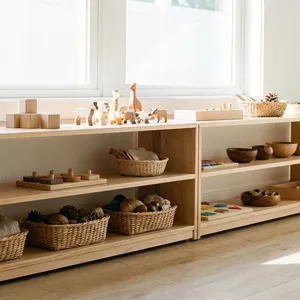
Where a neurotypical child might handle 6-8 items on a shelf, try 3-4 maximum for a child with ADHD. Too many options can trigger decision paralysis and frustration rather than engagement. Rotate more frequently instead. For shelf setup basics, see our Montessori Shelf Setup Guide.
Drop the Myth
There’s a persistent idea in Montessori circles that if a child can’t concentrate, the materials are wrong. For ADHD brains, concentration challenges aren’t a materials problem. They’re a neurology reality. Stop blaming yourself or your setup. Adapt the approach, not your expectations of your child.
Autism and Montessori: What to Adapt
Predictability Is Everything
Montessori’s prepared environment naturally supports this. Lean into it:
- Same shelf positions for favourite materials
- Consistent routine (work time, snack time, outdoor time in the same order)
- Visual schedules using photographs or simple drawings
- Transition warnings: “In two minutes, we’ll tidy the shelf”
Sensory Considerations
Some classic Montessori materials can be sensory landmines for autistic children:
- Sandpaper letters might be unbearable for tactile-sensitive children (try felt alternatives)
- Metal insets can feel cold and unpleasant (warm them first or offer wooden alternatives)
- Sound cylinders might be overwhelming (start with quieter, predictable sounds)
Observe which sensory inputs your child seeks and which they avoid. Build the shelf around their sensory profile, not a textbook.
Special Interests Are Entry Points
If your child is obsessed with trains, that’s not a distraction from learning. That’s a bridge to it. Counting trains. Sorting trains by colour. Reading books about trains. Building train tracks (spatial reasoning). In Montessori terms, the child is telling you what their sensitive period is. Listen.
Social Components
Grace and courtesy lessons — a core part of Montessori — may need adapting. Direct instruction about social norms (“we say please when…”) can work well for many autistic children who prefer explicit rules over implicit social expectations. Role-playing and social stories are legitimate Montessori-aligned tools.
Sensory Processing Differences
Whether or not your child has a specific diagnosis, sensory processing differences are common and worth addressing.
For Sensory Seekers
Children who need more sensory input thrive with:
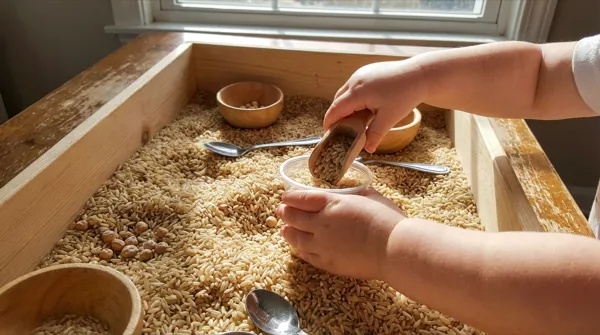
- Heavy work activities from practical life: pouring dried beans, kneading dough, grinding spices with a mortar and pestle, carrying heavy books
- Water play — pouring, sponging, washing dishes (classic practical life, and deeply regulating). The Step2 Water Table (~$55) is excellent for structured water exploration
- Tactile materials — different textures in sorting activities, fabric swatches, nature items, or Fat Brain Toys Squigz (~$35) for varied tactile input
- Proprioceptive input — push/pull toys, climbing, hanging from bars
For Sensory Avoiders
Children who are easily overwhelmed need:
- Simplified environment — neutral colours, minimal visual clutter, low noise
- Gradual introductions — one new material at a time, placed on the shelf for days before you demonstrate it
- Quiet workspace options — a small tent or canopy over their work area can reduce sensory input
- Choice over pace — never force interaction with a material they’re avoiding
Sensory Bins: The Purist Debate
Sensory bins (containers filled with rice, pasta, water beads, kinetic sand, etc.) aren’t strictly Montessori. Some purists actively discourage them. But for children with sensory processing differences, they’re incredibly useful regulatory tools. Products like Kinetic Sand 2.5lb ($12) and Fat Brain Toys Squigz ($35) offer excellent sensory input without being “non-Montessori.” Use them. Your child’s regulation matters more than method purity.
What Purists Get Wrong
Let’s be direct: the Montessori community has an elitism problem when it comes to neurodivergence.
“Real Montessori” gatekeeping — insisting on specific materials, specific timelines, specific behaviours — excludes the very children Maria Montessori originally designed for. When someone tells you your child should focus longer, sit stiller, or need fewer accommodations if you just “trust the method,” they’re confusing ideology with practice.
Flexibility IS Montessori. Maria Montessori adapted her approach constantly based on observation. She would be appalled at rigid adherence to a fixed set of rules that ignores the child in front of you.
You don’t fail at Montessori by making accommodations. You fail at Montessori by ignoring your child’s needs in favour of an aesthetic.
For more on what Montessori actually is (versus what Instagram says it is), see our What Is Montessori guide.
Getting Started: Practical Steps
-
Observe for 3 days before changing anything. Write down what your child is drawn to, what they avoid, when they seem regulated, when they seem overwhelmed. This data is your starting point.
-
Start with practical life. Pouring, sweeping, folding, washing — these activities are sensory-rich, have clear beginning and end points, and provide immediate feedback. They work for nearly every child. See our Practical Life Activities guide for ideas.
-
Build the environment around YOUR child. Not around an Instagram template. Not around a curriculum guide. Around the actual human being who lives in your house.
-
Work with professionals. Occupational therapists, speech therapists, and developmental paediatricians are allies, not competitors to the Montessori approach. The best outcomes come from combining therapeutic support with a thoughtful home environment.
-
Connect with other parents. Online communities for neurodivergent Montessori families exist and are growing. You’re not figuring this out alone.
FAQ
Is Montessori good for children with ADHD?
Yes, with adaptations. The self-paced, hands-on, movement-friendly aspects of Montessori align well with ADHD needs. The key adaptations are shorter work cycles, fewer shelf items, and building movement into the routine rather than treating it as a disruption.
Can autistic children do Montessori?
Absolutely. Many autistic children thrive in Montessori environments because of the predictability, structure, and sensory richness. Adaptations around social lessons, sensory sensitivities, and leveraging special interests make it work better. Some Montessori schools are specifically designed for neurodivergent learners.
How do I adapt a Montessori shelf for sensory sensitivities?
Reduce the number of items (3-4 instead of 6-8). Choose materials that match your child’s sensory preferences — avoid textures they find aversive. Place items at the same positions consistently. Consider a “regulation station” nearby with calming tools (weighted lap pad, fidget items). See our shelf setup guide for the basics.
Does Montessori work for children with learning disabilities?
The principles — self-paced, concrete before abstract, sensory-based learning — are actually what many special education approaches are based on. Materials may need to be simplified or adapted, and timelines should be thrown out entirely. Work with your child’s pace, not a milestone chart.
Should I tell our Montessori school about my child’s diagnosis?
Yes. A good Montessori school will use this information to better prepare the environment and adapt their approach. If a school responds to a diagnosis by suggesting your child “isn’t a good fit,” that school isn’t practising Montessori — they’re practising exclusion.
 Get weekly Montessori tips
Honest reviews, activity ideas, and budget-friendly picks — no spam, just what works.
Subscribe Free