Montessori Observation at Home: What to Watch Before You Buy Anything
· Updated
 Some children make it very obvious what they need.
They drag a stool to the counter every morning, attempt to peel a banana with the determination of a tiny pirate, and lose their minds when you try to help.
Other children are subtler. They keep opening and closing one drawer. They carry the same basket across the room six times. They ignore the expensive toy you felt weirdly proud of buying, then spend twenty glorious minutes transferring socks from one container to another.
This is exactly why Montessori starts with observation.
Not shopping. Not shelf styling. Not asking the internet which toy every two-year-old “must have.” Observation comes first.
If you skip that step, you usually end up with one of two problems. Either your home fills with lovely-looking materials your child does not care about, or you keep solving the wrong problem because you never stopped to see what your child was actually trying to do.
Montessori observation at home is simpler than it sounds. You are not writing a research paper. You are learning to look closely enough that your choices start making sense.
Quick choice guide
| Situation | Best starting point | Why it helps |
|---|---|---|
| You want the simplest option | Start with one low shelf or basket | Fewer choices make it easier for your child to focus |
| You are buying something new | Choose practical, open-ended materials first | They last longer and support real independence |
| Your space feels cluttered | Rotate materials weekly instead of adding more | Calm environments usually work better than bigger collections |
| Your child keeps asking for help | Watch the point where independence breaks down | The fix may be a lower hook, smaller pitcher, or simpler routine |
| You are unsure what age guide fits | Observe the skill, not the birthday | Toddlers often move unevenly across language, movement, hand work, and self-care |
If you are still setting up the basics, pair this with the how to start Montessori at home guide and the Montessori shelf setup guide. Observation tells you what to prioritise; those guides help you make the environment readable.
👀 What Montessori observation really means
Observation in Montessori is not staring at your child like a documentary narrator.
It means stepping back long enough to notice:
- what your child chooses on their own
- what they repeat
- what seems too easy
- what seems just out of reach
- what causes frustration
- what helps them concentrate
- what part of the environment is working, or not working
That is the heart of it.
You are looking for patterns, not perfect notes.
A lot of us do the opposite by accident. We see our child getting restless, then immediately jump to “maybe they need new toys.” Or we see a toddler throwing things and decide the problem is behaviour, when the real issue is that they are desperate for movement, carrying work, or a more usable space.
Observation slows that whole cycle down.
It helps you ask better questions:
- Is my child bored, or overloaded?
- Is this material too hard, or just badly presented?
- Are they refusing help, or asking for more independence?
- Do they need something new, or less stuff?
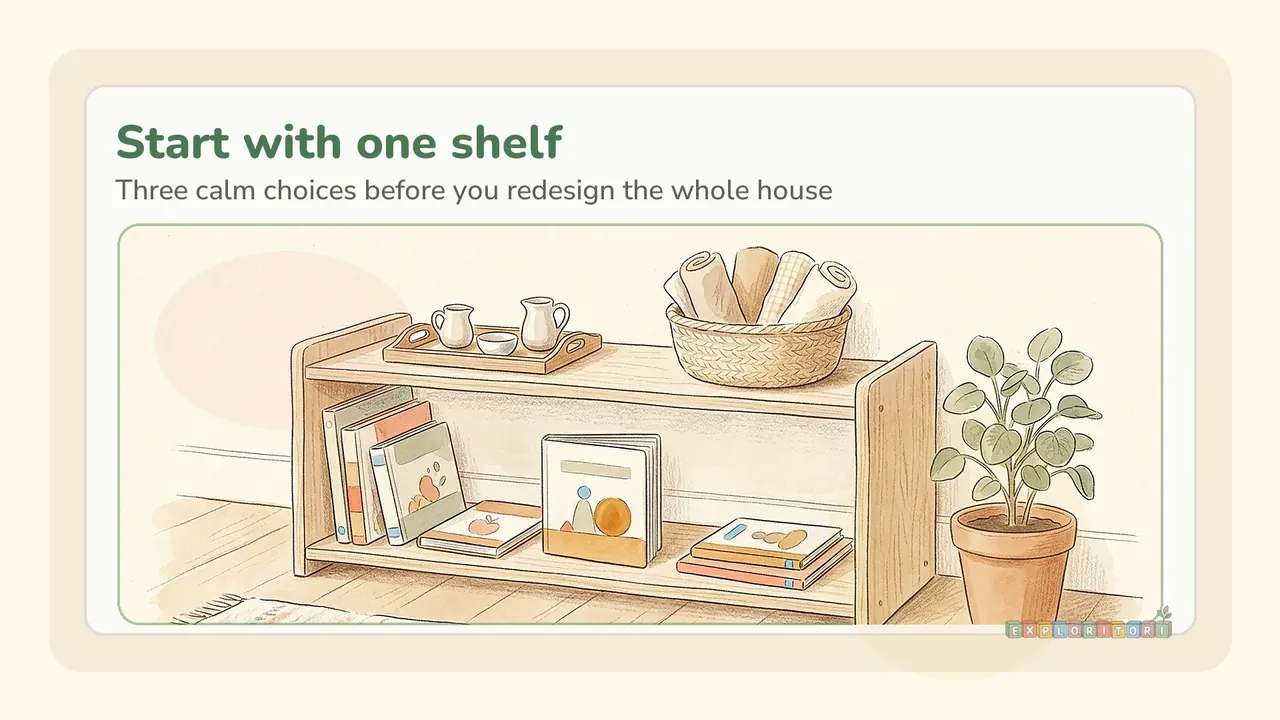
If you want one practical setup for observation time, keep it very plain. A small parent notebook, a simple timer, and a calm place to sit are enough.

Takeaway: Montessori observation is how you replace guessing with useful information.
🧠 What to watch for in your child
When you first start observing, it helps to know what matters.
You do not need to record every adorable thing your child does. Much as that would be delightful.
Focus on these five areas.
1. Repetition
If your child does the same action again and again, pay attention.
Repetition usually means development is happening. Pouring, opening, posting, stacking, climbing, wiping, matching, carrying, and sorting can all look boring to adults right before they become deeply important to the child.
2. Independence drives
Notice the moments when your child clearly wants to do something without you.
Maybe they insist on putting on their own shoes, washing their own apple, zipping the bag, or choosing the book. Those are not interruptions to the day. They are clues.
3. Friction points
Watch what consistently breaks down.
Does your child want a drink but cannot reach a cup? Want to help cook but the counter is impossible? Want to tidy up but the baskets are too heavy? Often the “behaviour issue” is just a badly matched environment.
4. Movement needs
Some children are in a strong transporting phase. Others are climbing, pushing, dumping, or carrying everything they can find. If you ignore that, you end up buying tabletop activities for a child whose whole body is saying, “No thanks, I need to move.”
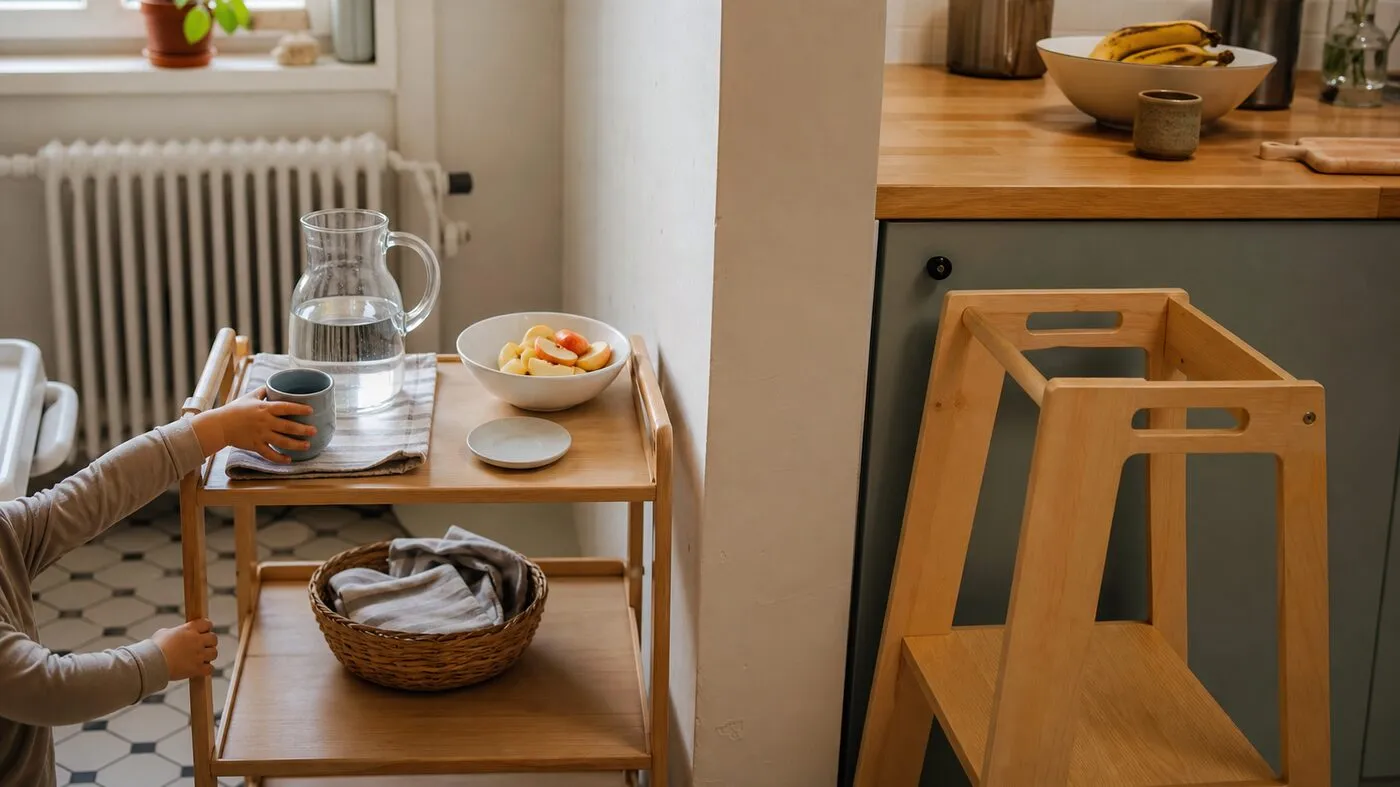
A sturdy toddler step stool, child-sized broom set, or simple balance beam stones can make much more sense than another puzzle if movement is the real need.
5. Concentration
This one matters most.
When does your child become calm, focused, and satisfied? What kinds of activities lead to that settled look where they are genuinely working?
That is gold.
Takeaway: watch for repeated interests, independence, friction, movement, and concentration. Those patterns tell you what to change next.
✍️ How to do a simple observation at home

Good news. This does not require a clipboard and a tragic amount of jargon.
Here is an easy way to do it.
Step 1: Pick one short window
Choose 5 to 10 minutes when your child is awake, reasonably settled, and free to move.
Morning often works well. So does the time after snack or after a reset outdoors.
Step 2: Change as little as possible
Do not suddenly present six new activities and then claim you are observing naturally. Just let your child move through the environment you already have.
Step 3: Be quiet
This is the hard part.
Try not to quiz, direct, entertain, praise every two seconds, or rescue too quickly. Your child behaves differently when they feel watched in an obvious way.
Step 4: Write down only what you see
Keep notes concrete.
Better notes:
- carried three wooden blocks to the kitchen
- tried to pour water twice, spilled, asked for cloth
- returned to zipper pouch four times
- ignored puzzle, chose sweeping
Less useful notes:
- seemed advanced
- was being difficult
- loves Montessori today
Step 5: Look for one decision
After the observation, do not overhaul the whole house. Make one useful change.
That might be:
- adding a reachable water station
- removing a toy that is too noisy or passive
- rotating in more posting or transferring work
- setting up a dressing basket
- offering fewer choices on the shelf
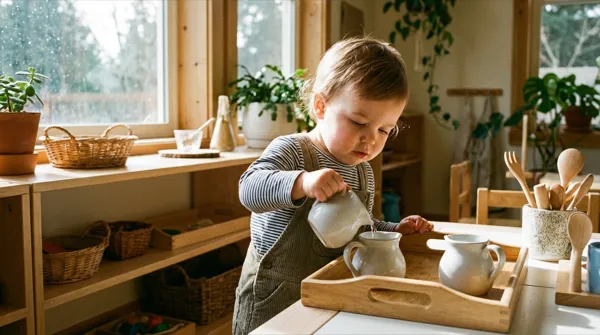
A low tray set, small open baskets, and child-sized pitcher and cup set can help you act on what you notice without turning the whole thing into a shopping spree.
Takeaway: observe briefly, write concrete notes, then make one environment change that matches what you saw.
A 10-minute observation log you can actually use
Keep the log boring. Boring notes are usually the most useful because they separate what happened from what you think it means.
| Time | What you saw | Possible pattern | One next step |
|---|---|---|---|
| 8:10 | Carried cups from shelf to sofa three times | Transporting, carrying, purposeful movement | Add one basket-carrying or tidying job |
| 8:13 | Tried to pour water, spilled, looked for cloth | Practical life, independence, cleanup | Set up a smaller pitcher and reachable cloth |
| 8:17 | Opened zipper pouch repeatedly | Hand work, fastening, repetition | Offer a dressing basket or opening-and-closing tray |
| 8:19 | Ignored six shelf items, chose broom | Real-life participation | Try a simple sweeping or wiping routine |
Use three columns if four feels like too much: I saw, I wonder, I will try. That tiny structure keeps observation from becoming a vague feeling.
The important discipline is to change one variable at a time. If you lower the shelf, add four new activities, move the books, and introduce a new routine on the same morning, you will not know which change helped.
For next steps, choose a narrow guide that matches the pattern: cleaning tools for sweeping and wiping, kitchen activities for food-prep interest, dressing skills for fastening and clothing work, or toy rotation when the shelf is the problem.
Takeaway: write down the action, the pattern, and one next step. Do not redesign the whole house from one observation.
🏠 How observation helps you prepare the environment
This is where Montessori gets very practical.
The point of observation is not simply to admire your child’s little developmental plot twists. The point is to prepare an environment that meets them where they are.
Let’s say you notice your toddler keeps dragging kitchen tools out of drawers and wandering off with them. You could call that chaos.
Or you could see a child who wants real work, real objects, and a clear place to use them.
That might lead to a better setup:
- one small basket with a whisk, sponge, and cloth
- a low hook for an apron
- a reachable stool at the counter
- one simple washing or food prep activity
If you notice that your child dumps every shelf basket in under four minutes, the answer may not be “more toy rotation.” It may be that the shelf is too full, the choices are unclear, or the materials do not match current interests.

Observation often leads to surprisingly unglamorous improvements:
- lower the shelf
- remove half the stuff
- put the cup where your child can reach it
- add a mirror near the dressing area
- create a place for dirty clothes
- swap one flashy toy for one purposeful activity
A few genuinely useful environment pieces, if they match what you observed:
The key is this: buy the item because the observation points to it, not because it looked good on Instagram.
Takeaway: a well-prepared Montessori environment is built from what your child shows you, not from a generic checklist.
🧸 How observation helps you choose toys and activities
This is the part that saves money.
A lot of toy regret comes from buying for an imagined child.
You buy the puzzle because it looks educational. You buy the rainbow sorting set because everyone else seems to own it. You buy the activity board because it promises “hours of engagement,” which is always a suspiciously confident phrase.
Then your child uses the box for a week and carries off the buckle strap like a tiny raccoon.
Observation helps you choose more wisely.
If your child is into transporting
Look for:
- baskets to carry
- objects to move from one place to another
- wagons or push toys used with purpose
- practical life work involving delivery or tidying
Useful options might include small market baskets or a sturdy push cart.
If your child is into hand work
Look for:
- posting activities
- simple puzzles with clear purpose
- opening and closing containers
- threading, transferring, or tongs
A posting box toy, object permanence box, or large wooden threading beads may fit better than a noisy electronic toy that does all the work itself.
If your child wants real-life participation
Look for:
- kitchen tools
- cleaning tools
- dressing practice
- snack prep work
- gardening help
This often matters more than buying any toy at all. A toddler-safe knife set, small watering can, or dressing frame alternatives like zipper pouches may be far more useful.
If your child is showing strong language interest
Look for:
- realistic books
- object-to-picture matching
- classified cards
- small themed vocabulary baskets
This is where realistic board books and mini object sets can shine.
The real rule is simple. Buy for the work your child is already trying to do.
Buy, wait, or use what you have
| Observation pattern | Buy | Wait | Use what you have |
|---|---|---|---|
| Repeats pouring and wiping | Smaller pitcher, stable tray, absorbent cloths | Big kitchen tower if counter work is still chaotic | Measuring cup, towel, plastic basin |
| Carries objects all morning | Child-sized basket or wagon | More tabletop puzzles | Laundry basket, tote bag, cloth napkins |
| Wants to help with meals | Crinkle cutter, small tongs, low snack bin | Full cooking set before knife safety is ready | Banana, spoon, butter knife, small bowl |
| Dumps every shelf basket | Clear trays or fewer open baskets | More new toys | Remove half the shelf for one week |
| Returns to books and naming games | Realistic board books, object cards | Abstract flashcards | Family photos, household objects, simple labels |
This is where observation protects your budget. The best purchase is the one that removes a real friction point you have seen more than once.
Takeaway: the best Montessori materials feel like a direct answer to something your child has already shown you.
🚩 Common mistakes that make observation less useful
A few things tend to ruin otherwise good observation.
Mistake 1: observing only when something is going wrong
If you only pay close attention during meltdowns, you miss what supports concentration and calm.
Observe during ordinary, peaceful moments too.
Mistake 2: interrupting constantly
You do not need to narrate every action.
Sometimes the most respectful thing you can do is let your child wrestle with a problem for ten extra seconds before stepping in.
Mistake 3: overinterpreting everything
Not every random toddler obsession is a deep developmental signal from the universe.
Look for repeated patterns across days, not one dramatic moment.
Mistake 4: copying someone else’s shelf
Another family’s setup may be lovely and completely wrong for your child.
That does not mean they are doing Montessori better. It just means they have a different child.
Mistake 5: using observation as a reason to do nothing
Sometimes parents discover Montessori observation and accidentally turn it into endless gentle watching with no follow-through.
Observation should lead to action.
Maybe a small action. Maybe just one change. But still, action.
A simple note pad or family planner board can help you turn observations into actual changes instead of vague intentions.
Takeaway: useful observation is calm, concrete, repeated, and connected to small next steps.
🌱 What this looks like in real life
Let’s make this less abstract.
Example 1: The child who dumps everything
You notice your toddler enters the play area, pulls every basket off the shelf, and wanders away.
At first glance, it looks like they cannot focus.
But after three short observations, you realise the shelf has eight choices, most of them stale, and none involve movement or practical work. Your child is not “bad at independent play.” The environment is cluttered and mismatched.
Next step: reduce the shelf to four clear choices and add one transporting or cleaning activity.
Example 2: The child who follows you into the kitchen all day
You keep trying to entertain your child in the playroom while they keep returning to the kitchen.
Observation shows they are not needy. They are interested in real work.
Next step: set up a stool, a little cloth, and one food prep task they can join safely.
Example 3: The child who ignores new toys but loves containers
You bought a lovely open-ended toy set. Your toddler is unmoved. Meanwhile, they spend twenty minutes opening jars, filling cups, and putting lids on random things.
That tells you hand work and practical life are alive right now.
Next step: offer transferring, opening and closing, spooning, and simple posting work instead of another big toy purchase.
None of this is glamorous. That is partly why it works.
Montessori at home is often less about the perfect material and more about finally seeing what has been right in front of you.
Takeaway: small observations can lead to much smarter choices than broad parenting advice ever will.
💛 Start here, not with a shopping list
If you want to bring Montessori into your home, begin with one quiet experiment.
Tomorrow, sit nearby for ten minutes.
Watch your child without steering the whole scene. Notice what they choose, repeat, avoid, carry, open, line up, ask for, or struggle to do alone. Then make one change based on what you saw.
That one change might help more than ten new toys.
And that is the lovely, humbling thing about Montessori observation. Your child is already giving you the roadmap. You just need enough stillness to read it.
If you do decide to buy something after observing, keep it tied to a real need. A step stool, low shelf, real cleaning set, or simple language materials can be wonderful when they answer a specific pattern you have already seen.
Turn the observation into one practical change: simplify the choices with the Montessori shelf setup guide, use toy rotation when interest fades, or choose a real household job from our practical life activities.
Not before.
Because the best Montessori guide for your home is not a trend report, a toy roundup, or a beautifully styled nursery photo.
It is your actual child.
Methodology and trust note
This guide is based on Montessori observation principles, common home setup patterns, and article-to-article review across Exploritori’s Montessori shelf, practical-life, age-stage, and toy-rotation guides. Product links are included only as examples of categories parents often consider after observation. You do not need to buy anything to begin, and any purchase should follow a repeated pattern you have seen in your own child.
 Get weekly Montessori tips
Honest reviews, activity ideas, and budget-friendly picks — no spam, just what works.
Subscribe Free