Montessori Treasure Basket for Babies: What to Put In, When to Start, and How to Make One at Home
· Updated
 A treasure basket is one of the simplest good Montessori ideas for babies.
No flashing lights. No songs about the alphabet. No giant plastic activity centre dominating your living room like a tiny casino.
Just a low basket filled with safe, interesting real objects that your baby can touch, mouth, shake, compare, and return to again and again.
That is why treasure baskets matter. They meet babies where they actually are. Your baby is not looking for entertainment in the adult sense. Your baby is building a map of the world through texture, weight, sound, temperature, smell, and movement.
A metal cup feels different from a wooden spoon. A soft brush gives different feedback from a silk scarf. A large wooden ring lands differently in the hand than a natural sponge. That is the work.
And unlike many baby toys, a treasure basket does not try to do everything at once. It gives your baby a calm invitation to concentrate.
Quick choice guide
| Situation | Best starting point | Why it helps |
|---|---|---|
| You want the simplest option | Start with one low shelf or basket | Fewer choices make it easier for your child to focus |
| You are buying something new | Choose practical, open-ended materials first | They last longer and support real independence |
| Your space feels cluttered | Rotate materials weekly instead of adding more | Calm environments usually work better than bigger collections |
🧺 What a Montessori treasure basket actually is
A Montessori treasure basket is usually a shallow basket filled with carefully chosen sensory objects for a baby who can sit independently.
It is not a random bin of toys. It is not a storage basket tipped onto the rug. And it is definitely not twenty loud things jammed together because babies “like stimulation.”
A good treasure basket is built around contrast.
You want objects that feel different from each other:
- smooth and rough
- cool and warm
- heavy and light
- soft and firm
- quiet and gently noisy
- natural and manmade
That contrast helps your baby notice more.
This is very aligned with Montessori thinking. Babies learn best through real, hands-on experience. They do not need constant adult instruction. They need an environment that lets them explore safely and meaningfully.
A treasure basket does exactly that.
Takeaway: the point is not to impress your baby with variety. The point is to offer a small set of real sensory experiences worth returning to.
A two-minute basket safety check
Do this each time you set the basket out, especially after an older sibling has been nearby or an item has been washed.
| Check | What to do | If the answer is no |
|---|---|---|
| Sitting and supervision | Use it only when your baby can sit steadily and an adult is close enough to intervene. | Choose floor movement, a mirror, or a single grasping object instead. |
| One-piece strength | Pull, twist, and inspect every item; it should not shed parts, splinters, paint, or fibres. | Remove it—“probably fine” is not a safety test. |
| Mouthing size | Keep out anything small enough to be swallowed or that could lodge in the mouth. | Swap for a larger, sturdier object. |
| Cleanliness | Washable items should be clean and dry; natural materials should be checked for damage or mould. | Clean, dry, or replace before using it. |
| Calm quantity | Start with six to eight contrasting objects, not every good object you own. | Put the extras away for a later rotation. |
This is practical setup guidance, not a substitute for your own safety judgement or paediatric advice. If an object is damaged, too small, or makes you hesitate, leave it out.
👶 When babies are ready for a treasure basket
The classic treasure basket stage usually starts when your baby can sit steadily without needing to prop themselves up all the time.
For many babies, that is somewhere around 6 to 10 months. Some are ready a little earlier, some later. The exact age matters less than the readiness signs.
Your baby is likely ready if they:
- sit stably on the floor
- grab, transfer, and mouth objects with control
- can focus on one object for more than a few seconds
- enjoy exploring household items more than many baby toys
If your baby is not sitting independently yet, do not rush it. Floor movement matters more than shelf work at that stage. A movement area, grasping toys, mirrors, and safe floor objects are usually a better fit first.
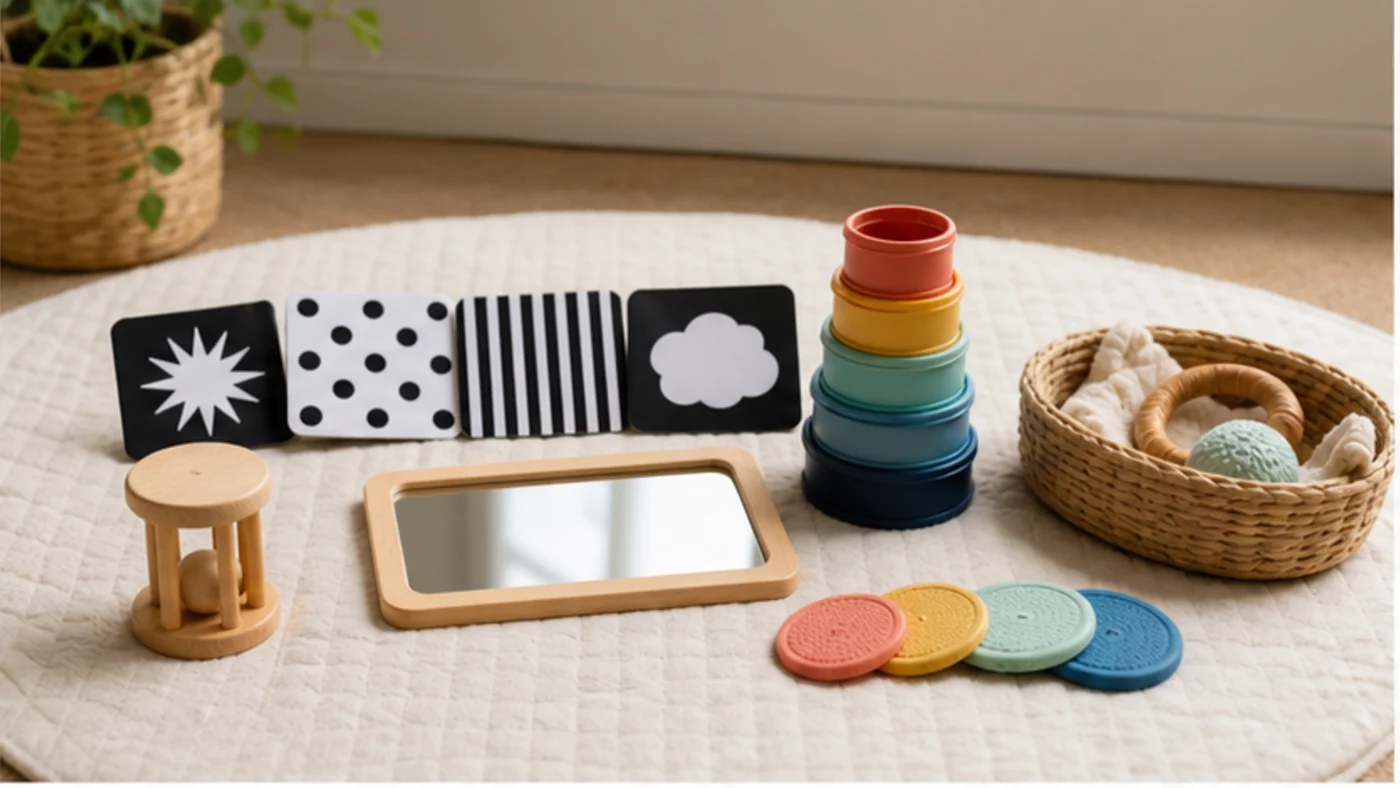
Once your baby is sitting confidently, though, a treasure basket can be brilliant. It creates a calm little work space without requiring the kind of fine motor precision that comes later.
Takeaway: wait for stable sitting, then keep the basket simple and heavily supervised.
For a baby who is still rolling, pivoting, or working on tummy time, the 0-12 month toy guide and 9-12 month activity guide are better places to choose the next small invitation.
🌿 Why treasure baskets work so well in Montessori homes

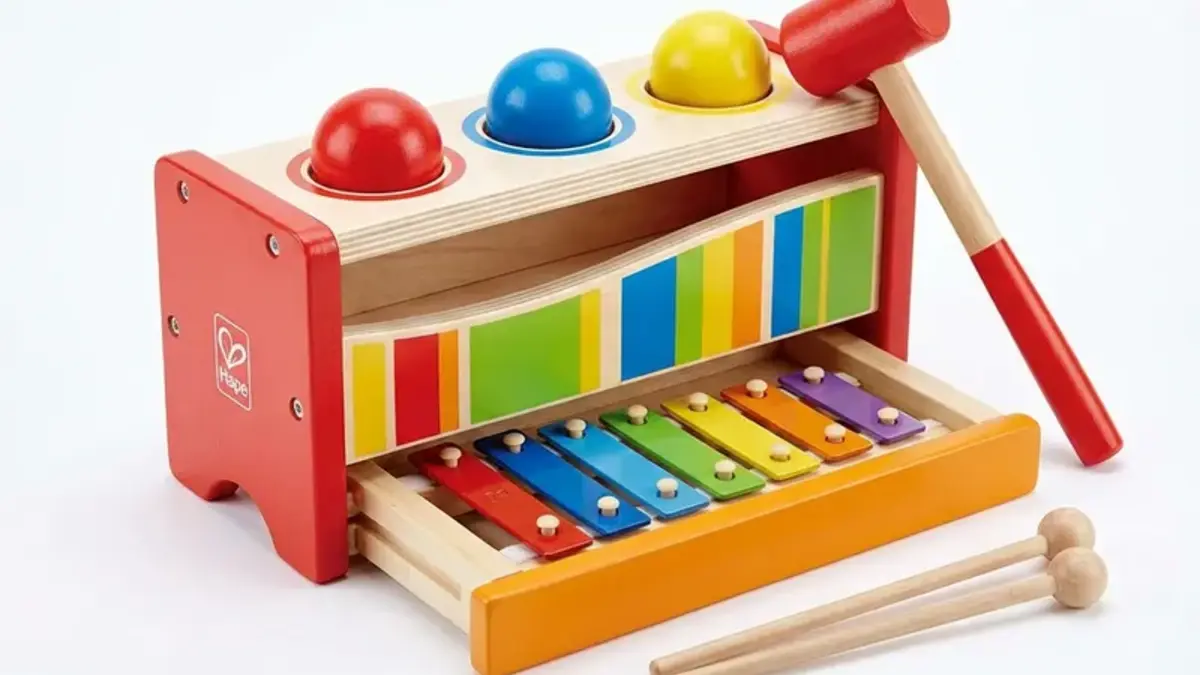
A lot of baby products are oddly disrespectful.
They assume babies need constant noise, constant novelty, and constant adult intervention. Press the button. Pull the tab. Spin the thing. Activate the song. Repeat until the grown-up quietly loses the will to live.
Treasure baskets work differently.
They trust that babies are capable of deep attention when the material is good enough.
A baby with a well-prepared treasure basket may spend a surprising amount of time doing what looks like almost nothing. Holding a wooden ring. Turning a metal cup. Rubbing a sponge against the floor. Banging a spoon once, then pausing, then doing it again.
That stillness is not boredom. It is concentration.
Treasure baskets also support several core Montessori ideas at once:
- independence: your baby chooses what to explore
- real materials: objects come from real life, not only toy aisles
- sensory refinement: every object offers distinct information
- order: a small, curated basket is easier to understand than a toy pile
- respect: your baby gets meaningful work, not passive entertainment
This is also why treasure baskets age well inside the bigger Montessori-at-home picture. They are an early version of the same principle you will use later with shelves, trays, practical life, and toy rotation.
Takeaway: treasure baskets are not a trendy hack. They are an early prepared environment for infant concentration.
🪵 What to put in a treasure basket
This is the part most parents overcomplicate.
You do not need a “Montessori treasure basket kit.” You need 6 to 10 safe items that are interesting in different ways.
Here are good categories to choose from.
Natural texture
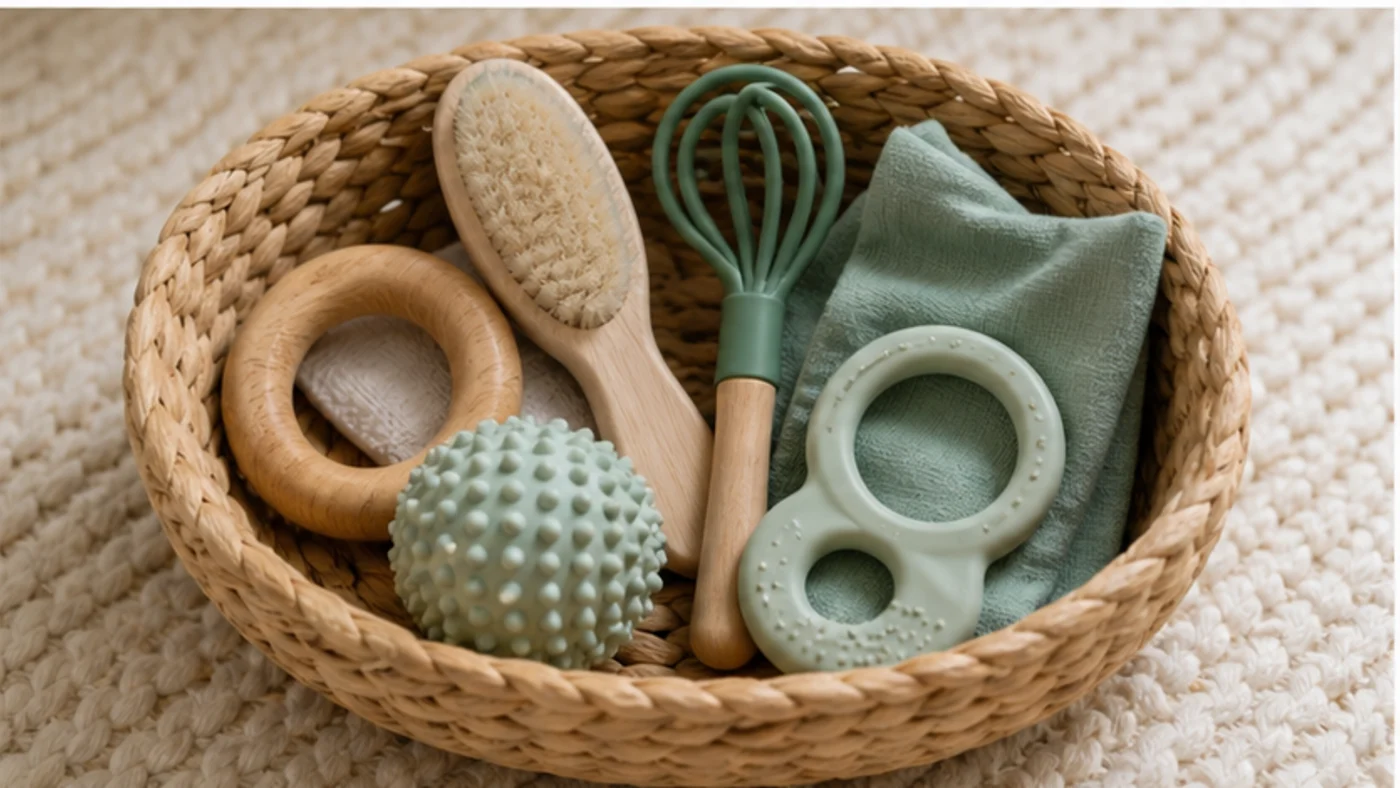
A natural sea sponge gives a very different sensory experience from hard toys. It is light, irregular, and easy for little hands to squeeze.
Wood
A large wooden ring, smooth spoon, or chunky napkin ring brings warmth, firmness, and a clean shape that babies can grip easily.
Metal
A stainless steel measuring cup or small metal bowl adds cool temperature, a bit of weight, and soft sound when tapped.
Silicone or rubber
A silicone whisk or large silicone teether adds flex and spring without becoming visually noisy.
Fabric
Try a silk scarf, linen square, velvet ribbon loop, or a large soft scrunchie. Fabric gives motion and softness that hard materials do not.
Brush or bristles
A soft baby hairbrush or natural nail brush offers a texture babies usually find fascinating.
Leather
A small coin purse or leather pouch can be lovely if it is sturdy, clean, and free from detachable hazards.
Sound object
This does not mean a noisy toy. It can be something as simple as a large bell on a secure strap, a metal cup with a spoon beside it, or a lidded container that makes a soft sound when moved.
The best treasure baskets include contrast across all of those categories. If every item is wood, the basket looks beautiful but teaches less.
A few easy Amazon-friendly items that can help if you want to buy rather than improvise:
- Large wooden rings for crafts and baby play
- Stainless steel measuring cups
- Silicone whisk mini
- Natural sea sponge
- Soft baby hair brush
None of these are mandatory. A very good basket can be built from your kitchen drawer and bathroom cupboard.
Takeaway: choose for sensory contrast, not for aesthetics or brand labels.
⚠️ What NOT to put in a treasure basket
This part matters more than the shopping list.
Treasure baskets are for exploration, and babies explore with their mouths. That means safety comes first every single time.
Do not include:
- choking hazards or anything that fits fully into a choke tube
- loose buttons, beads, corks, or tiny rings
- anything with peeling paint or flaking finish
- sharp metal edges
- objects that can shatter
- long cords or ribbons that create strangulation risk
- anything dirty, sentimental, or impossible to sanitize well
- battery toys, flashing toys, or items that overwhelm the basket
Also be careful with objects that are technically large enough but likely to break apart under chewing or twisting.
A good rule is this: if you feel even slightly unsure about an item, it does not belong in the basket.
And yes, supervision is part of the setup. A treasure basket is not a “leave the room and answer emails” station. It works best when your baby is on the floor with you nearby, calm but attentive.
If you want a dedicated base, a shallow woven basket with low sides is helpful because babies can see and reach the items easily. But again, the basket is the easy part. The curation is the real job.
Takeaway: safe, mouthable, sturdy, and simple beats clever every time.
🏡 How to make a Montessori treasure basket at home
This can take ten minutes.
Step 1: Find the basket
Pick a shallow, stable basket or low bowl with soft enough edges that it will not be unpleasant if it tips.
Step 2: Choose 6 to 10 objects
Aim for contrast in material, temperature, texture, and weight. Do not overfill.
Step 3: Check every item like a slightly paranoid quality inspector
Pull on it. Twist it. Wash it. Ask whether a determined baby could damage it or choke on it.
Step 4: Place it in a calm floor area
This works best on a rug, floor mat, or low clear space, not wedged into a loud toy corner.
Step 5: Present it simply
You do not need a performance. Put the basket down, sit nearby, and let your baby begin.
If your baby seems unsure, you can slowly lift one object, feel it, maybe tap it gently, then return it. That is enough modeling.
A washable play mat for floor work can make this setup easier if your home has hard floors and you want a consistent work area, but a rug is perfectly fine.
Takeaway: the best treasure basket setup feels calm, uncluttered, and almost boring to adults. That is usually a good sign.
🔄 How often to rotate a treasure basket
Not daily.
This is where adults often ruin a good thing.
Babies do not need a constant stream of fresh objects. Repetition is valuable. Your baby may spend three days becoming fascinated by the same metal cup because they are noticing something different each time.
A good rotation rhythm is usually:
- keep the basket the same for about a week
- swap one or two items if interest clearly drops
- fully refresh only when the basket stops inviting concentration
You can also rotate seasonally or practically. For example, a basket might lean slightly toward cool metal and textured brushes one month, then move toward fabric, wood, and soft household objects the next.
What you are looking for is not novelty. It is renewed attention.
A simple shelf nearby can help you store backup items without creating visual chaos. Something like a low toy shelf or Montessori shelf can be useful long term if you are building a Montessori play area, but it is not necessary just to start a treasure basket.
Takeaway: rotate slowly. Babies need time to go deep.
If the basket begins to turn into a pile, use the same “one out, one in” rule that keeps a Montessori shelf readable. Our toy rotation guide shows how to keep the backups out of sight without buying more storage.
🧠 What babies are learning from treasure baskets
A treasure basket can look almost too simple, which makes some adults suspicious.
But a lot is happening.
Your baby is learning:
- how different materials feel against skin and gums
- how shape changes grip
- how weight affects movement
- how sound changes from one object to another
- how to choose, inspect, and compare objects independently
- how to concentrate without being constantly interrupted
That last one matters a lot.
Concentration is not something that suddenly appears at preschool age. It starts much earlier, in small moments, when your baby gets to stay with an experience long enough to actually notice it.
This is one reason I would choose a treasure basket over many flashy infant toys every time. The basket leaves room for your baby to do the cognitive work.
If you want a few companion materials for the same stage, these are usually more useful than another pile of toys:
Those are not required for the treasure basket itself, but they fit the same bigger Montessori-at-home logic.
Takeaway: the visible action is simple, but the sensory and cognitive work is rich.
💸 Do you need to spend money on a treasure basket?
No, and honestly, this is where a lot of the Montessori internet goes a bit silly.
You do not need a branded baby set in muted earth tones with twelve matching objects and a perfect lifestyle photo.
A strong basket can be almost free.
You can build one from things like:
- a wooden spoon
- a large metal measuring cup
- a clean natural sponge
- a soft brush
- a silk scarf
- a big fabric scrunchie
- a safe purse or pouch
- a large wooden ring
What matters is whether the items are safe, interesting, and varied.
If you do buy anything, I would spend money in this order:
- a good basket if you do not have one
- one or two sensory objects you cannot improvise easily
- broader environment upgrades like a play mat or low shelf if you want a longer-term Montessori setup
That is a much better use of money than buying a huge pile of “educational” baby toys that all feel the same.
Takeaway: curation matters more than consumption.
🌼 A simple starter treasure basket list
If you want an easy beginner version, start here:
- 1 shallow basket
- 1 large wooden ring
- 1 stainless steel measuring cup
- 1 silicone whisk
- 1 natural sponge
- 1 soft baby brush
- 1 silk scarf or cotton square
- 1 wooden spoon
That is enough for a very solid first basket.
Then watch your baby.
The best clue for what to add next is not a shopping guide. It is observation. Does your baby keep reaching for cool metal? Love soft textures? Prefer objects they can bang? Become deeply interested in fabric and pulling?
Follow that.
Montessori at home always gets better when you observe first and buy second.
Use the broader Montessori toys for babies 0-12 months guide when your baby moves beyond basket exploration, or the sensory activities guide once they are ready for more active texture, sound, and transferring work.
How we chose the suggestions in this guide
The recommendations here are based on a simple home-use filter: an item should offer a noticeably different sensory experience, be robust enough for ordinary mouthing and handling, be easy to inspect and clean, and fit a calm six-to-ten-item basket. We have not treated a branded kit as necessary, and we do not claim that a particular product has been tested in every home. Product links are optional affiliate links; they may earn Exploritori a small commission at no added cost to you. Safety and your baby’s readiness always come before any suggested item.
FAQ
What is a Montessori treasure basket?
A Montessori treasure basket is a shallow basket filled with safe, real sensory objects for a sitting baby to explore independently. It is designed to support concentration, sensory discovery, and calm hands-on play.
What age is best for a treasure basket?
Most babies are ready once they can sit steadily on their own, often around 6 to 10 months. Stable sitting, mouthing safety, and close supervision matter more than a specific age.
What should go in a baby treasure basket?
Good items include a large wooden ring, metal measuring cup, wooden spoon, silicone whisk, natural sponge, soft brush, fabric square, and other safe household objects with different textures and weights.
Do treasure baskets need special Montessori toys?
No. Many of the best treasure basket items come from everyday household objects. You can buy a few helpful pieces if you want, but you do not need a special branded set.
How many items should I include?
Around 6 to 10 items is usually plenty. A smaller, calmer basket helps your baby focus better than an overstuffed one.
 Get weekly Montessori tips
Honest reviews, activity ideas, and budget-friendly picks — no spam, just what works.
Subscribe Free