Outdoor Montessori: 20 Nature Activities by Season
Maria Montessori was clear about this: children need to be outside. Not occasionally, not as a reward, not as a structured “outdoor lesson” — regularly, freely, in all weather and all seasons.
She wrote about children gardening, caring for animals, observing insects, and working in the soil. She saw the outdoor environment as essential, not supplementary. Somewhere between then and now, Montessori became associated primarily with indoor shelves and wooden toys. Time to fix that.
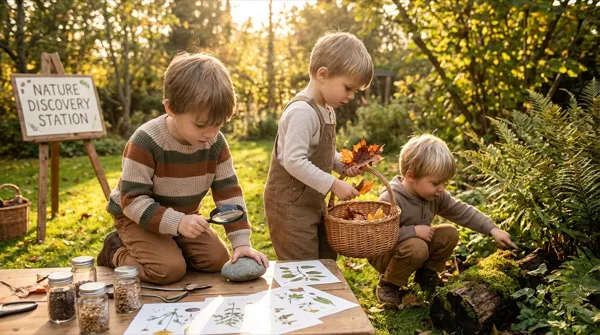
The activities below are organised by season, but many work year-round. They’re designed for toddlers and preschoolers (roughly ages 1.5-6), though older children will enjoy most of them too. Almost everything is free.
🌱 Spring
1. Planting Seeds
What you need: Seeds, soil, small pots or a patch of ground. That’s it.
Sunflower seeds are ideal starters — they’re large enough for small fingers to handle, and they grow fast enough to sustain a toddler’s patience. Cress is even faster (visible growth in 2-3 days) and grows on a damp paper towel — no garden needed.
Why it matters: Planting connects children to the cycle of life in the most literal way. They bury a seed, water it, wait, and watch something alive emerge from dirt. It’s patience, responsibility, and science in one activity.
Progression: Start with fast growers (cress, beans, sunflowers). Progress to a small herb garden (basil, mint, chives) that they can tend and eventually eat from. A child who grows their own basil and puts it on pasta has completed a full Montessori practical life cycle.
On a budget: Seeds cost pennies. Use yoghurt pots as containers and garden soil or compost. If you have no outdoor space, a sunny windowsill works.
2. Bug Hunting
What you need: Eyes. Optionally, a magnifying glass.
Lift rocks. Check under leaves. Look at tree bark. Crouch near flowers and wait. The bugs are there — your child just needs permission (and company) to look.
Why it matters: Observation is the foundation of scientific thinking. A child who watches a woodlouse curl into a ball, follows an ant trail, or counts the spots on a ladybird is practising sustained attention, classification, and wonder — all without a worksheet.
Tips: Bring a small container for temporary observation (always release afterwards). Name what you find — even “I don’t know what this is, let’s find out” is a great response. A simple insect identification card or book adds depth for older children.
Budget option: A magnifying glass (~$5) is the only purchase worth considering. Or just get closer — toddlers are already at ground level.
3. Mud Kitchen
What you need: Dirt, water, and old pots and pans.
A mud kitchen is simply an outdoor space where children mix, pour, stir, and create with mud, water, sand, leaves, and whatever else they find. It can be elaborate (a dedicated table with shelving) or simple (a plastic tub and some old cooking utensils).
Why it matters: Every practical life skill that works indoors — pouring, stirring, transferring, scooping — works in a mud kitchen, with the added sensory richness of natural materials. Mud has texture, weight, temperature, and smell that play dough can’t replicate.
Setup on zero budget: An old baking tray, a few kitchen items you were going to donate (wooden spoons, a colander, muffin tins, pots), and a patch of dirt. Add water from a jug or watering can. Done.
Worth buying: If you want a dedicated setup, a simple outdoor play kitchen frame (~$60-100) provides structure. But honestly, a low table or even a large cardboard box works fine.
4. Puddle Play
What you need: Rain. Wellies. Willingness to get wet.
Jumping in puddles is sensory overload in the best way — the splash, the sound, the cold water, the resistance of mud. But beyond jumping, puddles offer surprisingly rich learning: floating and sinking experiments (what floats? a leaf? a stone? a stick?), measuring depth with sticks, watching reflections, and pouring water between containers.
What to wear: Waterproof trousers and wellies. That’s the whole equipment list. If you don’t have waterproof trousers, old clothes and a change of dry ones work fine.
5. Nature Collecting Walk
What you need: A small bag or basket. A walk.
The rules are simple: walk somewhere with natural things. Let your child collect whatever catches their eye — feathers, interesting rocks, fallen petals, seed pods, sticks, leaves. At home, examine and sort the collection. What’s smooth? What’s rough? What’s heavy? Light? What colour groups can you make?
Why it matters: Collecting is classification in action. Sorting the collection afterwards is maths (grouping, comparing) and language (describing textures, colours, shapes). Displaying the collection on a nature shelf at home brings the outdoors in and gives the experience a lasting presence.
Tip: Keep a dedicated “nature tray” or shelf at home where the collection lives. Rotate items as new treasures arrive. This is a child-curated, ever-changing display — Montessori shelf rotation, handled by the child themselves.
☀️ Summer
6. Water Play and Pouring
What you need: Containers of various sizes. Water. An outdoor space where getting wet is fine.
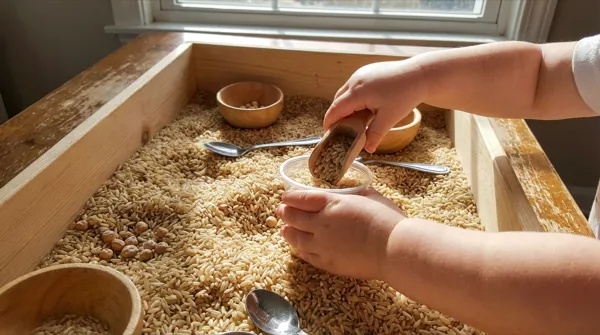
Fill a large tub or basin with water. Provide jugs, cups, funnels, sieves, spray bottles, turkey basters — anything that moves water from one place to another. Step back.
Why it matters: Water play is pouring practice with zero consequences. Indoors, spilled water means cleanup. Outdoors, spilled water means… wet ground. This freedom lets children experiment with flow, volume, and control without anxiety.
Progression: Add food colouring for colour mixing experiments. Freeze small toys in ice blocks and let children “excavate” them with warm water. Float boats made from walnut shells or bark.
Cost: Free, unless you want to add a water play table (~$40-60). A large storage container from home works identically.
7. Gardening: Weeding, Watering, and Harvesting
What you need: A garden, a pot, or a community plot. Basic tools.
Summer is when the spring planting pays off. Children can water plants daily (a small watering can gives them ownership), pull weeds (demonstrate which are weeds — “we pull the ones we didn’t plant”), and harvest anything that’s ready.
Why it matters: Harvesting is the culmination of patience. A child who planted a tomato seed in April and eats a tomato in July has lived through a complete cycle of care and reward. Few experiences build delayed gratification this effectively.
No garden? Window boxes of herbs, a strawberry plant in a pot, or even sprouting beans in a jar on the windowsill. The principle scales down beautifully.
8. Sand Play
What you need: Sand (a beach, a sandbox, or a bag of play sand). Containers and tools.
Sand offers almost infinite open-ended play: digging, moulding, pouring, burying, building, drawing. Add water and the physics change entirely — wet sand holds shapes, creates channels, and behaves like a different material.
Why it matters: Sand is one of the richest sensory materials available. Dry sand flows like water. Wet sand behaves like clay. The tactile feedback is constantly changing based on how the child interacts with it.
Free version: A beach or a friend’s sandbox. If buying sand, a bag of play sand (~$5-10) in a large container at home works.
9. Outdoor Art
What you need: Whatever you have — chalk, paintbrushes with water, natural materials for land art.
Chalk on pavements and fences. Paintbrushes dipped in water “painting” on walls and stones (it evaporates, so infinite canvas). Arranging sticks, stones, and leaves into patterns and pictures (land art).
Why it matters: Outdoor art removes the pressure of permanence. Chalk washes away. Water paintings evaporate. Land art blows away. This impermanence frees children to experiment, take risks, and focus on process over product.
Cost: Sidewalk chalk (~$5). Or just water and a paintbrush — literally free.
10. Barefoot Walking
What you need: A safe outdoor space. Bare feet.
Walk barefoot across different surfaces: grass, sand, gravel, smooth stone, mud, wooden decking. Talk about what each feels like. Warm? Cool? Smooth? Prickly? Squishy?
Why it matters: The soles of the feet contain thousands of nerve endings. Walking barefoot is an intense sensory experience that also develops balance, proprioception, and foot strength (important for developing walkers). Check for hazards first, obviously — glass, sharp objects, very hot surfaces.
🍂 Autumn
11. Leaf Collecting and Sorting
What you need: Autumn leaves. A bag.
Collect leaves of different colours, shapes, and sizes. At home (or right there in the park), sort them: by colour, by size, by shape, by tree type if you know. Press favourites between heavy books for an autumn nature display.
Why it matters: Autumn leaves are a natural sorting and classification material. The colour gradations alone — green to yellow to orange to red to brown — are a sensorial experience that rivals any Montessori colour box.
Extension: Leaf rubbings (place a leaf under paper, rub with a crayon), leaf crowns (thread leaves onto a string), or a leaf identification project using a simple tree guide.
12. Conker and Acorn Play
What you need: A visit to a park with horse chestnuts or oaks.
Collect conkers (horse chestnuts) and acorns. These are nature’s loose parts — they can be counted, sorted by size, used in mud kitchen “cooking,” lined up for pattern making, or simply treasured in a collection.
Why it matters: Natural loose parts are inherently open-ended. A conker is a ball, a potato in a mud kitchen, a counting token, a weight for a balance scale, and a beautiful object to hold and admire. No manufacturer can compete with that versatility.
Tip: Conkers develop a lovely shine when polished with a cloth — a natural polishing activity (see our practical life guide).
13. Rain Walking
What you need: Rain gear. An appreciation for being slightly uncomfortable.
Walk in the rain on purpose. Listen to the sound it makes on different surfaces — a leaf, a puddle, a metal railing, your hood. Watch where the water goes. Find streams forming in gutters. Look for earthworms on the pavement.
Why it matters: Rain transforms a familiar environment into something new. A walk you’ve done fifty times becomes different — sounds change, smells intensify, creatures appear. This is observation and sensory awareness without any preparation.
The key: Dress for it (waterproofs and wellies) and reframe it. Rain isn’t bad weather. It’s interesting weather.
14. Building with Sticks
What you need: Sticks. A space to build.
Dens, shelters, fences, bridges, towers, teepees — sticks are the original construction material. Children learn about balance, structure, and engineering through trial and error that no instruction manual can replicate.
Why it matters: Stick building is large-scale construction. It requires whole-body movement, spatial planning, cooperation (sticks are often too long for one person), and persistence. A den that keeps collapsing teaches more about structural engineering than a diagram.
The only rule: Check for sharp ends and eye-level branches. Supervise stick play with younger toddlers.
15. Composting and Decomposition
What you need: A compost bin (or just a designated patch of ground). Food scraps. Leaves.
Let your child add food scraps and leaves to the compost. Over weeks, observe what happens. Stir it. Look for worms. Notice the heat. Watch things break down.
Why it matters: Decomposition is biology in real time. It connects food waste to soil to growing plants — closing the cycle they started when they planted seeds in spring. It’s also slightly gross, which makes it fascinating to three-year-olds.
No compost bin? Put a banana peel and a leaf in a clear jar with some soil. Seal it. Watch what happens over weeks. A miniature decomposition experiment.
❄️ Winter
16. Ice Exploration
What you need: A freezer. Water. Small containers.
Freeze water in various containers — ice cube trays, muffin tins, balloons, rubber gloves. Add food colouring, small toys, flowers, or leaves before freezing. In the morning, turn them out and let your child explore.
Why it matters: Ice is water in a different state — same substance, totally different properties. Cold, hard, slippery, melting. Children explore temperature, states of matter, and cause and effect (what makes it melt faster? salt? warm water? sunshine?).
Cost: Free. Everything you need is already in your kitchen.
17. Bird Feeding and Watching
What you need: Bird food and a feeder (or a flat surface). Binoculars are optional but fun.
Set up a simple bird feeder where your child can see it from a window. Make filling it part of the daily routine — a practical life activity with a purpose. Observe which birds come. What do they look like? When do they visit? What do they eat?
Why it matters: Regular bird feeding builds routine, responsibility, and patience. It also introduces children to observation and identification — the same skills scientists use. Keep a simple chart or drawing of the birds you see together.
Budget option: A basic bird feeder (~$10-15). Or make one from a milk carton or pine cone rolled in peanut butter and seeds. The DIY version works just as well and adds a craft element.
18. Winter Nature Walk
What you need: Warm clothes. A familiar route.
Walk a route you’ve walked in other seasons. What’s different? Where did the leaves go? What do the bare trees look like? Is there frost? Ice on puddles? Animal tracks in mud?
Why it matters: Walking the same route in different seasons is one of the simplest and most powerful nature education tools. Children build a mental model of seasonal change through direct, repeated observation. No textbook compares.
Tip: Take a photo from the same spot each season. By the end of the year, you have four images that tell the story of seasonal change more effectively than any worksheet.
19. Sensory Snow or Frost Play
What you need: Snow or frost. Hands (and warm gloves).
If you get snow: build, dig, make tracks, roll, taste (clean snow only), listen to the crunch, feel the cold. If you don’t: explore frost on windows and surfaces — trace patterns, breathe on it, watch it melt from body heat.
Why it matters: Snow and ice offer sensory experiences that are impossible to replicate indoors. The cold, the crunch, the weight, the way it transforms between states — it’s a science laboratory.
No snow? Make your own sensory ice station: freeze a large block of water in a container. Add food colouring, salt, and droppers of warm water. Watch the salt create tunnels and the colours spread through the ice.
20. Pinecone and Natural Material Crafts
What you need: Pinecones, sticks, leaves, seed pods, and some glue or string.
Make pinecone bird feeders (roll in peanut butter and seeds). Build tiny stick houses. Create nature mobiles from hanging sticks and found objects. Assemble collages from winter materials.
Why it matters: Winter crafts with natural materials extend fine motor practice outdoors and connect children to the season. Unlike purchased craft kits, natural materials require problem-solving — how do I attach this stick to this pinecone? What will hold these leaves together?
Cost: Essentially free. A bottle of white glue and some string are the only potential purchases.
Making It a Habit
The biggest barrier to outdoor Montessori isn’t equipment or activities — it’s habit. Here’s how to build it:
Daily, not weekly. Even 20 minutes outside every day is better than a two-hour Saturday adventure. Make it routine, not an event.
Dress for it, then stop thinking about it. The right clothing eliminates 90% of weather objections. Waterproofs for rain. Layers for cold. Sun hat for summer. Once you’re dressed, the weather stops being a reason not to go.
Lower the bar. “Go outside” doesn’t mean driving to a nature reserve. Your garden, your street, the nearest park — a weed growing through a crack in the pavement is nature. A pigeon on a railing is wildlife.
Follow the child outside, too. If they want to stand at a puddle for fifteen minutes, that’s the activity. If they want to collect twenty identical sticks, that’s the collection. The Montessori principle of following the child doesn’t stop at your front door.
Accept the mess. Muddy clothes wash. Wet shoes dry. Dirty faces clean. The learning that happens in mud, water, and dirt doesn’t happen on clean surfaces.
FAQ
What if we live in a city with no garden?
Parks, tree-lined streets, canal paths, community gardens — nature exists in cities, just in different forms. A balcony with pots is a garden. A windowsill with herbs is a nature station. Urban nature is still nature.
How do I motivate my child to go outside when they resist?
Don’t announce it as an activity — just go. “Let’s walk to the shop” or “Come help me check if the bird feeder needs filling.” Embed outdoor time in routine rather than presenting it as a separate event. Also, once children are outside, resistance usually evaporates within minutes.
Is outdoor play in bad weather safe for toddlers?
Yes, with appropriate clothing. Children in Scandinavian countries play outside in all weather, including sub-zero temperatures. The saying “there’s no bad weather, only bad clothing” is a cliché because it’s true. Avoid genuine hazards (lightning, extreme heat, icy surfaces for new walkers), but don’t let drizzle keep you inside.
How do I handle the mess?
Dedicated “outdoor clothes” that live near the door. A boot tray for muddy shoes. A routine of changing when you come in. And acceptance that some dirt will make it into the house. It’s temporary. The experiences aren’t.
What about screen time vs. outdoor time?
This isn’t either/or. But if you’re looking for something to displace screen time, outdoor play is the strongest candidate. It provides the sensory richness, physical movement, and open-ended exploration that screens can’t — and most children prefer it once they’re out. See our honest guide to screen time for more on finding the balance.
Where curiosity leads, learning follows. ✨
 Get weekly Montessori tips
Honest reviews, activity ideas, and budget-friendly picks — no spam, just what works.
Subscribe Free