Wooden vs Plastic Montessori Toys: What Actually Matters?
· Updated
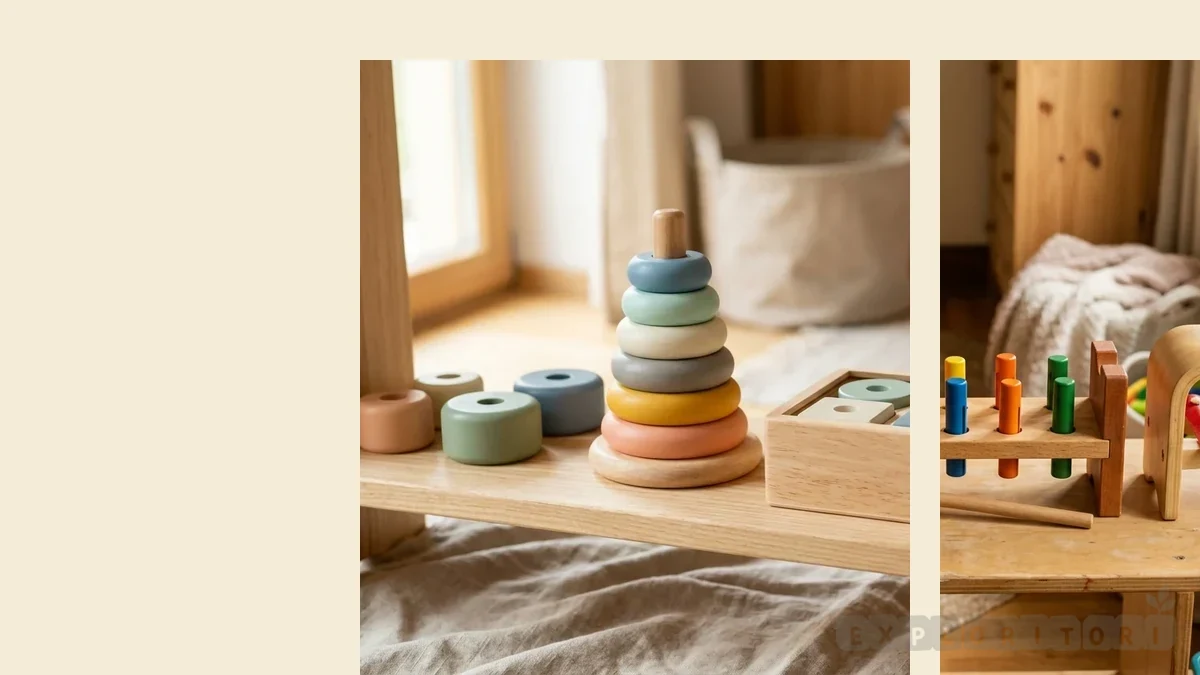 If you’ve spent any time in Montessori corners of the internet, you’ve seen the aesthetic.
Pale wood. Soft beige. A shelf that looks like it belongs in a Scandinavian boutique rather than a house where someone recently threw a banana.
It can leave you with one very specific question:
Do Montessori toys need to be wooden?
Short answer: no.
Longer answer: wood can be lovely, useful, durable, and genuinely better for some kinds of play. But a toy is not Montessori just because it is wooden. And a toy does not stop being useful just because one part of it is plastic.
That matters, because a lot of parents end up paying for the look of Montessori instead of the actual function.
So let’s strip away the beige fog and get practical. If you’re trying to choose between wooden and plastic Montessori toys, here’s what actually matters for your child.
🌱 First: Montessori is not a materials contest
Montessori is an educational approach, not a wood preference.
The goal is to help your child build independence, concentration, coordination, and confidence through hands-on experience. That can happen with a wooden puzzle. It can also happen with metal tongs, a glass pitcher, a cotton cloth, or a simple plastic stacking cup.
The better question is not:
“Is this toy wooden?”
It is:
“Does this material help my child do meaningful work well?”
That shift will save you money and confusion.
A good Montessori-style toy or activity usually has:
- one clear purpose
- a good match to your child’s current stage
- room for repetition
- built-in feedback
- a design your child can use with little help
Notice what is missing from that list.
Not once do you need to ask whether the toy fits a particular Instagram colour palette.
Takeaway: Material matters, but method matters more.
🪵 Why wooden toys became the Montessori default
Wooden toys are popular in Montessori spaces for real reasons.
Not fake reasons. Real ones.
Wood has weight. It has texture. It tends to feel warmer and more grounded in the hand than cheap glossy plastic. It is often quieter. It usually looks less chaotic on a shelf. And when it is well made, it lasts.
That makes wood a strong fit for many Montessori materials, especially when your child benefits from clear sensory feedback.
For example:
- a wooden knob puzzle gives a toddler clear hand control work
- a wooden ring stacker offers weight, sizing, and repetition
- a wooden object permanence box feels sturdy and gives satisfying feedback
Wood also tends to age well visually and physically. If you want toys that can survive more than one child, wood often earns its price better than flimsy plastic does.
But this is where people overcorrect.
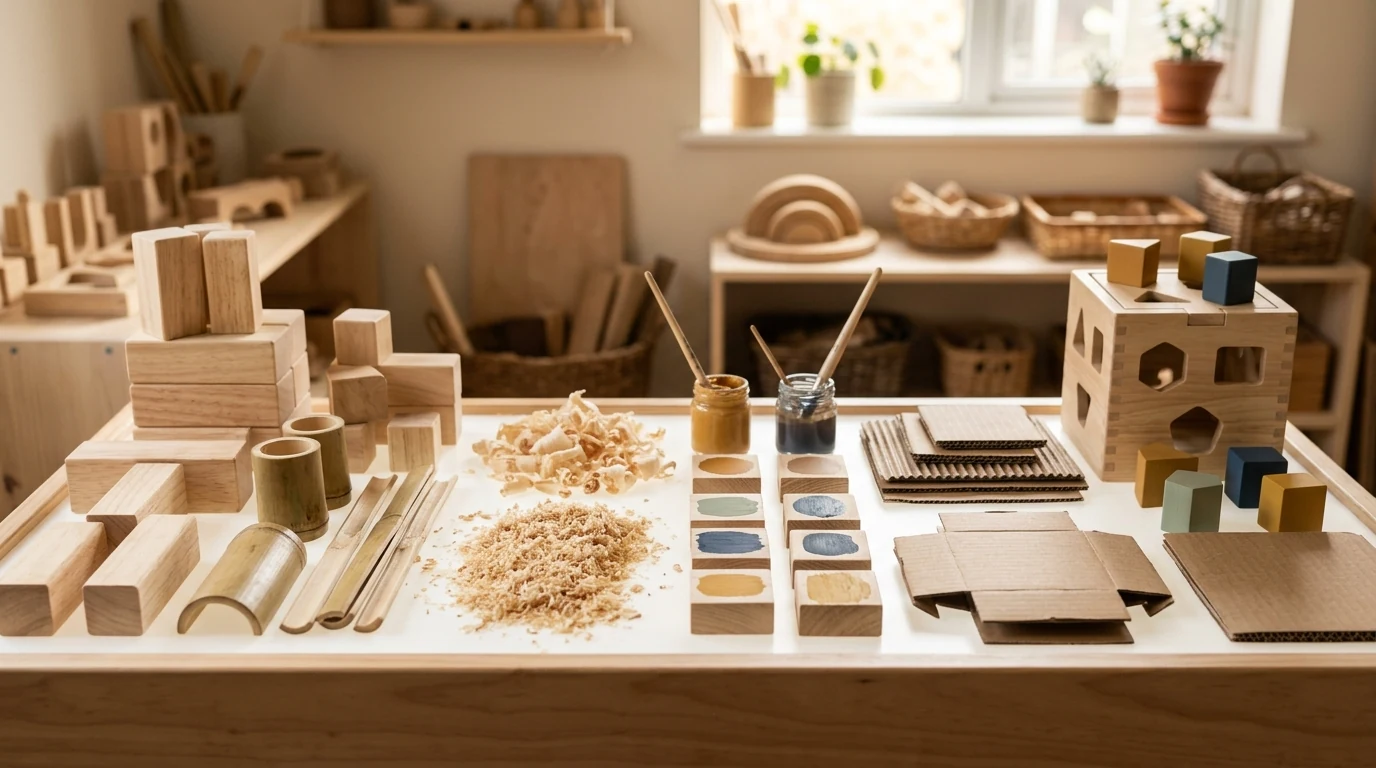
They go from “wood can be useful” to “plastic is anti-Montessori,” which is simply not true.
Takeaway: Wood is often a good Montessori material because of how it feels and functions, not because it carries moral purity points.
🧸 When plastic is completely fine


Some plastic toys are noisy, over-designed chaos machines.
Some are simple, durable, washable, and genuinely useful.
Those are not the same thing.
If a plastic toy is calm, well designed, and matched to your child’s development, it can work beautifully in a Montessori-style home.
A few obvious examples:
Stacking cups
A basic set of stacking cups is usually plastic, and honestly, they are brilliant. Babies and toddlers can stack them, nest them, fill them, pour with them, hide objects under them, use them in the bath, and bring them into sand or water play later.
Practical tools with plastic parts
A child-sized pitcher or small colander may include plastic. That does not ruin the developmental value if your child can pour, transfer, rinse, and clean independently. If you want a simple starter option, browse small toddler pitchers.
Fine motor tools
Many toddler training scissors and learning tongs use plastic for safety or grip. If the tool works well and fits your child’s hand, that matters more than the material snobbery.
Balls and outdoor items
A soft ball, watering can, wheelbarrow, or garden tool may have plastic parts because they are lighter and more practical outdoors.
The real issue with many plastic toys is not that they are plastic.
It is that they are often designed to overstimulate, entertain passively, or do the thinking for your child.
That is a design problem, not a chemistry problem.
Takeaway: Plastic is not the enemy. Bad design is.
✅ A two-minute shop check before you buy
When you are holding two versions of the same kind of toy, do not try to settle the whole wood-versus-plastic debate in the aisle. Use this quick check instead.
| Check | Choose the version that… | Why it matters |
|---|---|---|
| Fits your child’s hands | your child can lift, turn, carry, and return without struggling | Independence starts with an object they can actually manage. |
| Has one obvious job | makes the action easy to understand without a demonstration | A clear purpose leaves room for concentration and repetition. |
| Shows what happened | lets your child notice success or a mismatch themselves | This is the useful Montessori idea of a built-in “control of error.” |
| Survives its real use | can handle the kitchen, bath, garden, or shelf where it will live | The right material changes with the activity. |
| Is easy to keep in rotation | you would happily put it out again next week | A modest, repeatable toy beats a beautiful object nobody reaches for. |
A practical tie-breaker: choose wood when the extra weight, grip, and stability make the action clearer (a puzzle, stacker, or shelf material). Choose plastic or mixed materials when lightness and washability make the activity more usable (bath play, pouring, outdoor tools, or toddler scissors). If neither version passes the five checks, skip both.
This is a buying framework, not a safety certification. Check the manufacturer’s age guidance, inspect any loose parts, and supervise activities that involve small pieces, water, or tools.
🚫 When wooden is worse than plastic
This is the part many Montessori toy roundups skip.
A bad wooden toy is still a bad toy.
If a toy is wooden but has five unrelated tasks, strange cartoon styling, weak construction, or a difficulty level that does not match your child, the wood does not rescue it.
In fact, some wooden toys are worse than their plastic equivalents because they are:
- too heavy for your child to handle well
- rough or splinter-prone if cheaply finished
- awkwardly designed in the name of looking “educational”
- expensive without being more useful
I’ve seen wooden busy boards with zips, latches, gears, numbers, shapes, letters, animals, and random bells all mashed together like someone lost an argument with a craft fair.
That is not automatically Montessori just because it is wood.
Meanwhile, a very plain plastic shape sorter may offer:
- one clear task
- visible control of error
- good repetition
- the right challenge for a young toddler
And that makes it the better choice.
If you’re comparing options, never let “wooden” outrank “works well.”
Takeaway: Do not confuse natural material with good educational design.
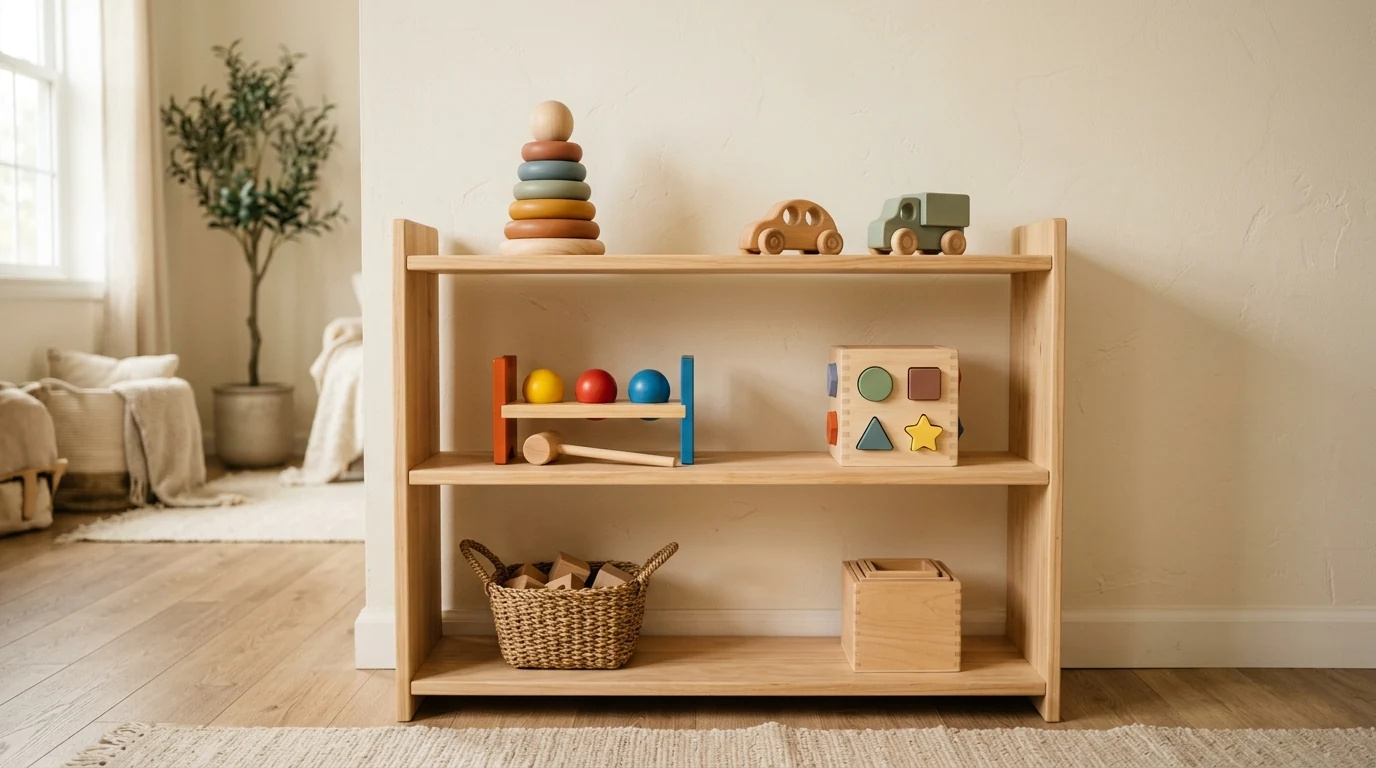
👀 What actually matters more than the material
If you want a reliable buying filter, use these five checks.
1. One clear purpose
Can your child tell what the toy is for?
A strong Montessori-style toy usually teaches one thing at a time. A posting box teaches posting. A puzzle teaches fitting. A pouring setup teaches controlled hand movement.
If the toy tries to teach colours, numbers, music, farm animals, and emotional resilience before lunch, it is doing too much.
2. A good developmental match
Is this challenge right for your child right now?
A beautiful toy can still fail if it is too easy or too hard. When the level fits, your child repeats. When it does not, they ignore it or get frustrated.
3. Built-in feedback
Can your child see for themselves whether it worked?
That is one of the quiet superpowers of Montessori materials. The object gives the lesson. A piece fits or it doesn’t. Water spills or it doesn’t. The ball drops through or it doesn’t.
4. Repetition value
Will your child come back to it?
Good materials become more interesting with repetition, not less. Novelty fades. useful work lasts.
5. Independence
Can your child carry it, use it, and tidy it with reasonable support?
A toy that only works when you set up fifteen pieces and sit there translating it into toddler is not doing much for independence.
Here is the short version:
| Question to ask | Why it matters |
|---|---|
| Does it do one thing clearly? | Helps concentration |
| Does it match my child’s stage? | Prevents boredom and frustration |
| Can my child see if it worked? | Builds self-correction |
| Will they repeat it? | Repetition drives learning |
| Can they use it more independently? | Supports confidence and competence |
Takeaway: These five questions will help you choose better toys than “wood or plastic?” ever will.
🧼 Safety, durability, and real-life practicality
Now for the unglamorous part.
Sometimes the best toy material is the one that survives your actual house.
Wood has real strengths:
- durable when well made
- pleasant texture
- often easier on the eyes
- usually more stable on shelves and trays
But it can also:
- chip if poorly finished
- absorb moisture
- get grubby in messy play
- weigh more than some children can manage comfortably
Plastic has strengths too:
- easy to wash
- lightweight
- often cheaper
- handy for water play, outdoor use, and early fine motor tools
But it can also:
- feel flimsy when cheaply made
- break in ugly ways
- come with loud colours and cluttered design
- invite low-quality impulse buys because it is cheap
This is why I would not recommend a blanket rule like “buy only wooden toys.”
A better rule is:
Buy the version that best serves the activity, lasts well enough, and feels calm enough to use repeatedly.
For example:
- For a shelf puzzle, wood is often excellent.
- For stacking cups, plastic is usually totally fine.
- For pouring work, glass, ceramic, metal, or plastic can all make sense depending on age and supervision.
- For cleaning tools, mixed materials are normal and often best.
If you need a few practical-life staples, these searches are genuinely useful starting points:
Takeaway: The best material is often the one that works in real life, not the one that wins aesthetic points online.
🛒 What I’d buy, what I’d skip
If you’re building a small Montessori-style setup and want to spend sensibly, this is the approach I’d take.
Worth buying in wood
These often benefit from weight, texture, and sturdiness:
- knob puzzles
- ring stackers
- simple peg puzzles
- object permanence boxes
- shape sorters with a clear design
- low shelves or display trays
A good place to browse is a simple wooden Montessori toy selection, but stay picky. Ignore anything that looks busy or purely decorative.
Fine in plastic or mixed materials
These do not lose their developmental value because of the material:
- stacking cups
- bath pouring tools
- beginner scissors
- tongs and transfer tools
- some outdoor tools
- balls and movement toys
A starter fine motor set with tongs and scoops can be very useful if you do not want to cobble pieces together one by one.
Usually not worth it in either material
Skip the toy if it is:
- cluttered with too many features
- full of lights and sounds that hijack the play
- clearly beyond your child’s stage
- so cute for adults that it loses clear function
- expensive mainly because it is branded “Montessori”
That last one catches a lot of families.
A toy can be wooden, beautiful, and wildly overpriced for what it actually teaches.
You do not need to rebuild your home into a boutique classroom.
You need a few good materials, a bit of floor space, and the confidence to ignore nonsense marketing.
Takeaway: Spend on function first, then durability, then beauty. Not the other way around.
🏡 A better Montessori rule for real families
If your home already has plastic toys, please do not panic and start purging everything tonight.
That is not Montessori. That is just stress with a shopping budget.
Look at what your child actually uses well.
Do they return to it? Does it help them practise something real? Can they use it with focus? Does it invite active play instead of passive button-mashing?
Keep the materials that genuinely work.
Then, as new needs come up, buy more thoughtfully.
That might mean choosing a wooden puzzle over a flashy electronic version.
It might also mean keeping the plastic stacking cups because they are excellent and spending your money instead on a learning tower or a low toy shelf, both of which may do more for independence than another “educational” toy ever will.
That is the deeper Montessori idea.
Not perfect materials.
A prepared environment that helps your child do more for themselves.
Before buying, check the non-toxic Montessori toy safety guide for finishes and labels, then use our authentic vs Montessori-inspired comparison to judge the design rather than the marketing. If the remaining question is value, read are Montessori toys worth it?.
How we assess a Montessori-style toy
This guide is a design-and-use analysis, not a claim that every wooden toy is safer or every plastic toy is poor quality. We compare materials by the job they need to do: how a child can grip and control the item, whether the activity has a clear purpose and feedback, and whether it is practical to maintain at home. Product examples and retailer links are starting points, not individual product safety approvals; check current specifications and recalls before buying.
❓ FAQ
Are Montessori toys always wooden?
No. Many Montessori toys are wooden because wood is durable, calm, and pleasant to use, but wood is not a requirement. A toy matters because of its design and developmental fit, not because of the label on the material.
Are plastic toys bad in Montessori?
No. A simple plastic toy can be far more Montessori-friendly than a busy wooden one. What matters is whether your child can use it actively, repeatedly, and independently.
Should I replace all plastic toys with wooden toys?
No. Keep the toys that genuinely serve your child well. Replace weak or overstimulating toys gradually as new needs come up rather than doing an expensive reset.
What is the biggest red flag when buying Montessori toys?
A toy that does too much. If it is noisy, cluttered, confusing, or driven by passive entertainment, it is usually a weaker Montessori fit regardless of material.
What should I prioritise instead of material?
Prioritise clear purpose, developmental match, repetition, self-correction, and independence. Those are the qualities that make a toy useful in a Montessori-style home.
If you’re choosing between wooden and plastic Montessori toys, here is the simplest possible answer:
Choose the toy that helps your child do the work.
Sometimes that will be wood.
Sometimes it won’t.
And that is completely fine.
 Get weekly Montessori tips
Honest reviews, activity ideas, and budget-friendly picks — no spam, just what works.
Subscribe Free