Are Montessori Toys Worth It? Honest Cost, Benefits, and What Actually Matters
· Updated

Montessori toys can feel like one of the biggest parenting traps on the internet.
You start out wanting a few thoughtful toys. Twenty minutes later, you are staring at a $79 wooden object with a linen dust bag, wondering whether your child needs it to become a functional adult.
So let’s cut through the beige fog.
Yes, some Montessori toys are genuinely worth buying. They can support concentration, independence, hand control, problem-solving, and calmer play. But some are just expensive branding wrapped around a very average toy. And plenty of the best Montessori-style purchases are not really toys at all.
If you have ever wondered whether Montessori toys are worth the extra money, the honest answer is this: they are worth it when they earn repeated use in real life, not when they just look nice on a shelf.
That one shift can save you a lot of money.
Quick choice guide
| Situation | Best starting point | Buy, wait, or skip? | Why it helps |
|---|---|---|---|
| You want the simplest option | Start with one low shelf or basket | Buy only if your child cannot see or reach current materials | Fewer choices make it easier for your child to focus |
| You are buying something new | Choose practical, open-ended materials first | Buy when it solves a daily routine or repeated skill | These purchases tend to last longer than narrow novelty toys |
| Your space feels cluttered | Rotate materials weekly instead of adding more | Wait until you have removed duplicates | Calm environments usually work better than bigger collections |
| You are comparing premium toy sets | List the 3 pieces your child would use this month | Skip if most pieces are for a future fantasy shelf | Timely fit matters more than a beautiful complete set |
| You are worried about missing out | Borrow, DIY, or test a household version first | Wait unless the simple version gets repeated use | A child who repeats the cheap version may justify the upgrade |
🌱 What parents usually mean by “worth it”
When you ask whether Montessori toys are worth it, you are usually asking at least three different questions at once.
- Are they actually better for development?
- Are they better quality?
- Are they worth paying more for than regular toys?
Those are fair questions. The problem is that “Montessori toy” now gets used so loosely that it often tells you more about the marketing than about the toy itself.
A wooden rainbow stacker can be lovely. So can a shape sorter, a posting box, or a child-sized broom. But wood alone does not make something Montessori, and the word Montessori does not magically make a toy useful.
What actually matters is whether the material helps your child do meaningful work.
That usually means:
- your child does most of the action
- the purpose is clear
- the challenge matches their current stage
- the toy invites repetition
- the toy can be used with little adult rescue
If those things are true, the toy may well be worth buying. If not, you may be paying a premium for vibes.
If you are still learning the difference between a real Montessori material, a Montessori-inspired toy, and a regular toy with better marketing, read the comparison guides on authentic Montessori toys versus Montessori-inspired toys and what makes a toy Montessori. They make the label easier to judge before you spend.
Takeaway: a Montessori toy is worth it when it supports real, repeated child activity, not when it simply matches a trendy aesthetic.
🧩 What actually makes a Montessori toy worth buying
A useful Montessori purchase usually earns its place in four ways.
1. Your child does the work
A good Montessori material is powered by your child, not by batteries, flashing lights, or surprise sounds. It invites effort.
A simple shape sorter such as the Melissa & Doug Shape Sorting Cube is a good example. Your child has to rotate, test, notice, and try again. The toy stays quiet. The thinking stays with the child.
2. The developmental job is clear
The best Montessori-style materials usually do one thing well. They isolate a skill instead of trying to teach the alphabet, colours, counting, and animal sounds all at once.
That clarity helps concentration. It also makes the toy easier to use independently.
3. It keeps coming back into rotation
This is the big one. A toy that gets used thirty times is usually worth far more than a fancy boxed set used twice.
Parents often underestimate how much value comes from repetition. Your child does not need constant novelty. They need a few materials that feel satisfying enough to return to.
4. It replaces clutter instead of adding to it
Montessori works best with fewer, better choices. If a new toy simply joins a pile of underused stuff, it probably is not improving your home environment at all.
A good buy is not just about the item. It is about whether it deserves one of your child’s limited shelf slots.
Takeaway: the strongest Montessori purchases are clear, repeatable, independent, and worthy of scarce shelf space.
💸 The best filter: cost per use, not price alone


This is my favourite buying rule because it cuts through almost all the nonsense.
Instead of asking, “Is this expensive?” ask, “Will this get enough meaningful use to justify the price?”
That is cost per use.
A €15 toy used forty times can be a brilliant buy. A €70 “Montessori set” used three times is not.
Cost per use tends to go down when:
- the toy matches your child’s current developmental drive
- it is easy to get out and put away
- it isolates one clear challenge
- it can return in future rotations
- it is durable enough for siblings or resale
Cost per use tends to go up when:
- the toy is bought too early or too late
- the set contains too many distracting parts
- the shelf is already overcrowded
- the material looks appealing to adults more than to children
- the child needs constant help to make it work
This is also why some larger Montessori purchases can be excellent value.
A Montessori learning tower is not cheap, but if your child uses it daily for food prep, handwashing, baking, and kitchen participation, the cost per use gets very low very quickly.
The same logic applies to simple practical life tools, low shelves, and step stools. These often outperform toy hauls because they get woven into daily life.
A quick cost-per-use test
Before buying, write down the price and a realistic use estimate:
| Price | Realistic repeat use | Cost per use | Verdict |
|---|---|---|---|
| $18 | 30 short sessions | $0.60 | Usually reasonable if the toy is safe and stage-fit |
| $45 | 10 sessions | $4.50 | Only worth it if it solves a specific problem |
| $120 | 100+ daily uses | $1.20 or less | Often reasonable for furniture or practical-life access |
| $70 | 3 trial sessions | $23.33 | Usually a styled-photo purchase, not a child-use purchase |
This is not about turning parenting into accounting. It is about noticing whether the object will live in your child’s hands or in your storage bin.
For low-budget homes or small apartments, the stronger first move is often the setup, not the toy: a reachable shelf, fewer choices, a stable stool, and a simple rotation rhythm. The guides on Montessori on a budget in small spaces, Montessori shelf setup, and toy rotation go deeper on that part.
Takeaway: a higher upfront price is not the problem. Low long-term use is the problem.
🚩 When Montessori toys are not worth it
There are some very common ways families overspend here.
You are paying for branding, not function
If the main selling point is that the toy is wooden, neutral-coloured, and sold by a brand with beautiful photos, pause.
That does not mean the toy is bad. It just means the value may be in the presentation, not in the play.
The set is too advanced
Many Montessori-style toys are sold as if they will grow with your child for years. Sometimes that is true. Often it is not.
If the challenge is too high, your child may ignore it entirely. A great toy at the wrong time is still a poor purchase.
The toy does the playing for your child
A toy that sings, flashes, announces success, or entertains your child without much effort is rarely a strong Montessori buy, even if the packaging says otherwise.
You are buying for adult identity
This is the sneaky one. Sometimes you are not buying for your child’s actual needs. You are buying for the version of yourself who wants the home to look calm, thoughtful, and educational.
I get it. But your child does not care whether the toy matches your Instagram colour palette.
You already own something that does the same job
This happens constantly. Families buy a new “Montessori” posting toy even though they already have a shape sorter, a posting box, and three puzzles that build very similar skills.
Montessori is not about collecting categories. It is about choosing a few materials with purpose.
Takeaway: if the toy is mostly expensive because it is pretty, redundant, or badly timed, skip it.
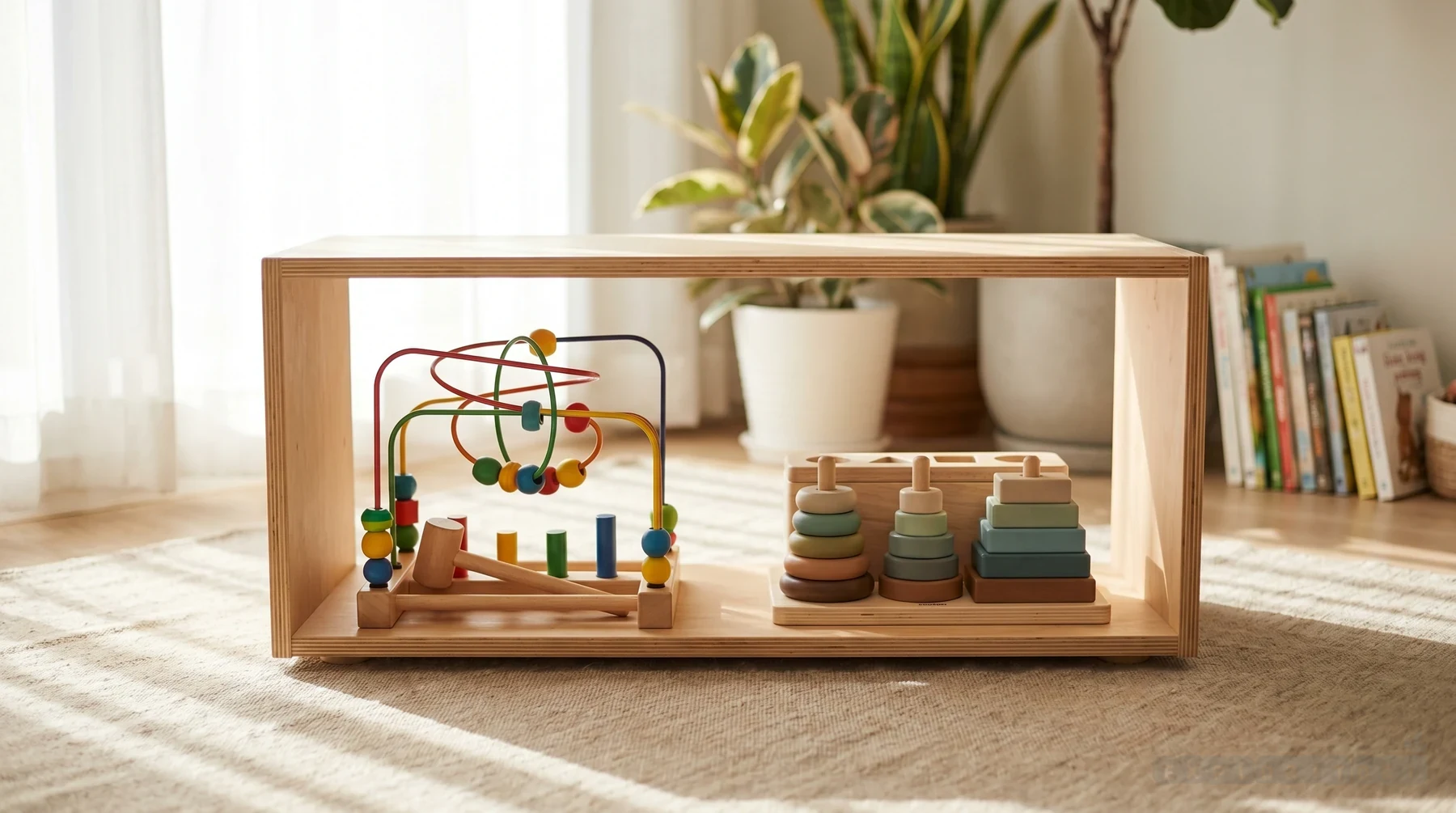
🪵 Do Montessori toys need to be wooden, beige, or branded?
No, and honestly, this is where a lot of parents get misled.
Wood can be lovely. It has weight, texture, warmth, and durability. Those are real advantages. But wood is not a guarantee of quality, and plastic is not an automatic fail.
A smart Montessori purchase might be:
- a metal watering can
- a glass pitcher for supervised pouring
- cotton cloths for table washing
- a silicone placemat for snack prep
- a sturdy plastic potty that your toddler can actually use independently
The point is not the material alone. The point is whether it supports reality-based, hands-on use.
The same goes for branding. Some Montessori brands make excellent products. Some make average products with elegant photos. A toy does not become more developmental because it has the word Montessori in the title.
If you want a practical rule, use this one:
Would I still want this if the listing never mentioned Montessori?
If the answer is no, that is useful information.
Takeaway: real value comes from fit, function, and repeatable use, not from wood, beige tones, or premium branding.
🧺 What is usually worth buying instead of a giant toy haul
This is the part many parents do not hear enough.
Some of the best Montessori purchases are not toy purchases.
If you are building a Montessori-style home, these often create more value than another big box of shelf materials.
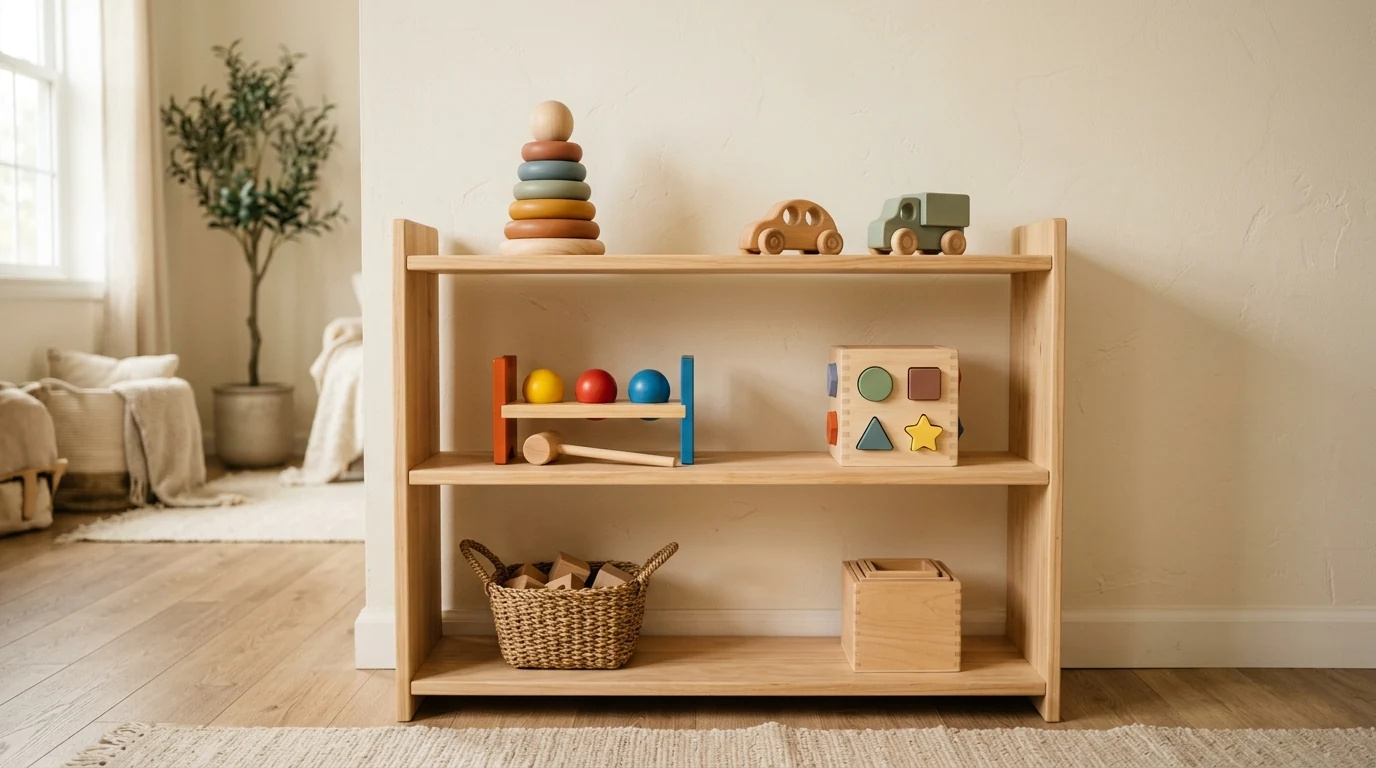
A low shelf
A simple low Montessori bookshelf can completely change how your child uses their materials. Visibility and independence matter.
Trays and baskets
A few small activity trays help make each activity feel complete and manageable.
A learning tower
As mentioned earlier, a learning tower often gets used more than half the toy shelf combined because it opens the door to real kitchen participation.
Child-sized practical life tools
Think small pitcher, toddler-safe knife, tiny broom, sponge, dustpan, washcloths, and a step stool. These are humble purchases, but they tend to deliver a lot of real engagement.
A child-sized cleaning set can be a much better investment than another puzzle if your child is in a heavy imitation phase.
A few high-quality basics
If your child is young, a couple of classic materials can still be worth buying. Good candidates include:
- a simple shape sorter
- a realistic knob puzzle
- a posting activity
- a ring stacker with obvious size grading
- one or two open-ended toys used well
For open-ended play, something like the Grimm’s Large Rainbow can be lovely if your child genuinely returns to it, though it is usually more worth it in homes that already support slow, imaginative play rather than homes chasing a single “must-have” toy.
Takeaway: if your budget is limited, buy for independence and daily use first, then add a few strong shelf materials.
👶 Which Montessori purchases tend to be most worth it by age
You do not need an elaborate age-by-age shopping spree, but it helps to know where money usually goes furthest.
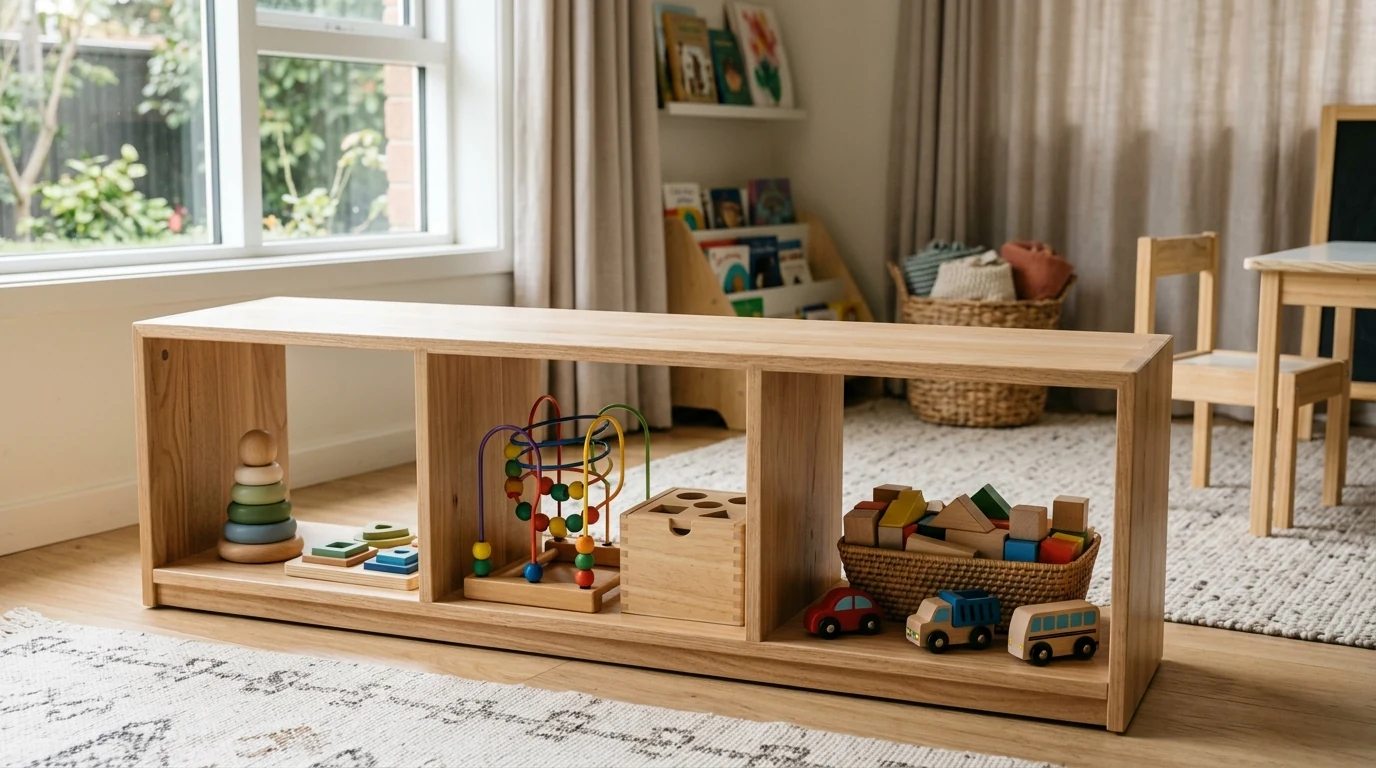
Babies under 12 months
Worth it:
- a few simple grasping toys
- a mirror and movement space
- one or two object permanence style materials
- realistic rattles and sensory objects
Less worth it:
- giant boxed toy sets for “brain development”
- lots of duplicate wooden baby toys that all do the same thing
Young toddlers, around 12 to 24 months
Worth it:
- shape sorters
- posting activities
- simple puzzles
- step stools
- practical life tools
- a low shelf for rotation
A sturdy musical cause-and-effect toy can also work here if it still requires action from your child. The Hape Pound & Tap Bench is a decent example because it still asks for coordinated movement and repetition.
Toddlers and preschoolers, around 2 to 4 years
Worth it:
- practical life tools they can use daily
- puzzles that match their stage
- art materials with real use
- kitchen tools
- gross motor equipment if space allows
- a few open-ended building or balancing materials
Less worth it:
- complicated “learning boards” with twenty tiny features
- oversized bundles that promise to teach every school skill early
The big principle
As children get older, money often goes further on real participation than on more shelf toys.
A stool, apron, water pitcher, child-safe knife, gardening tools, and cleaning tools can create more meaningful work than a pile of expensive “educational” objects.
Takeaway: younger children often benefit from a few classic developmental materials, but older toddlers usually get more value from real-life participation tools.
🛒 A simple buying checklist before you click “add to cart”
If you want one practical framework, use these five questions.
1. What developmental job will this toy do?
Can you name the skill clearly? Pouring, sorting, hand control, matching, dressing, balancing, language, practical life, or open-ended building are all solid answers.
If the only answer is “it seems educational,” that is not enough.
2. Can I imagine my child using this at least twenty times?
Not once. Not during the first excited afternoon. Twenty times.
If you cannot imagine repeated use, the value is probably weak.
3. Does this deserve one of our limited shelf spaces?
Shelf space is a hidden form of budget. A toy can be cheap and still be expensive if it clutters the environment and crowds out better work.
4. Does my child need this, or do I just like the idea of it?
A very fair question, occasionally painful, always useful.
5. Would a simpler version do the same job?
Could you achieve nearly the same benefit with household items, a cheaper tool, or a product you already own?
For example, before buying a specialised practical life set, you might get most of the value from a small pitcher, a sponge, and a tray you already have. Before buying a fancy stacking toy, you might ask whether a classic Fat Brain Toys Tobbles Neo or a simple ring stacker already covers that need beautifully.
Before buying, put the tempting toy into one of these three buckets:
| Decision | Use this when | Example |
|---|---|---|
| Buy | It matches a current repeated interest, your shelf has space, and a simpler version would not solve the same problem | A sturdy shape sorter for a toddler who keeps posting objects into containers |
| Wait | The toy looks useful but your child is not showing the skill yet, or your shelf is already crowded | A threading set for a child who is still mouthing small parts or avoiding fine-motor work |
| Skip | It mostly duplicates something you own, needs constant adult rescue, or is being bought for the photo | A second premium stacking toy when your child already ignores the first one |
If you are buying by age, use age guides as a filter, not a shopping list. The best starting points are usually Montessori toys for babies, Montessori toys for 1-year-olds, Montessori toys for 2-year-olds, and Montessori toys for ages 3 to 4, then your own observation decides what actually belongs on the shelf.
The 30-day shelf audit
If you already own too much, do this before buying anything else:
- Choose 6 to 8 materials for one low shelf or basket.
- Put duplicates and “maybe later” toys out of sight.
- Watch what your child repeats without adult prompting.
- Note which toys cause frustration, dumping, or constant rescue.
- After 7 days, rotate only 1 or 2 items, not the whole shelf.
- At the end of 30 days, buy only for the missing job you can clearly name.
Most families discover that the next useful purchase is boring: a better tray, a reachable hook, a child-sized cleaning tool, a stable stool, or one simpler material that replaces three half-used ones.
Takeaway: the best toy decisions are usually obvious once you force them through a calm checklist instead of a late-night scroll.
⚠️ What about non-toxic claims and “authentic” Montessori toys?
This comes up a lot, and it is worth being blunt.
Yes, safety matters. Materials, finishes, durability, and age-appropriate design all matter. If a toy smells strange, chips easily, has loose unsafe parts, or comes from a seller you do not trust, skip it.
But “non-toxic” is also used as a marketing shortcut, just like “Montessori”. It can be vague, unverified, and designed to trigger anxious parents into spending more than necessary.
The better question is not, “Does this sound pure enough?”
It is:
- is this toy sturdy and well-made?
- is it appropriate for your child’s age?
- is the brand transparent enough to trust?
- will this object actually get real use?
The same goes for “authentic Montessori”. A toy does not need a diploma to be helpful. It needs to support the kind of child activity Montessori values: concentration, independence, movement, repetition, and real engagement.
For a deeper safety pass, use the guide to non-toxic Montessori toy labels and red flags. It is especially useful when a marketplace listing leans heavily on words like natural, eco, non-toxic, Montessori, or educational without giving much concrete information.
Takeaway: use safety as a real filter, not a panic button, and use “authentic Montessori” as a functional question, not a branding badge.
❤️ So, are Montessori toys worth it?
Sometimes absolutely.
A well-chosen Montessori toy or practical life tool can be one of the best purchases in your home. It can slow things down, support independence, and give your child satisfying work they return to again and again.
But the label alone is not worth paying for.
Montessori toys are worth it when they:
- match your child’s current stage
- support active, independent use
- invite repetition
- earn strong cost per use
- replace clutter instead of adding to it
They are not worth it when they:
- are bought mainly for aesthetics
- duplicate skills you already cover
- are far too advanced
- depend on branding more than function
- sit untouched while your child keeps reaching for real life
If you remember one thing, let it be this:
The best Montessori buy is not always the prettiest toy. It is the object that helps your child do meaningful work well, often, and with growing independence.
That might be a shape sorter. It might be a step stool. It might be a learning tower. It might be a sponge and a tiny pitcher.
Montessori is not a shopping list. It is a way of seeing what actually helps your child.
How this guide was reviewed
We reviewed this guide in July 2026 against Exploritori’s Montessori-at-home criteria: child-led use, stage fit, repeatability, shelf space, safety clarity, and whether a purchase solves a real home problem. Product examples are included to make categories easier to identify, not because every family needs the exact item.
Some links may be affiliate links, which can earn Exploritori a commission at no extra cost to you. The recommendation stays the same either way: observe first, simplify second, buy only when the object earns repeated use.
FAQ
Are Montessori toys better than regular toys?
Not automatically. Some Montessori-style toys are better designed for concentration, independence, and repeated use, but many regular toys can also be excellent. The real question is whether the toy asks your child to think, move, and engage meaningfully.
Why are Montessori toys so expensive?
They are often more expensive because they use natural materials, smaller-scale manufacturing, or premium branding. Sometimes the quality justifies the price. Sometimes you are paying extra for aesthetics and marketing.
Are expensive wooden toys always better?
No. Wooden toys can be durable and sensory-rich, but a badly designed wooden toy is still a poor buy. Function matters more than the material alone.
What is the most worthwhile Montessori purchase for toddlers?
For many families, it is a learning tower, a low shelf, a step stool, or practical life tools. Those items often get more real use than a large toy bundle.
Should I buy Montessori toy subscriptions or boxed sets?
Usually with caution. Some are well-designed, but many families get better value by buying a few carefully chosen materials based on your child’s current interests and stage rather than receiving a large bundle all at once.
 Get weekly Montessori tips
Honest reviews, activity ideas, and budget-friendly picks — no spam, just what works.
Subscribe Free