Montessori Broom and Dustpan for Toddlers: Cleaning Supplies That Help
· Updated
Toddlers love cleaning tools for the same reason they love your keys, your broom, and the forbidden spray bottle under the sink.
They want to do real life.
Montessori practical life gives that urge somewhere useful to go. Instead of saying “not that” all day, you prepare a few safe, child-sized tools and show your child how to wipe, sweep, dust, carry, scrub, and put things back.
The goal is not a spotless house. Please release yourself from that fantasy immediately.
The goal is participation. Your child learns that spills can be handled, crumbs can be swept, a cloth has a place, and family life is something they can join.
This guide covers the cleaning tools that are actually worth having, the ones you can skip, how to set up a small cleaning station, and simple Montessori cleaning routines for toddlers at home.
Safety note: Toddlers should not use household cleaning chemicals. Keep sprays, detergents, disinfectants, pods, glass cleaners, bleach, essential oils, and concentrated products locked away. For toddler cleaning work, use water, dry cloths, child-safe tools, and close adult supervision.
Quick answer: Montessori broom, dustpan, and cleaning supplies
The cleaning supply most families actually need is a Montessori broom and dustpan. One child-sized broom and a dustpan that lies flat will handle snack crumbs, the mess toddlers make every day. Pair it with a small basket of washable cloths for spills. A spray bottle, sponge, and mop are later tools, not day-one supplies.
| You are choosing… | Buy or use this | Leave it for later |
|---|---|---|
| A Montessori broom and dustpan | A short hand broom, or a broom about chest height, plus a dustpan whose lip touches the floor | A cute set whose dustpan floats above the crumbs |
| A Montessori broom on its own | The shortest broom your child can hold with two hands and still move real crumbs | An adult broom, or a toy broom that only looks small |
| Montessori cleaning supplies | That broom and dustpan, three washable cloths, and a hook or low basket | A spray bottle, sponge, mop, and a full labelled caddy |
A broom without a flat dustpan is only half the job. Your child can sweep a neat line of crumbs and still have nowhere to put them.
If you are starting from zero, the same order works for the rest of the kit:
| Tool | Best first job | Good age fit | Skip it if… |
|---|---|---|---|
| Small hand broom + dustpan | Sweeping snack crumbs into one pile | 18 months+ with help | The dustpan does not sit flat |
| 3-5 washable cloths | Wiping spills, table spots, low shelves | 12-18 months+ | You need a colour-coded system to explain it |
| Tiny spray bottle with water | One spray, then wipe | 2 years+ for most children | The trigger is too stiff or spraying becomes the whole activity |
| Small sponge | Squeeze, wipe, dry one placemat | 2 years+ | Your child still mouths sponges or floods the tray |
| Nearly dry child-sized mop | One small floor tile or entry mat | 2.5-3 years+ | It is heavy, slippery, or turns into running |
| Low basket, hook, or caddy | Returning tools independently | Any age | It is hidden behind adult cleaning products |
The highest-value starter combination is a hand broom and dustpan plus a cloth basket. Add the spray bottle later, once wiping is already familiar.
Takeaway: a working Montessori broom and dustpan come first. Cloths are the other cleaning supply that earns a place immediately.
Best first purchase: broom and dustpan, or cloths?
Most families do not need a full set of Montessori cleaning supplies first.
Start with the tool that solves a real daily moment:
| If the real problem is… | Best first tool | Why this is the right start |
|---|---|---|
| Snack crumbs under the table | Child-sized hand broom and flat dustpan | The result is visible and the work has a clear finish |
| Water spills after snack or pouring | 3-5 washable cloths in a low basket | It is safe for very young toddlers and easy to repeat daily |
| Finger marks on a low table or mirror | Tiny spray bottle with water plus cloth | Good for older toddlers once wiping is familiar |
| Muddy entryway shoes | Small dry brush and shoe mat | Useful for children who want real work but are not ready for water |
| A child who wants to “mop” everything | Nearly dry sponge or cloth first | Safer than a wet mop and teaches the same wiping control |
If you buy only one item, choose a small hand broom and dustpan that actually works. It should not be a toy prop. The dustpan should lie flat, the broom should move real crumbs, and your child should be able to carry both without dragging them across the floor.
If your child is under 18 months or still mouths materials, start with cloths instead. A basket of washable cloths is boring in the best possible way: it gets used every day and does not invite wild broom play.
Takeaway: match the supply to the mess. A Montessori broom solves crumbs. Cloths solve spills. A pretty caddy solves neither.
Why cleaning belongs in Montessori practical life
Cleaning is not punishment in Montessori. It is care of the environment.
That phrase can sound formal, but the idea is simple: your child learns to notice the space around them and help restore it.
There is a spill. We wipe it.
There are crumbs. We sweep them.
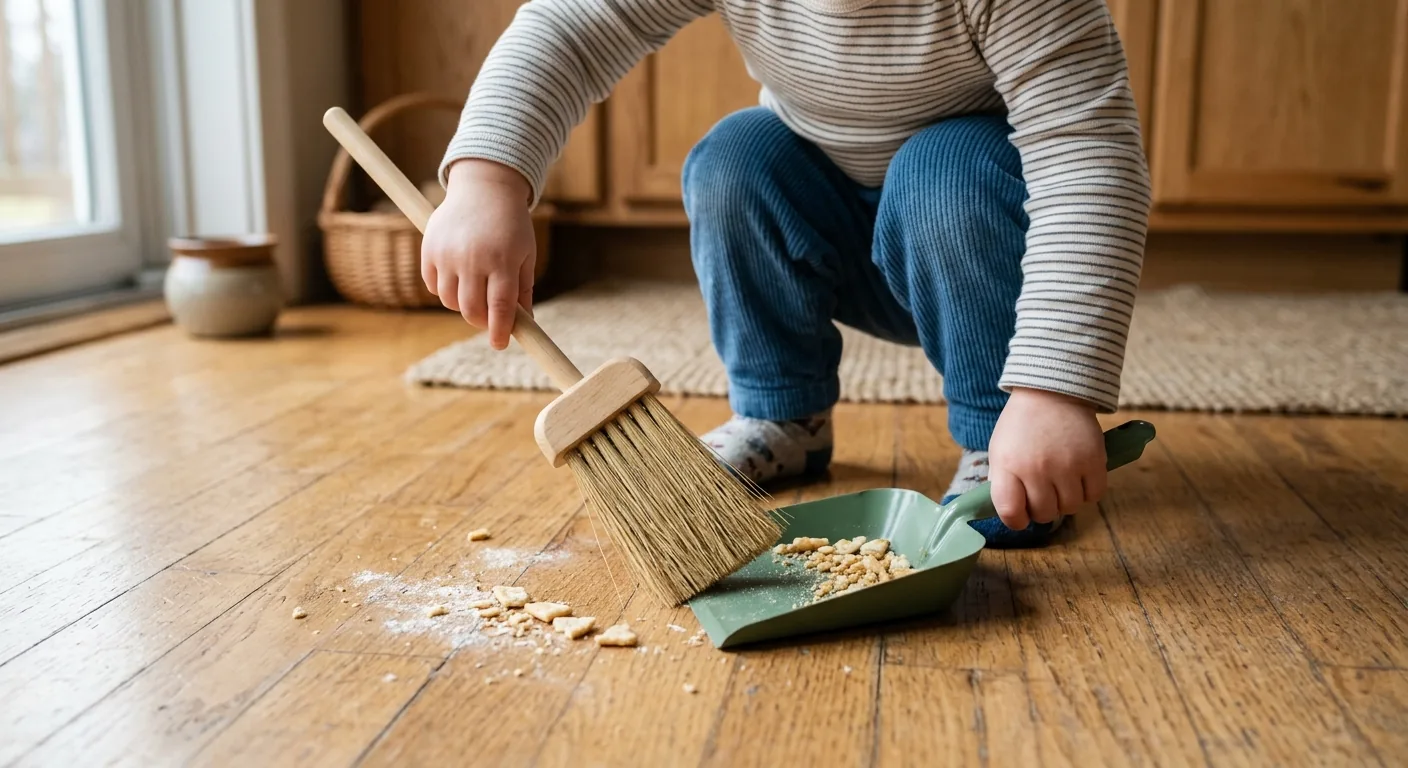
The table is dusty. We dust it.
The cloth is wet. We hang it to dry.
Those small sequences build more than housekeeping habits. They develop coordination, order, concentration, responsibility, and confidence.
A toddler wiping a table is using both hands, crossing the midline, watching cause and effect, sequencing steps, and learning that their actions matter. A child sweeping crumbs into a dustpan is practicing balance, wrist control, visual tracking, and patience.
It looks ordinary because it is ordinary.
That is why it works.
Montessori at home should not be a separate performance that happens only when the shelf looks pretty. It should help your child live more fully in the house they already live in. If you are building the bigger picture, our guide to Montessori practical life activities is the natural companion to this cleaning-tool setup.
Cleaning is one of the easiest ways to do that.
Takeaway: cleaning work gives toddlers a real role in family life, while quietly building coordination and independence.
Age fit: which cleaning work comes first?
Age is less useful than readiness, but it helps to have a rough order.
| Stage | Start with | Adult role | Watch for |
|---|---|---|---|
| 12-18 months | Handing you a cloth, wiping a tiny spill, putting cloths in a basket | Model almost everything | Mouthing cloths, frustration, wandering off mid-step |
| 18-24 months | Sweeping one crumb pile, dusting one shelf, wiping a placemat | Stay beside them and finish the reset | Too much water, broom waving, dumping the basket |
| 2-3 years | Spray-and-wipe with water, sponge squeezing, shoe brushing, plant leaf wiping | Prepare the amount of water and shorten the job | Over-spraying, slippery floors, wanting every tool at once |
| 3 years+ | Small mop work, mirror wiping, table scrubbing, station reset | Step back when the sequence is familiar | Rushing, using adult products, skipping cleanup |
If your child is younger but very interested, make the job smaller. If your child is older but uninterested, connect cleaning to a real moment instead of presenting it as a lesson.
Around 18 months, keep the job at one cloth and one wipe. The Montessori activities for 18-month-olds guide stays at that scale. Cleaning also works better as one job inside the day, which is the point of Montessori practical life routines for toddlers.
What makes a cleaning tool Montessori-friendly?
A tool does not become Montessori because the listing says “Montessori” in the title.
Look for these features instead.
It is child-sized, not toy-tiny
The tool should fit your child now.

A broom that is too tall becomes awkward. A dustpan that is too flimsy creates frustration. A mop that is mostly decoration will not help your child understand real work.
Good child-sized tools are small enough to control but sturdy enough to function.
For most toddlers, that means:
- a broom handle around chest or shoulder height
- a dustpan that sits flat on the floor
- a spray bottle small enough for one or two hands
- cloths that are easy to wring
- a sponge that fits in a small palm
- a lightweight mop with a washable head
If the tool keeps falling, sliding, bending, or spilling, your child will blame themselves. Usually the material is the problem.
It gives real feedback
Montessori materials often have what adults call “control of error.” The child can see what happened.
Cleaning tools are naturally good at this.
If water spills, the cloth becomes wet. If crumbs miss the dustpan, they stay on the floor. If the sponge is too full, it drips.
That feedback is useful as long as the task is small enough.
Do not give a toddler a full spray bottle and a whole table. Give two sprays of water and one placemat.
Do not ask them to sweep the kitchen. Give a small pile of crumbs and one dustpan.
The smaller the job, the easier it is for your child to notice the result.
It has a clear home
Cleaning tools need their own place.
This can be a low basket, a hook, a small caddy, or one corner of the pantry. The exact setup matters less than the predictability.
Your child should be able to see:
- where the cloths live
- where the dustpan returns
- where wet items go
- where dirty cloths are placed
- which tools are for children
- which adult tools are off limits
That last part matters.
If your child has a safe spray bottle with water, it is easier to keep real cleaning chemicals clearly separate and inaccessible.
Takeaway: Montessori-friendly cleaning tools are real, manageable, and easy to return.
The best Montessori cleaning tools for toddlers
You do not need a full cleaning kit on day one.
Start with one tool for one real job. Add more only when your child shows readiness.
Here is the practical shortlist.
1. Small broom and dustpan
A Montessori broom and dustpan is worth buying when it can finish a real job: crumbs after snack, dry rice from a pouring activity, leaves near the doorway, or little bits of paper after cutting practice. If the set only looks small and cute, skip it.
Look for a broom that has actual bristles and a dustpan that rests flat on the floor. Many toy sets look charming but make sweeping harder than it needs to be.
Use this quick test before buying:
- The broom handle reaches roughly chest or shoulder height, not adult height.
- The child can hold it with two hands without lifting their shoulders.
- The bristles bend slightly and move real crumbs.
- The dustpan lip touches the floor instead of leaving a gap.
- The set has a clear home: hook, stand, basket, or entryway spot.
This matters because sweeping is already hard for a toddler. If the dustpan floats above the floor or the broom is too tall, the child learns frustration instead of coordination.
The Melissa & Doug Dust! Sweep! Mop! set is a popular option because it includes a broom, mop, duster, brush, dustpan, and stand. It is still a pretend-play set, so treat it as a starter kit rather than a replacement for sturdy household tools. The best part is that each piece has a visible home on the stand.
If you already own a small hand broom and dustpan, start there. A low-cost real tool from a hardware shop may work better than a branded toddler set.
For small hands, a hand brush often works better than a long broom at first. Put one tiny crumb pile on a hard floor, kneel beside your child, and show how the crumbs move toward the dustpan. Once that movement is familiar, a longer broom makes more sense.
Takeaway: chest-height broom, flat dustpan, real crumbs. That is the buying test.
2. Spray bottle with water
A tiny spray bottle is one of the most loved toddler tools.

Use only water. You can offer it for:
- misting a washable table
- cleaning a mirror with supervision
- wiping a placemat
- dampening a cloth before dusting
- watering a hardy plant from a distance
Choose a bottle that your child can squeeze without strain. Some adult spray bottles are too stiff for toddler hands.
At first, fill it with very little water. Two or three sprays are enough. A full bottle turns wiping into flood management.
3. Cloths and sponges
Cloths are the humble heroes of Montessori cleaning work.
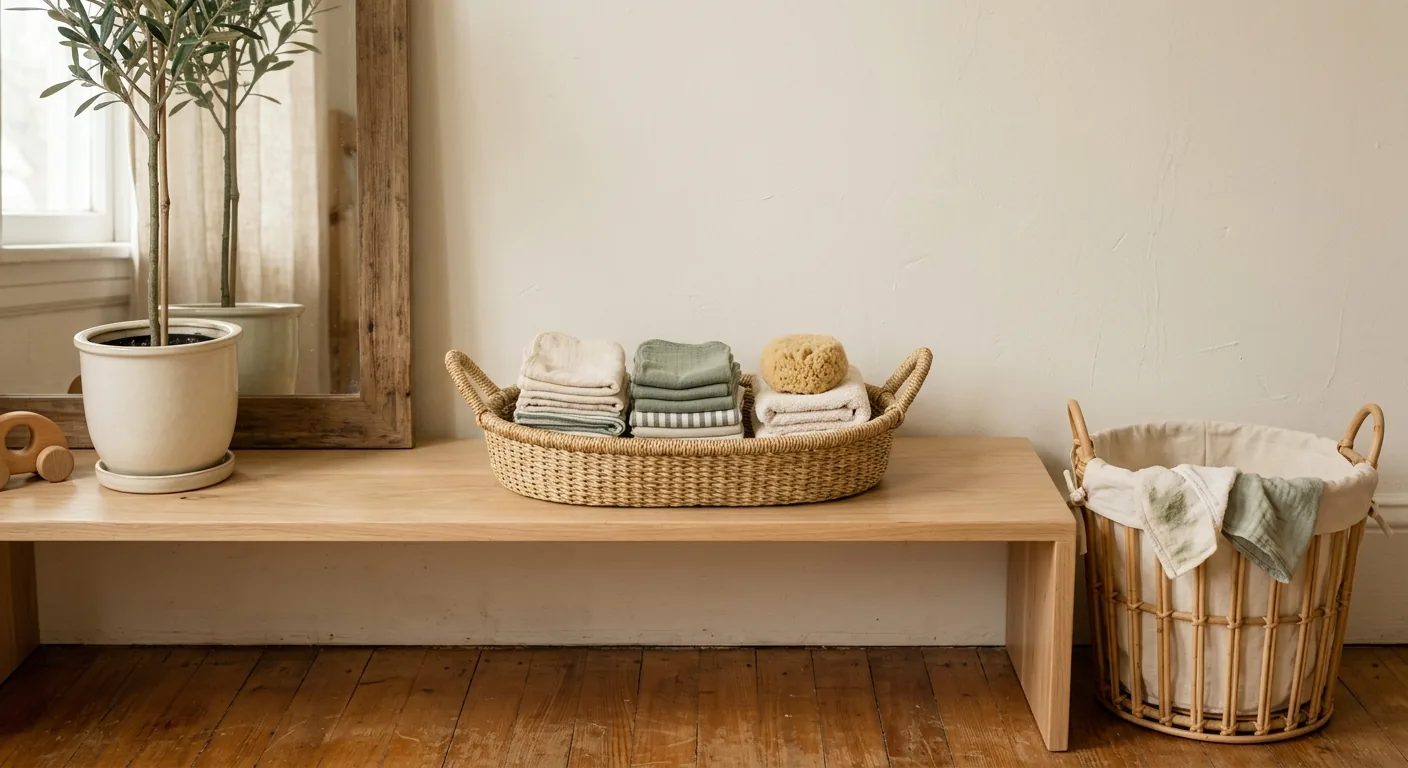
Keep a small stack where your child can reach them. Cut old cotton towels, use microfiber cloths, or choose simple washable squares. You do not need anything fancy.
Different cloths can have different jobs:
- dry cloth for dusting
- damp cloth for wiping
- small towel for spills
- sponge for squeezing and scrubbing
- old washcloth for floor spots
Color-coding can help if your child is older, but do not make the system complicated. A toddler does not need a housekeeping manual.
4. Small mop
A mop can be useful, but it is easy to introduce too early.

Many toddlers cannot control a wet mop yet. They push water around, slip, or become wildly enthusiastic.
If you offer a mop, keep it nearly dry. Use it for one tiny area, such as a washable kitchen spot, bathroom floor tile, or entryway mat.
A spray-and-squeegee style set like the Melissa & Doug Spray, Squirt & Squeegee play set can work for controlled water play and wiping practice, especially if your child loves squeezing bottles. The caveat is that you should still use it with water only and direct supervision.
If you want more water-based ideas before offering a mop, start with the lower-risk setups in Montessori water practical life activities. Sponge squeezing and tray drying teach many of the same skills with less slipping.
5. Apron or small towel
An apron is not required, but it can help mark the beginning of work.
For some children, putting on an apron says, “Now I am doing something real.” For others, it becomes one more battle. Follow your child.
A small towel tucked near the cleaning tools may be more useful than an apron. It gives your child an immediate way to deal with water on hands, sleeves, or the floor.
6. Low storage
The storage is part of the activity.
If the broom is jammed behind adult tools, your child cannot return it independently. If cloths are in a high cupboard, wiping becomes an adult-managed event.
Choose one simple storage option:
- a low basket for cloths and sponge
- a small hook for a hand broom
- a caddy for water bottle and cloth
- a stand for broom, mop, and duster
- a laundry basket for used cloths
Keep it boring and consistent. That is a compliment.
Takeaway: the most useful cleaning kit is small: broom, dustpan, cloths, sponge, water bottle, and a clear place to return everything.
Five-minute setup for a real kitchen or snack area
If your child already wants to help after meals, set up the cleaning work where the mess happens.
You need:
- one low basket with 3 cloths
- one hand broom and dustpan
- one tiny spray bottle with only water, if your child is ready
- one visible place for used cloths
- one rule: adult cleaning products are never part of this station
Place the basket near the snack table, kitchen helper tower, or entryway. Do not hide it in a playroom if spills happen in the kitchen. If snack is the daily mess, the Montessori snack station for toddlers shows where the cloth and broom should live. If your child wants to help cook as well as sweep, Montessori kitchen activities is the next practical-life step.
Then choose one repeatable script:
“There are crumbs. Sweep to the dustpan.”
Or:
“Water spilled. We need a cloth.”
That is enough. A small, repeated routine teaches more than a perfect cleaning shelf that nobody uses.
10 Montessori cleaning activities to start with
Cleaning work goes best when the task is real and tiny.
Here are simple activities that usually work well for toddlers.
1. Wiping a spill
This is the first cleaning routine most toddlers need.
Keep a cloth near snack or water work. When a spill happens, pause and say, “We need a cloth.” Show your child how to press the cloth down, wipe slowly, and put the wet cloth in the laundry basket.
Do not turn it into a lecture. The spill is not a moral failure. It is a practical problem with a practical solution.
2. Sweeping crumbs after snack
After snack, gather crumbs into one small pile. Show your child how to hold the broom with two hands, sweep toward the dustpan, and tap the dustpan into the bin.
Expect partial success.
You may need to finish the job. That is fine. The toddler’s work is participation and practice, not full adult-level cleaning.
3. Dusting a low shelf
Give your child a dry cloth and one shelf.
Remove the materials first if needed. Show one slow wiping pattern: left to right, then return the cloth to the basket.
This is a lovely activity because it connects directly to toy rotation. When the shelf has fewer items, your child can care for it.
4. Washing a placemat
Place one washable placemat on a towel. Offer a small bowl of water, a sponge, and a dry cloth.
Show the sequence:
- Dip sponge.
- Squeeze.
- Wipe placemat.
- Dry with cloth.
- Hang or return materials.
This is a good bridge between water work and cleaning work.
For more water-heavy routines, keep the same “tiny job, tiny amount of water” rule from our Montessori water practical life activities guide.
5. Cleaning a mirror
Use a low mirror, a small spray bottle with water, and a cloth.
Show one spray, then wipe. That is enough.
Toddlers tend to want twenty sprays. Keep the bottle barely filled or hold it yourself at first. If the spraying becomes the whole activity, switch to a damp cloth.
6. Scrubbing a table spot
Make one visible spot with water or a washable mark. Give your child a small brush or sponge.
Show small circular scrubbing motions, then wipe dry.
This gives strong feedback because your child can see the spot fade.
7. Putting laundry cloths in a basket
Toddlers often like the carrying part more than the cleaning part.
After wiping work, show where wet or dirty cloths go. A small open basket works better than a lidded hamper.
This tiny step completes the cycle: use, clean, return, reset.
8. Caring for shoes at the entryway
Cleaning does not have to involve water.
Offer a small brush or dry cloth near the entryway. Your child can brush dry dirt from boots, wipe shoes, or place shoes on a mat.
This pairs nicely with a leaving-the-house routine because the entryway becomes a prepared environment, not a daily scramble.
9. Wiping leaves on a plant
For older toddlers, plant care can include gently wiping large leaves with a damp cloth.
Choose a non-toxic plant and supervise closely. Show how to support the leaf with one hand and wipe with the other.
This is slow, careful work. It encourages gentleness in a way that sweeping crumbs does not.
10. Resetting the cleaning station
This may be the most Montessori part of the whole setup.
At the end, your child returns the broom, hangs the cloth, puts the sponge in its dish, or places the bottle back in the caddy.
Returning materials teaches order. It also makes tomorrow easier.
Takeaway: choose one cleaning activity that matches a real moment in your day. Repetition matters more than variety.
How to present cleaning work without nagging
Montessori cleaning work should not sound like a constant stream of adult instructions.
Show more than you say.
Set up the material before inviting your child. Move slowly. Use short phrases.
For example:
“There are crumbs.”
“Watch.”
“Sweep to the dustpan.”
“Now the crumbs go in the bin.”
“Your turn.”
That is enough.
If your child grabs the broom and waves it around, pause the activity. The tool is either too exciting, too hard, or your child is not ready to use it safely today.
You can say, “The broom is for sweeping. I will put it away now. We can try again later.”
Calm and boring is your friend here.
Avoid turning cleaning into a performance. If everyone claps every time your child wipes a spill, the work can become about adult approval instead of responsibility.
A simple “You wiped the water” is more useful than “Good job, you’re such a big helper!”
Describe what happened. Let your child feel the competence.
Takeaway: demonstrate slowly, use fewer words, and treat cleaning as normal family life.
Common mistakes with toddler cleaning tools
These are easy to make. Most of us make at least one.
Giving too many tools at once
A full cleaning caddy is exciting, but it can overwhelm a toddler.
Start with one tool and one job. Add the rest later.
Using too much water
Water multiplies the work very quickly.
For toddlers, a damp cloth often works better than a bowl of water. A spray bottle with two centimeters of water is better than a full one.
Expecting independence too soon
Your child may need you beside them for weeks or months.
That does not mean the routine is failing. Independence grows through shared repetition.
Buying tools that only look good
Some toddler cleaning sets are adorable and nearly useless.
Check function first. Does the broom sweep? Does the dustpan sit flat? Can your child lift the mop? Does the spray bottle actually spray?
Using cleaning as punishment
“You made the mess, now clean it up” can sound logical, but it often creates shame or resistance.
Try “The water spilled. Let’s get a cloth.” You are still teaching responsibility, but without making the child feel bad for learning.
Leaving adult cleaning products accessible
This is the non-negotiable one.
Child participation does not mean child access to chemicals. Keep real products locked away and visually separate from toddler materials.
Takeaway: small, safe, repeatable cleaning work beats a beautiful setup that creates more conflict.
A simple starter setup for real homes
If you want to start this week, do not buy everything.
Set up one cleaning station.
Here is the easiest version:
- one low basket
- three washable cloths
- one small sponge
- one small hand broom and dustpan
- one tiny spray bottle with water
- one laundry basket or hook for used cloths
Place it near the area where spills actually happen. For many families, that is the kitchen, snack table, bathroom, or entryway.
Then choose one routine:
- after snack, wipe the table
- after water work, dry the tray
- after coming inside, brush shoes
- after shelf rotation, dust one shelf
- after handwashing, hang the towel
Do that routine for a week before adding another.
This is where Montessori at home becomes refreshingly ordinary. You are not creating a mini classroom. You are making your real home easier for your child to participate in.
If you already have a practical life shelf, you can add a cleaning tray. But if your house is small, skip the tray and put the tools where the work happens.
Montessori is not about making your home look like someone else’s photo. It is about preparing your environment so your child can do meaningful work.
This same principle applies to clothing and entryway routines too: a prepared space matters more than a lecture. The Montessori toddler wardrobe guide is useful if shoes, coats, and laundry are part of the same independence push.
Takeaway: start with one station, one routine, and tools your child can return independently.
A one-week starter plan
Use this if you want cleaning work to become normal without turning the week into a project.
| Day | Setup | Parent script | Stop after |
|---|---|---|---|
| 1 | Put 3 cloths in a low basket near snack | ”Water spilled. We need a cloth.” | One wipe and cloth in basket |
| 2 | Add a visible used-cloth basket or hook | ”Wet cloths go here.” | Cloth returned |
| 3 | Make one small crumb pile after snack | ”Sweep to the dustpan.” | One attempt, even if you finish |
| 4 | Offer a dry cloth for one low shelf | ”Wipe this shelf.” | One shelf |
| 5 | Add a barely filled spray bottle | ”One spray. Wipe.” | Two sprays maximum |
| 6 | Let your child reset the basket | ”The cloths go back.” | Basket reset |
| 7 | Repeat the routine that caused the least conflict | ”You know this work.” | Before enthusiasm turns messy |
The goal is not seven different activities. It is one predictable cycle: notice, clean, return.
Troubleshooting: when cleaning work goes sideways
| Problem | Likely cause | Better next step |
|---|---|---|
| Your child sprays everything | The trigger is more exciting than the work | Offer a damp cloth for a week, then reintroduce one spray at a time |
| Sweeping spreads crumbs everywhere | The pile is too big or the broom is too long | Make a tiny pile on a hard floor and use a hand broom first |
| The mop becomes a slipping hazard | Too much water or too large an area | Switch to sponge drying on a towel-covered tray |
| Your child refuses to clean spills | The adult tone has become corrective | Model silently, then invite: “Do you want the cloth or should I wipe?” |
| Tools never get returned | The storage is unclear or too far away | Move the basket beside the actual spill/snack area |
| Everything becomes play-fighting with the broom | The tool is not safe today | Put the broom away calmly and offer cloth wiping instead |
If cleaning work repeatedly creates conflict, pause it. Practical life should make home life calmer over time, not add a daily power struggle.
How we chose these recommendations
This guide is based on Montessori practical-life principles: real tools, child-sized access, visible cause and effect, repetition, and care of the environment. We prioritise tools that a toddler can actually use for household participation, not sets that only photograph well.
Product links are included only where a common option helps parents compare features. We have not personally lab-tested every cleaning set, so the buying advice focuses on observable criteria: tool size, sturdiness, storage, water control, and whether the material can complete a real task. As always, keep adult cleaning products locked away and supervise closely.
Final thoughts
Montessori cleaning tools are not about training a tiny housekeeper.
They are about giving your child a real way to help.
A toddler who wipes a spill learns, “I can fix this.” A child who sweeps crumbs learns, “My work matters.” A child who returns the cloth learns, “This material has a place.”
That is practical life.
Keep the setup small. Keep the tools real. Use water, not cleaning chemicals. Demonstrate slowly, repeat often, and let the work be imperfect.
Your floor may not look better at first.
Your child probably will.
 Get weekly Montessori tips
Honest reviews, activity ideas, and budget-friendly picks — no spam, just what works.
Subscribe Free