Montessori Language Activities for Toddlers: A Practical Home Guide
· Updated
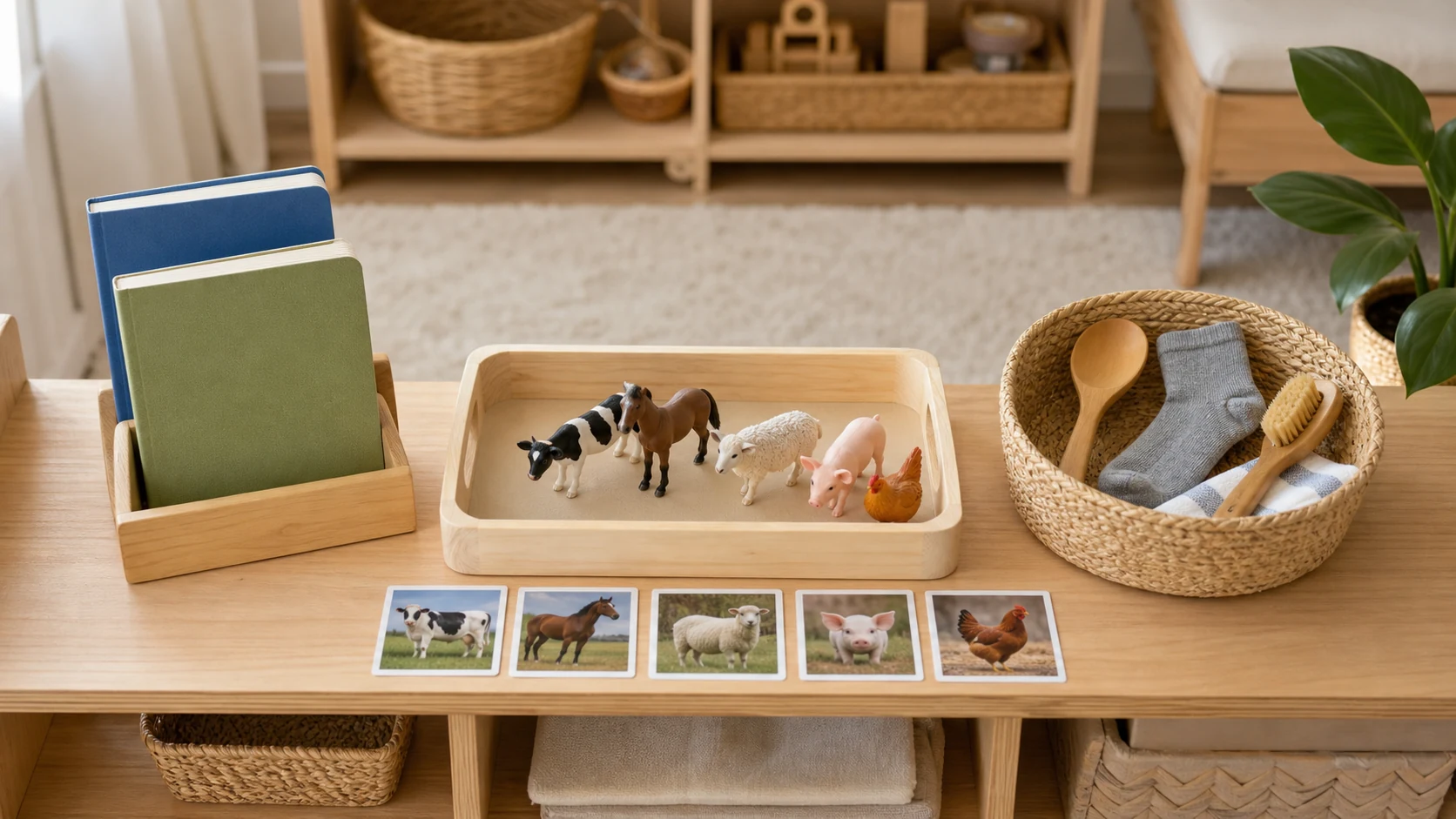
Toddlers are constantly collecting words.
Your child wants to know what things are called, what sounds they make, where they go, who uses them, and why you just said “colander” instead of “bowl.” That curiosity is not random. It is the foundation of language.
Montessori language activities for toddlers work best when they feel grounded, calm, and real. Not flashcards for the sake of flashcards. Not forced reading lessons at two. Just rich spoken language, matching, sorting, songs, books, and everyday work that gives words a job to do.
That is the heart of it. Language grows when your child can connect a word to something they can see, touch, carry, hear, or use.
Quick choice guide
| Situation | Best starting point | Why it helps |
|---|---|---|
| You want the simplest option | Start with one low shelf or basket | Fewer choices make it easier for your child to focus |
| You are buying something new | Choose practical, open-ended materials first | They last longer and support real independence |
| Your space feels cluttered | Rotate materials weekly instead of adding more | Calm environments usually work better than bigger collections |
| Your toddler mostly points or names single words | Use object baskets and real books | Concrete objects make new words easier to understand |
| Your toddler is already matching and sorting | Add object-to-picture matching | It connects real things with early symbolic thinking |
| Your toddler loves songs more than shelf work | Use rhymes during routines | Rhythm and repetition build listening without pressure |
🌱 What Montessori language work looks like in toddlerhood
Before we get into activities, it helps to know what you are actually supporting.
For toddlers, language work is not mainly about reading. It is about:
- hearing and understanding more words
- connecting words to real objects and actions
- learning categories like animals, foods, tools, and clothing
- noticing rhythm and sound patterns in speech
- following simple directions
- building confidence to ask, point, name, and tell
This is why Montessori language activities are usually concrete first.
A toddler learns more from matching a spoon to a picture of a spoon, helping you peel a banana, and hearing the same rhyme every day than from most noisy “educational” toys. Real experience gives words meaning.
If you want a simple setup at home, a low shelf, a few baskets, and some front-facing books are enough. A purpose-built Montessori bookshelf for toddlers can help if you want a neat reading corner, but it is not required. The principle matters more than the furniture.
For a broader home setup, pair this language work with the how to start Montessori at home guide. If your child is around 18 months, the Montessori activities for 18-month-olds guide shows how language can sit beside pouring, posting, dressing, and practical-life work.
Takeaway: in the toddler years, language work should feel like life, not school.
🧺 How to prepare Montessori language activities at home
A good language setup is surprisingly small.
Keep materials visible
Offer one clear basket or tray per activity. When everything is jumbled together, the invitation disappears.
A few small wooden trays or simple baskets can make shelf work much easier because each activity has a visible beginning and end.
Start with familiar themes
Choose words your child already hears in daily life:
- fruit
- animals
- vehicles
- kitchen tools
- clothes
- bathroom items
- things from the garden or park
Use realistic images
Clear photo cards usually work better than busy cartoon cards. Montessori tends to favour reality, especially for young children who are still building their mental map of the world.
Keep the set small
Three to five items is often enough. A tiny set invites focus. A giant set invites wandering off halfway through while holding one sock and a wooden cow.
Follow real interests
If your child is deeply committed to buses, dogs, shoes, or the vacuum cleaner, lovely. That is your theme now.
Takeaway: a strong Montessori language shelf is not impressive. It is clear.
A language basket recipe that actually holds attention
The easiest home setup is one basket, one theme, and one tiny extension.
| Basket theme | Put in the basket | Add beside it | Language to model |
|---|---|---|---|
| Kitchen words | spoon, whisk, cup, cloth | one realistic kitchen book | stir, wipe, pour, dry, full |
| Getting dressed | sock, hat, shoe, zip pouch | a mirror or dressing book | pull, open, close, soft, tight |
| Farm animals | 3 to 5 animal figures | matching photo cards | cow, calf, hoof, tail, loud |
| Bathroom routine | comb, toothbrush, washcloth | a routine card or book | brush, rinse, wet, clean, next |
| Garden walk | leaf, stone, flower pot, trowel | nature photo cards | rough, smooth, green, heavy |
Keep the first version almost too easy. If your child can name everything, add one new word, one matching card, or one action. If they throw everything on the floor, reduce the set and try again later.
Takeaway: a basket works when your toddler can finish it without needing you to rescue the activity.
🖼️ 1. Object-to-picture matching

If you only try one activity from this list, make it object-to-picture matching.
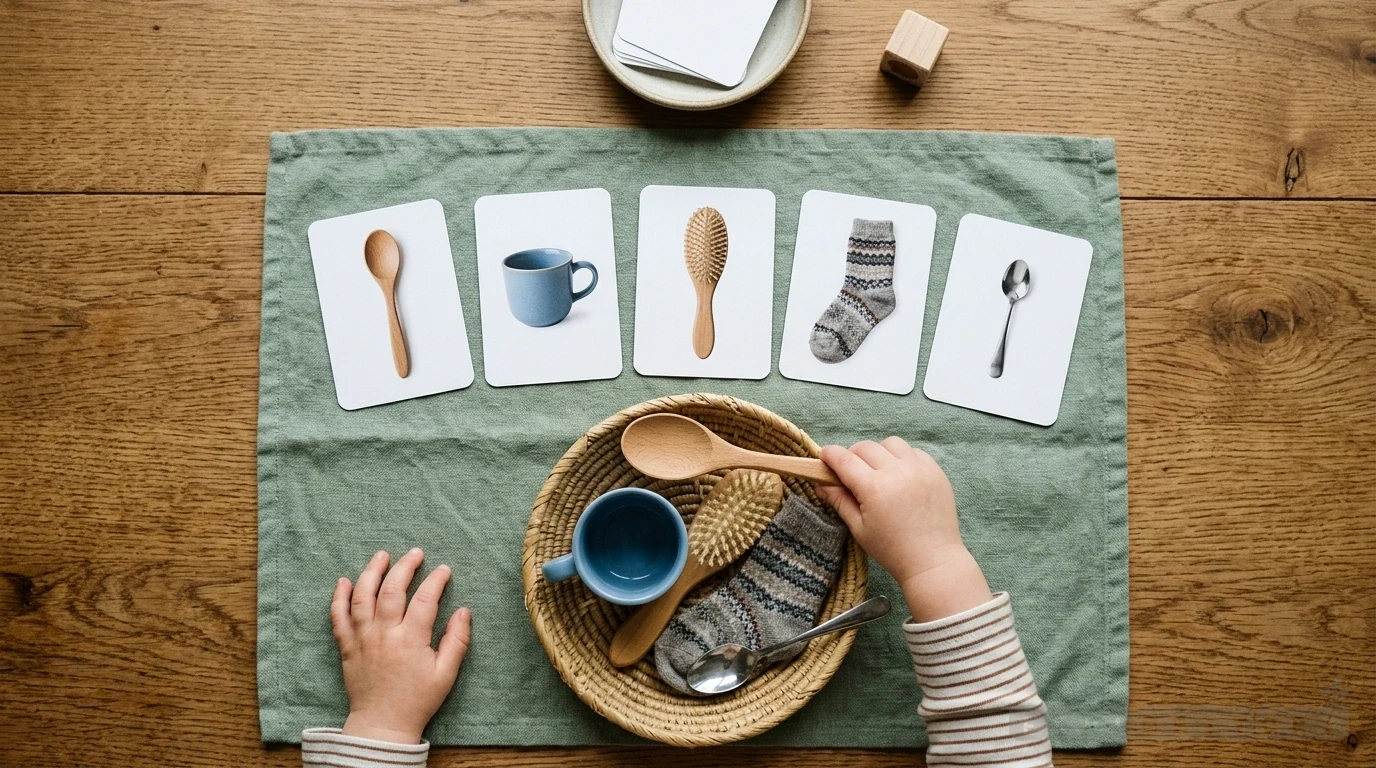
Put three or four real objects in a basket. Offer matching cards with realistic images. Show your child how to place each object on its card.
Simple theme ideas:
- spoon, cup, brush
- apple, banana, orange
- dog, cow, horse
- sock, hat, shoe
- car, bus, train
This activity builds:
- vocabulary
- observation
- concentration
- symbolic thinking
- category awareness
Start with very obvious objects. Once your child understands the pattern, you can move into more specific themes like farm animals or kitchen tools.
A classic support material here is the Melissa & Doug Farm Animals Jumbo Knob Puzzle. It is technically a puzzle, but it also gives you a tidy little vocabulary set for naming animals, sounds, colours, and actions.
Takeaway: matching real objects to images is one of the cleanest bridges from spoken language to early symbolic understanding.
🧸 2. Themed vocabulary baskets
Vocabulary baskets are simple and brilliant.

Pick one theme. Add a few objects. Sit with your child and name them naturally.
That is enough.
Good basket ideas for toddlers:
- Kitchen basket: whisk, spoon, mini rolling pin, cookie cutter
- Bathroom basket: comb, toothbrush, washcloth, soap dish
- Getting dressed basket: sock, mitten, hat, zip pouch
- Transport basket: car, bus, train, bike
- Animal basket: farm animals, pets, birds, sea animals
- Garden basket: leaf, small trowel, spray bottle, flower pot
You can say, “This is the whisk,” or “Can you find the sock?” But try not to turn it into a quiz show. The real value is repeated, pleasant exposure.
This kind of activity grows beautifully with your child. A younger toddler may mostly handle the objects and listen. An older toddler may sort them, match them, and start telling you tiny stories about them.
Takeaway: one well-chosen basket can give your child a week of rich language without feeling forced.
🎵 3. Songs, rhymes, and sound games
Toddlers love predictable language.
That is why songs and rhymes matter so much. They help your child hear rhythm, repetition, rhyme, and sound patterns long before they are ready for anything like formal reading.
Easy Montessori-friendly sound play:
- sing the same nursery rhymes often
- pause before the last word and let your child fill it in
- clap the beat of names
- exaggerate beginning sounds playfully
- listen for sounds in the environment, like birds, buses, taps, or the washing machine
You do not need to sit down and announce “Now we will do phonological awareness.” That would be awful for everyone.
Use songs in real moments. Sing while washing hands. Clap syllables while putting shoes away. Notice that “banana” is a long word and “bus” is a short one.
If your child loves a little movement with music, Fat Brain Toys Squigz can be surprisingly useful during song time because they invite sticking, pulling, popping, and naming actions together. Not necessary, but genuinely fun.
For toddlers who need more movement before they can sit with cards or books, the Montessori gross motor activities guide gives you ways to build language into carrying, climbing, walking, and naming body movements.
Takeaway: songs and sound play build listening and language memory in a way toddlers naturally enjoy.
📚 4. Real books with real pictures
If your toddler asks for the same animal book every night for twelve days, that is not a problem. That is concentration.
Montessori language work usually favours books with:
- realistic images
- one clear subject per page
- strong everyday vocabulary
- simple, uncluttered layouts
- themes tied to real life
Great toddler book themes include:
- farm animals
- transport
- body parts
- food
- home objects
- tools
- weather
- daily routines
A front-facing display helps a lot because toddlers choose books by the cover, not the spine. If you are setting up a book area, the Montessori bookshelf for toddlers is one neat option, but any low ledge or simple shelf works fine.
You can also add simple classified cards beside books. For example, if you are reading about farm animals, place a few farm animal cards or figures nearby. The theme becomes richer without becoming overwhelming.
Takeaway: realistic books help toddlers build precise vocabulary and make language feel meaningful, not abstract.
🍎 5. Language hidden inside practical life
This is one of the most useful Montessori ideas for parents.
Some of the best language activities do not look like language activities at all.

When your child helps you wash strawberries, wipe the table, carry laundry, pour water, or brush their hair, they are surrounded by meaningful words:
- pour
- full
- empty
- wet
- dry
- scrub
- fold
- match
- heavy
- light
- smooth
- rough
- first
- next
- last
That vocabulary sticks because it is tied to action.
A toddler learning tower can be worth it here if it helps your child safely join everyday kitchen work. It is not a “language product,” but it creates far more real conversation than most toy-room gadgets ever will.
If kitchen routines are your easiest entry point, use the Montessori kitchen activities guide for age-fit setup ideas, then add the language layer: name the tool, the action, the texture, and what happens next.
Try short, clear narration while your child works:
- “You are pouring slowly.”
- “This cloth is wet. Here is a dry one.”
- “Can you carry the spoon to the table?”
- “First we peel. Then we slice.”
Not constant chatter. Just useful language around real work.
Takeaway: if you want stronger language development, invite your child into more daily life.
🔤 6. Sound awareness without rushing reading
Many parents hear “Montessori language” and immediately wonder whether they should start letters at two.
Usually, no.
For toddlers, the priority is spoken language, vocabulary, comprehension, classification, and sound awareness. Those are the real foundations.
That said, some older toddlers become interested in:
- beginning sounds
- rhyming words
- hearing their own name
- noticing a few familiar letters
- tracing lines, shapes, or simple marks
You can support that gently.
Try:
- “Ball starts with b.”
- “Can you hear the mmm in mama?”
- “Let’s make a line in the sand.”
- “Your name starts with J.”
A sand tray, finger tracing in flour, or large arm movements in the air often work better than formal alphabet work at this age.
If your toddler enjoys puzzle-style materials, the Melissa & Doug Shape Sorting Cube is a nice reminder of the broader Montessori principle here: children learn well when the material gives clear feedback and lets them try again independently.
Takeaway: pre-reading for toddlers should feel playful, light, and optional.
🧩 7. Sixteen easy Montessori language activities for toddlers
Here is a practical list you can actually use.
1. Object-to-picture matching
Match 3 real objects to 3 cards.
2. Animal naming basket
Use 3 to 5 realistic animal figures or puzzle pieces.
3. Kitchen vocabulary tray
Add spoon, whisk, cup, and cookie cutter.
4. Clothing matching
Match real socks, hats, or shoes to pictures or pairs.
5. Fruit basket naming
Offer familiar fruits and name colour, texture, and taste.
6. Body parts during dressing
Name knees, elbows, fingers, socks, sleeves, and buttons.
7. Book-and-object pairing
Read a transport or animal book, then offer matching figures.
8. Sound walk
Go outside and notice birds, cars, dogs, wind, and tools.
9. Basket of things that open and close
Name lid, box, zip, snap, open, closed.
10. Laundry sorting
Match socks, sort shirts, name textures and colours.
11. Snack prep vocabulary
Peel, slice, spread, pour, stir, taste.
12. Simple classified cards
Try animals, foods, vehicles, or household tools.
13. Nursery rhyme basket
Add one prop to a familiar rhyme, like a toy spider or star.
14. Mystery bag naming
Place one familiar object in a soft bag and identify it by touch.
15. “Go and find” game
“Can you find your cup?” “Can you bring the brush?”
16. Nature naming tray
Leaf, stone, flower, stick, feather, pinecone.
You do not need to do all of these. Pick one or two and repeat them well.
Takeaway: the best toddler activities are the ones your child wants to come back to tomorrow.
🚫 Common mistakes that make language work worse
A few things tend to spoil otherwise good activities.
Asking too many test questions
If every interaction becomes “What is this?” your child may stop enjoying it.
Offering too much at once
Small sets build concentration. Giant sets build chaos.
Using cluttered materials
Busy, unrealistic, or noisy materials add confusion instead of clarity.
Pushing letters too early
Vocabulary and comprehension are not “lesser” skills. They are the real work.
Ignoring repetition
If your child wants the same basket, same rhyme, and same book every day, that usually means the activity is working.
Forgetting movement
Many toddlers learn best while carrying, sorting, walking, pointing, singing, and helping.
Takeaway: Montessori language activities should feel inviting, not performative.
🌼 A simple weekly rhythm that actually works
If you want this to feel sustainable, keep it light.
A realistic week might look like this:
| Day | Shelf or routine focus | Parent job |
|---|---|---|
| Monday | Introduce one language basket | Name slowly and stop before it becomes a quiz |
| Tuesday | Repeat the same basket | Notice which object gets repeated |
| Wednesday | Add one matching card or book | Keep the set small |
| Thursday | Use the same words in practical life | Say the action words during snack, dressing, or cleanup |
| Friday | Offer a sound walk or rhyme basket | Listen for interest, not performance |
| Weekend | Keep the favourite or rotate one item | Change only what is no longer being used |
That is plenty.
Rotate only when interest fades. If the animal basket is still working after ten days, keep it. If the transport cards flop instantly, change them.
This is where Montessori becomes deeply practical. You do not need a perfect curriculum. You need observation.
Watch what your child is trying to learn, then make that easier to do.
And if your toddler currently wants to discuss only buses, blueberries, and the family vacuum cleaner, I have good news. That still counts as a very respectable language education.
How we reviewed this guide
This guide is written for ordinary home use, not for recreating a certified Montessori classroom. We reviewed it against Exploritori’s Montessori-at-home library in July 2026 and focused on what parents can actually prepare: small sets, real objects, realistic pictures, practical-life vocabulary, repetition, and age-fit expectations.
Product examples are included only where they clarify a setup. Household objects, library books, and homemade photo cards are usually enough. Some product links may be affiliate links, which can earn Exploritori a commission at no extra cost to you.
❓Frequently asked questions
What are the best Montessori language activities for toddlers?
The best Montessori language activities for toddlers are simple, hands-on activities tied to real life. Good examples include object-to-picture matching, vocabulary baskets, realistic books, songs and rhymes, sound games, and practical life tasks with clear naming.
At what age can toddlers start Montessori language activities?
Many children can start around 12 to 18 months, as soon as they enjoy naming, pointing, listening to books, and matching familiar objects. The activities stay very simple at first.
Do Montessori language activities need special materials?
No. You can do excellent Montessori language work with books, household objects, baskets, toy animals, kitchen tools, clothes, and everyday routines.
Are Montessori language activities the same as teaching reading early?
No. In toddlerhood, Montessori language work is mostly about spoken language, vocabulary, listening, and sound awareness. Reading comes later.
How many language activities should I put on the shelf?
For most toddlers, one or two language activities plus a few books is enough. A clear shelf supports concentration better than a crowded one.
 Get weekly Montessori tips
Honest reviews, activity ideas, and budget-friendly picks — no spam, just what works.
Subscribe Free