How to Start Montessori at Home: A 4-Week No-Overwhelm Plan
· Updated
The Problem with Montessori Advice Online
Search “how to start Montessori at home” and you’ll find articles telling you to completely overhaul your kitchen, build a learning tower, create a capsule wardrobe for your toddler, set up a floor bed, install child-height mirrors, and curate an aesthetically colour-coordinated shelf — all before breakfast on Monday.
No wonder you’re overwhelmed.
Here’s the truth: most families who successfully do Montessori at home didn’t start by changing their environment. They started by changing how they observe their child. Everything else followed gradually.
For the full philosophy behind Montessori, our What Is Montessori guide covers the foundations.
Quick Start: What to Do First
Use this table if you are starting from zero and need the next move, not a whole home makeover.
| If your home feels like… | Start here | Skip for now |
|---|---|---|
| Too many toys everywhere | Put three useful choices on one low shelf or basket | buying more wooden toys |
| Your toddler wants to help constantly | Choose one practical life job: wiping, pouring, socks, or snack prep | a full pretend-play kitchen setup |
| You have no spare room | Use one corner, one tray, or one basket | creating a dedicated Montessori room |
| You are not sure what your child needs | Observe for one week before changing the shelf | copying an age chart blindly |
| Screen time is filling every gap | Replace one predictable screen moment with one hands-on routine | going cold turkey overnight |
If budget is the main constraint, pair this plan with Montessori on a budget for small spaces. If shelf clutter is the issue, the toy rotation guide will help you reduce choices without removing everything your child loves.
Takeaway: start with one repeatable routine and one reachable choice. That is enough to begin.
Week 1: Just Watch
Don’t buy anything. Don’t move furniture. Don’t even read another article (after this one).
Spend a week watching your child. Specifically, notice:
- What do they reach for? Not what you hand them — what do they choose?
- What do they repeat? Repetition is a clue about what they’re working on developmentally
- Where do they get frustrated? Frustration often means they’re trying to do something their environment won’t allow
- What do they try to do independently? Dress themselves? Pour their own water? Climb?
- When are they most focused? Morning? After a nap? What triggers deep concentration?
Write these observations down. Even just notes on your phone. This is your personalised Montessori curriculum — based on your actual child, not a generic age chart.
A 10-Minute Observation Checklist
Try this for three ordinary days, not just on your best parenting day:
| Watch for | What it might mean | First setup to try |
|---|---|---|
| Repeats pouring, dumping, or filling | hand control and cause-effect work | dry pouring tray, water pouring later |
| Climbs furniture or carries heavy things | movement and heavy-work need | cushion obstacle path, laundry carrying |
| Grabs the broom, cloth, or sponge | care of environment | tiny wiping basket or crumb sweeping |
| Pulls clothes, shoes, or socks | self-care interest | low basket with two easy clothing choices |
| Points, names, or sorts objects | language/category work | object basket with 4-6 real items |
Keep the notes boring and specific: “poured bath water between cups for six minutes” is more useful than “likes sensory play.” If language is the pattern you notice, you may want our Montessori language activities for toddlers after this starter plan.
Week 2: One Shelf, Three Activities
Now you’re ready for one change. Just one.
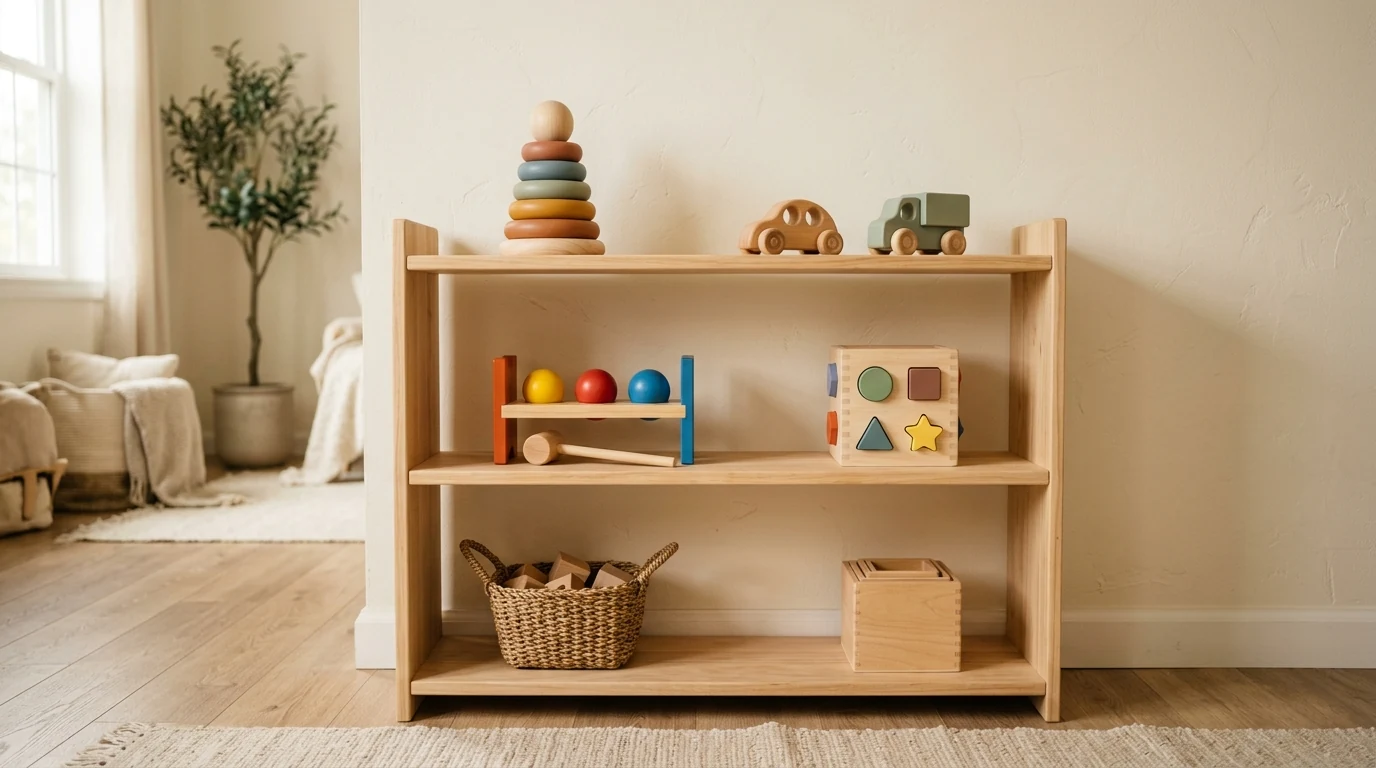
Set Up a Low Shelf
This doesn’t need to be an expensive Montessori shelf from Etsy. A bookshelf turned on its side, a low IKEA KALLAX unit, or even a sturdy cardboard box works. The point is that your child can see and reach everything on it without asking for help.
Place three activities on it based on what you observed in Week 1:
- Something they’re drawn to — maybe stacking with the Melissa & Doug Rainbow Stacker (~$16), maybe sorting, maybe art supplies
- Something for practical life — a small jug for pouring, a basket of socks to match, a spray bottle and cloth for wiping
- Something slightly challenging — one step above what they can easily do, like the Hape Double Bubble Bead Maze (~$22)
That’s your shelf. Three items. Not twelve.
For detailed shelf setup tips, see our Montessori Shelf Setup Guide.

The First-Shelf Formula
Your first shelf does not need to look complete. It needs to be readable to your child.
| Shelf spot | Simple example | Why it works |
|---|---|---|
| Practical life | small cloth, spray bottle with water, or sock-matching basket | real work with a clear finish |
| Fine motor | stacking cups, chunky puzzle, large beads, or posting box | hand control without too many pieces |
| Language or order | object basket, matching cards, or favourite books | vocabulary and classification without a worksheet |
Leave space between items. Put the activity back together after use. If your child dumps everything, reduce the shelf to two choices for a few days.

Week 3: Practical Life First
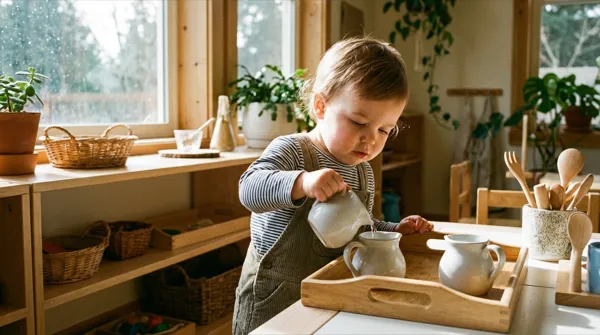
If there’s one area of Montessori that delivers the biggest return for the least investment, it’s practical life. These are real activities your child can do alongside you with things you already own.
Start with whichever ones match your child’s interests:
- Pouring — dry beans or Kinetic Sand (~$12) between two small jugs (start with big items, work down to water)
- Wiping — a sponge or cloth and a spray bottle with water
- Sweeping — a child-sized broom (or cut a regular one down)
- Food prep — tearing lettuce, washing fruit, spreading butter with a dull knife
- Dressing — pulling on socks, unzipping a jacket, choosing between two outfits
The mess will be real. The independence they build will be worth it.
For a full list, see our Practical Life Activities guide. If kitchen help is the thing your child wants most, start with Montessori kitchen activities or a small Montessori snack station instead of building a whole playroom.

Week 4: Adjust and Expand (Slowly)
By now you’ll notice what’s working and what isn’t. Some activities will be ignored. That’s fine — swap them out. Some will be used every day. Keep those.
Gradually add to your setup based on what your child shows you they need:
- If they love pouring/transferring — add spooning, tonging, threading with the Fat Brain Toys Squigz (~$35)
- If they love sorting — try colour sorting, size sorting, matching objects to pictures with the Melissa & Doug Shape Sorting Cube (~$18)
- If they crave movement — a balance board, obstacle course with cushions, or just more outdoor time
- If they want to help in the kitchen — a learning tower (or a sturdy step stool) and age-appropriate kitchen tasks
Add one new thing at a time. Not five.
How to Know What to Rotate
| What you see | What to do | Why |
|---|---|---|
| Used daily with focus | keep it out | repetition is the work, not a sign of boredom |
| Ignored for a week | remove it temporarily | the shelf should show real choices, not clutter |
| Dumped every time | simplify or model the ending | the sequence may be unclear |
| Too easy but still loved | add one tiny variation | keep confidence while adding challenge |
| Causes frustration every time | step back one level | independence grows from possible work |
For a fuller rotation rhythm, use the Montessori toy rotation guide. If your child is close to a specific age window, the activity guides for 12-18 months, 18 months, and 24-30 months can help you choose the next right-sized step.
What You Actually Need to Buy (and What You Don’t)
Worth buying:
- A low shelf of some kind (€10-30, secondhand is fine)
- A child-sized jug or pitcher (€5-8, or use a measuring cup)
- A few open-ended toys matched to your child’s age — quality staples like the Hape Pound & Tap Bench (
$30), Melissa & Doug Jumbo Knob Puzzle ($12), or Fat Brain Toys Tobbles Neo (~$25) — see our guides for 1-year-olds, 2-year-olds, or 3-4 year olds - A small broom/dustpan set (€8-12)
Not worth buying (yet):
- A floor bed (unless you’re already planning to transition — see our floor bed guide)
- A full set of Montessori materials (these are designed for classrooms, not homes)
- Matching wooden everything (your child doesn’t care if the broom matches the shelf)
- A learning tower (a step stool works fine to start)
Already in your house:
- Measuring cups and spoons
- Sponges and spray bottles
- Baskets for sorting
- Scarves, socks, and clothespins
- Kitchen utensils for food prep
Common Mistakes (and How to Avoid Them)
Doing too much at once
The number one reason parents burn out on Montessori is trying to implement everything simultaneously. You don’t need a Montessori bedroom, bathroom, kitchen, and playroom by next Tuesday. Pick one area. Get comfortable with it. Expand when it feels natural, not forced.
Buying before observing
Every child is different. The toy that one parenting blog swears by might bore your child completely. Watch your child first, buy based on what you see, not what an algorithm recommends. We talk about this trap in our 7 Common Montessori Mistakes post too.
Comparing to Instagram
Someone else’s beautifully curated, neutral-toned playroom is their space, not yours. Montessori is a philosophy about respecting children’s development, not an interior design aesthetic. A messy shelf that your child actually uses beats a beautiful one they don’t.
Expecting immediate results
Your child might ignore the new shelf for days. They might dump everything on the floor. They might only want to do one activity. This is all normal. The shift from passive entertainment to active exploration takes time — especially if your child is used to battery-operated toys or screen time.
The Mindset Shift That Matters Most
More than any toy or shelf arrangement, the single most important Montessori change is this: slow down and let your child struggle a little.
When they’re trying to put on a shoe and it’s taking three minutes, don’t take over. When they’re pouring water and spilling half of it, hand them the sponge instead of cleaning it yourself. When they’re choosing which shirt to wear and it’s taking forever, wait.
Independence is built in the space between “I can’t do it” and figuring out that they can. Your job is to prepare the environment so they have opportunities to try, and then step back far enough that they actually get to.
That’s Montessori. Not the shelf. Not the toys. The willingness to let your child lead.
How We Built This Starter Plan
This guide is written for home use, not for recreating a certified Montessori classroom. The sequence prioritises observation, one prepared area, practical life, and slow rotation because those are the changes most families can actually maintain.
We reviewed this article against Exploritori’s Montessori-at-home library in June 2026 and strengthened the parts parents usually need first: what to observe, what to put out, what to skip, how to rotate, and where to go next. Product links are included only where a specific example helps explain the setup; household alternatives are usually enough to begin. Some links may be affiliate links, which can earn Exploritori a commission at no extra cost to you.
FAQ
What age should I start Montessori at home?
Any age. Seriously. The principles apply from birth through primary school. For babies, it’s about creating a safe space for exploration. For toddlers, it’s practical life and independence. For preschoolers, it’s more structured activities and early academics. You haven’t missed the window.
Do I need to follow Montessori “rules” exactly?
No. Montessori at home is not Montessori school. You don’t need certified materials, a three-hour work cycle, or silence during activities. Take the principles that resonate — independence, observation, prepared environment, hands-on learning — and adapt them to your family’s reality.
My child just wants to play with regular toys. Is that OK?
Yes. Play is learning. A child building a tower with LEGO is doing spatial reasoning. A child role-playing with dolls is developing social cognition. Montessori isn’t about eliminating toys — it’s about adding purposeful activities alongside them. Over time, you may notice your child gravitating more toward hands-on, open-ended play.
How do I handle screen time in a Montessori home?
This is its own whole topic — we wrote a full post on Montessori and Screen Time. The short version: reducing screens creates a vacuum that hands-on activities naturally fill. But going cold turkey overnight usually backfires. Gradual replacement works better.
My partner/family thinks this is weird. How do I handle that?
Don’t lead with philosophy. Lead with results. “She can pour her own water now” is more convincing than explaining sensitive periods and the absorbent mind. Let the child’s growing independence make the case. Most skeptics come around when they see a toddler happily sweeping the floor instead of melting down over screen time.
 Get weekly Montessori tips
Honest reviews, activity ideas, and budget-friendly picks — no spam, just what works.
Subscribe Free