Montessori Activities for 12-18 Month Olds at Home: Simple, Safe Ideas
· Updated
The 12 to 18 month stage is wonderfully awkward.
Your child is not quite a baby in the old way, but not yet a steady toddler either. They may be walking, cruising, climbing, pointing, carrying things, posting objects into every available gap, emptying baskets, opening cupboards, and trying very hard to be useful.
Montessori activities for 12-18 months should respect that in-between stage.
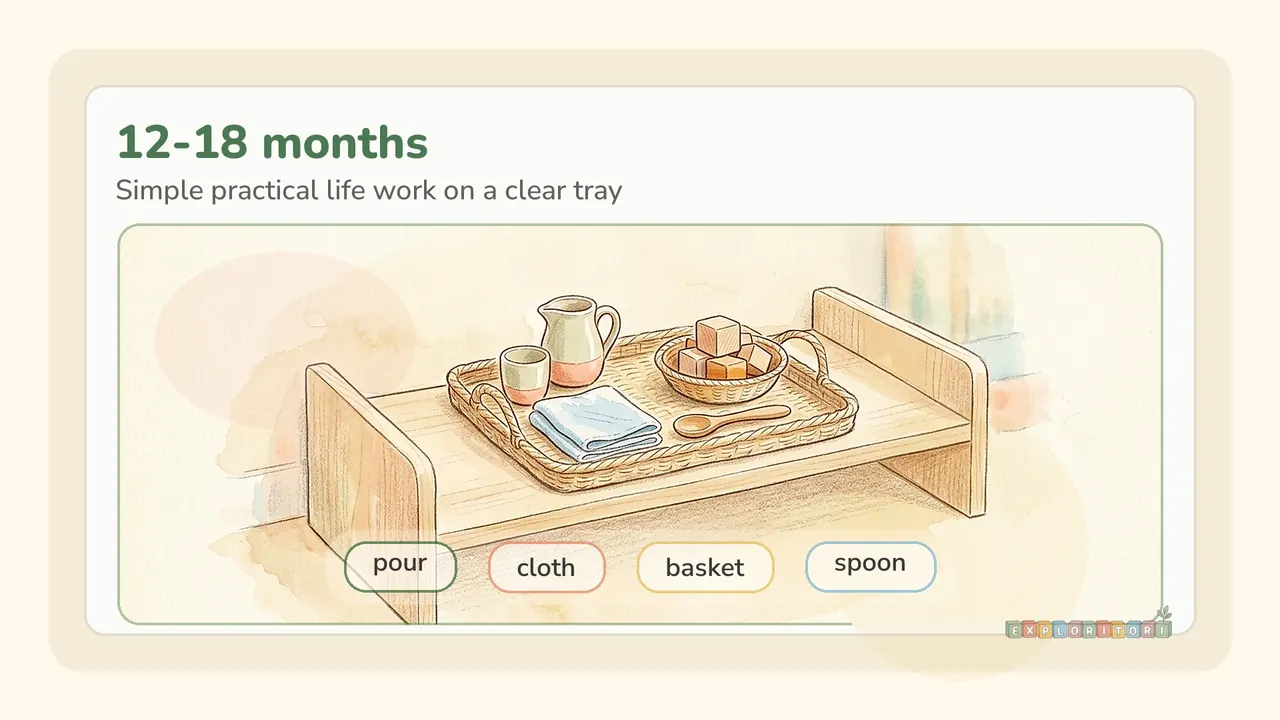
This is not the time for a crowded shelf, tiny beads, complicated matching games, or activities that need a long adult explanation. It is the time for simple work with a clear beginning and end: put in, take out, carry, wipe, pour a little, match one object, choose a book, push a ball, hand you a sock, help with snack.
At this age, “activity” does not need to mean a laminated printable or a special toy. It often means preparing one small part of daily life so your child can join in safely.
That is where Montessori at home becomes useful.
Safety note: Children between 12 and 18 months still explore with their mouths and move unpredictably. Use large, sturdy, non-toxic materials; avoid choking hazards, magnets, button batteries, cords, glass, sharp tools, hot liquids, and unstable climbing setups; and supervise closely.
What changes between 12 and 18 months
The biggest change is that your child wants more participation.
They may not have the coordination to do a task neatly, but they understand far more than they can say. They watch what you do, copy small movements, and repeat actions that create an interesting result.
Common interests at this age include:
- putting objects into containers
- taking objects out again
- carrying one thing from place to place
- opening and closing lids
- pushing, rolling, and dropping balls
- turning pages
- wiping with a cloth
- matching familiar objects
- climbing onto low surfaces
- helping with snack or laundry
This is also an age of big feelings. A child who wants to help may melt down when the task is too hard, too long, or too controlled by an adult.
The solution is not to make the activity more impressive. It is usually to make it smaller.
One basket. Three objects. One movement. A clear finish.
Takeaway: the best activities for 12-18 months are simple enough for your child to understand, but real enough to feel meaningful.
Quick activity chooser
Use what your child is already doing as the clue. The “best” activity is usually the one that matches today’s movement, mouthiness, and attention span.
| What you see today | Start with | Make it easier by |
|---|---|---|
| Everything goes into the mouth | Scarf pulling, sock basket, board books, or large ball posting | Using washable cloth, whole socks, and balls too large to swallow |
| Every basket gets dumped | Basket transfer with 2-3 large objects | Offering one basket at a time and modelling one slow return |
| Your child follows you around wanting to help | Wiping a placemat, laundry helper, or snack helper | Giving one job: one cloth, one sock, one napkin |
| Your child wants to climb or carry | Low movement path or basket carrying | Clearing the route and using a light basket |
| Your child points, names, or brings books | Object permanence basket or board book basket | Choosing 3-4 familiar objects rather than picture cards |
| Your child is calm with hand work | Opening containers, posting, or tiny pouring | Loosening lids, using only two balls, or pouring tablespoons of water |
If nothing works for more than a minute, that is not a failed Montessori day. Try a movement activity, go outside, or fold the activity back into a real routine like snack cleanup.
If your child is right around 18 months
Eighteen months sits on the edge of two stages. Some children still need the mouthing-safe, two-object activities in this guide. Others are ready for more toddler-style work with a longer sequence: pour, wipe, carry to the sink, return the towel.
Use this guide if your child still explores mostly by dumping, mouthing, carrying, opening, closing, and repeating one movement. Stay with large materials, very small choices, and close supervision.
Move toward the dedicated 18-month Montessori activities guide if your child can follow a short routine, copy two steps, carry a tray with help, or stay with one real-life task for several minutes. You do not need to switch everything at once. Keep one familiar 12-18 month activity on the shelf and add one slightly longer practical-life job.
| If your 18-month-old is mostly… | Try from this guide | Add next |
|---|---|---|
| Dumping and mouthing | Scarf pulling, basket transfer, board books | Fewer objects and more movement first |
| Opening every container | Opening and closing containers | A simple snack or laundry helper job |
| Following you around | Wiping a placemat or carrying one napkin | A two-step practical-life routine |
| Climbing and carrying | Low climbing and basket carrying | Outdoor or gross-motor work before shelf time |
How to set up a Montessori shelf for 12-18 months
For this age, a shelf is less about display and more about clarity.
Two to four activities are plenty. If your child is walking and exploring the whole room, even two may be enough. You can rotate more often rather than putting everything out at once.
Try this basic setup:
- one posting or container activity
- one movement activity
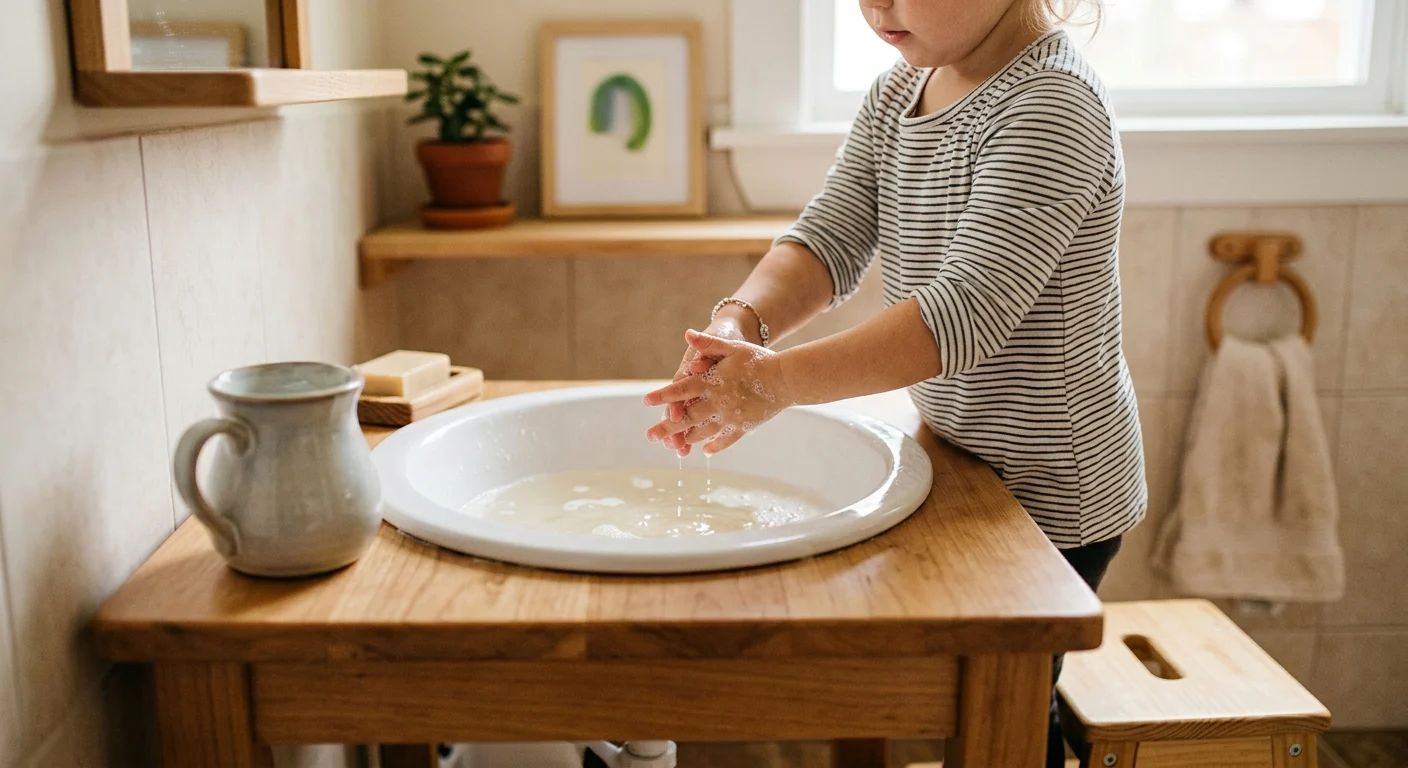
- one practical life item
- one book or language basket
Keep each activity complete. If the basket is for ball posting, it should have the box and the balls. If the tray is for wiping, it should have the cloth and the small surface or placemat. If the basket is for object matching, it should have just a few familiar objects.
Avoid half-activities. A random pile of pieces may be interesting for a minute, but it does not help your child know what to do next.
Also avoid overfilling.
At 12 to 18 months, more pieces often means more dumping. That is not bad behaviour. It is usually the child showing you that the setup is too much for their current control.
Start with fewer objects than you think:
- 2 balls
- 3 scarves
- 4 large blocks
- 2 matching objects
- 1 cloth
- 1 small basket
You can always add more later.
Takeaway: a calm shelf for 12-18 months gives your child a small number of clear choices, not a miniature toy shop.
Five-minute setup audit
Before you rotate anything, check the setup from your child’s height.
| Check | Good sign | Change it if… |
|---|---|---|
| Safety | Every object is too large to swallow and sturdy enough for mouthing | You see beads, coins, tiny lids, magnets, button batteries, or splintery pieces |
| Choice load | There are 2-4 complete choices | The shelf looks full, mixed, or decorative |
| Reset | You can reset the activity in under a minute | Pieces migrate everywhere or need adult sorting |
| Purpose | Each basket has one clear movement | It is just a pile of unrelated toys |
| Mess boundary | Water, snack, or wiping work has a towel/tray/cloth ready | Cleanup depends on you running across the room |
For a broader shelf framework, pair this with the Montessori shelf setup guide or the age-by-age shelfwork guide for 6-36 months.
14 Montessori activities for 12-18 months
Choose two or three for this week. Repeat them often. Repetition is not a problem at this age; it is the work.
1. Posting balls into a box
Use a sturdy box with a large round hole, or a container with a wide opening. Offer two or three large balls that cannot be swallowed.
Show your child how to place one ball into the opening and listen for it to drop.

This activity builds hand-eye coordination, problem solving, and the idea that an object can disappear and return. If your child loves it, keep it out for several days.
Make it easier: use a wider opening and only one ball. Make it harder: use two differently textured balls and name them as your child posts each one.
2. Object permanence basket
Place a few familiar objects in a basket: a spoon, a small brush, a soft ball, a wooden ring, or a cloth.
Name one object, pick it up slowly, and place it back. Later, ask, “Where is the spoon?” and let your child find it.
Do not turn this into a test. It should feel like shared attention, not performance.
3. Opening and closing containers
Offer two or three safe containers with easy lids: a small tin with no sharp edges, a wooden box, a fabric pouch, or a plastic food container.
Put one object inside each container. Your child opens, finds the object, closes, and repeats.
This is excellent practical problem solving. It also buys you a surprisingly peaceful five minutes if the lids are matched to your child’s ability.
If every lid causes frustration, pre-loosen it. At this age, the win is repeating the open-close movement, not mastering a tight container.
4. Scarf pulling
Place three or four lightweight scarves or cloths inside an empty tissue box or soft fabric bag.
Show your child how to pull one scarf out slowly. Then let them continue.
This builds grasp, arm movement, and cause-and-effect understanding. It is also a good reminder that babies and young toddlers do not need fancy materials to concentrate.
5. Basket transfer
Put a few large objects in one basket and an empty basket beside it.
Your child moves the objects from one basket to the other. Use safe objects with enough weight to feel satisfying: fabric balls, wooden rings, large blocks, or rolled socks.
If your child dumps the basket, reduce the number of objects and model one slow transfer.
If your child throws hard objects, switch to rolled socks or fabric balls. The same transfer pattern stays intact, but the room becomes calmer.
6. First spooning with large objects
At the older end of this range, some children enjoy early spooning.
Use two bowls and a toddler spoon. Start with large dry pasta, cotton balls, or big felt balls rather than rice or lentils.
The goal is not perfect scooping. The goal is learning the movement: scoop, carry, tip, repeat.
Skip this if your child still mouths everything or becomes frustrated immediately.
If spooning is too much, offer hand transfer first. Many children need weeks of whole-hand transfer before a spoon makes sense.
7. Tiny water pouring
Water pouring can work for some 15 to 18 month olds, but keep it tiny.
Use a small pitcher with only a few tablespoons of water, one cup, and a towel. Show the pour slowly and include wiping as part of the activity.
If your child dumps the whole pitcher, that is information. Try dry pouring, sponge squeezing, or water work another day.
For a child closer to 18 months who loves water, the next step is the dedicated Montessori water practical life guide.
8. Wiping a placemat
Give your child a small damp cloth and one placemat, tray, or low table.
Show one slow wiping movement. Then hand them the cloth.
This is one of the easiest practical life activities to start because spills and wiping already happen in real life. Your child gets to help with something they see adults do every day.
If wiping becomes a favourite routine, keep the setup tiny: one cloth, one placemat, and one place for the wet cloth to go. The fuller Montessori cleaning tools guide explains when to add a child-sized broom, dustpan, or spray bottle without overwhelming this age.
9. Laundry helper
Offer a small basket with a few clean socks, cloths, or bibs.
Your child can carry the basket, pull items out, hand them to you, or place them in a drawer with help.
This is not about folding. It is about participation, carrying, matching simple routines, and feeling useful.
10. Snack helper
Invite your child to place a napkin on the table, carry a banana to the snack spot, put a cup on a mat, or hand you a spoon.
Keep the job tiny and real.
A 14-month-old may only carry one napkin. That still counts. Practical life begins with belonging, not efficiency.
11. Board book basket
Choose three or four sturdy board books with real images, clear illustrations, or familiar routines.
Place them in a low basket. Sit nearby, name what your child points to, and let them turn pages.
At this age, reading may look like flipping, pointing, closing, opening, and wandering away. That is fine. The goal is a warm relationship with books and language.
12. Matching object to object
Start with real objects, not picture cards.
Use two pairs: two socks, two spoons, two wooden rings, or two small brushes. Place one of each in front of your child and keep the matching pair in a basket.
Show one match: spoon to spoon. Then pause.
If that is too hard, simply name and explore the objects together.
13. Push and roll
Use a soft ball, wooden car, or rolling cylinder on the floor.
Roll it slowly to your child. Let them push it back, chase it, or carry it.
This supports movement, tracking, turn-taking, and coordination. It is especially useful for children who need whole-body work before they settle into shelf activities.
14. Low climbing and carrying
Prepare a safe movement area: a firm cushion, low step, tunnel, or clear path for carrying a basket.
At 12 to 18 months, movement is not a break from learning. Movement is learning.
Your child is working on balance, judgment, strength, and confidence. Keep the setup low, stable, and supervised.
Takeaway: the best activities in this age window are ordinary, repeatable, and easy to reset.
What to skip at 12-18 months
Some Montessori-style activities are better later.
Skip tiny beads, small pom poms, coins, marbles, dried beans, magnets, button batteries, sharp tools, heavy glass, long cords, and anything that requires your child to sit still for a long adult-led lesson.
Also be cautious with activities that look good online but do not match your child yet.
If your child mouths everything, use larger materials. If they throw hard objects, switch to soft ones. If they dump every basket, offer fewer objects. If they walk away after ten seconds, the activity may be too hard, too easy, or simply not interesting today.
Montessori observation is not a trick. It is just paying attention and adjusting.
If you want to buy one or two materials, use the same standard. Choose something large, sturdy, open-ended, and useful for months: a knob puzzle, a posting box, a small basket, a washable cloth set, or a ball that can roll, carry, and post. The Montessori toys by age guide can help you separate useful materials from shelf filler.

A simple weekly rhythm
You do not need a new setup every morning.
Try this:
| Day | Put out | Real-life routine to invite |
|---|---|---|
| Monday | Posting balls plus board books | Carry one book back to the basket |
| Tuesday | Repeat Monday if it worked | Name the ball, book, or basket slowly |
| Wednesday | Container opening plus wiping a placemat | Wipe snack table with one damp cloth |
| Thursday | Repeat container work or simplify to scarf pulling | Put cloths in the laundry basket |
| Friday | Basket transfer plus snack helper | Carry one napkin or banana to the table |
| Weekend | Low movement path plus laundry helper | Carry socks, bibs, or soft cloths |
Keep the rhythm loose. If your child loves one activity, repeat it. If an activity causes chaos, simplify it.
For the next age step, see our guide to Montessori activities for 18-month-olds. If your child still prefers baby-style exploration, the 9-12 month activity guide may be a better match for a little longer. For broader shelf planning, use Montessori shelfwork by age.
Troubleshooting common problems
| Problem | Likely cause | Try this |
|---|---|---|
| The activity is dumped immediately | Too many pieces, too open-ended, or too much energy | Use 2-3 objects, switch to soft materials, or do movement first |
| Your child walks away fast | The setup is too hard, too easy, or badly timed | Try after snack/nap, loosen the lid, or choose a real-life job |
| Water work becomes a flood | Too much water or no cleanup boundary | Use tablespoons of water, a tray, and one towel; stop before it gets frantic |
| Your child only wants adult tools | They want to join real work | Offer one safe version of the real task: cloth, spoon, sock, napkin |
| Siblings disrupt the setup | The activity is in a high-traffic area | Move it to a corner or make it a shared basket with larger pieces |
The pattern is simple: reduce the number of pieces before you add a new activity.


How we reviewed this guide
This is a practical home activity guide, not a formal product review or medical developmental plan. We reviewed it against Exploritori’s Montessori-at-home library in July 2026 and prioritised activities that use ordinary household materials, have a clear movement, can be made easier without buying anything, and are realistic for children who still mouth, dump, carry, climb, and need close supervision.
Affiliate links may appear elsewhere on Exploritori, but this guide does not require special materials. If you do buy something for this stage, start with one sturdy, age-fit item that solves a real setup problem.
FAQ: Montessori activities for 12-18 months
What Montessori activities are best for 12-18 months?
The best activities are simple and repeatable: posting balls, opening containers, scarf pulling, basket transfer, wiping, snack help, board books, object matching, push-and-roll games, and safe movement practice.
How many activities should I put out?
Two to four choices are usually enough. If your child dumps everything or cannot settle, reduce the shelf. A small number of clear choices is better than a crowded shelf.
Do I need special Montessori materials?
No. Home materials are often better at this age because they connect to real routines. Baskets, cloths, cups, spoons, socks, containers, balls, and board books can carry most of the work.
Are small objects safe for this age?
Often, no. Many 12 to 18 month olds still mouth objects. Use large materials, supervise closely, and avoid anything that could fit fully in your child’s mouth.
What if my child just dumps everything?
Dumping is common. Offer fewer items, use heavier or larger objects, model putting one object back, and choose activities with a clear container. If the energy stays frantic, try a movement activity first.
Final thoughts
Montessori activities for 12-18 months should feel calm, useful, and possible.
Your child is learning how the world works through their whole body: hands, mouth, feet, balance, eyes, and ears. They need chances to repeat small actions in a prepared space, but they do not need a perfect shelf or expensive materials.
Start with one real movement.
Put in. Take out. Wipe. Carry. Open. Close. Roll. Point. Help.
That is enough for today.
 Get weekly Montessori tips
Honest reviews, activity ideas, and budget-friendly picks — no spam, just what works.
Subscribe Free