Montessori Shelfwork by Age: 6 to 36 Months
· Updated
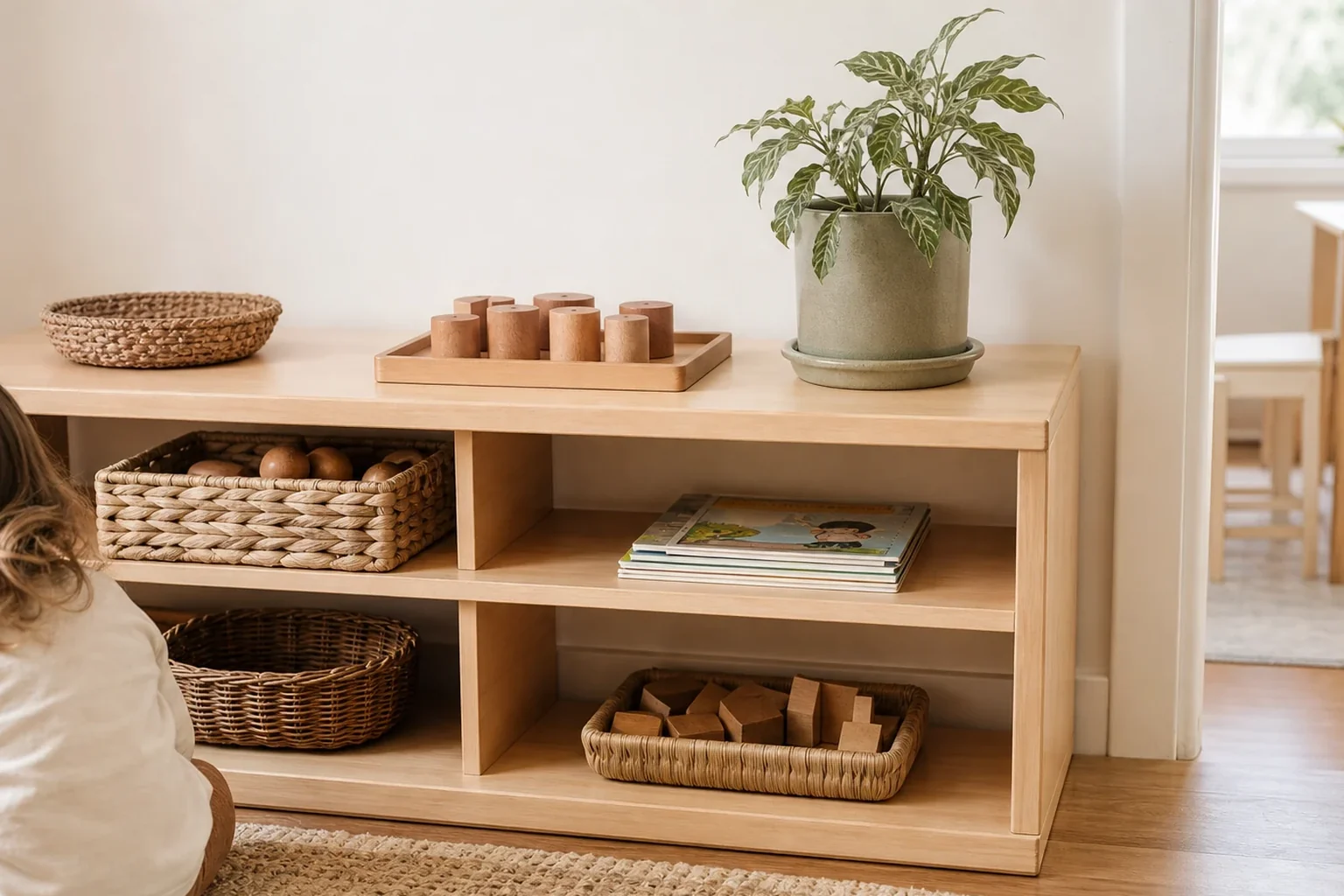
A Montessori shelf is not a display case for flawless toys.
It is a working surface for your child.
The goal is simple: your child should be able to see what is available, choose one thing, carry it to a mat or table, use it, and put it back.
That sounds easy until the shelf fills with too many toys, mismatched baskets, random pieces, and well-meaning activities that are either too babyish or too hard.
This guide gives you practical Montessori shelfwork ideas by age, from 6 to 36 months, without pretending every child develops on the same schedule.
Use the ages as a starting point. Then watch your actual child.
If you need the physical setup first, our Montessori shelf setup guide covers shelf height, spacing, baskets, and room layout. This article focuses on what to put on the shelf at each stage.
Safety note: Always follow current manufacturer age guidance and recall notices, and inspect materials for small parts, loose pieces, magnets, cords, damage, peeling finishes, and choking hazards. Use close supervision for babies and toddlers, especially with water, food, beads, threading materials, and any cutting or tool practice.
The shelf rule that matters most
The most useful Montessori shelf rule is this:
Each choice should be complete.
A complete activity is not a bin of mixed toys. It is one clear thing your child can take and use.
Examples:
- a knob puzzle
- a basket with three matching objects
- a posting box with six large pieces
- a tray with two bowls and a spoon
- a ring stacker
- a pouring setup
- a language basket
The shelf should not ask your child to dig, sort through clutter, or negotiate a pile before they begin. The activity should already make sense.
For most homes, this is enough:
| Age | Good starting number |
|---|---|
| 6-12 months | 3 to 4 choices |
| 12-18 months | 4 choices |
| 18-24 months | 4 to 5 choices |
| 24-36 months | 5 to 6 choices |
If your child dumps everything, reduce the number before buying anything new.
Quick shelf chooser by age
Use this table when you are standing in front of the shelf and deciding what earns space today.
| Age | Put out first | Skip for now | What you are watching for |
|---|---|---|---|
| 6-9 months | Grasping basket, soft ball, safe textured object | Tiny loose pieces, cards, anything that flakes or splinters | Reaching, mouthing, passing hand to hand |
| 9-12 months | Object permanence box, large balls, stacking cups | Threading, sorting cards, bead-style materials | Dropping, posting, pulling out, crawling toward work |
| 12-18 months | Posting box, ring stacker, knob puzzle, wiping cloth | Multi-step trays, small puzzle pieces, pretend worksheets | Carrying, opening, closing, imitating adults |
| 18-24 months | Spoon transfer, matching socks, simple puzzle, language basket | Full water pouring if spills still derail the morning | Repetition, matching, returning pieces with help |
| 24-30 months | Water pouring, colour sorting, snack setup, practical-life tray | Long cutting or lacing work without direct adult support | Longer focus, simple sequences, pride in cleanup |
| 30-36 months | Sequencing cards, plant care, table setting, early art tray | Abstract academic work that has no real purpose | Planning, choosing a mat, completing and returning work |
The best shelf usually has one easy win, one practical-life option, one fine-motor material, and one language or matching material. If all four choices demand the same skill, the shelf will look tidy but feel narrow.

Use the age bands as a ladder, not a promise. If your child is still mouthing small objects, skip beads, cards, and loose pieces. If a tray turns into dumping every time, move back to fewer pieces or a simpler container activity. Readiness beats the label on the calendar.
6 to 9 months: grasping, mouthing, and reaching
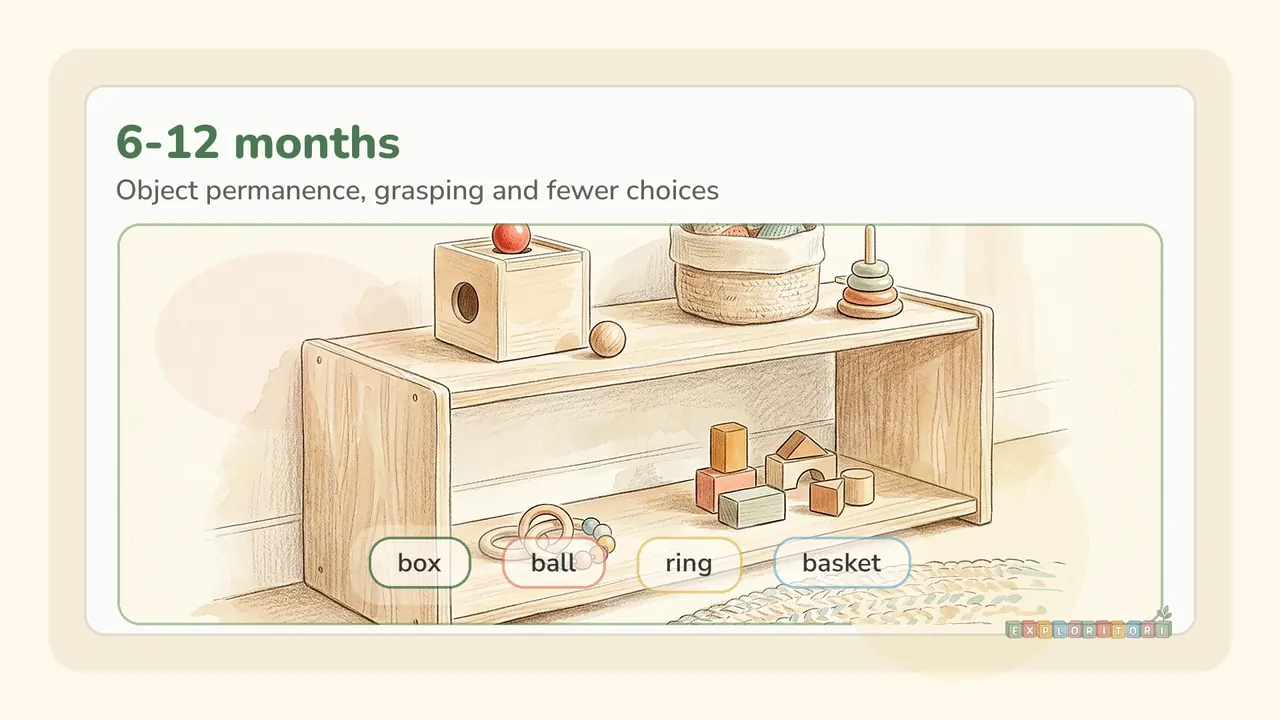
At this stage, the shelf is mostly for simple access. Your baby is learning to reach, grasp, mouth, pass objects between hands, and track movement.
Good shelf ideas:
- a soft ball or textured fabric ball
- a wooden ring or rattle
- a small basket with two safe household objects
- a rolling object for tummy time
- a simple cloth for peekaboo
- a mirror nearby, safely secured
Keep the shelf extremely calm. A baby does not need ten choices. They need a few objects that are safe, interesting, and easy to explore.
If your baby is not crawling yet, put the material within reach during floor time rather than expecting shelf independence.
Useful signs to watch:
- reaching with both hands
- passing objects hand to hand
- tracking rolling objects
- mouthing everything
- turning toward sounds
When your baby starts crawling toward objects intentionally, the shelf becomes more meaningful.
9 to 12 months: object permanence and simple cause-and-effect
At 9 to 12 months, many babies want to put things in, take things out, drop things, bang things, and repeat the same action over and over.
Good shelf ideas:
- object permanence box
- basket of large balls
- simple stacking cups
- container with fabric squares to pull out
- large knob puzzle with one or two pieces
- treasure basket with safe household textures
This is a good moment for simple cause-and-effect work. Not noisy electronic toys. Real physical cause and effect:
- ball disappears, then returns
- cup stacks, then falls
- cloth goes in, cloth comes out
- lid opens, lid closes
If you want one classic material, an object permanence box can work well for this stage, but a homemade posting box can teach the same idea.

12 to 18 months: posting, stacking, and first practical life
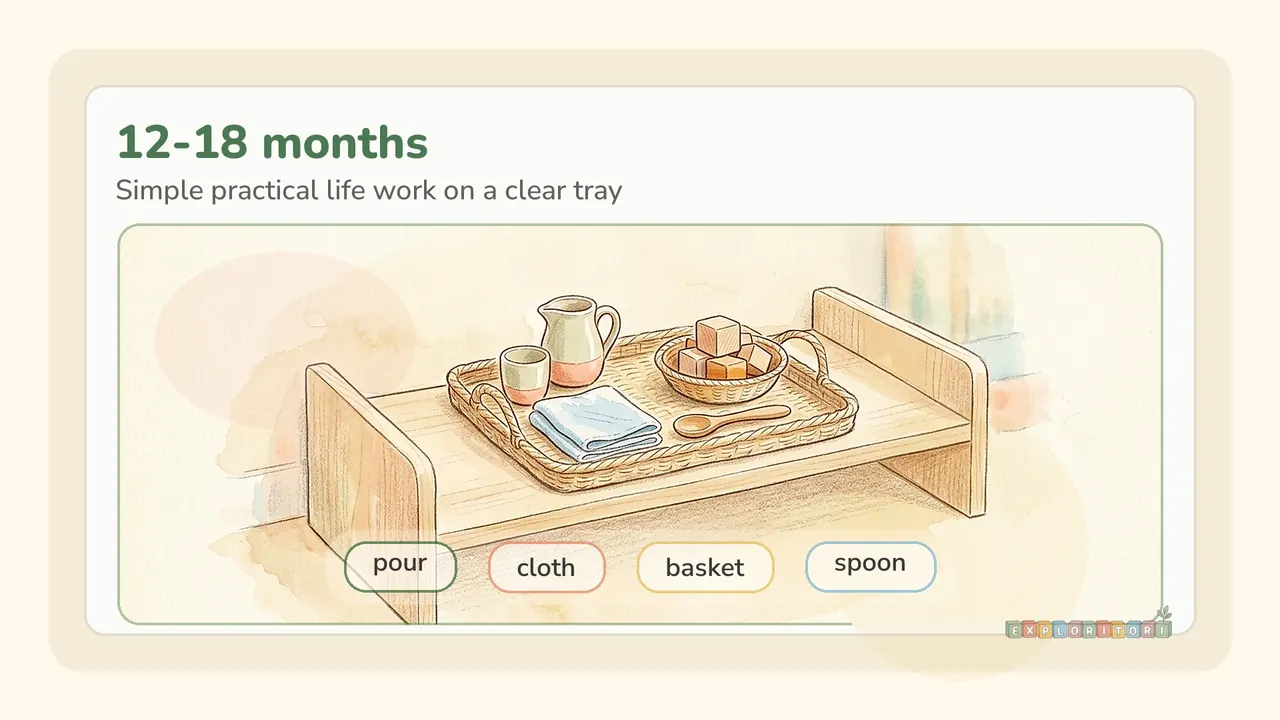
Around one year old, many children become obsessed with real movement: carrying, pushing, posting, stacking, opening, closing, wiping, and imitating adults.
Good shelf ideas:
- posting container with large blocks
- ring stacker
- nesting cups
- jumbo knob puzzle
- basket of matching household objects
- cloth for wiping
- simple open-close basket with safe containers
Keep practical life very small. Your child may not be ready for a full pouring tray, but they can carry a cloth, put socks in a basket, wipe a tiny spill, or move objects from one container to another.
This is also when many parents accidentally offer too much. A one-year-old shelf can look almost empty to adults and still be rich for the child.
One fine motor option, one puzzle, one posting activity, one practical-life object, and one familiar favourite is plenty.
For toy ideas by developmental stage, our Montessori toys by age guide gives a broader buying framework. If your child is right at the start of this range, the refreshed 12-18 month activity guide gives more concrete tray ideas using household materials.
18 to 24 months: movement, matching, and useful repetition
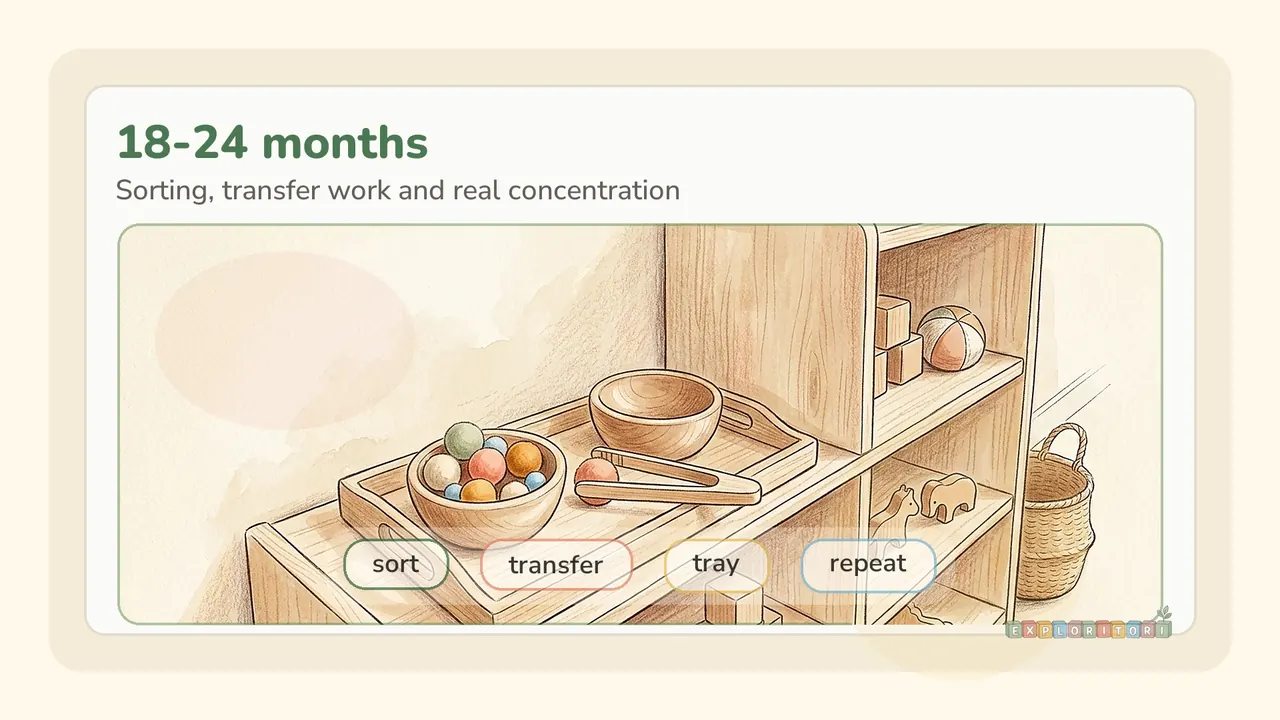
At 18 to 24 months, toddlers often want to do real household work but still need the job simplified.
Good shelf ideas:
- spoon transfer tray
- simple shape sorter
- matching socks or fabric squares
- two-piece or three-piece puzzle
- posting box with narrower slot
- basket of language objects
- stacking blocks or cups
This is a strong age for activities using things you already have. You can make a complete shelf with no new toys:
- two bowls and a spoon
- three pairs of socks
- a box with a slot
- a small cloth
- a basket of kitchen objects
- a few blocks
Our Montessori activities for 18-month-olds goes deeper into no-special-toy setups for the start of this stage. When those activities become too easy but preschool work is still too much, move into the narrower 21-24 month activity guide before jumping ahead.
The key is repetition. If your toddler chooses the same spoon transfer every morning, do not rush to rotate it. Repetition is how the skill settles.

24 to 30 months: longer work and real choices
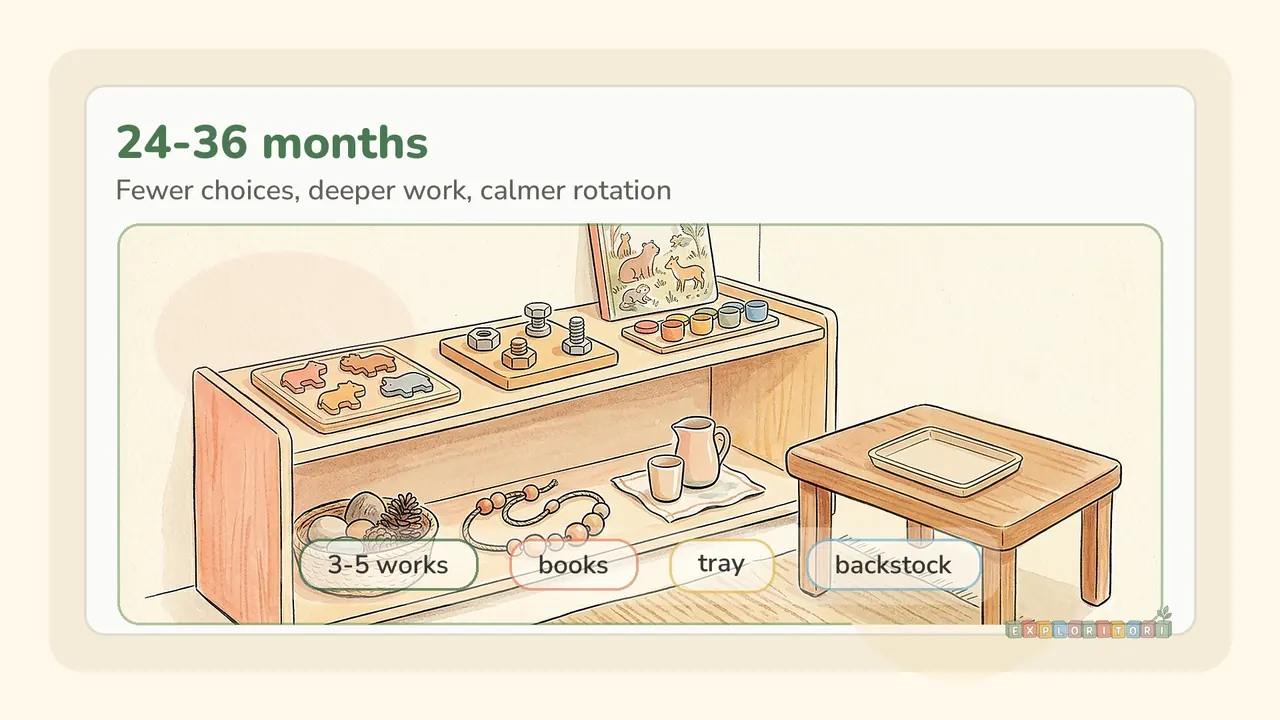
Two-year-olds can often manage more complex sequences, especially when the environment is calm.
Good shelf ideas:
- pouring with water
- matching cards or objects
- simple cutting practice with safe tools and soft food, right beside an adult
- knob puzzle or jigsaw puzzle
- threading large pieces, only if your child no longer mouths them
- sorting by colour or size
- practical-life tray for snack setup
- pretend-play object basket rooted in real life
At this age, you can begin balancing the shelf by type:
- one fine motor activity
- one practical-life activity
- one language or matching activity
- one puzzle
- one open-ended material
- one easy familiar activity
Do not make every item challenging. A shelf full of hard work creates avoidance. Every toddler needs one or two choices that feel easy and satisfying.
If your child is in a dumping phase, remove multi-piece sets for a week and offer fewer activities with clearer boundaries. If 24-30 month work still feels too hard, step back to the 21-24 month guide; if it feels too easy, use the 30-36 month guide for longer sequences.
30 to 36 months: independence, language, and early planning
Older toddlers and young three-year-olds often begin to handle longer activity loops:
- choose work
- bring it to a mat
- complete several steps
- clean up
- return it
Good shelf ideas:
- sequencing cards
- beginner practical-life trays
- simple counting baskets
- matching objects to pictures
- early art tray with limited materials
- floor puzzle with a small number of pieces
- dressing frame-style practice using real clothes
- flower arranging or plant care
This is also a good age for rotating by interest. If your child talks about vehicles, make a language basket with vehicles. If they want to help in the kitchen, offer a snack tray. If they love nature, rotate in leaves, pine cones, shells, or seasonal objects.
You do not have to turn the shelf into school. Follow the interest, then simplify it into one clear activity.
Our Montessori activities for 3-year-olds has more ideas for children who are ready for longer work.
What not to put on the shelf
The fastest way to improve a Montessori shelf is often removing things.
Avoid:
- mixed toy bins
- incomplete sets
- toys with missing parts
- noisy electronic toys
- activities that need constant adult rescue
- fragile items your child is not ready to handle
- too many options from the same skill area
If the shelf has five puzzles and no practical life, it will feel narrow. If it has five open-ended toys and no clear activity, it may invite dumping.
Balance matters more than an immaculate aesthetic.
A sample shelf for each age
Here are simple examples you can copy, then simplify.
| Age | Example shelf | Keep it realistic by |
|---|---|---|
| 9-12 months | Object permanence box, basket of balls, stacking cups, fabric pull basket | Leaving out only pieces that are safe to mouth and too large to choke on |
| 12-18 months | Jumbo knob puzzle, posting box, ring stacker, wiping cloth basket | Using four choices and repeating them longer than feels interesting to an adult |
| 18-24 months | Spoon transfer tray, matching socks, simple puzzle, language-object basket, stacking blocks | Choosing one transfer material at a time instead of mixing rice, beans, beads, and water |
| 24-36 months | Water pouring tray, sorting activity, threading or lacing, snack tray, matching cards, open-ended blocks | Keeping direct supervision for water, food prep, scissors, lacing, and any small parts |
These are not rules. They are starting points.
A first-week shelf rhythm
If you are resetting a shelf from scratch, do not rotate everything at once. Try this low-pressure rhythm instead.
| Day | What to do | What to write down |
|---|---|---|
| 1 | Put out only three or four complete activities | Which one your child chooses first |
| 2 | Keep the shelf the same | Whether the same activity gets repeated |
| 3 | Remove anything that gets dumped every time | What made the dumping tempting: too many pieces, unclear container, too hard |
| 4 | Add one practical-life option | Whether real work holds attention longer than toy work |
| 5 | Add one language or matching basket if the shelf still feels balanced | New words, pointing, matching, or sorting attempts |
| Weekend | Reset missing pieces and store backstock out of sight | Which activity deserves another week |
This rhythm pairs well with the weekly shelf rotation planner if you want a printable version, but a notes app or sticky note is enough.
How to know when to rotate
Rotate when you see one of these signs:
- your child no longer chooses the activity
- the material is being dumped every time
- the activity is clearly mastered
- the activity causes repeated frustration
- your child is showing a new developmental interest
- pieces are spreading around the room instead of being used
Do not rotate just because the calendar says Monday.
Observation beats schedule.
The best Montessori shelf is not the prettiest one. It is the one your child can actually use.
If you want a fuller rhythm for what to store, what to keep visible, and when to swap materials, read our Montessori toy rotation guide next or print the weekly shelf rotation planner for a one-page planning version.
Troubleshooting a shelf that is not working
| What you see | Likely cause | Try this first |
|---|---|---|
| Everything gets dumped | Too many pieces, mixed bins, or no clear endpoint | Reduce to three activities and use trays or baskets with obvious contents |
| Your child ignores the shelf | Choices are too hard, too easy, or not connected to current interests | Keep one favourite and swap only one material at a time |
| Pieces spread across the room | The activity is not complete or cleanup is too vague | Put each activity in its own basket and model return before adding novelty |
| Every choice needs adult rescue | The shelf is pitched above current independence | Step back one age band and rebuild with fewer steps |
| The shelf looks beautiful but play is frantic | Too many challenging or decorative materials | Add one familiar easy win and one real practical-life task |
For a crowded-room problem, read the small-space Montessori storage guide. For a child who wants real work more than shelf toys, move toward practical life activities, kitchen activities, or child-sized cleaning tools.
How we keep this guide practical
This article is based on Montessori-at-home principles that hold up in ordinary family rooms: visible choices, complete materials, child-height access, repetition, and observation before buying. We reviewed the age bands against Exploritori’s activity guides for 12-18, 18, 21-24, 24-30, and 30-36 months so the shelf suggestions connect to real developmental steps rather than a generic toy list.
Product examples are included only where they make a setup easier to understand. Household containers, cloths, socks, cups, baskets, and safe kitchen objects often work as well as bought materials. Some links may be affiliate links, which can earn Exploritori a commission at no extra cost to you.
The bottom line
A Montessori shelf by age should be simple, complete, and responsive.
For babies, offer safe objects for grasping, mouthing, and movement. For one-year-olds, add posting, stacking, and first practical life. For two-year-olds, offer clearer work with matching, pouring, sorting, and snack preparation. For three-year-olds, add longer sequences and more language.
Start small. Watch carefully. Rotate slowly.
That is enough to make the shelf useful.
FAQ
What should be on a Montessori shelf for a baby?
A baby shelf should be very simple: a few safe objects for grasping, mouthing, rolling, posting, object permanence, and early movement. Three or four choices is usually enough.
What should be on a Montessori shelf for a one-year-old?
A one-year-old shelf can include stacking, posting, simple puzzles, baskets for language, object permanence work, and early practical-life objects such as cloths or containers.
What should be on a Montessori shelf for a two-year-old?
A two-year-old shelf often works well with four to six activities: one fine motor material, one practical-life tray, one puzzle or matching activity, one language basket, one movement or gross motor option, and one familiar easy win.
How often should I change Montessori shelf activities?
Rotate when your child stops choosing an activity, has clearly mastered it, becomes frustrated by it, or shows a new interest. Many families rotate every one to two weeks, but observation matters more than the calendar.
Do I need an expensive Montessori shelf?
No. Any low, stable shelf can work if the choices are visible, complete, and easy for your child to carry and return.
 Get weekly Montessori tips
Honest reviews, activity ideas, and budget-friendly picks — no spam, just what works.
Subscribe Free