Montessori Gift Guide for Babies and Toddlers: What to Buy and What to Skip
· Updated
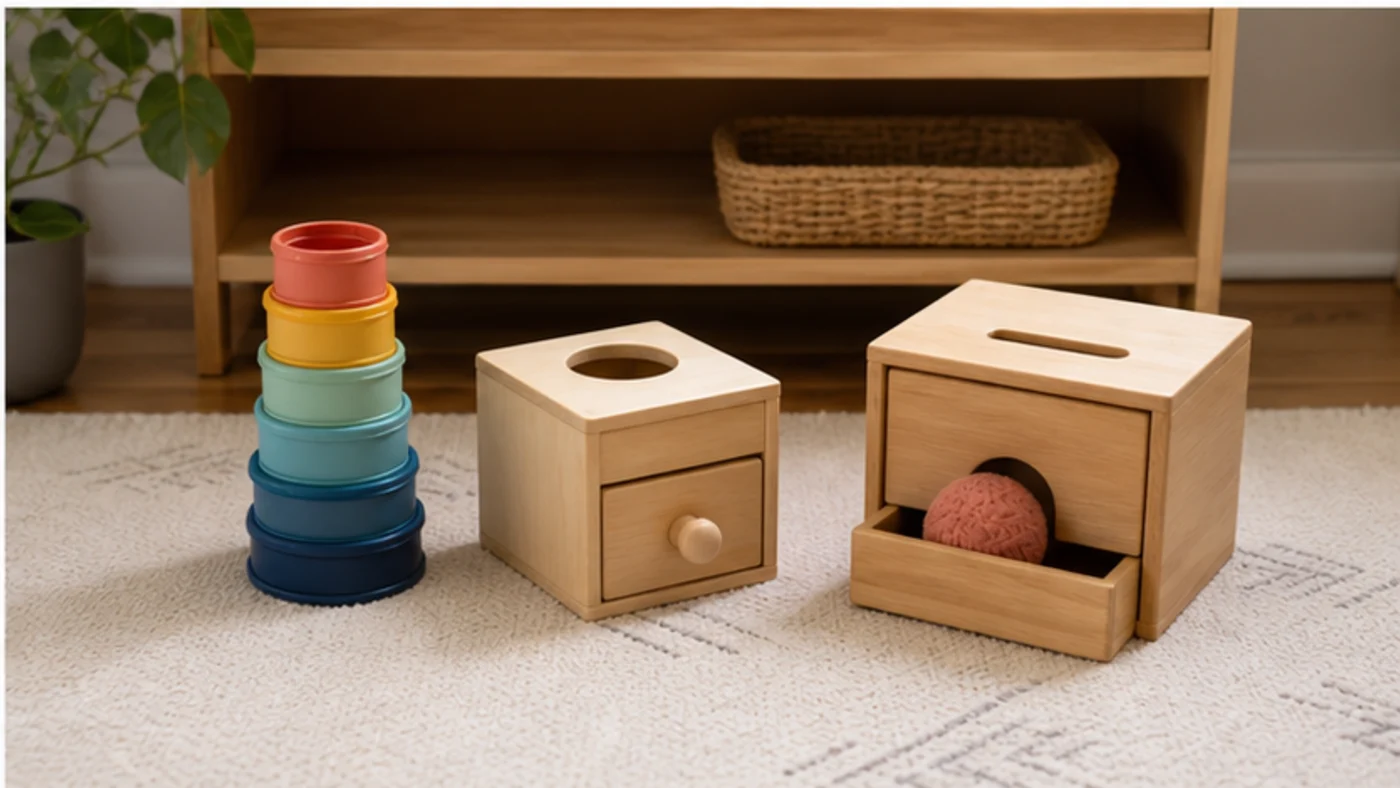
Buying gifts for babies and toddlers can get weirdly stressful.
You want something thoughtful. Useful. Beautiful, ideally. Then the internet starts throwing “Montessori” at every wooden object with rounded corners, and suddenly you are wondering whether a toddler needs a €60 neutral-coloured banana slicer to have a meaningful childhood.
Let’s make this simpler.
A good Montessori gift does not need to be trendy, beige, or expensive. It needs to match what your child is actually working on right now. Movement. Grasping. Repetition. Pouring. Carrying. Matching. Helping. That is the real filter.
So this guide is built around one question:
Will this gift give your child something meaningful to do, again and again?
If the answer is yes, it is probably a strong gift. If the answer is “well, it looks nice in a nursery reel,” we can do better.
Quick choice guide
| Situation | Best starting point | Why it helps | Better next read | |---|---|---| | You want the simplest option | Start with one low shelf or basket | Fewer choices make it easier for your child to focus | Montessori shelf setup | | You are buying for a baby | Choose grasping, movement, and object-permanence materials | They match what babies can actually use | Best Montessori toys for babies | | You are buying for a 1-year-old | Choose stacking, posting, carrying, and real-life tools | This age wants repetition and independence | Best Montessori toys for 1-year-olds | | You are buying for a 2-year-old | Choose practical life, open-ended building, and simple puzzles | They last longer than novelty toys | Best Montessori toys for 2-year-olds | | Your space feels cluttered | Rotate materials weekly instead of adding more | Calm environments usually work better than bigger collections | Toy rotation guide |
Buy, wait, or skip?
Use this before you fill a basket. Most gift mistakes happen because the item is good in theory but wrong for the child, the home, or the current stage.
| Gift category | Buy now when… | Wait when… | Usually skip when… |
|---|---|---|---|
| Grasping toys and rattles | Your baby is mouthing, holding, or tracking objects | You already have several easy-to-hold objects | It is heavy, painted loosely, or mostly decorative |
| Object permanence boxes | Your baby sits steadily and loves posting/drop games | Your baby is still mostly on tummy/back work | The pieces are small, awkward, or need constant adult resetting |
| Practical-life tools | Your toddler wants to wipe, sweep, pour, carry, or help | The tool is too big for real control | It is a toy version that does not actually work |
| Learning tower | Your toddler calmly follows simple kitchen limits | Climbing is impulsive or your kitchen is too tight | You need a gift that can be used without close supervision |
| Big wooden showpiece toys | Your child already builds, stacks, or creates with open-ended materials | Your basics are missing: blocks, puzzles, books, practical tools | You are buying it mostly because it looks beautiful |
The simplest rule: buy the gift that solves this month’s real problem. If your child is climbing, give safe movement. If they are posting everything into drawers, give a posting material. If they want your broom, give them a broom that actually sweeps.
🎁 What makes a gift Montessori in the first place?
A Montessori gift usually has a few things in common.
It is simple enough for your child to understand. It does not overwhelm them with buttons, sounds, or too many competing features. It lets your child do the work.
That might mean:
- grasping and shaking
- opening and closing
- posting and matching
- pouring and transferring
- climbing and balancing
- naming real objects
- repeating the same action until it clicks
The best Montessori-style gifts also tend to have a clear purpose. A shape sorter sorts shapes. A child-sized broom is for sweeping. A small pitcher is for pouring. The gift is not trying to teach colours, ABCs, animal sounds, and advanced diplomacy all at once.
And just to clear away one of the internet myths: a Montessori gift does not need to be wooden to be good. Wood can be lovely. It is not magical. A metal watering can, a glass snack bowl used with care, or a sturdy step stool can be far more “Montessori” than a pretty wooden toy that never gets touched.
Takeaway: the best Montessori gifts are purposeful, hands-on, and matched to your child’s real developmental work.
👶 Best Montessori gifts for babies (0-12 months)
Babies do not need a mountain of stuff.
They need a few interesting things they can actually use with their hands, eyes, mouth, and whole body. The strongest gifts at this stage support movement, grasping, visual focus, and the first little sparks of cause and effect.
1. A simple grasping toy or rattle
A lightweight wooden grasping toy is a classic for a reason. It gives your baby something real to hold, mouth, shake, and rotate.
The Hape grasping toy is a solid example: simple shape, easy to hold, no nonsense.
Why it works:
- supports grasp reflex and hand strength
- gives real sensory feedback through weight and texture
- invites repetition without overstimulating
2. An object permanence box or ball drop box
Around the second half of the first year, many babies become deeply interested in putting something in and seeing it come back out.
That is not random. It is the beginning of understanding that things still exist even when they disappear.
If you want a ready-made option, you can browse an object permanence box on Amazon. It is one of those gifts that looks almost too simple until you watch a baby repeat it with total seriousness.
3. A mirror and movement setup
Technically this is more of an environment gift than a toy gift, which is exactly why it is so good.
A low mirror, safe floor space, and a soft mat support rolling, reaching, tracking, and body awareness. For many babies, this creates more real development than a pile of novelty toys.
If you are building from scratch, a simple baby play mat is a practical starting point.
4. High-contrast cards or simple visual mobiles
For young babies, visual work matters. High-contrast cards or a very simple mobile can support focus and tracking without flooding the senses.
Look for strong black-and-white patterns or one clean visual idea, not loud clutter.
5. A treasure basket for older babies
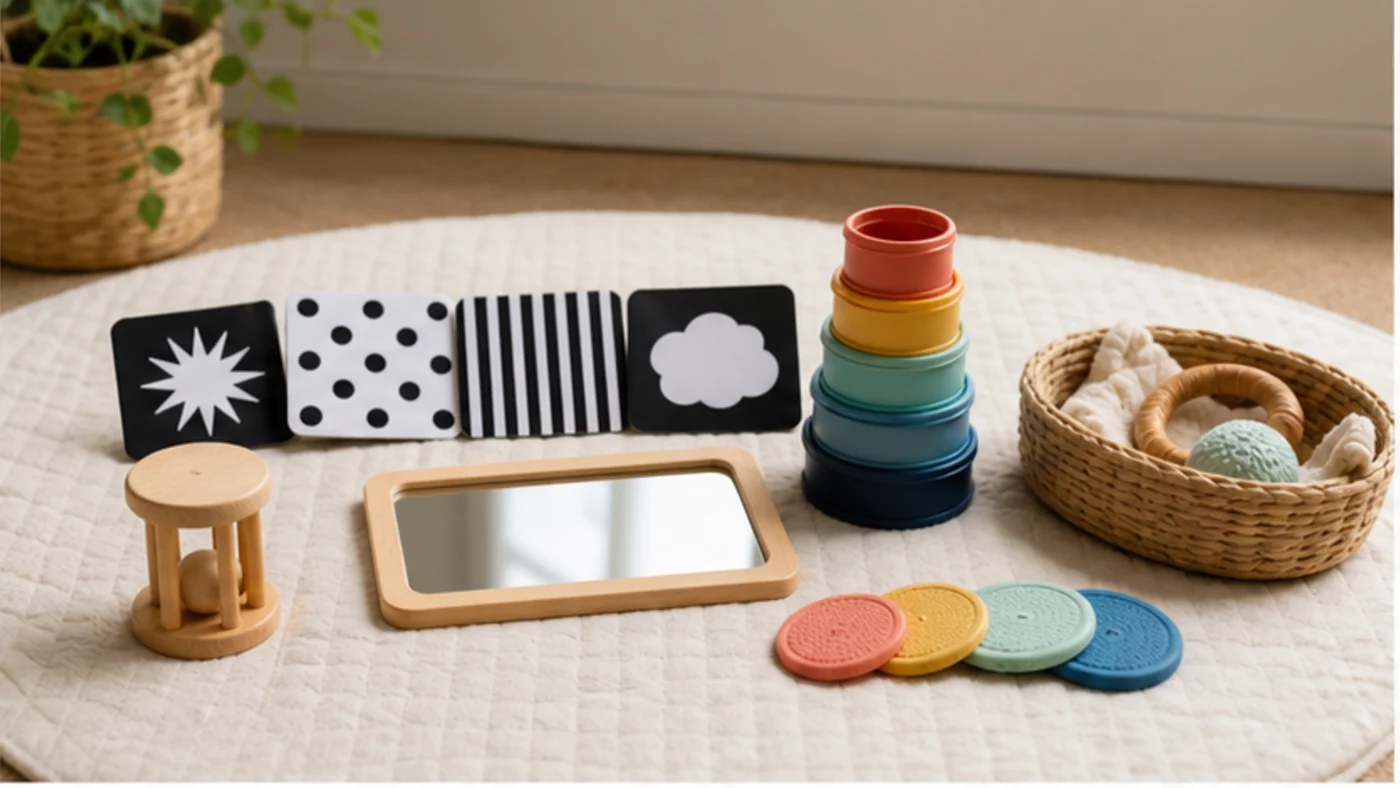
For babies who can sit independently, a small basket of safe everyday objects can be brilliant. Think wooden spoon, soft brush, metal cup, large fabric ring, silicone whisk, textured cloth.
If you want help building one, start with a small woven basket and curate it yourself. Homemade usually works better than buying a “sensory kit” full of filler.
What to skip for babies: giant toy bundles, noisy electronic toys, and gifts with ten features but no clear use. Babies do better with a few rich experiences than with a plastic circus.
Baby safety check before gifting: confirm the manufacturer age range, check every loose part against current choking guidance, avoid long cords or strings, and inspect finish quality before it goes in a baby’s mouth. If you are gifting second-hand, check recalls and skip anything with peeling paint, cracks, loose beads, or unknown parts.
Takeaway: the best baby gifts support movement, grasping, visual focus, and simple repetition.
🧒 Best Montessori gifts for young toddlers (12-24 months)

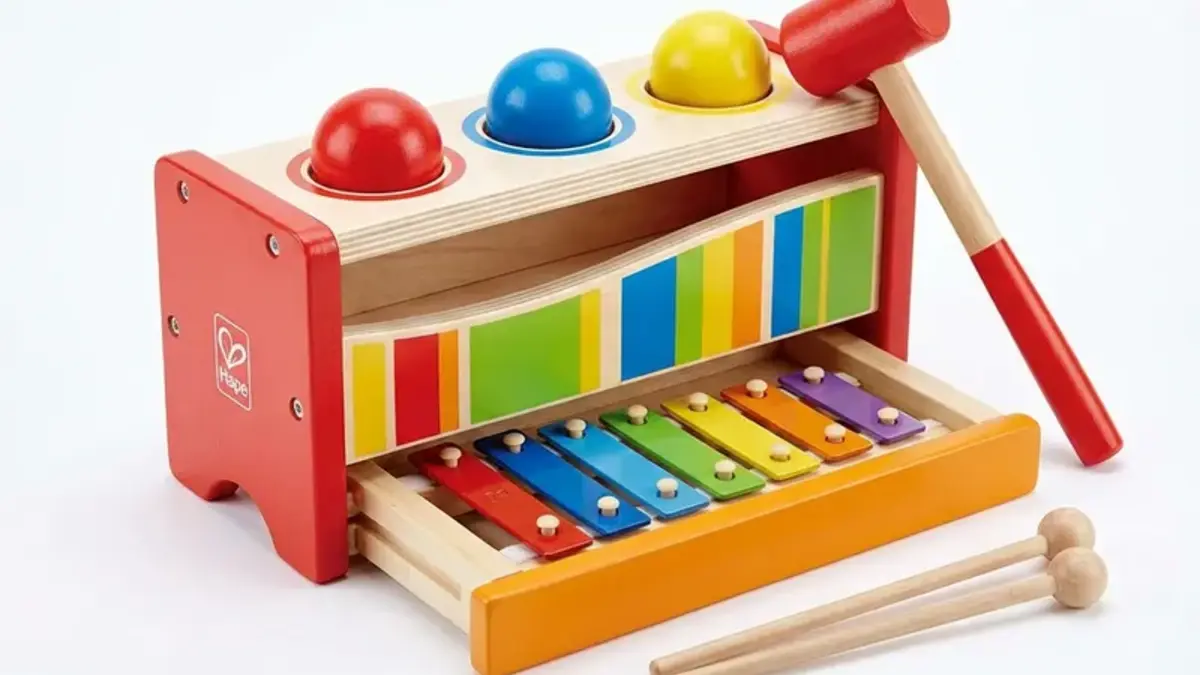
This is the glorious stage where your child wants to do everything independently, including the things you were really hoping to finish yourself.
That drive is gold.
The best Montessori gifts for young toddlers help them practise real coordination and feel capable. You are looking for materials they can carry, repeat, open, fit together, and use with growing confidence.
1. A shape sorter with one clear job
A shape sorter is one of the strongest gifts in this age range because it combines hand control, visual discrimination, and problem-solving.
The Melissa & Doug Shape Sorting Cube is a dependable pick and has held up well across many Montessori-style homes.
Why it works:
- clear challenge
- obvious feedback
- easy to repeat independently
- durable enough to come back into rotation later
2. Stacking cups or rings
Do not underestimate basic stacking materials. They support size discrimination, coordination, sequencing, and all that satisfying trial-and-error work toddlers love.
You can browse stacking cups for babies and toddlers if you want a simple, useful gift that almost always gets real use.
3. A posting activity or simple puzzle
Toddlers in this range often crave exact fit-and-place work. Posting coins, fitting circles, or completing a knob puzzle can hold surprising amounts of attention.
A wooden knob puzzle is a strong choice if you want something simple, skill-building, and not too flashy.
4. Child-sized practical life tools
This is one of my favourite gift categories because it is useful immediately.
A small broom, dustpan, sponge set, tiny pitcher, or toddler-safe food prep tools often create more meaningful engagement than another toy. Your child does not just “play” with them. They participate.
A child-sized cleaning set can be a genuinely excellent birthday or holiday gift for a toddler in the “I help” phase.
If this is the direction your toddler is already choosing, our Montessori cleaning tools guide goes deeper on which child-sized tools are actually useful and which sets are mostly cute clutter.
5. A low front-facing bookshelf
Again, not exactly a toy. Still one of the smartest gifts.
A front-facing bookshelf for kids makes books visible, reachable, and usable. For a young toddler, environment gifts often outperform toy gifts because they change what your child can do every day.
If you are not sure where to start, our guide to how to start Montessori at home pairs beautifully with this kind of gift.
What to skip for young toddlers: huge toy sets with lots of tiny pieces, toys that talk constantly, and decorative “Montessori bundles” that try to cover ten skills at once.
Takeaway: toddlers in this stage usually get the most value from simple problem-solving toys and real-life tools sized for independence.
🌿 Best Montessori gifts for older toddlers (2-3 years)
Now we get into one of the sweetest gift-giving windows.
Older toddlers still love repetition, but now they also want more challenge, more responsibility, and more chances to imitate real life. This is where thoughtful gifts can really shine.
1. A learning tower
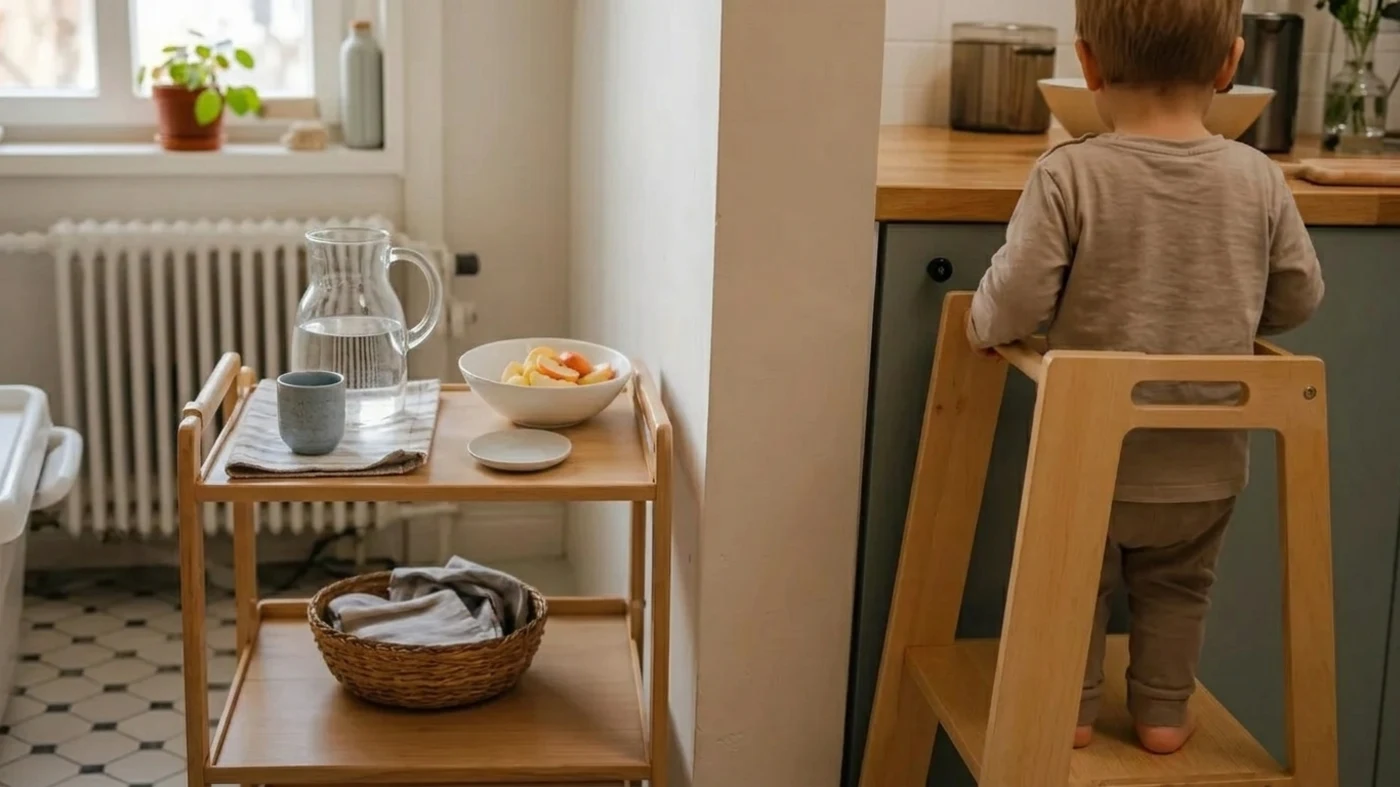
A Montessori learning tower is not cheap, but it often earns its cost fast.
If your child uses it for washing fruit, stirring batter, peeling eggs, helping at the sink, and watching you cook, the cost per use becomes excellent.
This is one of those purchases that supports Montessori at home far beyond “playtime.”
Do the safety decision first, though. A tower is a supervised kitchen tool, not a place to park a toddler while you cook. If you are deciding between a tower, stool, or waiting, use the full Montessori learning tower guide before spending the money.
2. Food prep tools for practical life
A crinkle cutter, small chopping board, child-safe knife, and small apron can turn gift-giving into real daily participation.
A toddler-safe knife set is a practical place to start if your child already hovers around the kitchen like a tiny sous-chef.
3. Open-ended building materials
Open-ended does not mean “buy a huge expensive fantasy set and hope for the best.” It means giving your child a material they can use in different ways over time.
The Grimm’s Large Rainbow is the famous example. It is beautiful, versatile, and very worth it in homes where children already enjoy building, arranging, and imaginative play.
If your child is not there yet, a smaller stacker or a basic set of blocks may be the smarter choice.
4. Realistic animal figures or matching materials
At this age, many toddlers love naming, sorting, and pairing real-world objects. Realistic animal figures work well for language, classification, and early pretend play.
You do not need a giant set. A few good figures and a book are plenty.
5. A low shelf and trays for activity setup
If your child’s room or play corner still relies on deep bins, upgrading the storage may be the best gift of all.
A low Montessori shelf plus a few small wooden trays makes it much easier for your child to choose work, carry it, and put it back.
If you are already in that phase, our posts on Montessori shelf setup and Montessori practical life activities will give you plenty of next-step ideas.
What to skip for older toddlers: toys that are impressive to adults but frustrating in real use, or giant “all-in-one learning boards” that try to cram every skill into one object.
Takeaway: at 2-3 years, the best gifts often combine independence, real-life usefulness, and just enough challenge to invite mastery.
🚫 What to skip, even if it looks Montessori online
A lot of expensive gift mistakes share the same pattern.
They look calm, beautiful, and educational from across the room. Then your child uses them twice, or not at all.
Here is what I would be cautious about.
Gifts that are mostly aesthetic
If the main reason you want it is that it would look lovely on a wooden shelf, pause.
That may still be a fine purchase. It is just not the same thing as a strong child-development purchase.
Massive boxed “Montessori sets”
These often promise incredible value because they include so many pieces. In practice, they can be overstimulating, repetitive, or oddly mismatched to your child’s stage.
A few better-chosen materials usually win.
Toys that need adult rescuing every two minutes
If your child cannot really use it without constant help, it is not doing much for independence.
Duplicates of skills you already own
You probably do not need three posting toys, four stackers, and two shape sorters unless you are running a tiny nursery.
Before buying, ask: does this add a new kind of useful work, or just a prettier version of what we already have?
Anything bought mainly because the word Montessori is in the title
This is the simplest filter I know:
Would I still want this if the listing never said Montessori?
If not, leave it.
Takeaway: buy for real use, not for branding, aesthetics, or shelf-decoration fantasies.
🛍️ A simple way to choose the right gift without overthinking it
If you are stuck, use this four-part filter.
1. What is your child obsessed with right now?
Pouring? Carrying? Climbing? Opening containers? Naming animals? Matching shapes?
Gifts land better when they match a live developmental urge.
2. Can your child use it mostly on their own?
A little help is fine. Constant intervention is not.
3. Will it earn a shelf slot or daily use?
Shelf space is precious. So is family attention. A good gift should deserve both.
4. Does it replace clutter or create it?
The strongest Montessori gifts simplify your home life. They do not add another loud layer of chaos.
That is why practical life tools, shelves, bookshelves, step stools, and a handful of well-chosen materials often beat a giant toy haul.
And if you want a broader age-by-age view after this, our complete guide to Montessori toys from 0 to 6 is a useful next read. If you are mostly trying to avoid wasting money, pair this with Are Montessori toys worth it? and authentic Montessori toys vs Montessori-inspired toys.
Takeaway: the best gift is the one your child can use deeply, not the one that looks most impressive when wrapped.
How this gift guide was put together
This is a review-analysis guide, not a claim that every product was tested side by side in one home. Recommendations are based on Montessori practical-life and prepared-environment principles, age-fit patterns across Exploritori’s baby and toddler toy guides, product-page review signals, and whether the gift gives a child a repeatable action they can control.
Product links are included as examples where they make the material easier to identify. Some may be affiliate links, which can earn Exploritori a commission at no extra cost to you. The recommendation stays the same either way: choose fewer, sturdier materials that match your child’s current work, and skip anything that relies mainly on branding.
❓FAQ
What is the best Montessori gift for a first birthday?
A first birthday gift works best when it supports movement, simple hand work, or early cause and effect. Good options include a grasping toy, object permanence box, simple stacking material, or a low bookshelf for independent access.
Are Montessori gifts good for babies who already have lots of toys?
Yes, especially if the toys they already own are noisy, cluttered, or hard to use independently. A few calmer, more purposeful gifts can balance the environment without adding more chaos.
Should I give one big gift or several small ones?
Usually one or two thoughtful gifts work better. Babies and toddlers can get overwhelmed by too many new materials at once, and fewer gifts often lead to deeper play.
Are practical life gifts too boring as presents?
Not for most toddlers. Many children are thrilled by real tools they are finally allowed to use. A tiny broom, pitcher, apron, or safe kitchen tool can be much more exciting than another passive toy.
What if my child prefers flashy toys?
That does not mean Montessori-style gifts will fail. Start with something easy to use and genuinely satisfying, like a shape sorter, stacking cups, or a practical life tool. Children often respond well when the gift is simple but gives them real control.
If you want the short version, here it is: buy fewer gifts, choose better ones, and let your child’s current interests do the decision-making. That is the heart of a good Montessori gift guide, and honestly, it makes gift shopping much less ridiculous.
 Get weekly Montessori tips
Honest reviews, activity ideas, and budget-friendly picks — no spam, just what works.
Subscribe Free