Montessori Storage Solutions for Small Spaces: Shelves, Rotation, and Simple Toy Limits
· Updated
 If your home is small, toy clutter does not feel like a design problem.
It feels like you are living inside a soft plastic avalanche.
A Montessori setup can help a lot here, but not because it gives you prettier baskets. It helps because it changes the job of storage.
Instead of asking, “How do I fit all of this stuff into one room?” Montessori asks, “What does my child actually need to see and use well today?”
That is a much better question.
The best Montessori storage solutions for small spaces are not complicated. They are usually some version of:
- one low shelf
- a small number of complete activities
- the rest stored out of sight
- clear homes for everything
- enough empty space that your child can actually think
That last part matters more than people expect.
Quick choice guide
| Situation | Best starting point | Why it helps |
|---|---|---|
| You want the simplest option | Start with one low shelf or basket | Fewer choices make it easier for your child to focus |
| You are buying something new | Choose practical, open-ended materials first | They last longer and support real independence |
| Your space feels cluttered | Rotate materials weekly instead of adding more | Calm environments usually work better than bigger collections |
🧺 What Montessori storage actually means
Montessori storage is not about buying matching wooden everything.
It is about making the environment readable for your child.
When a toddler walks up to a shelf, they should be able to understand it quickly:
- what is available
- where each activity begins
- where it goes back when they are done
- what they can reach without help
That is why low open shelving works so well. Your child can see the materials, choose intentionally, and return them independently. A deep toy box does the opposite. It hides everything, invites dumping, and turns cleanup into archaeology.
This is also why Montessori homes often look calmer even when the family does not actually own fewer things. The active environment is edited.
Not sterile. Not empty. Just edited.
If you only take one idea from this whole post, take this one: good storage is not about holding more. It is about showing less, better.
Takeaway: In Montessori, storage is part of teaching. A clear shelf quietly teaches choice, order, and independence every day.
🪑 The storage pieces that work best in real homes
You do not need a dedicated playroom for this.
You need a few storage types that each do one job well.
1. A low open shelf for active materials
This is the centre of the setup.
A low shelf holds the activities your child is actually using right now. Not every toy you own. Just the current working set.
For most families, that means about:
- 3 to 4 items for babies
- 4 to 6 items for toddlers
- 6 to 8 items for preschoolers
A simple shelf can be enough. If you want a purpose-built option, a Montessori bookshelf for toddlers works well for front-facing books or light materials, but a basic low shelf from IKEA or a secondhand unit can do the job just as well.
The rule is simple: if the top shelf is hard to reach, it is not truly child-accessible.
2. Trays and baskets for complete activities
A tray gives an activity a beginning and an end.
Instead of loose pieces drifting across the room, the whole work lives together. Your child lifts one tray, does one activity, and returns one thing.
That is much easier than asking a two-year-old to mentally group five random objects into a category called “sorting stuff.”
A few small wooden trays are genuinely useful here, especially for puzzles, transferring work, practical life materials, or shelf invitations. Simple baskets also work well, especially for balls, scarves, blocks, or language cards.
Use trays when the activity has pieces that belong together.
Use baskets when the material is soft, open-ended, or naturally gathered.
3. Front-facing book storage
Toddlers do not choose books by the spine.
They choose by the cover.
A front-facing display makes books far more likely to be used, especially in a small home where the reading corner has to compete with the rest of family life. Four to eight visible books is usually enough.
You do not need a giant library wall. In fact, too many visible books often creates the same problem as too many visible toys: more scanning, less choosing.
4. Hidden backstock
This is the part parents resist, usually because it feels mean.
It is not mean.
Hidden storage is what makes the visible storage work.
Backstock can live in:
- a hall cupboard
- the top of a wardrobe
- under-bed boxes
- lidded bins in an adult closet
- labelled tubs on a high shelf
The point is that your child does not need access to everything at once. They need access to enough.
5. One or two flexible family zones
In small homes, child life spills into shared rooms.
That is normal.
A basket in the living room for current books, a low kitchen drawer for child-safe tools, or one hallway hook for a coat and bag can all count as Montessori storage. It does not have to be one perfect Pinterest corner.
It just has to support independence where your child actually lives.

Takeaway: The best small-space setup uses a few simple storage types with clear jobs: active shelf, trays, books, and hidden backstock.
🏠 How to set up Montessori storage in a small space


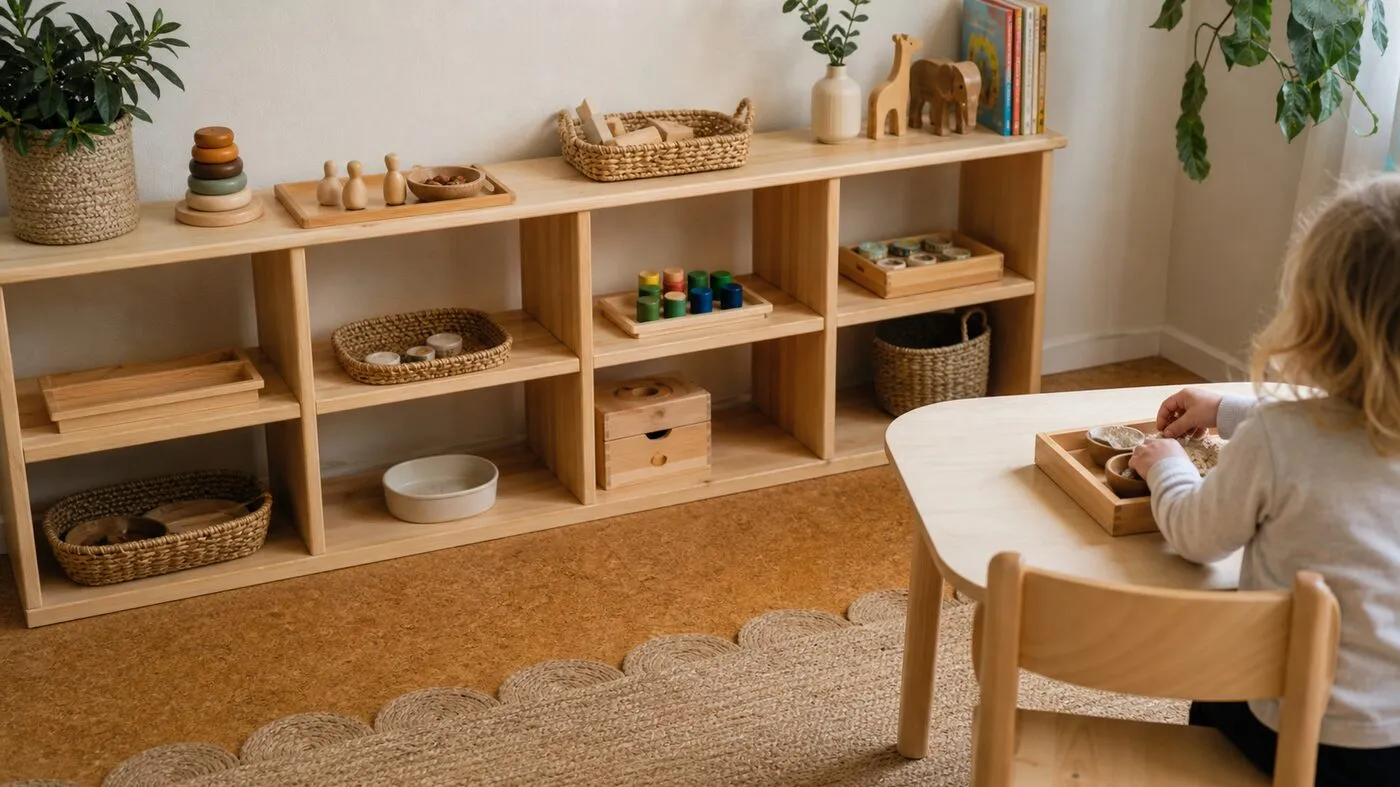
Small-space Montessori works best when you stop trying to create a miniature classroom and start designing around friction.
Where does clutter pile up?
Where does your child constantly ask for help?
Where do materials get dumped and ignored?
Start there.
Keep the active zone tiny
In a small home, I would rather see one beautiful, calm shelf in the living room than three half-working child zones scattered everywhere.
A tiny active zone is easier to maintain and easier for your child to understand.
A strong setup might be:
- one low shelf
- one small rug or mat
- one front-facing book ledge
- one basket for large items like balls or soft toys
That is enough.
Try a ten-minute shelf reset before buying anything
Use this once when the room feels crowded, then repeat it whenever the shelf stops working. Do not aim to organise the whole house in one go.
| Minute | Do this | Keep the decision simple |
|---|---|---|
| 0–2 | Clear the shelf completely | Put every item on the floor or table so you can see the actual volume |
| 2–4 | Choose the current 4–6 activities | Keep what your child repeats, can mostly finish, or is just ready to practise |
| 4–6 | Make each activity complete | Add missing pieces, a tray, or a small basket; store broken or incomplete work |
| 6–8 | Give books and big items one clear home | Put a few covers facing out and limit the floor basket to one useful category |
| 8–10 | Move everything else to backstock | Label the bin only if it helps you rotate later; your child does not need to see it today |
If choosing feels hard, start with the materials that have been used in the last week. A favourite does not need to be educational-looking to earn a place; it needs to be safe, manageable, and worth returning to.
Store by use, not by category alone
Adults love organising by category.
Children benefit more from organising by how the material is used.
For example:
- shelf work together
- art supplies together
- practical life tools together
- large movement toys together
- bath toys somewhere near the bathroom, not mixed with puzzles
This reduces the weird household pattern where one activity somehow requires resources from four different rooms.
Make cleanup visually obvious
If your child cannot tell where something belongs, cleanup will always depend on you.
This is why open shelves, trays, and baskets work so well. The space itself answers the question.
You can make that even easier by:
- leaving a visible gap where the tray returns
- using one basket per material type
- avoiding overstuffed bins
- keeping shelf layouts stable for at least a week or two
Young children love repetition more than novelty. Stability helps them feel competent.
Use vertical space for adults, low space for children
This is one of the cleanest small-space moves you can make.
Child materials stay low and reachable.
Backstock, seasonal items, craft refills, and parent-managed extras go up high.
That way your home can hold more without showing more.
Keep large toys on a short leash
Ride-on toys, play kitchens, oversized activity centres, and giant plastic things can dominate a room very quickly.
If you have one large item, let it earn its space.
Ask:
- Is it used often?
- Does it support independent play?
- Is it developmentally current?
- Could one smaller, calmer setup do the same job better?
Sometimes the answer is yes. Sometimes the giant toy is genuinely beloved. But big items should not get automatic residency just because they were expensive.
Takeaway: In a small home, the goal is not to fit everything beautifully. It is to reduce friction so your child can use a few things well.
🔄 What to keep out, what to store, and how rotation helps
Toy rotation is not a separate system from storage.
It is the reason storage works.
If the shelf always looks crowded, the problem is usually not the shelf. It is that too much of the collection is living there full-time.
A simple rotation rule works well:
Keep out materials that are:
- being used repeatedly
- just challenging enough
- easy to complete independently
- relevant to your child’s current interests
Store materials that are:
- too easy
- too hard
- ignored for a week or two
- missing pieces
- more exciting in theory than in real life
This matters because children often show us very clearly what belongs in the current environment.
If a Melissa & Doug Shape Sorting Cube keeps getting chosen, keep it out. If the posting box has been untouched for ten days, rotate it. If a Melissa & Doug Farm Animals Jumbo Knob Puzzle is the one calm activity that reliably works before dinner, let it stay.
The goal is not fairness between toys.
The goal is a shelf that actually functions.
For babies, that might mean a very small setup with a Montessori object permanence box, a grasping toy, a few books, and one basket item.
For toddlers, it might mean:
- one puzzle
- one practical life tray
- one language or matching activity
- one open-ended building or posting work
- one book basket nearby
That is a complete play environment. Not a deprived one.
If your child has lots of toys from birthdays, grandparents, and impulse buys, rotation is how you stop that generosity from becoming noise.
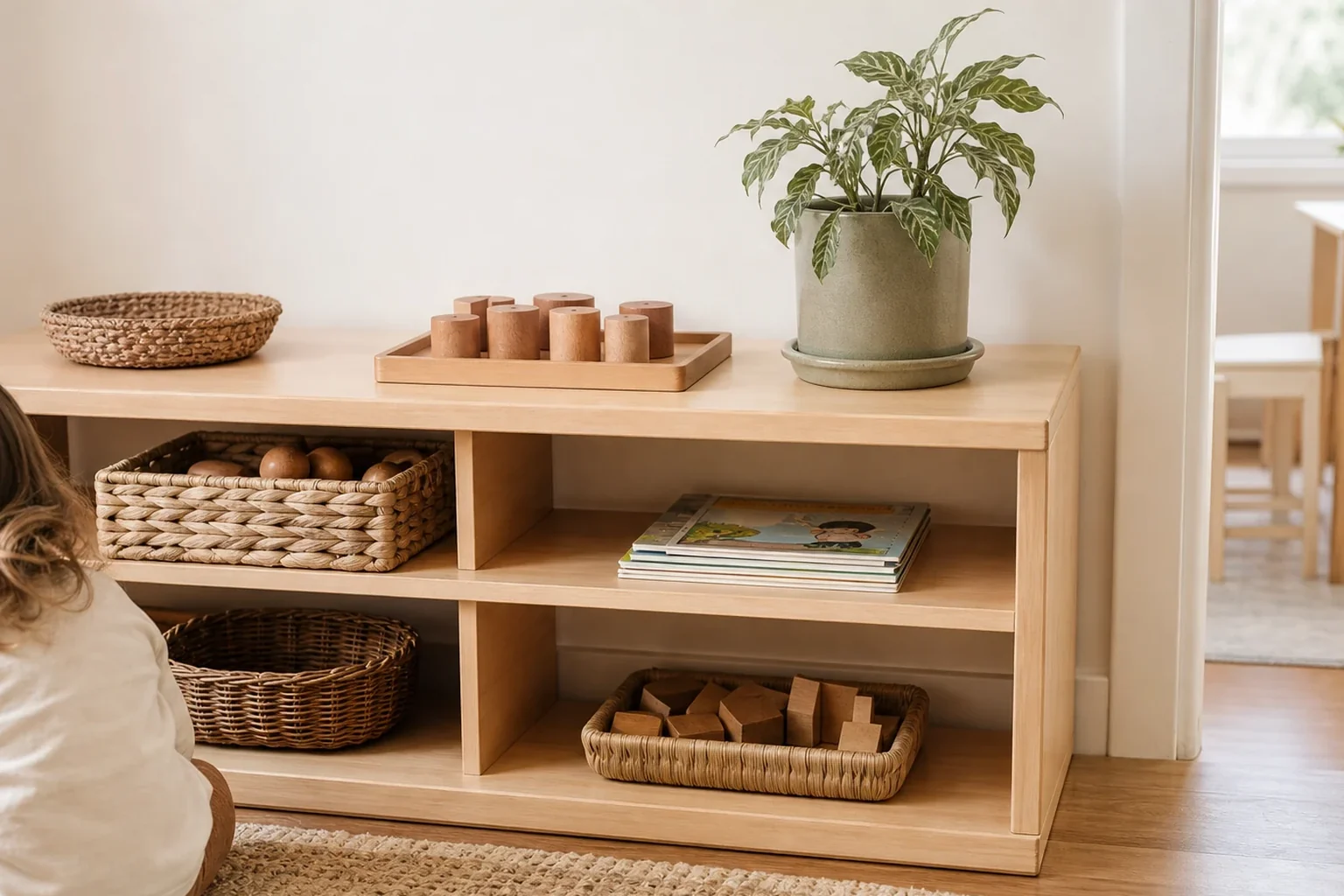
Takeaway: Rotate based on use, not guilt. The best shelf is not the most complete one. It is the one your child actually engages with.
🚫 The storage mistakes that make small homes feel worse
A few common mistakes create most of the chaos.
1. Too many toys visible at once
This is the big one.
A shelf packed edge to edge does not look rich to a toddler. It looks noisy.
When everything is visible, nothing stands out.
2. Baskets that become black holes
Baskets are useful. Giant mixed baskets are not.
If one basket contains magnetic tiles, toy cars, puzzle pieces, pretend food, and a random sock, that is not storage. That is surrender.
3. Using storage to avoid decisions
Sometimes families buy more bins because they do not want to decide what stays active and what gets stored.
I get it.
But more containers do not solve a curation problem.
They just give the clutter better packaging.
4. Keeping everything at child height
Not everything should be accessible.
Montessori is about independence, not unlimited access.
Paint refills, eighty-seven sticker sheets, sensory bin backup rice, and the toy your child only uses with you do not need to live at floor level.
5. Letting gifts and hand-me-downs bypass the system
This happens in every family.
Something new arrives, and because it is new, it goes straight onto the shelf.
Soon the whole environment is being run by other people’s shopping.
A better rule: every new item waits in backstock first. Then you decide whether it deserves active space.
That one rule saves a lot of clutter.
6. Designing for photos instead of use
A setup can look beautiful and still be impractical.
If the basket is too heavy, the tray is too big, the shelf is too tall, or the book ledge is jammed tight, your child will not use it well.
Montessori storage should feel easy in the hands, not just pretty on the feed.
Takeaway: Most storage problems are really editing problems. The fix is usually fewer visible things, not more furniture.
🛒 What is actually worth buying
The encouraging part is that you probably need less than you think.
The most useful purchases are usually the boring ones.
Worth buying
A low shelf
If you do not already have one, this is the highest-impact purchase. It changes how your child sees and uses their materials.
A few trays or baskets
A handful of trays can make an ordinary shelf work much better. They create boundaries without adding visual clutter.
A front-facing book display
Especially useful if books currently live in one deep basket and never get chosen.
One strong practical-life access point
Sometimes this is not technically storage, but it changes daily life more than another toy shelf would. A toddler learning tower can be worth it if it lets your child safely join kitchen routines instead of needing entertainment while you cook.
Usually not worth buying first
Huge toy organisers
If they encourage you to keep everything visible, they often make the room feel busier, not calmer.
Fancy labelled systems before you have rotated
Do the editing first. Then label what remains.
Lots of matching decor storage
It can look lovely, but it is rarely the thing that fixes function.
If your budget is limited, spend it on accessibility and safety first.
That might mean a shelf, trays, wall anchors, and a stool.
Everything else can grow slowly.
For families working on the bigger home setup picture, our guides to IKEA Montessori hacks, Montessori shelf setup, toy rotation without overwhelm, and Montessori on a budget in small spaces go deeper into the room-by-room side. If the shelf is competing with daily routines, a toddler snack station or child-friendly cleaning tools can be a more useful next step than another toy basket.
Takeaway: The best Montessori storage purchases are the ones that make daily independence easier, not the ones that make the room look more expensive.
🌿 A calmer room usually leads to calmer play
One of the nicest surprises in Montessori at home is that storage changes behaviour.
Not because your child becomes a tiny minimalist.
Because the environment finally makes sense.
When there are fewer visible choices, children often:
- start activities faster
- stay with them longer
- dump less
- ask for less help
- tidy more willingly because the return spot is obvious
That does not mean your home becomes silent and angelic.
It means the room works with your child instead of against them.
If your current storage setup feels chaotic, I would not start by buying six more bins.
I would start by removing half the visible toys, setting up one low shelf, and seeing what happens over the next week.
That experiment teaches you more than any shopping list will.
And in a small home, that kind of clarity is gold.
Methodology and trust notes
This is a practical home-setup guide, not a claim that one shelf layout or toy limit suits every child. We refreshed it in August 2026 alongside our shelf setup guide, toy-rotation guide, small-space budget guide, and toddler wardrobe guide to make the choices, links, and reset steps more useful in ordinary shared homes.
The age ranges and activity counts are starting points rather than developmental rules. Secure shelves to the wall where needed, keep heavy or unsafe items out of reach, and adjust access for your child and your home. Product links are optional affiliate links that may support Exploritori at no extra cost; they are examples, not hands-on product tests, and ordinary household storage can work just as well.
❓FAQ
What are the best Montessori storage solutions for small spaces?
The best Montessori storage solutions for small spaces are low open shelves, a few trays or baskets, front-facing book storage, and hidden backstock for everything not currently in use. The setup works best when only a small number of materials are visible at once.
Do I need special Montessori furniture for toy storage?
No. A basic low shelf, secondhand furniture, or simple IKEA unit can work beautifully. Montessori storage depends more on accessibility, order, and clear limits than on branded furniture.
How many toys should be visible at once?
Most toddlers do best with about 4 to 6 visible activities. Babies usually need 3 to 4, and preschoolers can often manage 6 to 8 if the shelf remains calm and easy to read.
Is toy rotation really necessary in a small home?
Yes. In a small home, rotation is often the thing that makes the environment workable. It lets you keep the active space light while still using a larger collection over time.
What is the biggest Montessori storage mistake?
The biggest mistake is keeping too much within your child’s view. Crowded shelves, overflowing baskets, and constant novelty usually make play shallower, not richer.
 Get weekly Montessori tips
Honest reviews, activity ideas, and budget-friendly picks — no spam, just what works.
Subscribe Free