Montessori on a Budget: Affordable Setups for Small Spaces That Really Work
· Updated
Montessori can look expensive from the outside.
You see the beautiful shelves, the wooden toys, the floor beds, the tiny wardrobes, the matching baskets. If you live in a small apartment or you are watching every euro, it is easy to assume Montessori is for people with more space, more money, and fewer laundry piles.
That is the wrong read.
At home, Montessori is not about buying a curated aesthetic. It is about making your space work better for your child. A lower hook. A reachable shelf. A stool by the sink. Fewer toys, displayed more clearly. Real tools scaled to small hands.
That means Montessori can actually work especially well in a small home. Small spaces force you to be selective. And selective is very Montessori.
If you want a calm, practical Montessori setup without turning your home into a showroom, this is where I would start.

Quick choice guide
| Situation | Best starting point | Why it helps |
|---|---|---|
| You want the simplest option | Start with one low shelf or basket | Fewer choices make it easier for your child to focus |
| You are buying something new | Choose practical, open-ended materials first | They last longer and support real independence |
| Your space feels cluttered | Rotate materials weekly instead of adding more | Calm environments usually work better than bigger collections |
| You have almost no budget | Move existing items lower before shopping | Access often changes more than new materials |
| You live in one shared room | Build one tiny “yes” zone | A contained corner is easier to keep usable than a whole-room makeover |
🏡 Start with the principle, not the shopping list
When people say they want a Montessori home, they often picture furniture first.
But the real question is simpler: what can your child do on their own in your current space?
Can they reach their coat? Can they get a book without asking? Can they pour a little water? Can they help wipe the table? Can they choose between a few activities without dumping everything out?
That is the heart of it.
A Montessori home does not need:
- a dedicated playroom
- custom wooden furniture
- twenty matching baskets
- expensive materials with the word Montessori in the title
A Montessori home does need:
- accessibility
- order
- a few clear choices
- real participation in daily life
If your budget is tight, spend on independence first and aesthetics last.
Takeaway: if one small purchase helps your child do something real without you, it is usually a better Montessori buy than another decorative toy.
The 30-minute no-buy reset
Before buying anything, walk through the home with one question: what is already here that could move down, simplify, or become child-accessible?
Start with this fast reset:
| Area | No-buy change | What to watch |
|---|---|---|
| Entryway | Put one coat hook, shoe basket, or tote bag within reach | Keep only current-season items there |
| Bathroom | Move toothbrush, towel, or hairbrush to a low tray or basket | Check that liquids, razors, medicines, and cleaners stay locked away |
| Kitchen | Dedicate one low drawer or basket to cloths, a small cup, and one safe utensil | Avoid glass or sharp tools unless you are supervising |
| Living room | Remove half the visible toys and group the rest by activity | If everything gets dumped, there are still too many choices |
| Bedroom | Offer 2 to 4 outfit choices in a low basket | Too many clothes can be as overwhelming as too many toys |
This gives you a baseline. If the moved-down version works for a week, then a better stool, tray, shelf, or hook is more likely to earn its place.
If you are not sure what a focused shelf should look like, use the step-by-step Montessori shelf setup guide before buying a specialist shelf.
💸 The best budget rule: buy fewer things that solve daily problems
A lot of families overspend because they buy Montessori as a category instead of solving one friction point at a time.
That usually leads to random toy hauls. You end up with a shelf full of worthy-looking objects, but your mornings are still chaotic and your child still cannot wash hands, help in the kitchen, or put shoes away.
A better rule is this: buy the next item that increases daily independence.
For most homes, that means this rough order:
- A step stool for bathroom or kitchen access
A simple toddler step stool opens up handwashing, toothbrushing, food prep, and practical life. - A low storage system
This can be a true shelf, a cube unit on its side, or even two baskets under a console. A low Montessori bookshelf is useful, but you do not need a branded one. - A few trays or baskets
Wooden activity trays or simple household trays help define what belongs where. - Child-sized practical life tools
A small pitcher, cloths, sponge, and a child-sized cleaning set often get more use than extra toys. - One or two high-use play materials
Not ten. Just enough to support concentration.
That order matters because layout changes how your child uses everything else.
A great toy in an inaccessible room gets ignored. A very ordinary tool in the right spot gets used every day.
If you are trying to do this with familiar flat-pack furniture instead of specialist Montessori pieces, our IKEA Montessori hacks guide shows practical low-shelf, stool, storage, and room-by-room ideas that fit this same budget-first logic.
For practical-life setups that actually get repeated, the Montessori practical life activities guide and Montessori kitchen activities guide are better starting points than a toy wish list.
Takeaway: your first Montessori purchases should fix real daily bottlenecks, not fill shelves for the sake of it.
A realistic budget ladder
You can build this gradually. The order below is intentionally practical, not pretty.
| Budget | Best use of the money | Skip for now |
|---|---|---|
| €0 | Move hooks, baskets, books, and safe tools lower; rotate toys from storage | Any new toy bought because the shelf looks empty |
| €10-25 | Add trays, cloths, a sponge, low hooks, or a small pitcher | Decorative baskets that do not fit real materials |
| €25-60 | Buy a sturdy step stool, low book display, or simple cube shelf | Large themed toy sets with duplicate skills |
| €60-120 | Upgrade the one zone used daily, usually kitchen access or a living-room shelf | Furniture for rooms your child rarely uses independently |
| €120+ | Consider a learning tower only if it will be used most days | Premium Montessori pieces that solve no daily problem |
The best test is boring: if the item will be touched every day and reduces adult rescue, it is probably a good buy. If it mainly improves the photo, wait.
🧸 What to skip when space and money are limited
This is where you save yourself a lot of regret.
If you are building a Montessori home in a small space, some things are much easier to skip than people think.
Skip huge toy collections
More toys do not create more meaningful play. In a small home, they usually create visual noise, messy floors, and constant dumping.
Most toddlers do better with 6 to 10 visible choices than with 30.
Skip duplicate skill toys
You do not need three shape sorters, two stackers, five puzzles, and four posting games all doing nearly the same job.
Choose one or two strong options and rotate.
A simple classic like the Melissa & Doug Shape Sorting Cube can carry a lot of value without needing a whole category of similar toys beside it.
For a broader age-by-age filter, use the Montessori toys by age guide and buy only the next skill your child is ready to practise.
Skip furniture that only works for one phase
If a piece is expensive, bulky, and useful for six months, think hard before bringing it into a small apartment.
Whenever possible, choose items that can serve more than one role, like a low shelf that stores toys now and books later.
Skip buying for the photo
This one is sneaky. Neutral colours, wooden accessories, and matching baskets can make a setup look calm online. But they do not automatically make it more functional.
Your child does not care whether the tray matches the shelf. They care whether they can use it.
Takeaway: in a small Montessori home, every item should either increase independence, support concentration, or earn its footprint in daily life.
🛋️ Room-by-room Montessori ideas for small homes
You do not need to redo the whole house at once. Small wins compound fast.
Living room
This is often the best place to start because it is where family life already happens.
Try this:
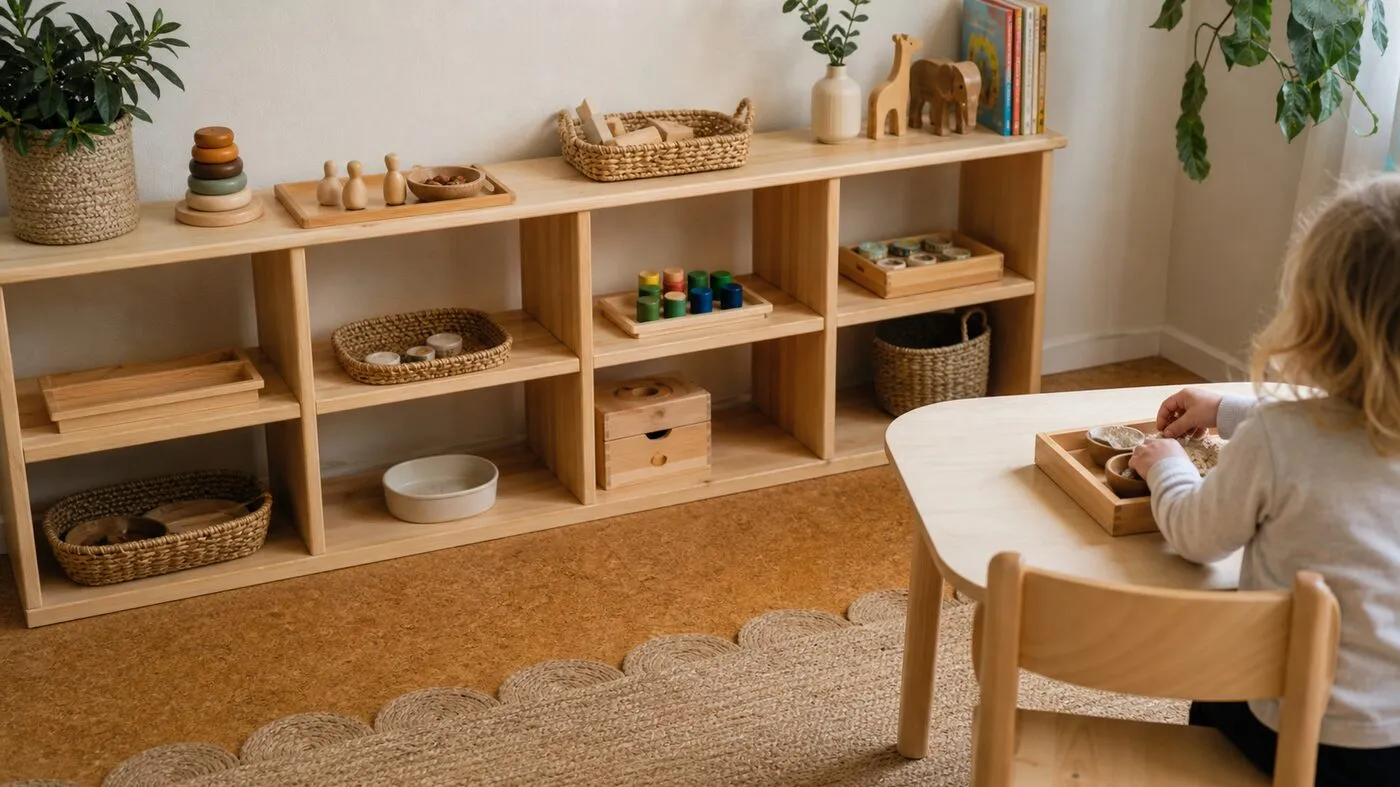
- one low shelf or basket station for toys
- books front-facing in a small rack or basket
- a small rug or mat to define the work area
- one accessible place for your child to return items when finished
If you do not have room for a dedicated shelf, use the bottom shelf of existing furniture or place two baskets under a sideboard. One can hold books, the other a few rotated activities.
A small mat does more work than people expect. It gives activities a beginning and end. It also helps limit spread in a shared room.
If the living room keeps sliding back into chaos, troubleshoot with the Montessori toy rotation guide before adding more storage.
Kitchen
The kitchen is one of the highest-value Montessori spaces because it supports real participation.
You do not need a giant setup. You need access.
Try this:
- step stool at the counter or sink
- one low drawer or basket for child-safe utensils
- a small training knife set for kids for supervised food prep
- a small pitcher or cup for pouring water
- one cloth and sponge for wiping spills
If you only change one room, I would honestly pick the kitchen. Children love real work, and kitchen participation pulls a lot of energy away from random toy-seeking.
For toddlers who are ready for wiping, sweeping, and table jobs, the Montessori cleaning tools for toddlers guide shows which child-sized tools are useful and which ones are mostly decoration.

Bathroom
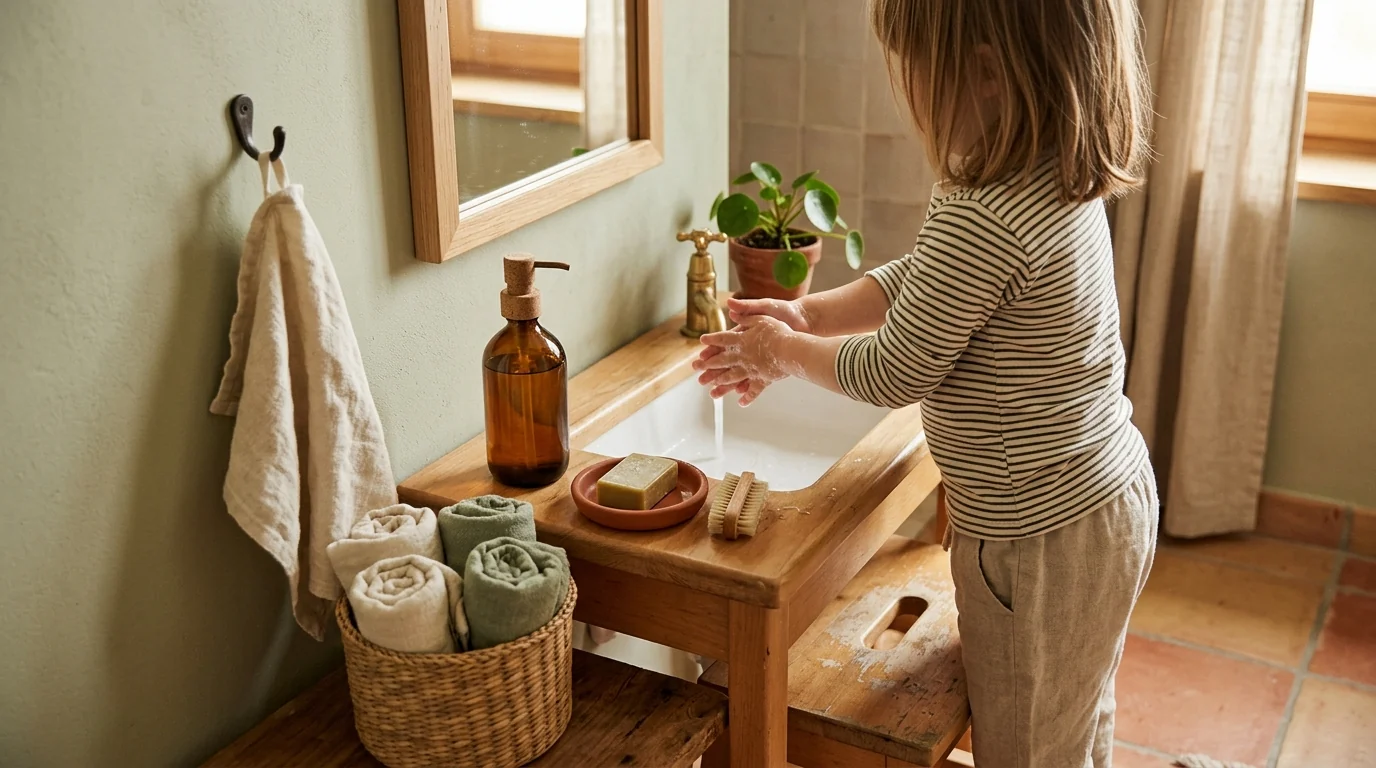
A Montessori bathroom setup can be tiny and still helpful.
Try this:
- step stool for sink access
- hook or low basket for towel
- reachable toothbrush and hairbrush
- small container for wipes or tissues
- potty or toilet step system that your child can manage with less help
This area matters because bathroom independence removes friction from the day very quickly.
Bedroom
If your child has a small bedroom, keep it simple.
Try this:
- a low bed or easy bed access
- a few visible books
- a tiny clothing area with 2 to 4 outfit choices
- one basket for dirty clothes
- one hook for tomorrow’s outfit or sleep bag
A full toddler wardrobe is not required. Even one low basket with two shirts and two trousers creates more autonomy than a closet full of clothes your child cannot reach.
For a fuller self-care setup, connect this with the Montessori dressing skills guide rather than buying a complete wardrobe system at once.
Takeaway: the smallest home improvements often come from making everyday spaces usable, not from building a separate “Montessori room.”
🪴 How to make a small space feel calm without hiding your whole life
The goal is not to own less than everyone else. The goal is to let your child see what is available without being flooded by it.
That usually comes down to visibility and limits.
Keep fewer items out
This is the single biggest reset if your space feels busy.
For toddlers, try keeping out:
- 4 to 6 toys or activities
- 5 to 8 books
- 1 basket of art materials, only if it is genuinely usable
Everything else can live in a closet, under the bed, in a hallway cupboard, or on a high shelf for rotation.

Group by purpose
A puzzle next to a random drum next to a basket of cars next to crayons feels chaotic. A tray with one activity feels clear.
Trays, shallow baskets, and small containers help because they create boundaries without needing more furniture.
Use vertical space carefully
Small homes benefit from walls, but not every wall item is child-accessible. Use high shelves for storage and low hooks for the things your child should actually reach.
A row of low wall hooks for kids by the entryway can do more for independence than a whole toy shelf.

Rotate on purpose
Toy rotation does not need to be a big system. A cardboard box in a wardrobe works fine.
If an item is being ignored, swap it. If your child is deeply using something, keep it out.
Montessori order is not about rigid perfection. It is about making the environment readable.
Use a “parking lot” box
Small homes need a temporary place for items that are not wrong, just not right now. Keep one closed box for:
- toys that are too easy or too hard this week
- books your child loves but is currently scattering
- seasonal tools
- duplicate activities
- gifts you are not ready to display
Review it every two weeks. If something returns to the shelf and gets used, keep it. If it keeps returning to storage unused, pass it on.
Takeaway: calm comes more from editing than from decorating.
🧺 The highest-value Montessori purchases for a small budget
If I were setting up a small-space Montessori home from scratch and wanted the biggest return for the least money, I would focus here.
1. A sturdy step stool
Probably the best first buy for most homes.
It supports handwashing, snack prep, kitchen observation, and bathroom routines. That is a lot of use from one object.
2. A low shelf or simple cube unit
A child can only choose well from what they can see.
If a shelf is out of budget, start with baskets on the floor and upgrade later.
3. Trays and baskets
These are boring to buy and surprisingly powerful to use.
They turn scattered objects into usable activities. They also make tidy-up much easier for toddlers.
4. Practical life basics
A small pitcher, toddler-safe knife, hand towel, dustpan, and sponge are often better value than another boxed toy set.
5. One excellent open-ended or skill-building toy
You do not need many. You need one or two that actually get used.
For open-ended play, the Grimm’s Large Rainbow is beautiful if it fits your budget and your child enjoys building, stacking, and imaginative reuse. For a more skills-based option, the Melissa & Doug Shape Sorting Cube remains a solid, high-use classic.
6. A learning tower, if your home will use it daily
This is the first item on the list that is not automatically a budget buy. But if your child is in the kitchen with you every day, a Montessori learning tower can justify its cost very quickly.
It earns its place when it becomes part of daily life, not when it sits parked in the corner looking beautiful.
Takeaway: the best budget Montessori purchases are the ones that pull your child into real life every day.
Five checks before you buy anything bulky
Use this before bringing in a shelf, tower, bed, table, or large toy.
| Check | Good sign | Pause if |
|---|---|---|
| Daily use | It supports a routine that already happens every day | You are inventing a new routine to justify it |
| Footprint | It can stay out without blocking adult movement | It needs to be folded or moved constantly |
| Independence | Your child can use it with less help after practice | It creates a new adult setup job every time |
| Safety | It can be anchored, supervised, or stored clearly | It invites climbing, tipping, or unsupervised water/tool use |
| Longevity | It can serve another role later | It solves a narrow phase for only a few months |
This is also where many families avoid the classic Montessori mistakes: buying too much, copying a photo, and forgetting that the prepared environment has to work for the adults too.
❤️ What Montessori on a budget really looks like in real family life
It looks like a stool dragged to the sink.
It looks like two books face-out on the bottom shelf because that is the space you have.
It looks like one basket of rotated toys in the living room, not a dedicated playroom.
It looks like your toddler helping slice a banana with a safe knife while you make lunch.
It looks like hooks by the door, a towel they can reach, and a shelf that does not require your help every five minutes.
That is Montessori.
Not because it is pretty, but because it is usable.
You do not need to buy your way into the philosophy. You need to notice where your child keeps hitting walls in your home, then lower a few of those walls.
That might cost nothing. Or it might cost the price of a stool, a basket, and a sponge.
Either way, it is often more powerful than another trendy toy haul.
If you want to keep this simple, start with one question tonight:
What is one thing your child wants to do independently tomorrow that your home currently makes too hard?
Fix that first.
That is a very good Montessori beginning.
How we reviewed this guide
This is a Montessori-at-home setup guide, not a product lab test or a requirement list. We reviewed it in July 2026 against Exploritori’s shelf setup, toy rotation, practical-life, kitchen, cleaning, dressing, and age-based toy guides, then prioritised changes that cost little, reduce daily friction, and fit shared rooms or small apartments.
Product links are included only when they help illustrate a practical option. Household alternatives are often enough to begin. Some links may be affiliate links, which can earn Exploritori a commission at no extra cost to you.
 Get weekly Montessori tips
Honest reviews, activity ideas, and budget-friendly picks — no spam, just what works.
Subscribe Free