Montessori Toddler Wardrobe: A Simple Dressing Space That Builds Real Independence
 Getting dressed can quietly become one of the most exhausting parts of the day.
You offer three shirts. Your toddler wants the one in the laundry. You suggest socks. They run away half naked. You try to help, and suddenly everyone is having a bigger emotional experience than a pair of leggings should be allowed to cause.
A Montessori toddler wardrobe helps because it changes the environment, not just your expectations. For the practical dressing sequence itself — shoes, coats, buttons, zippers, and mirror routines — use our Montessori dressing skills guide with this setup.
Instead of one overstuffed drawer or a full-height closet your child cannot use, you create a small, readable dressing space. A few weather-appropriate options. Low hooks or shelves. A mirror. A place for dirty clothes. A setup your child can actually understand.
That is the real Montessori move: make independence possible, then step back enough for it to happen.
And no, you do not need a Pinterest-perfect playroom or expensive furniture to do it.
Start with the friction, not a shopping list
Before buying a rail, mirror, or matching baskets, notice where the routine stops. Pick the row that sounds most like your morning, make that one change, and leave the rest alone for a few days.
| If this is happening | Try this first | Leave for later |
|---|---|---|
| Your toddler cannot choose without a fight | Put out two weather-ready outfits the night before | More drawers or more clothes |
| They choose easily but cannot put clothes on | Swap in elastic waists and wide-neck tops | Teaching buttons during the school-run rush |
| Clothes end up everywhere | Put one open hamper directly beside the dressing spot | Asking them to sort a full laundry basket |
| Shoes and outerwear cause the delay | Add one low hook and one shoe basket near the door | Rebuilding the whole bedroom closet |
| The room is shared or very small | Claim one low drawer or basket as the active wardrobe | A separate child-sized wardrobe |
For a predictable morning sequence after the room is ready, pair this with Montessori routine cards for toddlers. If trousers, socks, coats, or fasteners are the sticking point, use the dressing skills guide to practise one skill at a calm time instead of trying to solve it all at 7:40.
Actionable takeaway: Change the step that is blocking your child today. A small working system beats a bigger system that adds new decisions.
👕 What a Montessori toddler wardrobe actually is
A Montessori wardrobe is not a mini boutique. It is not about aesthetics for their own sake. It is a prepared environment for one daily task: getting dressed.
That means the setup should help your child do four things with as little adult intervention as possible:
- see the available options
- choose what to wear
- put clothes on or take them off
- return dirty clothes to the hamper or place pajamas where they belong
When that sequence is clear, dressing becomes practice instead of power struggle.
The most important features are very simple:
- your child can reach what is active
- the visible choices are limited
- the clothes are easy enough to manage independently
- the setup matches your child’s current stage, not some idealized future version
That is why a low drawer, a basket, and a mirror can be more Montessori than a beautiful wardrobe your toddler cannot use.
Actionable takeaway: If your child still needs you to access every item, the problem is probably the setup, not their willingness.
🌱 Why this matters so much in Montessori
Montessori treats dressing as practical life. That means getting dressed is not a chore you rush through before the “real learning” starts. It is real learning.
When your child chooses a shirt, balances to pull on trousers, checks the mirror, and drops pajamas into the hamper, they are practicing:
- fine motor skills
- sequencing
- body awareness
- concentration
- decision-making
- care of self
- independence
They are also getting a daily dose of a very powerful message: I can do things for myself.
That confidence spills into everything else. A child who starts managing dressing often becomes more willing to help with handwashing, snack prep, shoe routines, and tidying too. If you already use practical life activities at home, a wardrobe setup fits naturally with that same rhythm. Our guide to Montessori practical life activities goes deeper into why these ordinary routines matter so much.
There is another reason this setup helps: toddlers love order, but they are easily overwhelmed. A packed closet with twenty tops and seven mismatched trousers does not feel empowering. It feels unreadable. Then adults step in, override the choices, and everyone learns the wrong lesson.
Montessori offers freedom within limits. Your child gets a real choice, but only from options that are seasonally appropriate, comfortable, and manageable.
Actionable takeaway: A smaller active wardrobe often creates more independence, not less.
🧺 What to include in a Montessori wardrobe setup


You do not need a full room makeover. Start with the smallest setup that supports success.
The essentials
A low place for active clothes
This might be one low drawer, a cube shelf, a short hanging rail, or even a basket system on the floor. If you want a simple furniture hack, a low cube shelf plus fabric storage bins can work beautifully.
A small number of visible options
Two to four outfits is plenty for most toddlers. Or set out a tiny mix of tops and bottoms that all work together.
A child-height mirror
A mirror helps with body awareness and gives your child a natural way to check their progress. A basic acrylic wall mirror for kids is often a safer option than glass in small bedrooms.
A hamper or laundry basket
If dirty clothes still disappear onto the floor, your child cannot complete the dressing cycle. A small soft laundry basket makes a surprising difference.
Easy shoes and easy clothes
Elastic waists, wide neck openings, cardigans over complex jackets, and shoes with simple fastenings are your allies here.
Helpful extras

- a low hook for tomorrow’s outfit or pajamas
- a stool or bench for sitting while putting on trousers or socks
- a basket for underwear and socks
- a second small basket for hairbrush, tissues, or simple care-of-self items
- slim toddler hangers if you are using a low rail, like children’s velvet hangers
Here is a good rule: if an item helps your child complete the routine without you, it earns its place. If it just looks cute, it can wait.
A simple setup by home type
| Your space | What works well |
|---|---|
| Small apartment bedroom | 1 low drawer, mirror, hamper, one hook |
| Shared bedroom | Cube shelf with bins, basket for socks, mirror on wall |
| Full closet available | Lower one rail or one shelf only, keep backstock out of reach |
| Tight budget | Reuse existing drawer, add labels or baskets, skip special furniture |
Actionable takeaway: Build the wardrobe around the routine, not around furniture trends.
👶 How many clothes should your toddler actually see?
This is where many Montessori wardrobes quietly succeed or fail.
Giving full closet access too early usually creates mess, indecision, and adult veto loops. Your toddler picks party tights in a heatwave, you say no, and now the “choice” was never real.
A better default is:
- 2-3 complete outfit choices for younger toddlers, or
- a very small mix-and-match set for older toddlers
Everything else can stay in adult-managed backstock.
That is not controlling. It is honest. You are curating the environment so your child can genuinely succeed inside it.
A practical active wardrobe formula
For many toddlers, this is enough in the active area:
- 3 tops
- 2 bottoms
- 3 pairs of underwear or nappies/training pants
- 3 pairs of socks
- 1 cardigan or light layer
- 1 pair of everyday shoes
- 1 set of pajamas
Adjust for laundry rhythm, weather, and how often your child turns snack time into a textile event.
The real test is not the number. It is whether your child can:
- make a choice without melting down
- mostly dress with the clothes you left out
- put things back with minimal help
- avoid constant adult correction
If not, shrink the visible set.
Actionable takeaway: When independence drops, reduce choice before you add more storage.
🪜 Age-by-age: what this looks like in real life
A Montessori wardrobe should grow with your child. You are not aiming for full independence overnight.
12-18 months
At this stage, the wardrobe is mostly about participation.
You might offer two shirts and ask, “Blue or green?” Your child may help pull trousers down, sit while you guide one foot at a time, or carry pajamas to the basket. That still counts.
Best setup at this age:
- two visible outfit choices
- very easy clothing
- one reachable basket or drawer
- mirror near dressing area
18-24 months
This is when many toddlers start caring deeply about doing it themselves, even when they cannot quite do it smoothly yet.
Now the environment really starts to matter. A low shelf, a little sock basket, and a clear hamper suddenly become useful instead of decorative.
Best focus at this age:
- choosing between a few real options
- pulling clothes on and off with support
- practicing the dressing order
- putting dirty clothes away
2-3 years
Now you can often expand the routine without making it messy.
Your child may manage:
- choosing a full outfit
- getting dressed mostly independently
- hanging pajamas on a hook
- returning clothes to the hamper
- choosing shoes and putting them on
This is also the age when self-dressing connects strongly to toileting, because clothing that is easy to manage supports bathroom independence too.

3-6 years
Older preschoolers can usually handle a bit more complexity, but clarity still matters more than quantity. Just because they can access more clothes does not mean they need a full wardrobe explosion.
Our favourite rule here is simple: expand slowly, only when the current system is working.
| Age | Realistic wardrobe goal |
|---|---|
| 12-18 months | choose between 2 options, help with routine |
| 18-24 months | access a few clothes, start pulling items on/off |
| 2-3 years | choose and dress mostly independently |
| 3-6 years | manage a fuller routine while keeping order |
Actionable takeaway: Match the wardrobe to your child’s current skill level, not to the setup you hope they will use six months from now.
🚫 Common mistakes that make dressing harder
A Montessori wardrobe can look lovely and still not work. These are the mistakes we see most often.
1. Too many choices
This is the big one.
If your child sees every dress, every jumper, every pair of trousers, and every costume piece at 7:40 in the morning, you have created a tiny fashion emergency.
Better move: rotate a small active set and keep the rest stored elsewhere.
2. Clothes your child cannot actually manage
If the wardrobe is full of skinny jeans, complicated dungarees, tight socks, and impossible buttons, independence stalls fast.
Better move: prioritize elastic waistbands, soft fabrics, simple necklines, and easy shoes.
3. The wardrobe is low, but the rest of the routine is not
A child may reach their clothes but still need you for the mirror, socks, laundry, or shoes.
Better move: think in sequences. Outfit, mirror, hamper, shoes, outerwear. The whole flow matters.
4. Prioritising aesthetics over function
There is nothing wrong with wanting the room to look nice. But if the cutest setup still needs adult hands for every step, it is not doing the job.
Better move: lower the usable layer first. Make it functional. Then make it beautiful.
5. Treating the system as fixed forever
Toddlers change fast. What worked at 17 months may frustrate them at 28 months.
Better move: review the setup every few months and adjust as independence grows.
Actionable takeaway: If dressing still feels like a daily battle, look for friction in the environment before blaming behaviour.
💸 Budget-friendly ideas that work in real homes
You do not need special Montessori furniture to do this well.
Some of the best setups are improvised from things families already own.
Low-cost wardrobe ideas
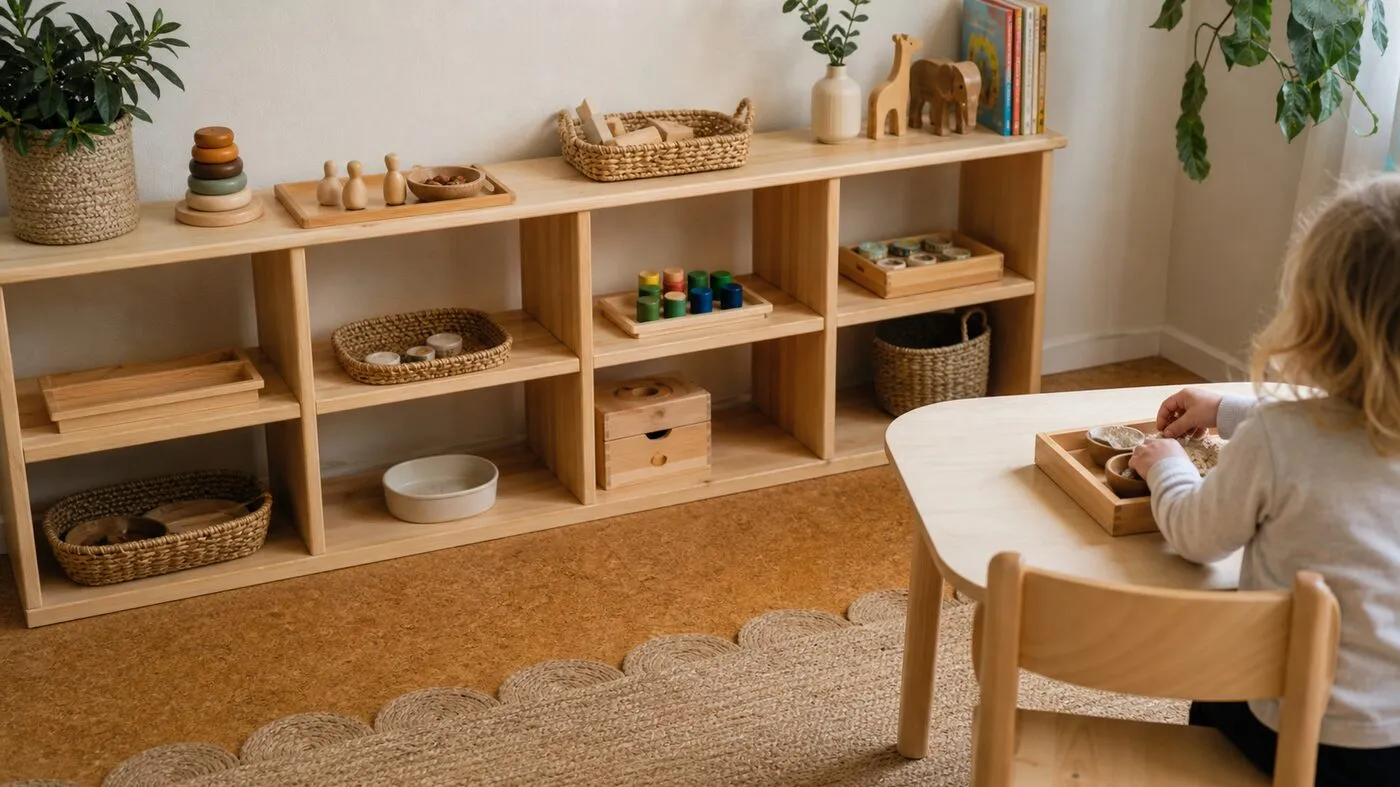
- turn one existing drawer into the active wardrobe
- use a cube shelf sideways with baskets
- add a removable low tension rod inside a shelf or cupboard
- place a mirror at toddler height instead of buying a new wardrobe unit
- use labelled baskets for socks, underwear, and pajamas
- keep off-season and backup clothes elsewhere
If you like IKEA-style solutions, this pairs naturally with the same logic behind budget Montessori home setups: use simple furniture in a child-accessible way. Our IKEA Montessori hacks guide has several ideas you can adapt for bedroom storage.
A few genuinely useful accessories, if you need them:
- adjustable tension rod for shelves or closets
- small wooden step stool for toddlers
- drawer dividers for baby and toddler clothes
Notice that none of these products make the wardrobe Montessori. They just reduce friction if they fit your space.
Actionable takeaway: Start with the environment you have. You can always upgrade later if a real need appears.
🤝 How to help without taking over
This part matters as much as the furniture.
A Montessori wardrobe works best when your role shifts from manager to guide.
That means:
- offering calm, limited choices
- giving enough time for practice
- helping only with the hardest step
- resisting the urge to redo everything for speed
- accepting that backward trousers are not a family emergency
You can still support a lot.
Try phrases like:
- “You can choose the striped top or the green one.”
- “I’ll hold the waistband. You push your foot through.”
- “Your socks are in the basket.”
- “Where do dirty clothes go now?”
That language keeps the responsibility with the child while still offering structure.
And if mornings are too rushed for practice, do more of the independence work in the evening. Let your child choose tomorrow’s outfit, put pajamas on independently, or practice pulling trousers up before bath time. The point is not to prove something at school-run speed.
Actionable takeaway: Independence grows faster when you support the process without stealing the final step.
A five-minute reset when the wardrobe stops working
Use this after a growth spurt, a weather change, or a week when getting dressed has become tense again:
- Remove anything that no longer fits, feels uncomfortable, or needs adult-level fastening.
- Keep only two to four weather-appropriate choices in the active area.
- Put a hamper, shoes, and the next outerwear step within the same short route.
- Test the route with your child at an unhurried time; watch rather than correcting every move.
- Keep the step they can do, and offer help only at the next genuinely difficult one.
If toileting clothing is the friction point, a child-height Montessori bathroom setup and our toilet-learning guide can make the sequence easier to manage. For the rest of the home, the same “one accessible layer” idea works in a toddler snack station and with practical-life activities.
How we approached this guide
This is a Montessori-at-home setup guide, not a developmental assessment or a guarantee of independent dressing at a particular age. We reviewed the advice against Exploritori’s practical-life, dressing-skills, bathroom, routine, and small-space guides, then prioritised choices that work with ordinary clothing and existing furniture: access, limited options, an easy sequence, and adult supervision where it is still needed.
Some links are affiliate links. They never change the recommendation to start with what you already have; a low drawer, a basket, and clothes your child can manage are often enough.
❓FAQ: Montessori toddler wardrobe questions parents ask most
Do I need a special Montessori wardrobe or closet?
No. One low drawer, a few baskets, and a mirror can be enough. Accessibility matters more than special furniture.
How many outfit choices should I leave out?
For most toddlers, two to four visible options works best. If your child gets overwhelmed or dressing gets messy fast, reduce the active set.
What age should I start a Montessori wardrobe?
You can begin around 12 to 18 months with very simple choices and easy clothes. The setup becomes more useful as your toddler wants more control over dressing.
What if my child keeps choosing the wrong clothes for the weather?
That usually means the active wardrobe is too open. Curate the options first so every available choice is workable. That keeps the choice real.
What clothes make independence easier?
Elastic waistbands, soft trousers, simple tops, easy cardigans, and shoes with straightforward fastenings are the most helpful.
A Montessori toddler wardrobe is one of those small home changes that can have an outsized effect.
Not because it looks beautiful. Because it makes a daily routine legible. It gives your child a real chance to practice independence. And it often turns dressing from something you do to them into something they begin to do for themselves.
That is the heart of Montessori at home.
 Get weekly Montessori tips
Honest reviews, activity ideas, and budget-friendly picks — no spam, just what works.
Subscribe Free