Montessori Dressing Skills for Toddlers: Shoes, Coats, Buttons, and Real Independence
· Updated
Dressing is one of those Montessori skills that sounds simple until you are actually living it.
Your toddler wants to do it themselves. You need to leave the house. One sock is inside out. The shoe is on the wrong foot. The coat is suddenly offensive. Everyone is too warm, too late, and too close to tears.
This is exactly why dressing belongs in Montessori practical life.
It is real. It happens every day. It gives your child a meaningful way to care for their own body. It also asks for a lot of coordination: balance, sequencing, hand strength, body awareness, patience, and problem-solving.
The goal is not a toddler who gets fully dressed alone by Tuesday.
The goal is a child who gradually understands the routine, participates in small useful ways, and feels capable instead of dragged through the morning.
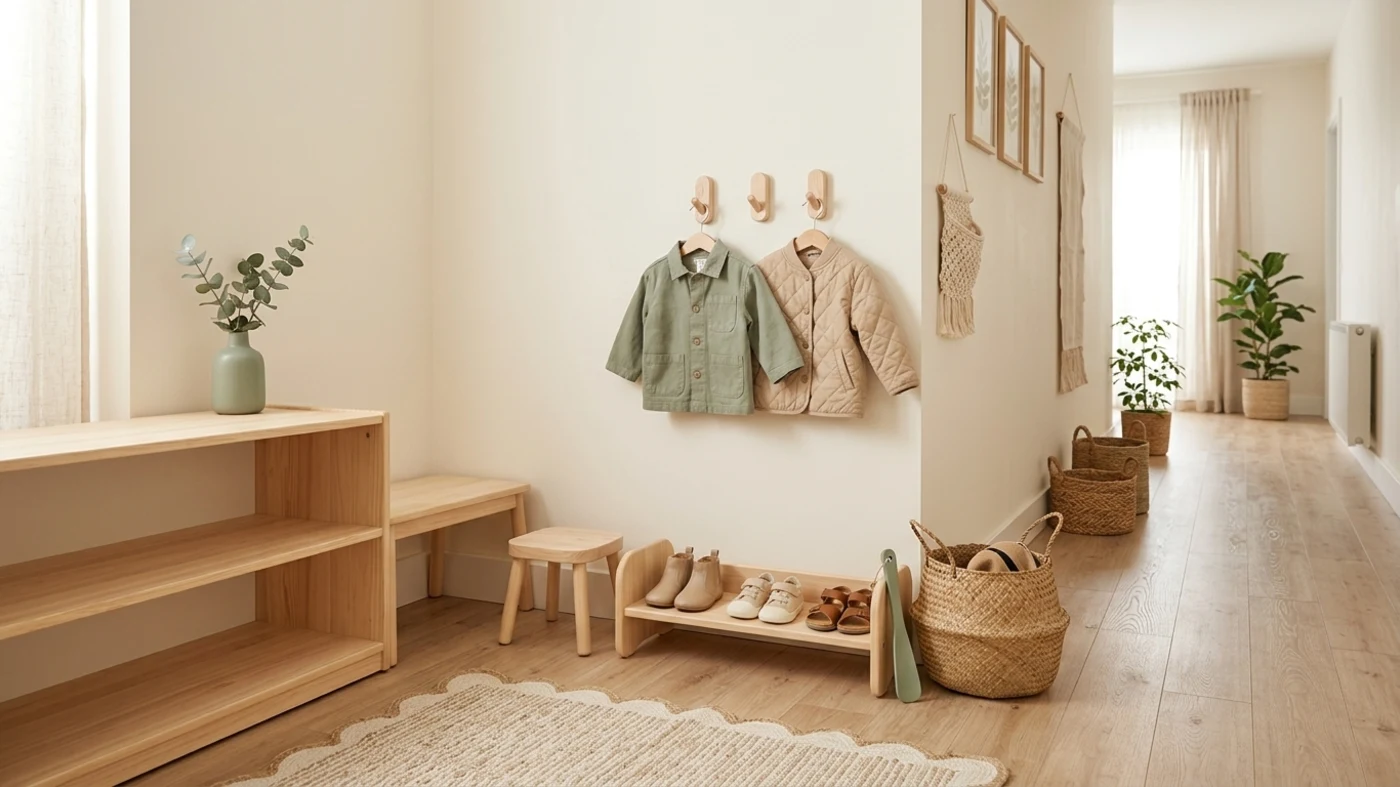
You do not need a beautiful dressing frame set or a perfect child-sized wardrobe to begin. A low hook, a shoe basket, two clothing choices, and a calmer rhythm can change the whole mood of getting ready.
Safety note: Dressing practice should be supervised. Avoid cords around the neck, loose drawstrings, choking hazards, unstable stools, tight shoes, slippery socks on hard floors, and anything that could trap fingers or restrict movement.
Quick chooser: what to practise first
Start with the part of dressing that causes the most friction in your home. One small repeatable job is better than teaching the whole routine at once.
| If the hard part is… | Practise this first | Make it easier by… |
|---|---|---|
| Leaving the house | carrying shoes to the door or closing one Velcro strap | keeping only one everyday pair in a visible basket |
| Coat battles | the coat flip with a cardigan or soft jacket | practising after nap or play, not while everyone is late |
| Sock frustration | pulling socks off, then matching socks by colour | choosing socks with a loose cuff and clear heel |
| Too many clothing choices | choosing between two outfits | preparing both options the night before |
| Fasteners | pulling a zipper up after an adult starts it | using a pouch or jacket before trying clothes on the body |
| Bathroom independence | pushing elastic trousers down and up | pairing dressing practice with a simple bathroom setup |
If the room itself is the problem, fix that before adding more lessons. The same prepared-environment logic appears in our Montessori bathroom setup, toddler wardrobe guide, and practical life activities guides.
Takeaway: choose the smallest useful skill that matches today’s bottleneck.
Why dressing is Montessori practical life
Montessori practical life is not about making children do adult chores early.
It is about giving them real, purposeful work at the right size.
Dressing fits that beautifully because it connects directly to your child’s body and daily rhythm. Clothes are not abstract learning materials. They have a clear purpose. Socks keep feet warm. Shoes help us go outside. A coat means we are leaving. Pajamas mean sleep is coming.
When your child helps with dressing, they practice:

- crossing the midline while reaching for sleeves
- using both hands together
- balancing on one foot
- matching body parts to clothing parts
- pulling, pushing, gripping, and pinching
- following a sequence
- noticing front, back, inside, outside, left, and right
- caring for belongings
- making small choices within limits
That is a lot of development hidden inside one pair of trousers.
The Montessori difference is that we slow the task down enough for the child to participate. Instead of dressing your toddler as quickly as possible every time, you choose one part they can do today.
“Push your arm through.”
“Pull the sock off.”
“Put your shoes in the basket.”
“Hang your coat on the hook.”
Small tasks count. Repetition counts even more.
Takeaway: dressing is not just a morning obstacle. It is daily practical life work, and toddlers learn it best in tiny repeatable steps. For more everyday independence ideas, see our guides to Montessori practical life activities and cleaning and care-of-environment work.
Start with the environment, not the lecture
Most dressing battles get worse when the environment asks too much of the child.
The coat hook is too high. The shoe pile is confusing. The drawer is stuffed. The socks all look the same. The child has six choices but no real way to choose. The adult explains more and more, while the setup stays difficult.
Montessori starts with the prepared environment.
For dressing, that means your child can see what belongs where and reach the things they are expected to use.

A simple home setup might include:
- one low hook for a coat or cardigan
- one small basket for everyday shoes
- one basket for hats or weather gear
- one laundry basket your child can reach
- two outfit choices instead of an open drawer
- a small mirror at child height, if you have space
- a bench, rug, or stable spot for sitting to put on shoes
Five-minute dressing-space audit
Before buying anything, stand where your child stands and check the route from bedroom to door:
| Check | Good enough looks like… |
|---|---|
| Reach | your child can reach one hook, one shoe basket, and one laundry spot |
| Choice | only two clothing options are visible at a time |
| Sitting | there is a stable place to sit for socks and shoes |
| Return path | dirty clothes, pajamas, shoes, and coats each have one obvious place |
| Adult help | the hardest step has a clear adult job and a clear child job |
If you can only change one thing, make the return path clearer. A toddler who knows where shoes, coat, and laundry go can participate even before they can dress alone.
You do not need a miniature dressing room. In many homes, a single entryway hook and shoe basket are enough. If you want to build the clothing side more intentionally, our Montessori toddler wardrobe guide shows a simple version without turning the bedroom into a showroom.
The key is clarity.
If your child is expected to hang their coat, the hook should be obvious and reachable. If they are expected to find shoes, the shoes should not be buried under adult boots, shopping bags, and three umbrellas. If they are expected to choose clothes, the choice should be small enough to handle.
Two options are usually enough:
“Blue shirt or striped shirt?”
“Leggings or soft trousers?”
“Red socks or grey socks?”
This gives real agency without turning the morning into a full wardrobe debate.
For younger toddlers, you can prepare the outfit in a basket the night before. Your child still participates by carrying the basket, pulling out each item, or putting dirty clothes away later.
Takeaway: before asking your toddler to be more independent, make the dressing space easier to read.
The best first dressing skills for toddlers
Independent dressing develops unevenly.
A child may pull off socks easily but struggle to put them on. They may master the coat flip before they can manage sleeves calmly. They may love shoes one week and reject them the next.
That is normal.
Instead of teaching everything at once, choose the next useful skill.

1. Put dirty clothes in the laundry basket
This is often the easiest starting point.
After changing clothes, hand your child one item and say, “Laundry basket.” Walk with them if needed. Keep the basket low and consistent.
This builds care of belongings and helps your child understand the full dressing cycle: clothes come off, dirty clothes go away, clean clothes come on.
2. Pull off socks
Taking off is usually easier than putting on.
Choose socks that are not too tight. Loosen the heel a little, then let your child pull from the toe. At first, they may pull dramatically and fall backward. That is part of the learning.
Practice when you are not in a hurry.
3. Push arms through sleeves
Hold the shirt, jacket, or cardigan so the sleeve opening is easy to find. Instead of pushing your child’s arm through for them, pause and invite:
“Find the tunnel.”
“Push your hand through.”
“Where are your fingers?”
This gives your child one clear job inside a bigger adult-assisted task.
4. Step into trousers
Sit your child down, hold the waistband low, and help guide one foot at a time.
You can say:
“One foot.”
“Other foot.”
“Stand up.”
“Pull up.”
The words become part of the routine. Over time, your child begins to anticipate the sequence.
5. Carry shoes to the door
Before shoes go on, your child can fetch them.
This is useful even if they cannot put shoes on independently. It connects the object to the routine and gives them a real contribution.
If matching shoes is tricky, keep only one everyday pair in the basket.
6. Hang a coat on a low hook
A low hook is one of the simplest Montessori home upgrades.
When you come inside, help your child take off the coat, then invite them to place the loop or hood on the hook. At first, you may need to hold the coat with them. Later, they can do it alone.
This is much more realistic than expecting a toddler to use adult hangers in a wardrobe.
Takeaway: teach the tiny useful parts first. A toddler who can do one step proudly is already building independence.
Shoes: Velcro, left and right, and less morning drama
Shoes are often the most emotional part of getting ready.
They require balance, finger strength, foot awareness, patience, and the mysterious ability to know which shoe belongs where.
For toddlers, the easiest shoe setup is usually:
- flexible sole
- wide opening

- firm heel
- Velcro or slip-on closure
- no fiddly laces
- easy-to-see left and right difference
You do not have to buy special Montessori shoes. You just want shoes your child can participate with.
To make left and right easier, try one simple cue. Some families cut a sticker in half and place one half inside each shoe so the picture matches when the shoes are correctly placed side by side. Others mark the inside edge with a dot.
Keep the cue inside the shoe so it helps your child without becoming a decoration battle.
For putting shoes on, slow the task down:
- Put shoes side by side.
- Invite your child to sit.
- Open the Velcro fully.
- Help them push toes in.
- Ask them to push the heel down.
- Let them close the strap.
Closing the strap may be the only independent step for a while, and that is fine.
If your child insists on the wrong foot, you can avoid turning it into a power struggle. Try:
“Walk to the door and see how it feels.”
Sometimes the feedback from the shoe does more than an adult correction. If the shoe is genuinely uncomfortable or unsafe, help calmly:
“That one is pinching. Let’s switch.”
Takeaway: choose shoes that let your child help, then give them one repeatable job instead of expecting full independence.
Coats and the Montessori coat flip
The coat flip is popular for a reason: it gives toddlers a dramatic, successful way to put on a coat.
It works best with soft jackets, cardigans, and coats that are not too heavy.
Here is how to teach it:
- Lay the coat on the floor.
- Put the hood or collar by your child’s feet.
- Make sure the inside of the coat faces up.
- Invite your child to put both arms into the sleeves.
- Once arms are in, they lift and flip the coat over their head.
- Help adjust the shoulders if needed.
The first few attempts may be chaotic. Practice when you do not need to leave immediately. A hallway floor five minutes before preschool is not the best first lesson.
You can also teach the coat flip with a cardigan or hoodie indoors. That removes the pressure of weather, shoes, bags, and keys.
Once the coat is on, choose one closing skill:
- push the zipper tab down
- hold the bottom while you start the zipper
- pull the zipper up once it is connected
- close one large snap
- press Velcro together
Zippers are hard because the beginning requires precise alignment. Many toddlers can pull a zipper up long before they can start it. Let that be their job.
“I’ll start it. You pull up.”
That is cooperation, not failure.
Takeaway: the coat flip is useful, but it works best as playful practice outside the rushed leaving-the-house moment.
Buttons, zippers, snaps, and dressing frames
Montessori classrooms often use dressing frames: wooden frames with buttons, buckles, zippers, bows, snaps, and hooks.
They isolate one skill beautifully.
At home, though, you do not need to buy a full set unless your child is genuinely interested or you want a dedicated material. Real clothes usually provide plenty of practice.
Good home alternatives include:
- a zipper pouch
- a jacket with a large zipper pull
- a cardigan with big buttons
- a soft bag with buckles
- a doll or teddy with simple clothes
- an old shirt with large buttons
- a laundry basket of socks to sort and pair
The Montessori principle is isolation of difficulty. That means you make one challenge clear instead of mixing five challenges together.
If you want to teach buttons, choose large buttons on loose fabric. Do not start with tiny shirt buttons while the shirt is on your child’s body and everyone is leaving.
If you want to teach zipping, start with pulling up after you connect the zipper. Later, practice inserting the pin into the box.
If snaps are frustrating, use just one large snap on a pouch or jacket.
Short practice sessions are better than long ones. Two minutes with interest is more useful than fifteen minutes of forced “fine motor work.” If fasteners are the hard part, pair dressing practice with simple Montessori fine motor activities for toddlers.
Also watch your child’s hands. Dressing fasteners require strength and coordination. If the material is too stiff, your child may understand the task but physically struggle to complete it.
That is not defiance. It is development.
Takeaway: dressing frames are optional. What matters is giving your child one clear fastening skill at a time.
Build a calmer getting-ready routine
Most dressing problems are not really about dressing.
They are about timing, transitions, hunger, tiredness, too many choices, or adults trying to teach a new skill during the most stressful ten minutes of the day.
If mornings are rough, protect the routine.
Prepare what you can the night before:
- choose two outfit options
- put socks with the clothes
- place shoes by the door
- hang the coat on the low hook
- pack the bag
- decide which weather layer is needed
In the morning, keep the language short.
“Pajamas off.”
“Shirt on.”
“Socks.”
“Shoes.”
“Coat.”
Toddlers do not need a long explanation when they are dysregulated. They need a predictable sequence and a calm adult body nearby.
If your child resists, look for the smallest point of participation.
“Do you want to pull the sleeve or close the shoe strap?”
“Do you want blue socks or grey socks?”
“Should I help with the shirt first or trousers first?”
These are bounded choices. They keep the adult responsible for the routine while giving your child a real voice.
You can also separate practice from performance.
Morning is performance. You need to get dressed and leave.
Afternoon is practice. Your child can try the coat flip ten times, zip and unzip a pouch, pair socks, or dress a doll.
This removes a lot of pressure.
A first-week practice rhythm
Use one calm week to build the routine instead of trying to solve every dressing skill in one morning.
| Day | Tiny practice | When to do it |
|---|---|---|
| Monday | put pajamas or dirty clothes in the laundry basket | after getting dressed |
| Tuesday | choose between two shirts or trousers | the night before |
| Wednesday | carry shoes to the door and open the strap | before an outing with extra time |
| Thursday | pull socks off and match them into a pair | after bath or before laundry |
| Friday | practise the coat flip with a cardigan | afternoon playtime |
| Weekend | hang coat, hat, or bag on the low hook | every time you come inside |
Keep the same sentence for each action. Toddlers often cooperate better with a predictable cue than with a new explanation every day.
Takeaway: do not teach brand-new dressing skills in the morning rush. Use calm moments for practice, then let the routine carry you when time matters.
A simple age-by-age dressing guide
Every child develops differently, but rough expectations can help.
12-18 months
At this stage, your child may:
- pull off socks or hats
- push arms through sleeves
- put clothes in the laundry basket
- carry shoes
- help wipe after spills
- choose between two items
- imitate brushing hair or wiping face
Keep tasks short and concrete. Use large openings, soft clothes, and obvious storage.
18-24 months
Your child may begin to:
- step into trousers with help
- pull elastic waistbands up or down
- open Velcro shoes
- close simple Velcro straps
- hang a coat on a low hook
- try the coat flip
- match socks by color
- put pajamas in a basket
Expect mistakes. Backward trousers and inside-out socks are part of the process.
2-3 years
Many children can practice:
- putting on easy shoes
- pulling pants up more independently
- removing simple shirts
- pulling a zipper up after an adult starts it
- using large snaps or buttons
- choosing weather-appropriate options from two choices
- folding washcloths or pairing socks
This is a good age to create a small dressing station if your home allows it.
3-4 years
Many children become more capable with:
- front and back orientation
- larger buttons
- starting some zippers
- putting on coats
- choosing full outfits with guidance
- managing simple toileting clothing
- putting clean clothes away in low drawers
You will still need to help, especially when tired, cold, rushed, or dealing with tricky clothes. Clothing independence also supports toileting, so it can help to plan dressing alongside a child-accessible Montessori bathroom setup and realistic toilet learning routine.
For broader age planning, compare this with our Montessori activities for 18-month-olds, 24-30 month activity guide, and 3-year-old Montessori activities. Dressing usually improves when it is part of a wider practical-life rhythm, not treated as an isolated morning demand.
Takeaway: use age guides gently. Your child’s next useful step matters more than the chart.
Common mistakes that make dressing harder
The first mistake is offering too many choices.
An open wardrobe can overwhelm a toddler. Two choices are usually better than twenty.
The second mistake is choosing clothes that adults like but children cannot manage. Tiny buttons, stiff denim, tight sleeves, complicated straps, and slippery dress shoes may look lovely but create daily frustration.
The third mistake is correcting every error.
If the shirt is backward but safe and your child is proud, you do not always need to fix it immediately. You can say, “You put it on by yourself,” then adjust later if needed.
The fourth mistake is doing everything for speed every day, then expecting independence suddenly.
Children need repetition. If they never get to try when time is calm, they will not magically perform when time is tight.
The fifth mistake is turning dressing into a moral issue.
A toddler who resists socks is not trying to ruin the day. They may be seeking control, reacting to a sensory discomfort, testing a routine, or simply being two.
Stay practical.
“The socks feel bumpy. Let’s try these.”
“You can choose shoes or coat first.”
“I’ll help your foot. You close the strap.”
Takeaway: independence grows faster when the clothes, choices, and adult expectations are realistic.
What to buy, what to skip, and what to use instead
You can support dressing skills without buying much.
Useful items, if you need them, include:
- low wall hooks
- a small shoe basket
- soft elastic-waist trousers
- socks with clear heel markings
- Velcro shoes with a wide opening
- a child-safe mirror
- a low bench or sturdy stool
- a simple zipper pouch
- a laundry basket your child can reach
Skip anything that makes the routine more complicated than it needs to be.
You probably do not need a full wardrobe system, a large set of dressing frames, or a different “Montessori” item for every fastener. If you already own clothes with buttons, zippers, snaps, and Velcro, you already have practice materials.
The best purchase is often the boring one: a hook at the right height, a basket that makes sense, or shoes your child can actually open.
Second-hand is completely fine. Dressing practice does not require matching wooden furniture or neutral linen everything. It requires access, repetition, and clothes that fit your child’s current abilities.
If you plan to add affiliate products later, choose items that solve a real problem: easier shoe independence, better coat storage, safer sitting while dressing, or fastener practice that your child actually enjoys.
Takeaway: buy for the bottleneck, not for the aesthetic.
How we reviewed this guide
This is a Montessori-at-home self-care guide, not a clinical motor-development assessment or a product test. We reviewed it in July 2026 against Exploritori’s practical-life, bathroom, toilet-learning, toddler wardrobe, fine-motor, and age-based activity guides, then prioritised steps that use ordinary clothes and home routines, isolate one difficulty at a time, and keep adult supervision clear.
Some links may be affiliate links, which can earn Exploritori a commission at no extra cost to you. The core setup here does not require special Montessori materials. Buy only when a hook, basket, bench, shoe, or fastener tool solves a real size, safety, or repeat-use problem in your home.
Final thoughts
Montessori dressing skills are not about rushing independence.
They are about giving your child a real role in caring for themselves.
Some days that role will be tiny. They put one sock in the laundry basket. They close one shoe strap. They push one arm through a sleeve. They hang a coat badly but proudly.
That counts.
The more you prepare the environment and simplify the routine, the less dressing becomes a daily fight for control. Your child knows where things go. They know what comes next. They have a small job they can repeat.
And you still get to help.
Montessori at home is not about stepping back completely. It is about stepping in less than necessary, and only where your child still needs you.
Start with one hook, one basket, one choice, and one skill.
Then let repetition do what repetition does best.
 Get weekly Montessori tips
Honest reviews, activity ideas, and budget-friendly picks — no spam, just what works.
Subscribe Free