Montessori vs Reggio Emilia: What's the Actual Difference?
The Comparison Nobody Explains Properly
You’ve read that both Montessori and Reggio Emilia are “child-led.” Both use open-ended materials. Both originated in Italy. Both are popular with thoughtful, engaged parents.
And yet they are fundamentally different philosophies — different enough that choosing one over the other will shape your child’s daily experience in meaningful ways.
This comparison won’t tell you which is better. That’s the wrong question. It will tell you what each actually is, where they genuinely differ, and how to think about which one fits your child, your family, and your values.
Origins and Context
Montessori: The Scientist
Maria Montessori (1870–1952) was a physician — the first woman to graduate from the University of Rome’s medical programme. Her method grew out of work with children in Rome’s poverty-stricken San Lorenzo district in 1907. She observed children’s behaviour scientifically, tracked what they were drawn to, and built a method from evidence.
The result: a highly systematised approach with specific materials, a specific environment (the “prepared environment”), and a specific adult role (the “guide”). Montessori wrote everything down. She trained teachers. Her method became a global franchise.
Reggio Emilia: The Community
Reggio Emilia is a city in northern Italy. After World War II, parents in the city literally built their own school from the rubble — using money raised from selling a German tank, a truck, and some horses. Loris Malaguzzi, a young psychologist, heard about it and joined the project.
What grew from that community effort became the Reggio Emilia Approach — not a method, but an educational philosophy. Malaguzzi died in 1994 without writing a curriculum, by design. Reggio Emilia is deliberately not codified, not franchised, not trademarked. It’s a living philosophy tied to a specific community and adapted differently everywhere it travels.
The key difference, right from the start: Montessori is a method with defined materials and training. Reggio Emilia is an approach with principles but no prescribed curriculum. One can be implemented consistently; the other is reinvented in every context.
The Philosophical Core
Montessori: The Absorbent Mind
Montessori’s central concept is that children are born with an “absorbent mind” — a natural capacity to learn from their environment that is qualitatively different from adult learning. Young children (0–6) don’t learn by being taught. They absorb everything around them, unconsciously building their understanding of reality.
From this follows:
- Children need freedom to follow their natural learning drive
- The environment must be prepared to support this drive (right materials, right order, right scale)
- Adults must observe rather than direct
- Learning is individual, not collective — each child is on their own developmental path
Montessori believed development followed predictable “sensitive periods” — windows of intense interest in particular skills (language, order, movement, refinement of the senses). Materials are designed to match these windows.
Reggio Emilia: The Hundred Languages
Malaguzzi’s foundational belief: children have a hundred ways of knowing, expressing, and communicating. Clay. Paint. Shadow. Music. Movement. Story. Drama. Dance. Most traditional education privileges exactly two: reading and maths. Reggio Emilia insists on respecting all hundred.
The philosophical pillars:
- The child as a strong, capable agent — competent from birth, not a vessel to be filled
- The environment as a third teacher — the space itself communicates values, invites investigation, makes learning visible
- The teacher as co-researcher — not a facilitator who steps back, but a curious collaborator who investigates alongside children
- Documentation — making learning visible through photographs, transcripts, and artwork displayed throughout the school
- The project (progettazione) — long-term investigations that follow children’s genuine curiosity, sometimes lasting weeks or months
The difference in the adult’s role is significant. Montessori asks the adult to prepare, demonstrate, and observe. Reggio asks the adult to wonder, investigate, and co-discover.
Environment: Two Completely Different Visions
This is where the philosophies become visually distinct.
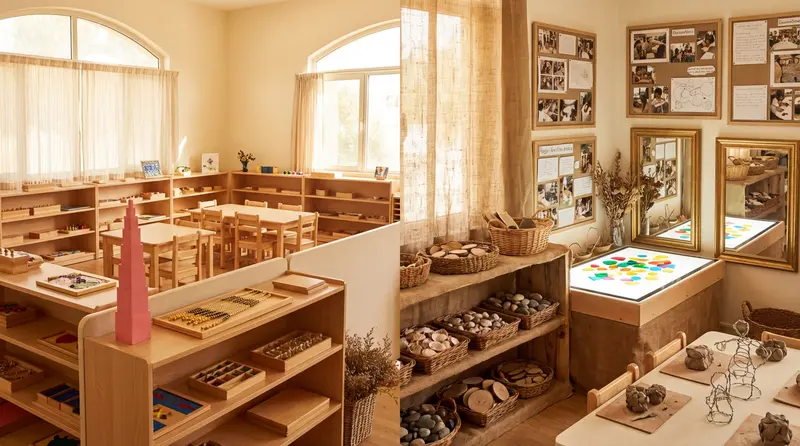
The Montessori Prepared Environment
Walk into a Montessori classroom and you’ll notice:
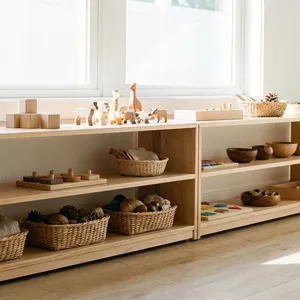
- Order — everything has a place, materials are on open shelves at child height, arranged in developmental sequence from left to right
- Beauty — natural light, plants, real (not toy) objects, muted colours
- Specific materials — the pink tower, the sandpaper letters, the golden bead material. These are not interchangeable; each isolates one concept.
- Work rugs — children take a mat from the shelf, define their workspace, complete their work, return the material exactly as they found it
- Calm purposefulness — children choosing activities, working independently or in small groups by choice, rarely in whole-group instruction
The Montessori environment is curated to eliminate distraction and support concentration. Less is more — a cluttered shelf is considered a failure of preparation.
The Reggio Emilia Atelier
Reggio Emilia schools are ateliers — studios. They’re designed to provoke wonder, invite exploration, and make learning visible. You’ll notice:
- The atelier (art studio) — every Reggio school has one, stocked with real artists’ materials: clay, wire, charcoal, light tables, projectors
- The atelierista — a professional artist who works alongside the teachers
- Documentation everywhere — walls covered with photographs of children’s work-in-progress, transcripts of conversations, drawings at every stage of a project
- Natural light and mirrors — strategic use of reflection, shadow, and light as learning materials in themselves
- Loose parts and provocation tables — collections of shells, sticks, fabric, metal, glass (yes, real glass) arranged to provoke curiosity and investigation
- Warmth and beauty — Reggio spaces tend to feel more like studios or living rooms than classrooms
The Reggio environment is designed to generate questions, not to have all the answers ready. Where Montessori says “here is what to do with this,” Reggio says “I wonder what you’ll discover.”
Materials and Learning Tools
Montessori Materials
Montessori materials are iconic and intentional. Each one was designed (many by Montessori herself) to isolate a specific developmental concept and provide built-in control of error.
The pink tower (ten wooden cubes that decrease in size from 10cm to 1cm) teaches discrimination of dimension, spatial awareness, and order — and if a child builds it incorrectly, the irregular shape tells them without adult intervention.
Key Montessori materials and their home-equivalent alternatives:
| Material | Concept | Budget option |
|---|---|---|
| Pink Tower | Size discrimination | Graduated stacking cups |
| Sandpaper Letters | Letter sounds, reading | Sandpaper letter tracing cards |
| Spindle Boxes | Introduction to zero | Household containers with craft sticks |
| Golden Beads | Decimal system | Abacus or counting beads |
| Knobbed Cylinders | Visual discrimination | Shape sorters |
| Metal Insets | Pencil control | Stencil sets |
The Melissa & Doug Shape Sorting Cube ($18) and the Hape Pound & Tap Bench ($30) are excellent entry points for a Montessori-aligned home. For a broader selection by age, see our Complete Guide to Montessori Toys by Age.
Reggio Materials
Reggio Emilia doesn’t have “materials” in the Montessori sense — specific items designed for specific learning outcomes. Instead, Reggio uses natural and authentic materials that invite open-ended exploration and aesthetic engagement.
What you’d find in a Reggio-inspired space at home:
- Real art supplies — watercolours, clay, charcoal, ink (not crayons and construction paper)
- Light table — a backlit surface for examining leaves, mixing colours, tracing shadows
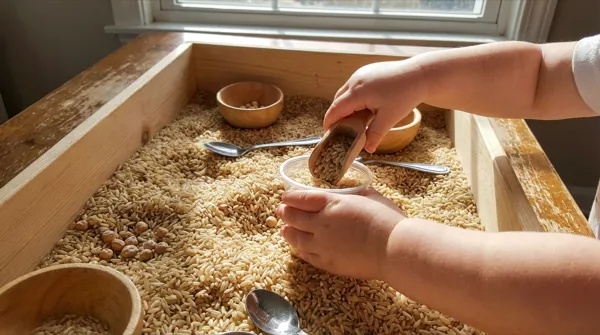
- Loose parts — pebbles, shells, buttons, fabric scraps, wooden discs, metal washers, pinecones
- Mirrors and reflective surfaces — to create unexpected perspectives
- Natural materials — branches, seed pods, moss, flowers, feathers
- Wire, cloth, wood — for three-dimensional construction
The Grimm’s Large Rainbow (~$55) — while commonly associated with Waldorf — is deeply Reggio-compatible: it invites open-ended interpretation, aesthetic engagement, and creative construction without prescribing what to do with it.
The Role of the Adult
This is the sharpest practical difference for parents implementing either approach at home.
Montessori: The Prepared Guide
In Montessori, the adult’s job is to:
- Prepare the environment — curate the materials, maintain the order
- Present materials — demonstrate how to use an item in a slow, precise, three-period lesson (name it, identify it, name it again)
- Observe — watch what the child chooses, how long they stay with it, what they’re drawn to next
- Step back — resist the urge to help, correct, or redirect unless safety is a concern
- Follow the child — let the child’s interest guide the pacing, not a plan or schedule
The Montessori guide is restrained. The hardest part for most parents is learning to do less — not jumping in to fix, not praising every completed task (“Good job!” is not Montessori), not directing activity.
Reggio: The Co-Researcher
In Reggio Emilia, the adult’s job is to:
- Listen deeply — pay attention to what genuinely interests and puzzles the child
- Create provocations — set up an environment, object, or experience that might spark investigation
- Ask good questions — “What do you think would happen if…?” “I wonder why…?”
- Document — photograph, record, write down what children say and do to make learning visible
- Co-investigate — be genuinely curious alongside the child, not knowing the answer either
- Extend projects — help children go deeper into topics that emerge organically
The Reggio adult is engaged. Not directing, not stepping back — but actively participating in the investigation. This requires genuine curiosity from the adult, which is either delightful or exhausting depending on your temperament.
The Role of Other Children
Montessori: Intentional Mixed Ages
Montessori classrooms use mixed-age groups (typically three-year spans: 0–3, 3–6, 6–9, 9–12). This is deliberate. Older children consolidate their knowledge by teaching younger ones. Younger children are inspired by older ones. Competition is reduced because children aren’t all expected to achieve the same benchmarks at the same time.
Social interaction is encouraged but not structured. Children choose whether to work alone or alongside others. There are no designated “group activities” in the traditional Montessori school day.
Reggio: The Learning Group as Co-Author
In Reggio Emilia, the group is considered essential — not incidental — to learning. Children investigate together. Ideas build through dialogue. A child’s theory is challenged, refined, or extended by another child’s observation. The group co-authors the project.
Documentation serves partly to make this collective thinking visible: what did the group think last week? How has our understanding changed? What do we still want to find out?
Academic Learning: When and How
Montessori
Academic content begins early — sometimes very early. Three-year-olds in Montessori environments handle sandpaper letters, explore number rods, and engage with early reading materials. The pace is child-led, but the materials are available.
By age 5–6, many Montessori children are reading. By ages 6–9, they’re encountering fractions, grammar, geometry, and world history through concrete materials.
This early academic emphasis sometimes surprises parents who expect an entirely play-based early childhood. Montessori is play-based, but the play has specific developmental targets.
Reggio Emilia
Reggio Emilia doesn’t have a curriculum. There are no predetermined academic milestones. Reading and writing emerge through projects — a child making a sign for their block structure, or writing the caption for a photograph in the documentation display. Maths emerges from counting loose parts, building with precise measurements, or discussing quantities in a cooking project.
This isn’t academic delay — it’s embedded learning. Skills appear organically within meaningful contexts rather than as isolated exercises. For families who worry about school readiness, this can feel uncomfortable. For families who trust child-led timing, it feels natural.
What Happens When Things Go Wrong
Every approach has failure modes — ways the philosophy gets distorted in practice.
Montessori: When It Goes Wrong
- Over-restriction — some Montessori practitioners become rigid about materials, eliminating all imaginative play and insisting on “authentic” materials to an unhelpful degree
- Adult hovering with a different label — “observing” can become surveillance; “presenting materials” can become pressure
- The Instagram version — a beautifully arranged shelf with expensive wooden toys that nobody actually uses, while parents feel guilty their child prefers dress-up
- Developmental pressure — using “sensitive periods” as evidence a child is behind rather than as a guide
Reggio Emilia: When It Goes Wrong
- Projects as performance — documentation becomes a performance for parents rather than genuine reflection on children’s thinking
- “Child-led” meaning unstructured — using Reggio language to justify chaos without real intentionality
- The atelierista as gatekeeper — when the art studio becomes a place children go for “real art” instead of a philosophy that permeates everything
- Inaccessible cost — Reggio-inspired private schools can be enormously expensive; the approach risks becoming aspirational branding
Practical Guide: Which One Fits Your Life?
Choose Montessori if:
- You want clarity. Montessori tells you what materials to buy, how to set up the shelf, and how to present activities. There’s a right and a wrong way, which is either comforting or constraining depending on who you are.
- Your child loves order. Some children are intensely drawn to the precision and sequence of Montessori materials. If your child lines up toys, sorts objects by colour, and gets upset when things are out of place — Montessori is probably a match.
- You prefer to observe from a distance. The Montessori guide’s job is to prepare and step back. If jumping in makes you feel helpful but you’re willing to resist it, Montessori teaches valuable restraint.
- Early academics feel right. If you’re comfortable with your 4-year-old tracing letters and working with number rods, Montessori gives you a clear pathway.
- You want documented outcomes. There’s a century of Montessori research. If evidence matters to you, it exists. See also our overview of how to start Montessori at home.
Choose Reggio Emilia if:
- You are genuinely curious. Reggio works best when the adult is actually interested in the questions children raise — not performing interest, but experiencing it. If you find yourself thinking “hmm, I wonder about that too,” you’ll thrive in a Reggio approach.
- Your child is a maker. Children who love clay, building, constructing, drawing, and working with materials in open-ended ways find Reggio deeply satisfying.
- You love documentation. Reggio practitioners make beautiful records of children’s learning. If photographing, captioning, and creating documentation displays sounds joyful rather than exhausting, this is the approach for you.
- You trust emergent learning. If you’re comfortable not knowing what your child will be “working on” next week because it depends on what they’re curious about, Reggio suits you.
- You want deep engagement over breadth. Reggio projects go deep — a study of puddles might last three weeks and encompass science, art, language, and drama. If depth over coverage appeals to you, this is the match.
The hybrid truth:
Most thoughtful parents end up somewhere between the two — and that’s fine. The Montessori shelf (orderly, purposeful, child-height) with Reggio-influenced loose parts and a genuine invitation to investigate is a perfectly coherent approach. A light table next to sandpaper letters is not a contradiction; it’s a well-furnished childhood.
The underlying values are compatible: both trust children, both prioritise the environment, both resist adult-directed instruction for young children. The differences are in method, pace, and what you believe the adult’s role actually is.
The Italy Connection: Does It Matter?
Both methods originated in Italy. This comes up in marketing constantly — “authentic Italian pedagogy” — as if geography confers quality.
What it actually reflects is a specific moment in 20th-century Italian intellectual history, when progressive educators were challenging the authoritarian, rote-learning models inherited from the 19th century. Both Montessori and Reggio emerged from the same broad tradition: a belief that children deserved better than they were getting.
Today, neither requires Italian credentials to implement well. A thoughtful parent in Barcelona applying Reggio principles at home is doing something more authentically Reggio than a school in Milan using Reggio branding as marketing.
FAQ
Is Reggio Emilia better than Montessori?
No. They serve different goals and suit different children and families. Montessori offers a clearer structure and earlier academic development. Reggio Emilia offers deeper creative and investigative experiences. Both produce confident, curious, capable children. The research on both is positive; neither has been shown to cause harm.
Can I do Reggio Emilia at home without special training?
Yes. Reggio Emilia is an approach, not a method — there’s no certification required. You can apply Reggio principles at home by providing open-ended materials, asking genuine questions, following your child’s interests into projects, and making learning visible through documentation. Start with loose parts (shells, stones, buttons, fabric scraps), a few good art supplies, and a willingness to wonder alongside your child.
Do Montessori children do worse at creative arts?
The research suggests not. While Montessori’s specific materials are precise and structured, the broader Montessori environment supports creativity through practical life, expressive arts, and child-directed choice. The concern arises when Montessori is implemented rigidly and imaginative play is prohibited. In well-implemented Montessori settings (and at home), creativity flourishes. For Montessori-compatible art activities, see our process art guide.
Is Reggio Emilia only for art-focused children?
No. The hundred languages concept applies to all children, including those whose languages are numbers, patterns, building, or physical movement. A child who loves to count can investigate quantity with the same depth a painting child investigates colour. The art studio is central to Reggio schools, but the investigative approach extends to science, maths, language, and social studies equally.
Are there Reggio Emilia schools everywhere?
Reggio-inspired schools exist worldwide. True Reggio Emilia schools (affiliated with the original Reggio Emilia municipality and its Reggio Children organisation) are mainly in Italy. Most schools outside Italy describe themselves as “Reggio-inspired” — meaning they apply the principles without the specific institutional affiliation. The quality of Reggio-inspired schools varies enormously; the label is not protected the way “Montessori” sometimes is.
What age is Reggio Emilia suitable for?
Reggio Emilia began with schools for children aged 3–6, then expanded to infant-toddler centres for 0–3. The approach is applied from birth through primary school in some communities. The investigative, project-based elements become more prominent from age 3 onwards, but the core values (listening to children, respecting their competence, providing rich environments) apply at any age.
Which produces better academic outcomes?
Longitudinal research on Montessori (there’s more of it) shows Montessori students perform well academically, particularly in reading and executive function. Reggio Emilia research is harder to assess because the approach doesn’t produce standardised outcomes — but studies of project-based learning generally show strong gains in critical thinking, collaboration, and intrinsic motivation. Neither has been shown to disadvantage children academically.
Can I combine Montessori and Reggio Emilia?
Yes, and many educators do. The Montessori prepared environment (orderly, purposeful, child-accessible) pairs well with Reggio documentation practices and the atelierista model. Both share the underlying value of respecting the child’s own drive to understand the world. The tension is in the adult’s role: Montessori asks you to step back, Reggio asks you to step in (differently). Holding both simultaneously requires intentionality — but it’s absolutely possible.
For more on building your Montessori approach at home, start with our guides to setting up a Montessori shelf and practical life activities for toddlers. For comparison content, see also Montessori vs Waldorf and Lovevery vs DIY.
 Get weekly Montessori tips
Honest reviews, activity ideas, and budget-friendly picks — no spam, just what works.
Subscribe Free