Montessori vs Waldorf: Which Approach Fits Your Child?
· Updated

Why This Comparison Matters
If you’re a parent exploring alternatives to mainstream education, you’ve probably encountered both Montessori and Waldorf — and left more confused than when you started.
They’re often mentioned together, lumped into the same “alternative education” category. But aside from both being named after their founders and both using wooden toys, they’re fundamentally different approaches to how children learn.
This isn’t a “Montessori is better” post (we run a Montessori site, so you already know where our expertise lies). It’s an honest comparison for parents who want to understand what they’re actually choosing between.
The 60-Second Decision Table
If you are deciding for a real child, start here before getting lost in philosophy.
| Parent question | Montessori usually fits better when… | Waldorf usually fits better when… |
|---|---|---|
| What does my child do when given free time? | Chooses tasks, repeats precise movements, sorts, pours, builds, or asks how things work. | Invents stories, costumes, small worlds, songs, and group pretend play. |
| How much adult direction helps? | Your child settles when shown a clear material and then left to practise. | Your child joins in through imitation, rhythm, story, and adult modelling. |
| What environment calms them? | Order, visible choices, child-height tools, and a predictable shelf. | Warmth, nature materials, seasonal rhythms, songs, and fewer explicit choices. |
| How do you feel about early academics? | You want letters, numbers, and maths available when interest appears. | You prefer delayed formal academics with pre-reading through story, rhyme, and movement. |
| What do you want at home? | Practical independence: dressing, cooking, cleaning, shelf work, real tools. | Imaginative rhythm: baking day, nature table, handwork, storytelling, open-ended play. |
This is not a personality test. A child can enjoy both. The useful question is which environment reduces friction for your family today.
The Philosophical Divide
Montessori: Follow the Child
Maria Montessori (1870-1952) was an Italian physician who developed her method through scientific observation of children. Her core belief: children are naturally driven to learn, and adults should prepare the environment and then get out of the way.
Key principles:
- Child-led learning — the child chooses what to work on and for how long
- Prepared environment — carefully organised spaces with purposeful materials
- Concrete to abstract — physical materials before concepts
- Reality-based — real objects, real activities, real consequences
- Mixed-age groups — typically 3-year age spans (0-3, 3-6, 6-9, 9-12)
- Independence — children do things themselves as early as possible
Waldorf: Protect the Child
Rudolf Steiner (1861-1925) was an Austrian philosopher who founded Waldorf education based on his spiritual philosophy (anthroposophy). His core belief: children develop in stages, and education should match the stage — not push ahead of it.
Key principles:
- Rhythm-based learning — daily, weekly, and seasonal rhythms structure the experience
- Teacher-guided — the teacher (or parent) leads activities, children follow
- Imagination first — fantasy, stories, and creative play before academic content
- Nature-centred — strong emphasis on outdoor time, natural materials, seasonal celebrations
- Delayed academics — formal reading and maths typically begin at age 7
- Artistic integration — every subject taught through art, music, movement, or story

The Practical Differences
On Play
Montessori: Distinguishes between “work” and “play.” Montessori activities (called “work”) are purposeful — pouring, sorting, building, cleaning. Fantasy play is not discouraged at home, but Montessori classrooms typically don’t include dress-up, dollhouses, or pretend kitchens for children under 6.
Waldorf: Play IS the work, especially for young children. Creative, imaginative, unstructured play is the primary learning vehicle until age 7. Dress-up, storytelling, puppet shows, and open-ended toys are central.
In practice: A Montessori toddler might spend morning time transferring beans between bowls with a spoon (practical life). A Waldorf toddler might spend the same time playing “cooking” with a wooden kitchen and felt food. Both are developing fine motor skills. The framing is different.
On Toys and Materials
Montessori: Specific, purposeful materials — often wooden, designed to isolate one concept. A pink tower teaches size discrimination. A sound cylinder teaches auditory discrimination. Toys serve a developmental purpose. Excellent examples include the Melissa & Doug Shape Sorting Cube ($18) and Hape Pound & Tap Bench ($30). For our approach to toys, see our Complete Guide to Montessori Toys by Age.
Waldorf: Open-ended, simple toys that leave room for imagination. A wooden block can be a car, a phone, a piece of bread, or a block. Playthings are deliberately unfinished-looking — faceless dolls, unpainted wood, silk scarves. The child’s imagination fills in the details. The Grimm’s Large Rainbow (~$55) is an excellent example of Waldorf-aligned open-ended play.
The overlap: Both prefer natural materials (wood, cotton, silk, metal) over plastic. Both avoid battery-operated, light-up, noise-making toys. Both favour simplicity. Your shelf of wooden toys could work in either philosophy.
For shopping decisions, the important distinction is not “wooden equals Montessori” or “rainbow equals Waldorf.” Montessori materials usually isolate one skill and invite repetition. Waldorf materials stay looser so the child can transform them during play. A shape sorter, knobbed puzzle, or pouring tray belongs more naturally on a Montessori shelf. Silks, peg dolls, blocks, baskets, and nature-table objects lean more Waldorf, though many families use them across both styles.
On Academics
Montessori: Early academic exposure through concrete materials. Three-year-olds might trace sandpaper letters. Four-year-olds might be reading phonetically. Maths begins with physical counting beads. The child leads the pace, but academic materials are available from age 3.
Waldorf: Academics are deliberately delayed. Formal reading, writing, and maths begin at age 6-7 (first grade). Before that, “pre-academic” skills are developed through storytelling, rhyming, singing, and handwork — not worksheets or phonics cards.
The research: Studies suggest that early academic exposure (Montessori-style) gives an initial advantage that tends to level out by age 8-10. Late-starting readers (Waldorf-style) typically catch up and sometimes surpass their peers in reading enjoyment. Neither approach produces long-term academic damage.
On Screens and Technology
Montessori: Generally cautious about screens for young children, but less dogmatic than Waldorf. The emphasis is on hands-on, concrete learning. Screens are seen as passive and abstract — the opposite of what young children need. For a full discussion, see our Screen Time guide.
Waldorf: Strongly anti-screen, especially for children under 7. Many Waldorf families avoid television, tablets, and smartphones entirely during early childhood. This extends to Waldorf schools, which typically don’t introduce computers until high school.
On the Adult’s Role
Montessori: The adult is a “guide” — an observer who prepares the environment, demonstrates materials, and then steps back. The less the adult intervenes, the better (in theory). Children are trusted to choose their activities and self-correct.
Waldorf: The adult is a model and storyteller — someone the child wants to imitate. The teacher leads by doing: baking, knitting, gardening, singing. Children join in because they’re naturally drawn to imitate adults they trust.
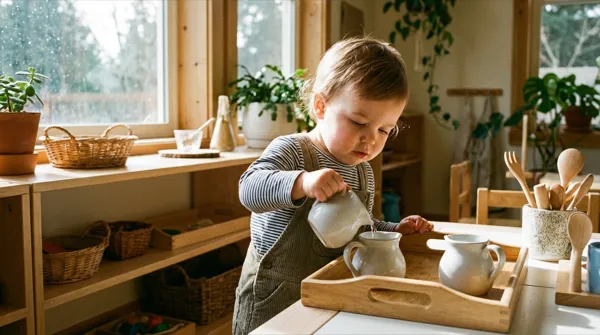
On Structure
Montessori: Highly structured environment, loosely structured time. The classroom is meticulously organised (everything has a place, materials are displayed beautifully). But within that environment, children choose what to do and when.
Waldorf: Structured rhythm, loosely structured environment. The day follows a breathing pattern (active-calm-active-calm). Monday is baking day. Tuesday is painting day. The predictability comes from routine, not from the physical arrangement of materials.
What to Look for When You Visit a School
The label on the door matters less than what happens in the room. During a visit, watch for these practical signs:
| What to observe | Strong Montessori sign | Strong Waldorf sign | Red flag in either |
|---|---|---|---|
| Adult behaviour | Guides demonstrate quietly, then step back and observe. | Teachers lead through songs, stories, imitation, and calm rhythm. | Adults constantly correct, hurry, or entertain children. |
| Child movement | Children choose work, carry trays, roll mats, and return materials. | Children move through shared activities, outdoor play, handwork, and story. | Children look bored, chaotic, or afraid to touch anything. |
| Materials | Complete, clean, ordered, child-sized, and available at child height. | Natural, open-ended, seasonal, beautiful, and used in imaginative ways. | Pretty shelves that children cannot actually use. |
| Conflict handling | Calm redirection toward repair, independence, and respect for work. | Warm modelling, rhythm, story, and restoration of group calm. | Shame, public comparison, or punishment dressed up as philosophy. |
| Parent fit | You understand how to support independence at home. | You understand how to support rhythm and imaginative play at home. | The school cannot explain what happens beyond vague buzzwords. |
Ask to see a normal morning, not only a polished open day. If possible, ask how new children settle, how toilet learning is handled, how mixed ages work, and what happens when a child refuses group participation or avoids shelf work.
Common Myths
”Montessori children don’t play”
False. They play constantly. Montessori just uses the word “work” for purposeful activity. A child stacking blocks, pouring water, or building a tower IS playing — Montessori just frames it as meaningful engagement rather than idle entertainment.
”Waldorf children can’t read until age 7”
Misleading. If a Waldorf child shows interest in reading before 7, they’re not stopped. The philosophy simply doesn’t push formal reading instruction until then. Many Waldorf children learn letter sounds through songs and stories well before formal lessons.
”Montessori is rigid and structured”
Partly true of the materials, but the child’s experience is remarkably free. They choose what to work on, for how long, and often where in the room. The structure serves freedom — it’s not the opposite of it.
”Waldorf is anti-science”
Complicated. Steiner’s anthroposophy includes some ideas that conflict with modern science. But Waldorf education’s emphasis on nature observation, gardening, animal care, and experiential learning is actually very compatible with scientific thinking. The philosophy behind it is questionable; the practice often works well.

Which Is Right for Your Child?
Your child might thrive in Montessori if they:
- Are naturally orderly and like knowing where things belong
- Enjoy purposeful tasks (helping cook, clean, organise)
- Are fascinated by how things work (mechanisms, puzzles, building)
- Show early interest in letters, numbers, or reading
- Like choosing their own activities
- Are independent and self-directed
Your child might thrive in Waldorf if they:
- Are deeply imaginative and love storytelling
- Learn best through movement, art, and music
- Are sensitive to overstimulation (Waldorf environments are deliberately calm)
- Benefit from strong routine and rhythm
- Are social and love group activities
- Are not yet interested in academic content (and that’s fine)
Your child might be fine in either if they:
- Are adaptable and curious
- Respond well to both structured and unstructured environments
- Like some combination of purposeful work and imaginative play
If your child is still under 3, do not over-read a single temperament trait. Toddlers can look “Montessori” during a pouring phase and “Waldorf” during a pretend-play leap. A better test is what helps your home feel calmer for two weeks in a row: fewer, clearer choices and real tools, or a steadier rhythm with more outdoor and story-based play.
If both approaches feel too adult-led for what you want, compare them with Reggio Emilia’s project-led, environment-focused approach before choosing a school or home rhythm.

Can You Combine Them?
Yes, and many families do. At home, you’re not bound to a single philosophy. Some practical combinations:
- Montessori shelf setup with Waldorf-style open-ended toys like the Fat Brain Toys Tobbles Neo (~$25)
- Montessori practical life activities with Waldorf seasonal rhythms
- Montessori approach to independence with Waldorf emphasis on nature and art
- Montessori materials for early academics alongside Waldorf storytelling
- A Montessori toy rotation rhythm with Waldorf-style baskets, silks, blocks, and nature objects
- Montessori self-care routines alongside seasonal songs, baking, gardening, and simple handwork
The philosophies disagree on some fundamentals, but your living room doesn’t have to pick a side. Take what works, leave what doesn’t.
For more on our approach to Montessori at home, start with How to Start Montessori at Home, then use the shelf setup guide, practical life activities, and Montessori observation guide to adapt the ideas without turning your home into a school.

A Simple Home Trial Before You Choose
If you are choosing between approaches for home or school, try this for two weeks:
| Day pattern | Montessori-leaning trial | Waldorf-leaning trial |
|---|---|---|
| Morning | Offer 3-5 clear shelf choices: pouring, matching, practical life, puzzle, book basket. | Keep a repeating rhythm: song, outdoor walk, bread or snack prep, story, free play. |
| Adult role | Demonstrate once, use fewer words, let the child repeat or abandon the work. | Model the activity yourself and let the child join by imitation. |
| Materials | Real objects, child-sized tools, trays, baskets, cloths, water, simple sorting. | Open-ended blocks, silks, peg dolls, seasonal nature objects, art, handwork. |
| What to track | Does independence increase? Does cleanup get easier? Does repetition calm the child? | Does rhythm reduce conflict? Does imaginative play deepen? Does transition stress drop? |
At the end, choose the pattern that made family life more workable. That answer is more useful than picking the philosophy that sounds better online.
How We Compared Montessori and Waldorf
This guide is a practical parent comparison, not a claim that one method is universally superior. We compared the two approaches through their founding principles, common early-childhood classroom practices, home setup implications, screen/academic expectations, and the questions parents actually face when choosing a school or arranging a home environment.
Exploritori’s direct expertise is Montessori at home, so we are careful not to present Waldorf as something we have “tested” in the same way. Where we discuss Waldorf, we focus on widely described educational principles: rhythm, imitation, imaginative play, nature, handwork, delayed formal academics, and lower screen exposure. Affiliate links may earn a commission, but they do not affect the comparison.
FAQ
Is Montessori or Waldorf better for ADHD?
Both can work well, but for different reasons. Montessori’s freedom of movement and self-pacing suit ADHD needs. Waldorf’s rhythm and routine provide the predictability many ADHD children crave. The “better” choice depends on your specific child. See our guide on Montessori for Neurodivergent Children for more.
Are Montessori schools more expensive than Waldorf?
Costs vary enormously by location. Both private Montessori and Waldorf schools tend to be expensive (800-2000 euros/month in Europe). Public Montessori options exist in many countries. Public Waldorf schools are available in some European countries (particularly Germany, where Steiner schools receive state funding).
Can I switch from Waldorf to Montessori (or vice versa)?
Yes. Children adapt. There may be an adjustment period — a Waldorf child entering Montessori might need time with the structured materials. A Montessori child entering Waldorf might need time adjusting to group-led activities. But children are resilient, and the transition is rarely traumatic.
What do teachers in each system think of the other?
Honestly? There’s sometimes tension. Montessori teachers can see Waldorf as lacking rigour. Waldorf teachers can see Montessori as too structured and insufficiently creative. Both camps tend to soften their views when they see the other approach done well. The best teachers in either system share the same goal: supporting children’s natural development.
Which approach has more research backing?
Montessori has more published research, partly because it’s been studied in public school settings (particularly in the US). Several studies show positive outcomes for academic achievement, social development, and executive function. Waldorf research is more limited but generally positive, with studies showing strong creative thinking, social skills, and love of learning. Neither has overwhelming evidence of superiority over the other.
 Get weekly Montessori tips
Honest reviews, activity ideas, and budget-friendly picks — no spam, just what works.
Subscribe Free