Best Montessori Toys for 1-Year-Olds in 2026: Honest Picks, Budget Swaps, and What to Skip
· Updated
What's Actually Happening at 12 Months
Before you buy anything, it helps to know what a one-year-old is working on developmentally. Around 12 months, children are typically:
- Refining their grasp -- moving from palmar to pincer grip
- Exploring object permanence -- they now know things exist even when hidden
- Starting to stand and cruise -- movement is everything
- Developing cause and effect understanding -- drop it, bang it, see what happens
- Beginning to sort and categorise -- big vs small, in vs out
The best toys for this age work with these drives. No bells, no screens, no "correct" way to use them.
For a broader age-by-age overview, see our Complete Guide to Montessori Toys by Age: 0-6 Years.
Quick Chooser: Start Here
| If your child is mostly... | Start with | Skip for now |
|---|---|---|
| Dropping, posting, and hiding objects | Object permanence box or scarf box | Multi-step shape sorters |
| Pulling up, cruising, and banging | Pound-and-tap bench or mallet + dough | Delicate stackers that topple instantly |
| Emptying baskets and opening drawers | Stacking cups, containers, safe kitchen objects | Big toy sets with 10+ pieces |
| Using fingertips more precisely | Egg and cup, large-knob puzzle | Small pegs, beads, or tight-fitting puzzles |
If you only buy one thing, choose the material that matches your child's current movement. A toy that is "advanced" but unused is clutter; a simple object repeated daily is the work.
Our Top Picks for 1-Year-Olds
1. Object Permanence Box (Top Pick for Cognitive Development)
What it is: A simple wooden box with a hole on top and a tray where a ball reappears after being dropped in.
Why it works: This is the Montessori classic for a reason. Around 12 months, children are fascinated by the concept that objects don't vanish when they can't see them. Dropping the ball and watching it roll out is endlessly satisfying -- and it builds hand-eye coordination at the same time.
What to look for: Solid wood construction, a ball large enough to avoid choking hazards (at least 4.5cm diameter), and a smooth tray. Avoid versions with multiple holes -- one is enough at this age.
Price range: 15-30 euros depending on brand.
Budget alternative: A tissue box with scarves stuffed inside. Same concept -- pull it out, it "disappears," stuff it back. Free if you already have scarves.
Who should skip this: If your child has no interest in dropping things yet (some kids get there closer to 14-15 months), wait. No rush.
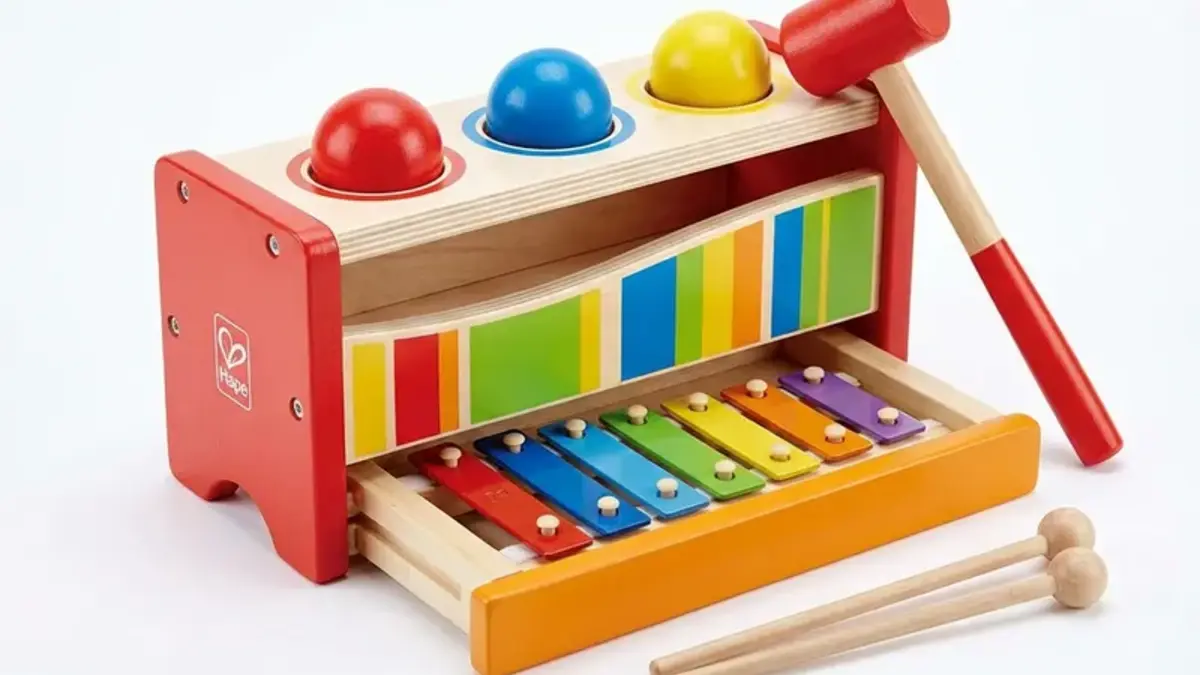
2. Hape Pound and Tap Bench (Top Pick Overall)
What it is: A wooden bench with coloured balls that you hammer through holes, and a xylophone tray underneath.
Why it works: It satisfies the one-year-old's deep need to bang things. The hammering builds arm strength and bilateral coordination. The xylophone underneath introduces cause and effect with sound. Two toys in one, essentially.
The trade-off: At around 25-35 euros, it's mid-range. The xylophone is decent but not concert-quality (obviously). Some purists will note the bright colours aren't strictly Montessori -- but honestly, your child won't care about aesthetic philosophy.
Budget alternative: A wooden mallet and some play dough. The pounding action is the same, and play dough adds a sensory element.
3. Stacking Cups
What it is: A set of graduated cups that nest, stack, and pour.
Why it works: Stacking cups are absurdly versatile. Stack them. Nest them. Pour water through them in the bath. Use them as scoops in a sandbox. Line them up by size. Hide a small toy under one. They teach size comparison, spatial reasoning, and fine motor control -- all for about 5-8 euros.
The honest take: They're not glamorous. Nobody's posting stacking cups on their Montessori Instagram. But in terms of developmental value per euro, almost nothing beats them.
Who this is for: Every single one-year-old. Seriously.
4. Wooden Egg and Cup
What it is: A wooden egg that sits in a small wooden cup. That's it.
Why it works: The simplicity is the point. Placing the egg in the cup requires wrist rotation (a surprisingly complex skill at this age), hand-eye coordination, and concentration. It introduces the concept of an object fitting into a specific space.
Price range: 5-12 euros. Some come in sets with multiple shapes and cups.
Budget alternative: A real egg cup and a wooden or plastic egg. Works identically.
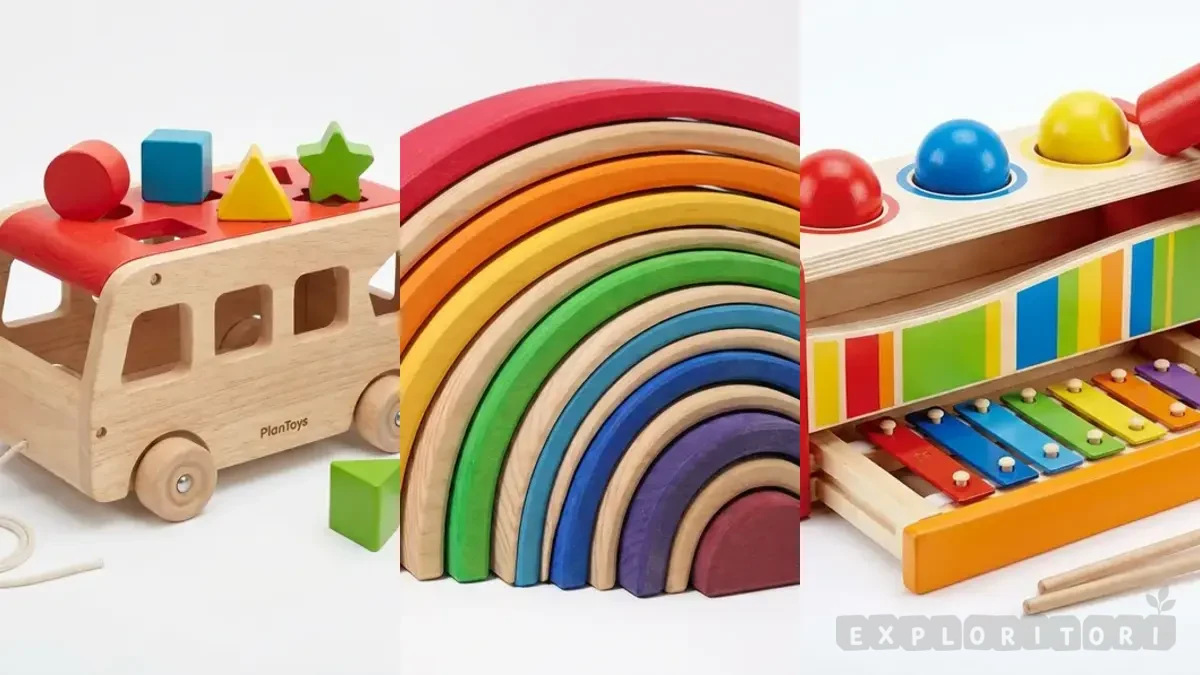
5. PlanToys Stacking Ring
What it is: A wooden ring stacker with graduated rings on a central post.
Why it works: Classic for a reason. It develops size discrimination, hand-eye coordination, and sequencing. PlanToys makes theirs from sustainable rubberwood, and the muted colours are genuinely appealing without being overstimulating.
The trade-off: At around 18-25 euros, PlanToys is pricier than generic versions. The quality difference is noticeable -- smoother finish, tighter tolerances -- but a 10-euro generic stacker does the same job developmentally.
Who should skip this: If you already have stacking cups, you might not need both right away. They develop similar skills. Get one now, add the other later.
6. Simple Wooden Puzzles (2-4 Pieces)
What it is: Single-layer puzzles with large knobs, usually featuring simple shapes or animals.
Why it works: Around 12-15 months, children start matching shapes to spaces. The large knobs help with the pincer grip they're developing. Start with circle/square/triangle and work up from there.
What to avoid: Puzzles with more than 4-5 pieces at this age. Puzzles without knobs (too frustrating for most one-year-olds). Anything with pieces small enough to swallow.
Price range: 8-15 euros for good quality wooden options.
What I Would Not Buy First
Some Montessori-labelled toys look beautiful but are poor first purchases for this age:
- Tiny peg boards: better closer to 18-24 months, when the pincer grip is steadier and mouthing is less constant.
- Complex shape sorters: one or two shapes are plenty at first; five-shape cubes often become parent-led demonstrations.
- Large rainbow stackers: lovely long-term toys, but not the strongest first birthday purchase if your shelf lacks posting, stacking, or practical-life basics.
- Busy boards with many latches: they can be fun, but they often reward novelty-hopping instead of slow repetition.
For a more detailed value check on premium wooden toys, see Are Montessori toys worth it?.
What About Lovevery?
Lovevery's Play Kits for 12-14 months are popular, and honestly, they're well-designed. But at around 36 euros per box (quarterly subscription), you're paying a premium for curation. If budget matters -- and for most families it does -- you can replicate 80% of what Lovevery offers with the items above for less money.
For a deeper dive on this, check out our Lovevery vs DIY comparison.
The Budget Shelf: Under 30 Euros Total
If you want a solid Montessori shelf for a one-year-old without spending much:
- Stacking cups (8 euros)
- Wooden egg and cup (8 euros)
- A simple 3-piece puzzle (10 euros)
- A basket of household objects for sorting (free)
Total: around 26 euros. That covers fine motor, gross motor, cognitive development, and sensory exploration. No subscription box required.
If you already have enough shelf toys, spend the next few euros on real practical-life tools instead. A small cloth, hand brush, or tiny dustpan often gets more repeat use than another wooden gadget; our Montessori cleaning tools guide shows what is worth buying and what you can skip.
The 5-Minute Shelf Test
Before buying another toy, check the shelf you already have:
| Question | What it tells you | Fix |
|---|---|---|
| Does your child repeat one action 5-10 times? | The material is developmentally matched | Keep it out another week |
| Do they dump everything and walk away? | Too many pieces or too much visual noise | Offer 3-5 items total |
| Do you need to demonstrate every step? | The toy may be too advanced | Swap for a simpler version |
| Is mouthing constant? | Safety and material size matter most | Remove small parts and chipped paint |
| Is cleanup impossible? | The set is too big for this stage | Use baskets with one complete activity each |
This same shelf logic applies beyond toys. The Montessori shelf setup guide covers spacing, trays, and rotation in more detail.
Before Buying Another Toy, Try Real Work
One-year-olds do not need a shelf that looks like a catalogue. They need a few repeatable chances to use their hands with real objects.
Before adding another toy, try one of these:
- a basket of clean cloths to pull out, fold roughly, and put back
- a low drawer with wooden spoons, cups, and safe lids to open and close
- a small laundry basket for carrying socks or washcloths
- a child-sized cloth for wiping a tiny spill with help
- a simple scarf box or posting basket for object permanence
These are not lesser alternatives to toys. They are often the most Montessori part of the day because they connect movement, order, language, and family life. If your child is closer to 12-18 months, our Montessori activities for 12-18 months guide gives more age-specific examples.
Quick Buying Guide
| Age | Focus | Our Pick | Budget Pick |
|---|---|---|---|
| 10-12 months | Object permanence | Object permanence box | Tissue box + scarves |
| 12-14 months | Cause and effect | Hape Pound and Tap Bench | Wooden mallet + play dough |
| 12-15 months | Size/stacking | PlanToys Stacking Ring | Generic stacking cups |
| 13-16 months | Shape matching | Wooden knob puzzle | DIY shape sorter |
Safety and Setup Notes for 12-18 Months
At this age, the best toy is still only useful if the setup is boringly safe:
- Check balls, puzzle knobs, rings, and loose parts against a small-parts tester or the manufacturer's age guidance.
- Avoid chipped paint, splintering wood, loose screws, and long cords.
- Choose fewer pieces than the box provides. A puzzle with three pieces on the shelf is often better than the full set.
- Put one activity per basket or tray so cleanup is visible and achievable.
- Rotate when interest fades, not because a calendar says the week is over.
If your child is already walking, add more gross-motor work alongside shelf toys. Our Montessori gross motor activities guide is a better next step than buying another tabletop material.

Exploritori Rating
Best Montessori Toys for 1-Year-OldsHow We Picked These Toys
This is a review-analysis guide, not a claim that every product was lab-tested by Exploritori. We prioritised materials that match common 12-18 month developmental work: posting, stacking, opening/closing, cause and effect, early matching, carrying, and practical-life imitation. We also weighed price, durability, small-parts risk, ease of cleanup, and whether a household alternative can do the same job.
Some links are affiliate links, which may earn Exploritori a small commission at no extra cost to you. That does not change the recommendation order; when a low-cost household swap works, we say so.
FAQ
What makes a toy "Montessori"?
There's no official Montessori certification for toys. Generally, Montessori-aligned toys are made from natural materials, have a single purpose or skill focus, are child-sized, and allow open-ended exploration rather than directing play. But don't get too hung up on the label -- a wooden spoon and a pot from your kitchen is more "Montessori" than most branded toys.
How many toys should a 1-year-old have on their shelf?
Less than you think. Three to five items, rotated every week or two, is plenty. Too many choices overwhelm young children. For shelf setup tips, see our Montessori Shelf Setup Guide.
Are plastic toys ever OK in a Montessori setup?
Here's where we'll get some angry comments: yes. Stacking cups are often plastic, and they're brilliant. The preference for natural materials is about sensory experience (weight, texture, temperature), not dogma. If a plastic toy is well-designed and serves a developmental purpose, use it without guilt.
When should I introduce new toys?
Watch your child, not the calendar. When they lose interest in an activity (consistently ignoring it for several days), swap it out. When they master something (completing a puzzle easily every time), level up. The child sets the pace, not the age on the box.
Is it worth buying expensive Montessori brands?
Sometimes. Premium brands like Grimm's and PlanToys offer genuinely better quality -- smoother finishes, non-toxic dyes, better durability. But for a one-year-old who's going to chew on everything and throw it across the room, a well-made generic toy often does the job just as well. Save the investment pieces for ages 2-3 when they'll appreciate (and preserve) the quality more.
Looking for toys for older children? Check out our guides for 2-year-olds and 3-4 year olds.
 Get weekly Montessori tips
Honest reviews, activity ideas, and budget-friendly picks — no spam, just what works.
Subscribe Free