Montessori Toddler Activities Using Things You Own
· Updated

The best Montessori toddler activities at home usually do not look impressive on Pinterest.
They look like a bowl, a spoon, a cloth, a pair of socks, a cardboard box, and a child who really wants to do what you are doing.
That is good news.
You do not need a styled playroom or a shelf full of special materials to start. Toddlers learn through real movement, real language, real repetition, and real participation in family life. Montessori at home works best when it takes the ordinary parts of your day and makes them accessible.
This guide is a practical list of activities you can set up with things you probably already own.
Safety note: Always supervise toddler activities, especially when small objects, water, kitchen tools, food, glass, or household materials are involved. Remove choking hazards, check age guidance, and adapt every activity to your child.
Quick activity chooser
Use this when you have ten minutes and no prepared shelf.
| If your toddler wants… | Start with | Use what you own | Make it easier | Add challenge |
|---|---|---|---|---|
| To copy kitchen work | Spoon transfer or dry pouring | two bowls, spoon, cereal or pasta | use large pieces and only six objects | switch to tongs or smaller pieces |
| Water play | Water pouring or wiping spills | two cups, tray, cloth | use two tablespoons of water | add a sponge squeeze or a marked fill line |
| Real responsibility | Snack prep or laundry matching | banana, crackers, socks, basket | prepare one tiny step | ask them to carry, serve, or return the item |
| Movement | Carrying path or posting box | basket, pillow, tape, shoebox | make the route short | add a target, second basket, or return trip |
| Calm language | Observation basket | spoon, lemon, scarf, brush | offer three objects | sort by texture, colour, or use |
For a child under 18 months, keep the work closer to our 12-18 month Montessori activity guide. If your child is around 18 months and wants more carrying, posting, and practical life, the 18-month Montessori activity guide is the closest next step.
How to make a household activity feel Montessori
A Montessori-style activity is not defined by the object. It is defined by the setup.
Good toddler activities are:
- simple enough to understand
- real enough to matter
- limited enough to avoid chaos
- repeatable enough to build mastery
- accessible enough for your child to try independently
That means one spoon and two bowls is usually better than a giant sensory bin with fifteen props. A small cloth for wiping spills is better than a pretend cleanup toy. A low drawer with two snack choices is better than an adult-controlled snack station your toddler cannot reach.
Before setting anything up, ask:
- Can my child see what to do?
- Can they carry it safely?
- Can they repeat it?
- Can they clean up some part of it?
- Is the adult role small enough?
If the answer is yes, you are close.
For the broader philosophy behind these real-home tasks, our Montessori practical life activities guide explains why ordinary household work matters so much. If the shelf itself is the hard part, pair this with the Montessori shelf setup guide before you add more choices.
Readiness check before you offer an activity
Age matters less than what your child can safely manage today. A 16-month-old who still mouths objects needs a different setup from a 28-month-old who can carry a tray and wipe a spill.
| Readiness sign | Good activities to try | Simplify or wait on |
|---|---|---|
| Carries a small object with two hands | posting, carrying path, dry transfer | full cups, glass, long routes |
| Watches you pour, wipe, cook, or fold | water pouring, wiping, snack prep, socks | sharp tools, hot surfaces, large amounts of water |
| Notices “same” and “different” | sock matching, lid sorting, colour sorting | too many categories at once |
| Wants to repeat one action | spoon transfer, posting, opening and closing | open-ended bins with many loose pieces |
| Gets frustrated quickly | wiping, observation basket, one-step snack job | tasks with several adult-dependent steps |
If the activity needs constant correction, shrink it. Fewer pieces, less water, a smaller tray, or one clear finish point usually helps more than a new toy.
Five-minute setup rules
Before you invite your toddler, do a quick adult check:
- Put every item needed for the activity on one tray, mat, basket, or low table.
- Remove anything you do not want used.
- Keep cleanup visible: cloth, small bowl, basket, or return spot.
- Show the work once, slowly and silently where possible.
- Stop while your child still wants to try; avoid turning the activity into a lesson.
For families using a low shelf, four to six choices is usually enough. The weekly shelf rotation planner can help you choose a small mix instead of rebuilding the shelf every day.
1. Spoon transfer with pantry items
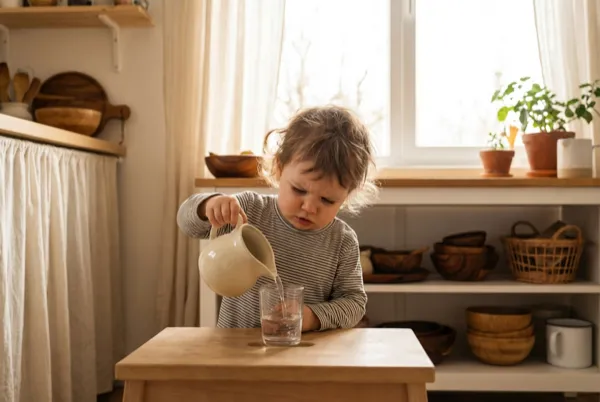
Put two small bowls on a tray. Add a spoon. Place a small amount of dry pasta, large beans, cereal, or pom-poms in one bowl.
Show your toddler how to move one spoonful from the full bowl to the empty bowl. Go slowly. Then stop and let them try.
This activity builds:
- hand control
- concentration
- left-to-right movement
- early independence with eating tools
- patience after spills
For younger toddlers, use larger objects and a deeper spoon. For older toddlers, use smaller objects or tongs.
The cleanup is part of the lesson. Keep a little cloth or hand broom nearby and show how to gather spilled pieces without turning it into a scolding moment.
2. Water pouring
Pouring is a classic because it is real work. Toddlers see adults pour all day, and they want in.
Use two small cups or measuring jugs, a tray, a tiny amount of water, and a cloth. Start with less water than feels necessary. A few tablespoons is enough.
Show your child:
- Hold the cup with two hands.
- Pour slowly.
- Stop before the cup overflows.
- Wipe the tray if water spills.
This is not just “fine motor practice.” It is food independence, body control, attention, and cleanup in one tiny loop.
If water still creates too much excitement, begin with dry pouring using large pasta or cereal.
3. Matching socks
Matching socks is one of the easiest Montessori activities because it uses real laundry.
Choose three pairs that look very different: one striped, one plain, one bright colour. Put them in a small basket. Take out one sock and ask your child to find the one that matches.
You can add language naturally:
- “This one is blue.”
- “This one has stripes.”
- “These two are the same.”
- “This one is different.”
The Montessori value here is not making laundry faster. It is visual discrimination, order, vocabulary, and participation in family work.
For older toddlers, add more similar pairs. For younger toddlers, start with only two pairs.
4. Posting objects into a box

Take a shoebox, tissue box, or clean food container. Cut a slot or hole in the lid. Offer a few safe objects that fit through the opening.
Toddlers love posting because the action is clear:
- pick up object
- aim
- push through
- open box
- repeat
This supports hand-eye coordination, problem solving, object permanence, and repetition.
You can change the challenge without buying anything:
- big circular hole for balls
- narrow slot for cards
- small opening for clothespins
- two openings for sorting
If your toddler is still mouthing small objects, use large blocks or fabric squares instead.
5. Wiping a spill
This is the activity adults forget because it looks too ordinary.
Give your toddler a small cloth that actually works. Spill a little water on a tray or table and show how to wipe from one side to the other. Then wring the cloth into a bowl or carry it to the laundry.
This teaches:
- practical responsibility
- wrist movement
- sequence
- care for the environment
- confidence after mistakes
The quiet Montessori shift is this: spills are not disasters. They are part of work.
Once your child knows where the cloths live, they may begin wiping real spills without being asked. That is the win.
6. Snack preparation
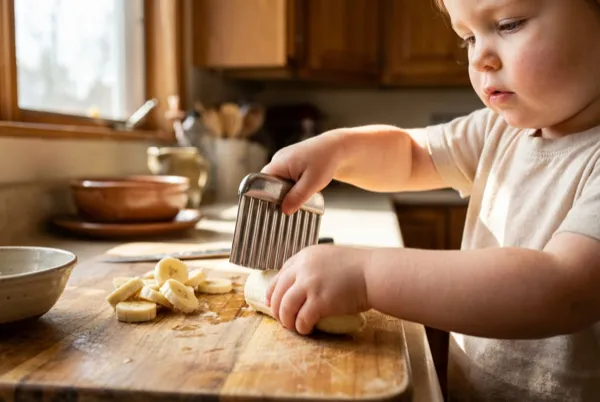
Snack preparation is high-value because toddlers care about the result.
Start with one tiny job:
- peel a banana you have already started
- spread soft cheese with a child-safe spreader
- put crackers on a plate
- wash berries in a small colander
- tear lettuce
- pour water from a tiny jug
Keep the work real. If your child is only pretending, they know. A toddler who can prepare part of their own snack is doing practical life, language, fine motor work, and self-care at once.
A learning tower can help if you want your child safely at counter height, but you can also begin at a low table with a tray.
7. Sorting kitchen objects
Set out two small bowls and a mixed handful of safe objects:
- spoons and forks
- big pasta shapes
- fabric squares by colour
- lids by size
- wooden blocks by shape
Show your child how to put one type in one bowl and one type in the other.
Do not over-explain. Toddlers learn a lot by seeing the first two or three examples, then testing the pattern.
Sorting builds early mathematical thinking, visual discrimination, and vocabulary. It also gives you a clean way to observe what your child notices: colour, size, shape, texture, or use.
8. Dressing practice with real clothes
Dressing is one of the richest toddler activities because it is hard in exactly the right way.
You can isolate the skill instead of waiting until everyone is late.
Try:
- pushing arms through sleeves
- pulling socks off
- matching shoes
- opening and closing velcro
- putting dirty clothes in a basket
- choosing between two weather-appropriate outfits
If your toddler gets frustrated, make the task smaller. Montessori independence is built in steps, not by throwing the whole morning routine at a two-year-old.
Our Montessori toddler wardrobe guide goes deeper on making clothes accessible without turning the bedroom into a pile.
9. A simple movement path
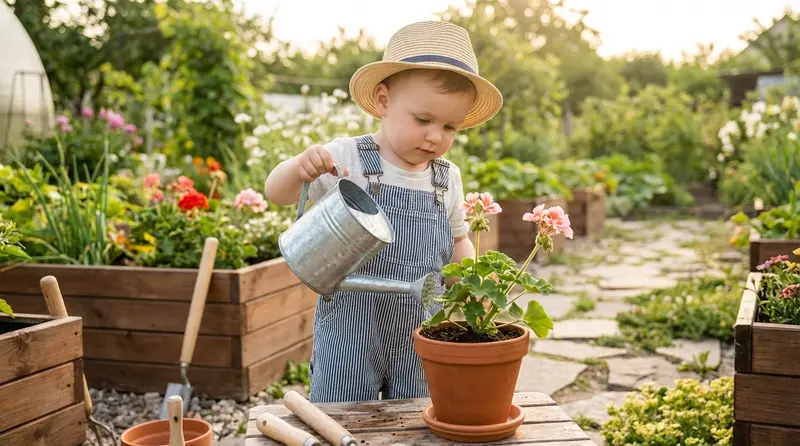
Not every Montessori activity needs to be seated.
Create a small movement path with pillows, tape lines, a low step, a basket to carry, or a mat to walk around. The goal is controlled movement, not a soft-play centre in your living room.
Ideas:
- carry one object from basket to basket
- walk along a tape line
- step over a pillow
- push a laundry basket
- move napkins from table to drawer
This is especially useful when your child is restless but not actually ready for wild play. It gives the body real work with a clear beginning and end.
10. Observation basket
An observation basket is just a few safe objects chosen for close looking and language.
For example:
- a wooden spoon
- a lemon
- a pine cone
- a scarf
- a large shell
- a clean brush
Sit nearby and name what your child notices:
- “rough”
- “smooth”
- “heavy”
- “soft”
- “round”
- “cold”
This is especially good for younger toddlers or a calm late-afternoon reset. Keep the basket small. Five good objects beat twenty random ones.
A simple weekly rhythm
If you want structure, do not plan ten new activities every week. That becomes adult homework.
Use a small rhythm instead:
| Day | Easy focus |
|---|---|
| Monday | Spoon transfer with six large pieces |
| Tuesday | Water pouring with a cloth on the tray |
| Wednesday | Sock matching or laundry basket carrying |
| Thursday | Posting box or lid sorting |
| Friday | Snack preparation at a low table |
| Weekend | Outdoor practical life, plant care, or a short carrying path |
Repeat the same activities for several weeks. Toddlers do not need constant novelty. They need repetition with small changes.
If your shelf feels crowded, pair this guide with our Montessori toy rotation guide. A clear shelf makes these activities easier to choose and return.
Common setup problems
| What happens | Likely reason | Try this |
|---|---|---|
| Your toddler dumps the tray immediately | Too many pieces or no clear finish | Offer six objects, one bowl, and one return basket |
| Water work becomes wild | Too much water or no cleanup job | Use a tiny amount and place the cloth on the tray from the start |
| They walk away after one try | The work is too easy, too hard, or badly timed | Offer it later, or add one small challenge such as tongs or a second bowl |
| Cleanup becomes a battle | The return spot is unclear | Put the basket, cloth, or shelf space in sight before starting |
| They want the adult’s real tools | The child version does not actually work | Offer a smaller real cloth, spoon, brush, cup, or safe spreader instead of a toy version |
What to do when your toddler dumps everything
Dumping is communication.
It can mean:
- the activity is too hard
- the tray has too many pieces
- your child needs gross motor movement
- the cleanup routine is unclear
- they are tired
- they want connection, not an activity
Try reducing the setup first. Two bowls and six objects. One cloth. One basket. One clear job.
If dumping continues, put the activity away without drama and offer movement or connection. Montessori at home is not about forcing shelf work. It is about preparing an environment your child can use.
How this guide was refreshed
This guide is based on Montessori practical-life principles, parent-observation patterns, and a review of related Exploritori activity guides for 12-36 months. The refresh focused on making the advice easier to use in a normal home: clearer age fit, smaller setup decisions, better internal links, and more honest safety boundaries. It does not claim that every activity has been tested with every toddler; adapt materials to your child and current safety guidance.
FAQ
What are easy Montessori activities for toddlers at home?
The easiest Montessori toddler activities at home are practical-life activities using real household objects: spoon transfer, water pouring, matching socks, wiping spills, posting objects into boxes, snack preparation, and simple sorting.
Do Montessori toddler activities need special toys?
No. Many useful Montessori activities use things you already own, such as bowls, spoons, laundry, cloths, baskets, cardboard boxes, socks, cups, and safe kitchen tools.
How long should a toddler Montessori activity last?
There is no fixed length. Some toddlers work for two minutes and some repeat the same activity for twenty. The goal is concentration and independence, not filling a planned time block.
How many Montessori activities should I offer at once?
Start with one activity on a tray or mat. If you keep a low shelf, most toddlers do best with four to six complete choices rather than a crowded shelf.
What is the best age to start Montessori activities at home?
You can start when your child begins showing interest in real household work, often around 12 to 18 months. Keep the setup simple, safe, and matched to what they can actually do.
The bottom line
Montessori toddler activities at home work best when they are boring in the right way.
Real spoon. Real bowl. Real cloth. Real laundry. Real snack. Real cleanup.
That is enough.
Start with one small activity, show it slowly, and let your child repeat it. The magic is not in the materials. It is in giving your toddler meaningful work they can actually do.
 Get weekly Montessori tips
Honest reviews, activity ideas, and budget-friendly picks — no spam, just what works.
Subscribe Free