Montessori Toy Rotation for Toddlers: Shelf Setup, Storage, and a Simple Weekly Rhythm
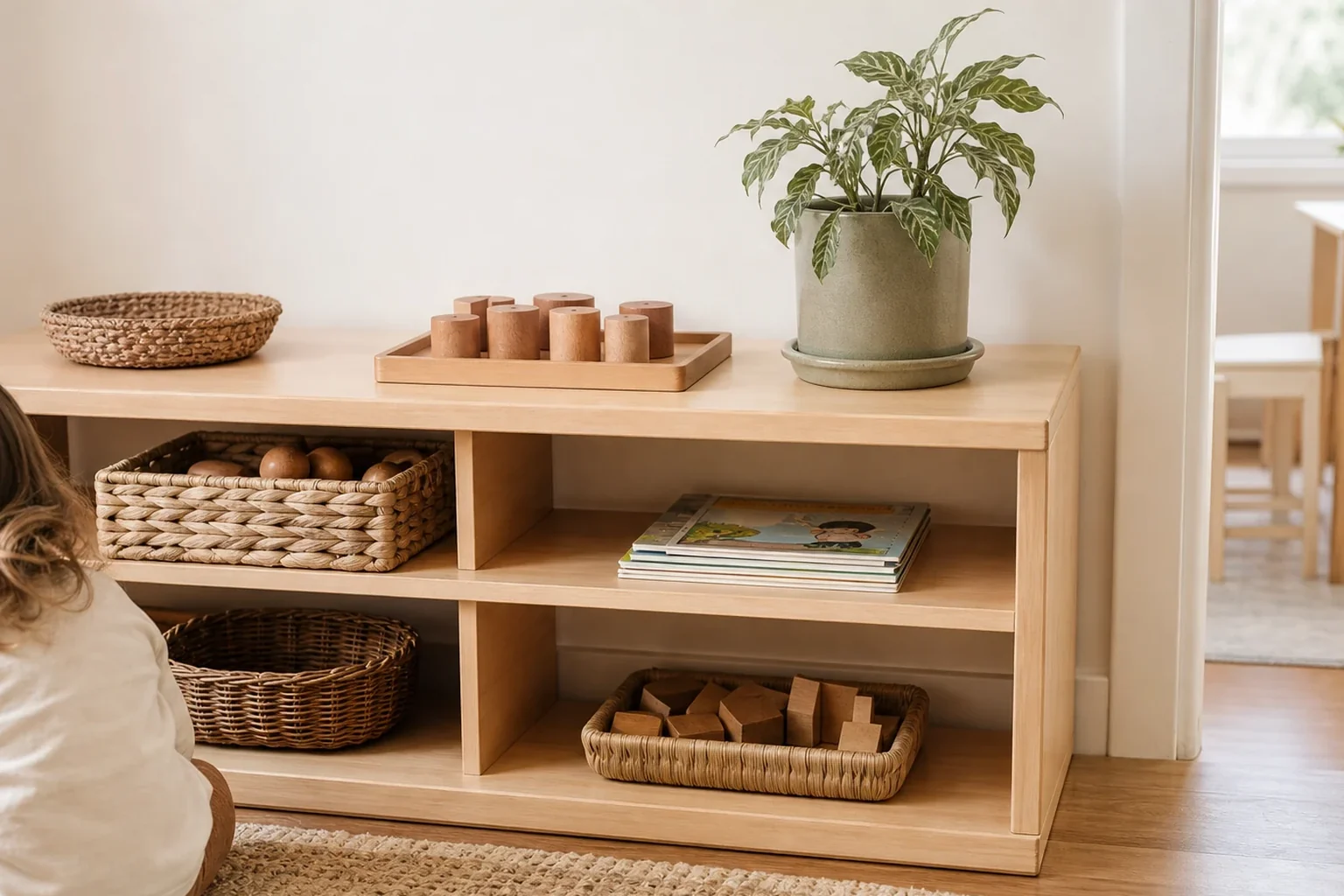
If your toddler has plenty of toys but still drifts from one thing to another, the problem usually is not a lack of toys.
It is a lack of clarity.
When everything is visible, noisy, mixed together, and fighting for attention, your child has to work much harder just to choose. That often looks like boredom, dumping, or asking you to entertain them.
A Montessori toy rotation fixes that by making the environment readable. You offer a small number of good choices, store the rest out of sight, and change materials when your child is ready.
That is it. No colour-coded spreadsheet. No toy prison. Just a calmer shelf and a child who can actually see their options.
This is one of the most useful Montessori ideas for real homes because it works in big playrooms, tiny flats, and messy living rooms that also contain adult life.
Quick answer: the simplest toy rotation setup
If you only have five minutes, start here.
| Decision | Good default | Adjust when… |
|---|---|---|
| Shelf size | 4 to 6 complete activities | Your child dumps everything, ignores the shelf, or cannot return work independently |
| Rotation pace | Every 1 to 2 weeks | A material is still being repeated deeply; leave it longer |
| What stays visible | One low shelf, a small book basket, and one gross-motor option if you have space | Visible backup toys are pulling attention away from the shelf |
| What goes away | Duplicates, noisy toys, outgrown puzzles, seasonal items, and anything with missing pieces | Your child needs a familiar success item for confidence |
| First reset goal | Remove two stale things and add one better-matched activity | The shelf already feels calm; observe before changing |
The best first rotation is usually smaller than you expect. Do not rebuild the whole play area. Remove clutter, keep a favourite, add one purposeful activity, and watch what happens for a few days.
For a full room reset, pair this article with our Montessori storage solutions for small spaces and Montessori shelf ideas by age.
🌿 What Montessori toy rotation actually means
Toy rotation sounds fancy, but the principle is simple.
You put out a small, intentional set of activities. You keep the rest out of sight. Then you swap materials based on what your child is working on now.
The goal is not novelty for novelty’s sake.
The goal is concentration.
When a shelf is crowded, your child often grabs randomly, tips baskets out, and bounces between activities. When the shelf is clear, your child can see each option, carry one thing at a time, and return it more easily.
That is why toy rotation supports independent play so well. It lowers visual noise and helps your child settle into real work.
A Montessori rotation also helps you observe better. Instead of wondering why your child never touches anything, you start seeing patterns:
- the puzzle they repeat every morning
- the posting activity they have outgrown
- the pouring work they suddenly love
- the basket that only comes off the shelf to be dumped
Those patterns tell you what to keep, what to remove, and what to introduce next.
Takeaway: Montessori toy rotation is not about owning less for the sake of it. It is about offering fewer, clearer choices so your child can engage more deeply.
🧸 How many toys should be on the shelf?

For most toddlers, 4 to 6 complete activities is the sweet spot.
That sounds sparse to adults at first. Then you see how much calmer the shelf feels.
A rough guide:
| Age | Good starting number |
|---|---|
| Babies | 3 to 4 items |
| Toddlers | 4 to 6 activities |
| Preschoolers | 6 to 8 activities |
The important word here is complete.
A complete activity is something your child can take, use, and return as one clear piece of work. Good examples:
- a knob puzzle
- a shape sorter
- a tray with scooping tools
- a stacking toy
- a posting activity
- a basket for object permanence or simple matching
That is very different from one deep bin of mixed toys, where half the energy goes into searching and scattering.
A balanced toddler shelf often includes:
- one fine motor activity
- one practical life activity
- one language or matching activity
- one open-ended material
- one familiar easy win your child already loves
Here is a more practical age-based starting point:
| Stage | Start with | Good signs | Reduce the shelf if… |
|---|---|---|---|
| 9 to 12 months | 3 to 4 simple baskets or objects | Reaches, mouths safely, repeats posting or grasping | Everything is tipped immediately with no return to the material |
| 12 to 18 months | 4 clear choices | Carries one basket, repeats simple hand work | The shelf becomes a dumping station |
| 18 to 24 months | 4 to 6 activities | Repeats transferring, matching, opening, closing, wiping | Frustration rises because work is too hard or too many steps |
| 24 to 36 months | 5 to 7 activities | Chooses independently and returns some materials | Materials are mixed together or pretend play takes over every tray |
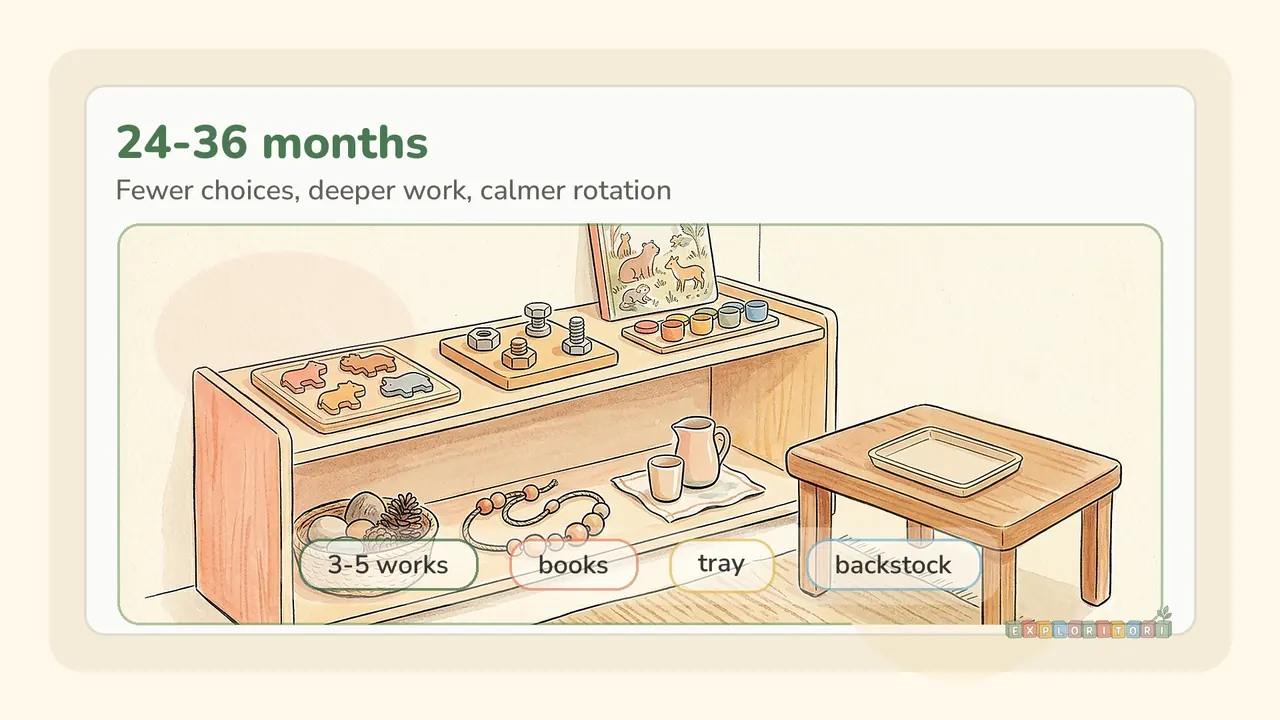
The age ranges are not rules. They are reset points. If your two-year-old concentrates better with four choices, four is the right number.
If you need a few shelf-friendly classics, these are rotation-friendly because they are simple, complete, and easy to return:
- Melissa & Doug Farm Animals Jumbo Knob Puzzle
- Melissa & Doug Shape Sorting Cube
- Montessori Object Permanence Box
- Melissa & Doug Rainbow Stacker
You do not need all of them. In fact, that would miss the point.
A few high-use materials work better than a shelf stuffed with worthy purchases.
Takeaway: Start with fewer items than feels normal. You can always add later. It is much harder to recover from an overloaded shelf than from a slightly sparse one.
🪑 How to set up a shelf that your toddler can actually use

A good Montessori shelf quietly answers three questions for your child:
- What can I choose?
- How do I carry it?
- Where does it go back?
That means your shelf should be:
- low enough to access without help
- open rather than hidden behind doors
- stable and anchored if needed
- simple enough that each item has a clear home
You do not need special Montessori furniture to get this right.
A low bookcase, a cube shelf on its side, or a simple open shelf can work beautifully. If you want a purpose-built option, a Montessori bookshelf for toddlers gives you child-height display without much improvisation.
The small details matter just as much as the shelf itself.
Use trays and baskets
A tray gives an activity boundaries. Your child can see that the whole work belongs together and returns together.
A few small wooden trays make a big difference here. They are not decorative fluff. They help the shelf feel organised and understandable.
Keep books separate if you can
Books often work better in their own area instead of competing with shelf work. A front-facing display is much easier for toddlers to browse than a row of spines.
Leave white space
Every shelf does not need to be full. Empty space is part of the design. It helps each activity stand out.
If you want more room-by-room setup ideas, our guides on Montessori shelf setup and IKEA Montessori hacks go deeper on affordable home layouts.
Takeaway: The best shelf setup is not the prettiest one. It is the one your child can read, use, and reset with the least adult help.
🔍 What to put on the shelf right now
This is where many parents overcomplicate things.
You do not need to create a perfect mini classroom. You need to match the shelf to what your child is developing now.
Ask yourself:
- Are they posting, inserting, opening, and closing things?
- Are they interested in carrying, pouring, wiping, and helping?
- Are they repeating simple hand movements over and over?
- Are they suddenly drawn to language, matching, or categorising?
Then build the shelf around those real interests.
A very workable toddler shelf might include:
- Fine motor — shape sorter, ring stacker, posting work
- Practical life — scooping beans, transferring pom-poms, cloth + spray bottle for wiping
- Language or matching — animal matching, object-to-picture cards, simple classified cards
- Open-ended material — stacking cups, wooden blocks, scarves in a basket
- Comfort item — one familiar activity your child can do independently with confidence
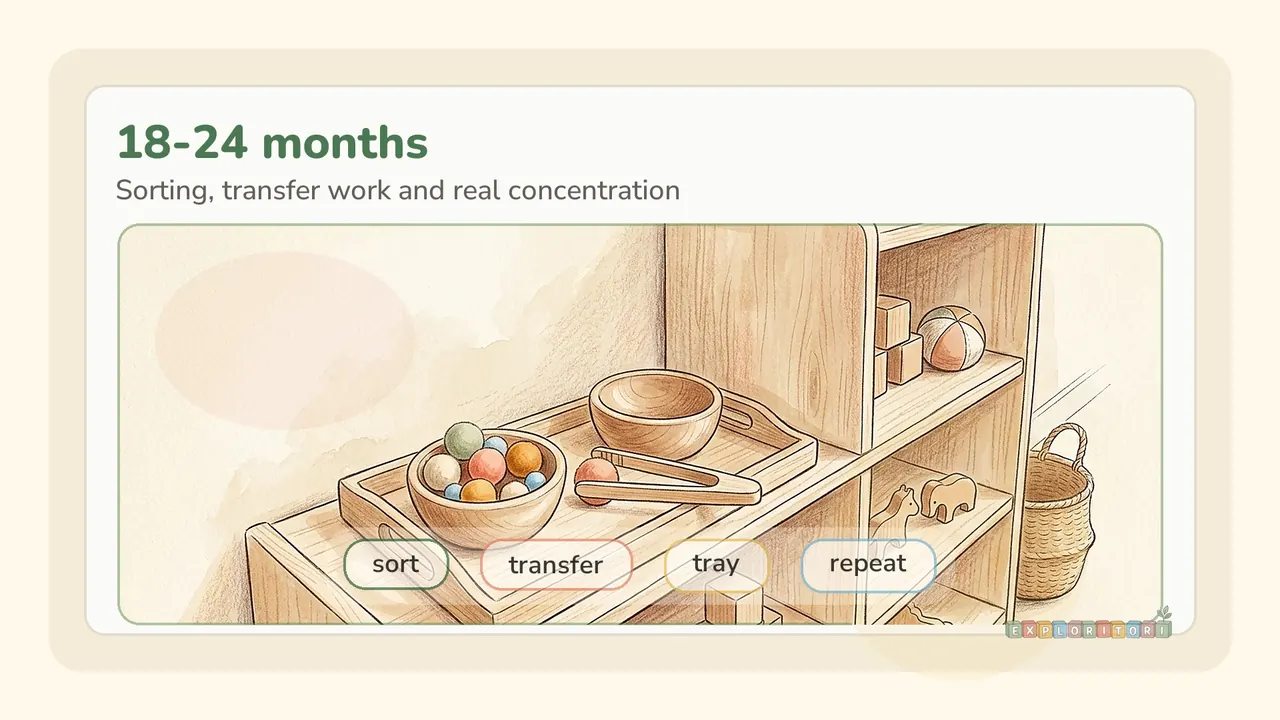
If your child is in a heavy practical-life phase, let the shelf reflect that. A tray with a small pitcher, a bowl, and a sponge can bring more concentration than a flashy toy that does everything for them.
That is one reason a toddler learning tower is often more useful than another toy purchase. When your child can reach the counter safely, real life starts competing very well with toy life.
And if your child is still young, especially under 18 months, simple shelf materials often beat bigger “educational” products. Object permanence boxes, stacking toys, first puzzles, nesting cups, and treasure-basket style objects usually have far more replay value.
Good companion guides by stage:
- For babies and early walkers: Montessori activities for 9-12 months and Montessori activities for 12-18 months
- For younger toddlers: Montessori activities for 18-month-olds and Montessori activities for 21-24 months
- For older toddlers: Montessori activities for 24-30 months and Montessori activities for 30-36 months
- For real household work: Montessori practical life routines for toddlers
Takeaway: Choose materials based on your child’s developmental work, not on what looks impressive on social media.
🔄 When to rotate toys and what a simple rhythm looks like
This is the part where many families accidentally turn a helpful system into admin.
You do not need to rotate on a rigid schedule.
Rotate when one of these things is true:
- your child has stopped choosing the activity
- it now feels too easy
- it creates frustration every time
- a new interest has appeared
- the shelf has become crowded or messy again
For many homes, that works out to every 1 to 2 weeks.
But sometimes the right move is to leave something out for a month because your child is still deeply engaged. That is not a failure. That is concentration doing its job.
A simple weekly rhythm
If you like a loose routine, this works well:
- Observe during the week: What gets repeated? What gets ignored?
- Reset once a week or every other week: Remove one or two stale items.
- Keep one familiar success: Your child should not face a completely new shelf.
- Add only one or two fresh materials: More than that can feel noisy again.
A rotation reset can honestly take ten minutes:
- remove finished or ignored activities
- wipe the shelf and straighten trays
- return one familiar favourite
- add one or two new or returning materials
- stop before the shelf feels crowded
That is enough.
The 10-minute shelf audit
Use this when the shelf looks fine but your child is not using it well.
| Check | What to look for | Fix |
|---|---|---|
| Choice load | More than six toddler activities visible | Remove the two least-used items first |
| Completeness | Missing pieces, mixed sets, half-finished trays | Rebuild one complete activity or store it |
| Carry path | Your child cannot lift or move the work easily | Use a smaller tray, basket, or mat |
| Difficulty | A material causes the same frustration every time | Store it for later or simplify the steps |
| Reset cue | It is unclear where each item goes back | Give every activity its own visible home |
| Adult maintenance | You dread rotating because storage is chaotic | Group backstock by type, not by perfect labels |
If you only fix one thing, fix completeness. A half-missing activity creates more mess than learning.
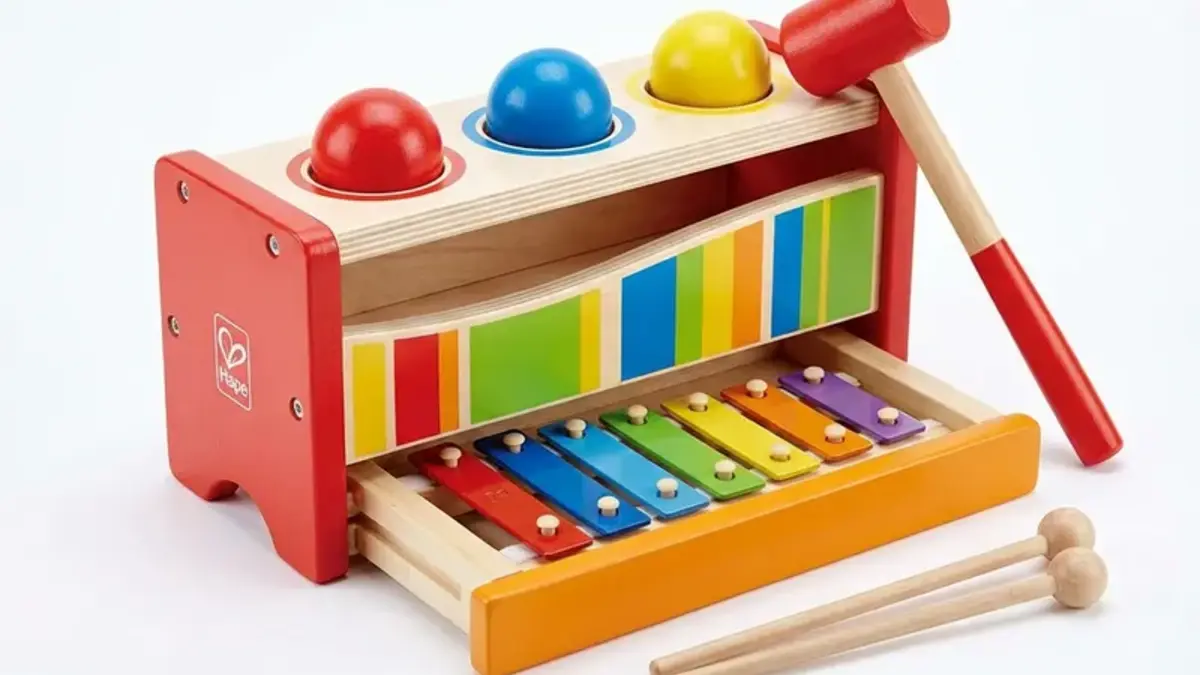
If you want a couple of good reserve materials that rotate in and out well, Fat Brain Toys Tobbles Neo and the Hape Pound & Tap Bench are both easy to reintroduce later without feeling complicated.
Takeaway: Rotate based on observation, not guilt. The system should make life easier, not create a new job.
🏠 How to store the rest without creating hidden chaos
A toy rotation only works if the extra materials are easy for you to manage.
If “stored toys” means three collapsing bags in the hall cupboard, the system will slowly die.
You need simple backstock storage.
A realistic small-home setup looks like this:
- one low shelf in the main living area
- one adult-only cupboard or closet for backup toys
- one basket for books
- one larger gross-motor item nearby, not necessarily on the shelf
Group stored toys loosely by type:
- puzzles and matching
- practical life tools
- baby materials
- open-ended toys
- seasonal or occasional items
You do not need a label maker marathon. A few bins or baskets are enough.
What matters is that your child cannot see the whole backup inventory all day. Visible backup stock weakens the whole point of rotation. It becomes temptation instead of calm reserve.
If you are short on space, choose toys that store well and do more than one job. Nesting cups, simple puzzles, baskets of loose objects, and compact stackers earn their shelf space much better than giant plastic contraptions with one trick.
This is also where honesty helps. If a toy never rotates back in because it is annoying, noisy, or oddly useless, you do not have to keep preserving it forever.
You are building a working environment, not a museum to past purchases.
Takeaway: Store backups simply, out of sight, and in a way that makes future rotations easy enough to maintain.
🚫 The toy rotation mistakes that create more mess, not less
Most toy rotation problems are really setup problems.
Here are the big ones.
1. Putting out too much
This is the classic mistake.
A crowded shelf creates visual noise. Your child stops choosing deliberately and starts grabbing.
2. Rotating too fast
Children need repetition. If your child still loves a material, leave it.
3. Keeping backup toys visible
Clear bins at child height are not magical organisation. They are an invitation to ignore the shelf and go straight for the stash.
4. Choosing aesthetics over usefulness
A beige wooden object can still be a terrible activity.
A Montessori shelf should help your child do meaningful work, not just look calm in a photo.
5. Forgetting practical life
Many of the best rotation materials are not toy-store toys at all. They are real tasks scaled to your child.
6. Expecting the shelf to do all the teaching
The shelf helps a lot, but you may still need to model how to carry a tray, return a basket, or choose one thing at a time. That is normal.
If the system feels off, simplify before you buy anything else.
Takeaway: When toy rotation is not working, the answer is usually fewer items, clearer presentation, and more observation.
How we evaluate toy rotation advice
This guide is based on practical Montessori-at-home principles: fewer visible choices, complete materials, child-height access, repetition, and observation before buying. We also keep it updated when parents need clearer help choosing, arranging, or resetting a shelf at home.
We have not personally tested every linked product in every home. Product mentions are included only when the item type fits the setup logic: simple, complete, easy to return, and not dependent on lights, noise, or adult-managed features. Treat them as examples of useful material categories, not a shopping list.
For broader setup context, start with How to Start Montessori at Home, then use Montessori shelf setup to refine the physical space.
❓FAQ: Montessori toy rotation, answered simply
What is Montessori toy rotation?
It is the practice of offering a small number of carefully chosen materials on an accessible shelf, storing the rest out of sight, and changing activities based on your child’s readiness and interest.
How many toys should be on a Montessori shelf?
For most toddlers, 4 to 6 complete activities is a very good starting point. If your child is overwhelmed easily, start with even fewer.
How often should I rotate Montessori toys?
There is no perfect timetable. Rotate when a material is ignored, clearly mastered, frustrating, or no longer a good developmental fit.
Do I need to buy special Montessori shelves or toys?
No. A low stable shelf and a few clear activities are enough to start. Montessori is about accessibility and intention, not buying a branded setup.
What is the biggest toy rotation mistake?
Offering too much at once. The more crowded the shelf, the harder it is for your child to choose, focus, and return work independently.
Final thought
A Montessori toy rotation works because it respects two truths at once:
Your child does better with less visual noise.
And you do better with a simpler system.
You do not need a perfect playroom. You need one shelf that makes sense.
Start small. Put out fewer things. Watch what your child actually uses. Then let the shelf evolve with them.
That is the real rhythm.
 Get weekly Montessori tips
Honest reviews, activity ideas, and budget-friendly picks — no spam, just what works.
Subscribe Free