Non-Toxic Montessori Toys: A 5-Point Safety Check for Parents
· Updated

If you have ever typed “non-toxic Montessori toys” into a search bar, you already know how weird this corner of the internet gets.
Suddenly every toy is “natural.” Every block is “safe.” Every beige object is apparently handcrafted by saints in a forest.
That is not helpful when you are just trying to buy a few toys without bringing mystery chemicals, loud junk, or overpriced nonsense into your house.
So let’s make this practical.
If you want safer Montessori-style toys, start with this five-point check before you buy: can you identify the materials, find age and safety information, understand the finish, recognise the maker, and walk away from a vague listing? If any answer is no, skip it.
You do not need a spotless toxin-free fantasy. You need a few better filters:
- materials you understand
- brands that say what they use
- finishes that feel straightforward
- toys with one clear purpose
- fewer impulse buys from vague listings
That alone puts you far ahead of most toy shopping.
And it fits Montessori beautifully, because Montessori was never about collecting the most expensive objects. It was about preparing an environment where your child can act with purpose.
Safety note: This guide is buyer guidance, not a certification check. Always confirm current manufacturer age guidance, inspect toys for damage, loose parts, peeling finishes, magnets, or small pieces, and check official recall or safety notices before giving a product to a child.
Who this guide is for
This guide is for parents who want a calmer way to judge toy materials, labels, finishes, and vague safety claims before buying.
It is not a substitute for official product safety documentation, recalls, or local regulations. If a toy is for a baby who mouths everything, a child with allergies, or a situation where safety information is unclear, treat the manufacturer’s guidance and official safety notices as the deciding source.
Skip any product if the listing cannot tell you what it is made from, who made it, what age it is for, or which safety standards it is designed to meet. A cheaper alternative is only useful if the basics are transparent.
What parents usually mean by “non-toxic”
Most parents are not trying to run a home laboratory.
You are usually asking something more reasonable:
- Will this toy put questionable chemicals in my child’s hands and mouth?
- Does the paint, finish, or plastic feel trustworthy?
- Is this product made by a company that follows actual toy safety rules?
- Am I paying for safety, or just for branding?

That is the right frame.
“Non-toxic” is not one magic badge. It is a cluster of better choices.
The toy should feel boring in the best possible way. No strong smell. No peeling finish. No sticky mystery coating. No weirdly soft plastic with no useful product detail. No giant wall of marketing fluff where the material information should be.
In a Montessori home, you also want the toy to stay simple enough that your child does the work.
That matters because a “clean” toy that is chaotic, noisy, and badly designed is still not a great Montessori purchase.
Takeaway: the more reassuring toy is not the one with the prettiest claims. It is the one with clear materials, sensible construction, and a real purpose.
The labels and details that actually matter
This is where parents often get overwhelmed, so here is the short version first.
When you read a toy listing, these signals matter more than words like “eco,” “natural,” or “Montessori-inspired.”
1. Clear safety compliance
For children’s toys sold in Europe, the most reassuring brands make it obvious that their toys are built to meet relevant toy safety requirements, including clear age guidance and CE marking where it applies. If you are buying from Amazon US or an international seller, look for the same level of transparency rather than assuming the listing has been checked for your country.

You do not need to become a regulatory expert, but you do want signs that the company treats safety as normal documentation, not as a vague vibe.
Look for:
- clear age grading
- named toy-safety standards such as ASTM F963 or a Children’s Product Certificate for US listings
- CE marking or equivalent market-access information for European listings
- named materials
- paint or finish details
- OEKO-TEX or GOTS-style textile certification when fabrics or fillings are part of the product
- safety information that sounds specific, not mystical
If a listing gives you ten lifestyle photos and almost no material information, that is not a great sign.
2. Paint and finish transparency
For wooden toys, the finish matters almost as much as the wood itself.
Good listings often mention:
- water-based paint
- non-toxic finishes
- child-safe paint
That does not automatically make the toy safe, but it is better than silence.
3. Material disclosure
You want to know what the toy is actually made from.
Better:
- solid wood
- plywood or engineered wood from a known brand
- stainless steel
- silicone
- cotton, wool, or other familiar fibers
- a specific plastic type from a known toy brand
Worse:
- “premium material”
- “high-quality eco material”
- “safe and natural”
- no material details at all
4. FSC certification as a bonus signal
If you are buying wooden toys, FSC-certified wood can be a nice extra layer of confidence around responsible sourcing.
It is not the main safety test, but it is a useful quality signal when comparing similar wooden toys.
Takeaway: clarity beats buzzwords. The best listings tell you what the toy is, what it is finished with, and who made it.
Which toy materials tend to feel safest
No material solves everything. Each one has strengths, tradeoffs, and situations where it makes more sense.
Here is the honest parent version.
Wood
Wood is popular in Montessori spaces for good reasons.
It is durable, calm-looking, easy to grip, and often easier to trust than an ultra-cheap plastic toy from an unknown seller.
But wood is only as reassuring as the whole product.
You still need to care about:
- paint
- varnish
- glue
- rough edges
- splinters
- how transparent the brand is
So yes, wood is often a strong starting point. No, wood is not an automatic guarantee.
Stainless steel and metal tools
For practical life materials, stainless steel often makes a lot of sense.
Small pitchers, child-safe utensils, and simple kitchen tools can be excellent Montessori purchases because they support real work instead of decorative toy work.
Metal is especially useful when you want:
- durability
- easy cleaning
- no paint-heavy surfaces
- more realistic household tools
Silicone
Silicone can be very helpful for snack tools, placemats, bibs, and some toddler utensils.
It is not traditional Montessori classroom material, but it often works well in real homes because it is washable, simple, and practical.
Plastic
This is where people get weird.
Plastic is not automatically the villain.
A simple plastic item from a reputable children’s brand can be a much better choice than a badly finished wooden toy from a random marketplace seller.
The bigger issue is usually cheap unknown plastic with weak transparency, not plastic as a category.
If you keep any plastic in your home, keep the standards high:
- simple design
- known brand
- no heavy perfume smell
- no sticky surface
- no low-trust seller with recycled buzzwords and no details
Fabric and fibers
For dolls, play silks, cloths, and soft practical-life tools, natural fibers can be lovely.
Cotton and wool often feel simpler and easier to trust than synthetic blends covered in decorative extras.
That said, keep your expectations sensible. A soft basket of cloth napkins can be more Montessori-useful than a “non-toxic sensory toy set” with twenty random textures attached to it.
Takeaway: choose the material that best fits the job, then judge the actual product quality on top of that.
Red flags that make me leave the listing
You do not need to overthink every purchase.
But these are the red flags that usually make me back out fast.
Vague material language
If the listing says “safe natural premium eco-friendly material” and still never tells you what the toy is made of, leave.

Strong scent
If a toy arrives with a sharp chemical smell, that is not the moment for positive thinking. Airing it out in the corner while you hope for the best is not my favourite parenting hobby.
Too much paint, glitter, or glossy coating
A little paint is not the issue. The issue is when the finish feels thick, cheap, flaky, or like it is doing most of the selling.
Random marketplace brands with no real product identity
Some unbranded listings are fine. Plenty are not.
If the seller name looks autogenerated, the photos are generic, and the description feels copied from five other listings, I would rather skip it.
Fake safety language
Phrases like “BPA-free” on a toy that barely explains anything else do not reassure me by themselves.
You want a whole picture, not one trendy phrase taped over a low-trust product.
Toys that do ten things badly
This is not a chemistry red flag. It is still worth mentioning because it matters in Montessori.
A toy that flashes, sings, counts, sorts, spins, projects stars, teaches Spanish, and claims to boost IQ is usually trying to impress adults.
Your child needs simpler tools than that.
Takeaway: if the listing feels murky, overdesigned, or oddly defensive, trust the discomfort.
What is usually worth buying first
If your budget is limited, the best non-toxic Montessori purchases are often not the fanciest toys.
They are the objects your child will actually use again and again.
Start here:
A few first-skill toys
Think shape sorting, posting, peg puzzles, and one or two quiet fine motor materials.
These are often enough to build concentration without filling the room.
Practical life tools
A small pitcher, child-safe scissors, a sponge, a little brush, a step stool, or a toddler snack setup often gives more daily value than another stack of shelf toys.
Shelf basics
A tray, basket, or low shelf is not glamorous, but it can do more for independence than a huge toy haul.
Presentation matters in Montessori.
Children use materials better when they can see them, carry them, and return them without chaos.
Takeaway: spend first on calm, repeatable use, not on the biggest box.
Simple Amazon picks worth a closer look
These are not “the only safe toys.” They are just a few examples of simple products from known brands that make the shopping conversation more concrete. Listings, prices, and safety details can change, so treat them as examples to compare rather than fixed bargains.
Skip this section if you already have enough simple materials at home. A basket, a small pitcher, a sponge, and a few real-life tools may be more useful than buying another shelf toy. These picks are for parents who want concrete examples, not a shopping list you have to complete.
Melissa & Doug Large Farm Jumbo Knob Puzzle
The Melissa & Doug Large Farm Jumbo Knob Puzzle is a strong first puzzle because it is clear, durable, and easy for small hands to use.
It is also one of the easier listings to evaluate. At the time of review, the Amazon page identified the product as wood and noted that it was PVC-free, latex-free, phthalate-free, BPA-free, and lead-free.
That is exactly the kind of material transparency I like to see.
Best for: first puzzle work, early vocabulary, and toddlers who need a simple success loop.
Melissa & Doug Shape Sorting Cube
The Melissa & Doug Shape Sorting Cube is not fancy, which is part of the appeal.
It is a straightforward wooden sorter with one clear job. Your child rotates, tests, adjusts, and tries again. No batteries. No noise. No cluttered learning claims.
For a Montessori-style shelf, that simplicity is useful.
Best for: toddlers who are ready for a more sustained shape-and-fit challenge.
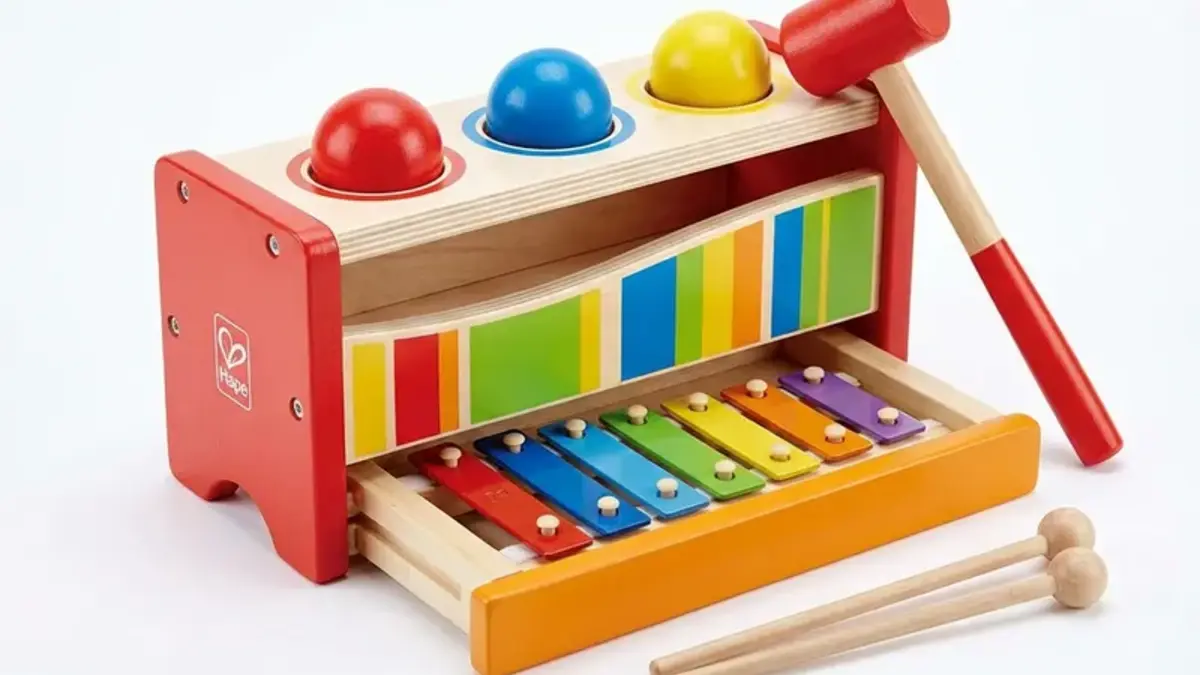
Hape Pound & Tap Bench
The Hape Pound & Tap Bench is a good example of a toy that feels lively without becoming electronic chaos.
At the time of review, the listing identified wood and water-based paint, and Hape’s product information pointed to applicable safety-standard compliance for its North America range.
It is not the most classic Montessori material in the world, but it can still be a solid home toy if your child enjoys repetition, movement, and cause-and-effect work.
Best for: toddlers who like pounding, repetition, and gross-to-fine motor transitions.
Fiskars Blunt-Tip Kids Scissors
The Fiskars Blunt-Tip Kids Scissors are here for a reason.
Montessori is not only about toys. It is also about giving your child real tools that let them practice real skills.
A pair of functional, supervised scissors usually adds more developmental value than another decorative wooden object.
Best for: preschoolers ready for early cutting work with supervision.
Takeaway: the best affiliate product is not the one with the most poetic branding. It is the one you can understand, trust, and actually use.
My simple buying checklist
If you want a five-question filter, use this every time.
- Do I know what this is made from?
- Do I trust the brand more than the marketing?
- Does the toy have one clear purpose?
- Will my child use it more than once or twice?
- Would I still want it if the word “Montessori” disappeared from the listing?
That last question is my favourite.
It cuts through a lot.
If the answer is yes, you may have a genuinely useful toy.
If the answer is no, you may just be buying an aesthetic.
A calmer way to think about “safe enough”
You do not need an immaculate toy museum.
You need a home where your child can touch, carry, pour, stack, cut, sort, scrub, match, and repeat without constant clutter and low-trust junk getting in the way.
That usually means:
- buying less
- choosing more slowly
- trusting known brands over mystery listings
- caring about function as much as materials
- remembering that practical life tools often beat toy overload
That is a very Montessori answer, honestly.
Because the real goal is not to win the non-toxic toy Olympics.
The goal is to prepare an environment where your child can do meaningful work with enough care, repetition, and joy that the toy becomes part of real life instead of shelf decor.
If you want to go deeper next, these guides pair well with this one:
- Are Montessori Toys Worth It?
- Wooden vs Plastic Montessori Toys: What Actually Matters?
- What Makes a Toy Montessori?
FAQ
Are non-toxic Montessori toys always expensive?
No. Some are expensive, but the safer choice is often the simpler choice. A basic puzzle from a known brand can be a better buy than a premium-looking toy with weak product detail.
Should I avoid all painted wooden toys?
No. Painted wooden toys can be reasonable when the brand clearly explains its finishes and safety approach. The issue is not paint alone. It is poor transparency and poor quality.
Are secondhand Montessori toys okay?
Often yes, especially for solid wood materials in good condition. Check for peeling paint, cracks, splinters, rust, mold, or strong odor before bringing them in.
Is silicone better than plastic?
Sometimes, depending on the product. Silicone can be useful for utensils and practical-life accessories, but simple design and trustworthy manufacturing still matter more than chasing one supposedly ideal material.
What matters most if I can only remember one rule?
Buy fewer toys from brands and listings you can understand clearly. That one rule prevents a lot of bad purchases.
 Get weekly Montessori tips
Honest reviews, activity ideas, and budget-friendly picks — no spam, just what works.
Subscribe Free