Best Montessori Toys for Babies (0-12 Months): The Simple First Toys Worth Buying
· Updated
If you’ve been searching for the best Montessori toys for babies, you’ve probably noticed something annoying.
Half the internet acts like your baby needs a full wooden boutique before they can blink properly. The other half throws the word Montessori onto anything beige and calls it a day.
Meanwhile, your actual baby is busy doing very sensible baby things: staring at light, chewing a sleeve, trying to grab their own foot, and dropping the same object twelve times in a row.
That is the real clue.
The best Montessori toys for babies are not the fanciest ones. They are the ones that match what your baby is working on right now: seeing, reaching, grasping, transferring, dropping, crawling, and figuring out how the world behaves.
So this guide keeps it simple. We’ll go age by age through the first year, look at what is actually useful, and skip the toy-marketing theatre.
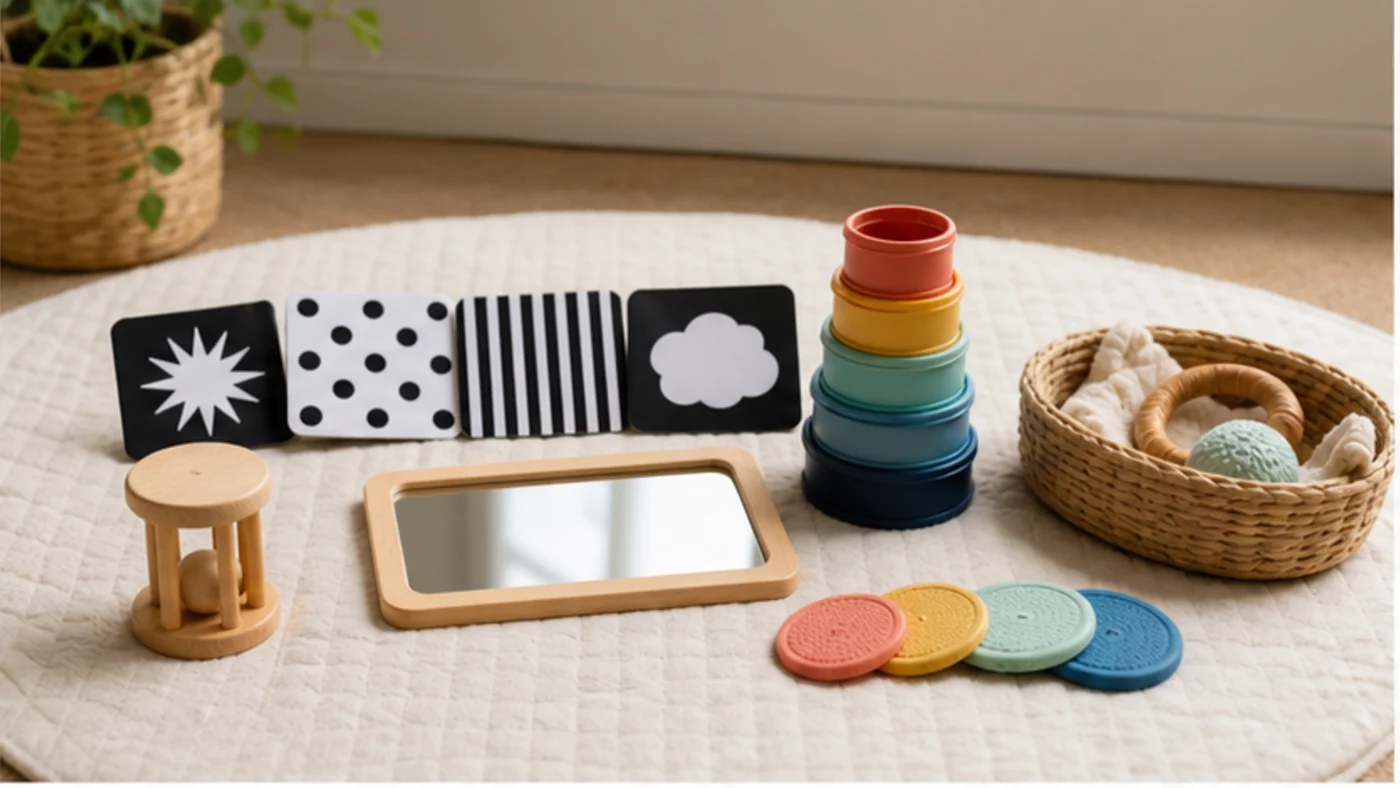
🌱 What makes a baby toy Montessori?
Montessori is not really about buying “Montessori toys.”
It is about offering materials that help your baby do real developmental work.
For babies, that usually means toys and objects that are:
- simple to understand
- calm instead of noisy
- easy for small hands to hold
- built around one clear skill
- satisfying enough to repeat
- doing less so your baby can do more
That last one matters.
A lot of baby toys are designed to perform for your child. They flash, sing, vibrate, and celebrate every accidental tap. Montessori toys work the other way around. They invite your baby to act, notice, repeat, and learn from what happens.
If you want a quick buying filter, ask yourself:
- Does this match my baby’s current stage?
- Will my baby do the action, or will the toy do it for them?
- Is this likely to get repeated use after the first five minutes?
If the answer is yes, you’re probably on the right track.
Takeaway: A Montessori baby toy is clear, calm, and matched to development. It does not need fancy branding to be useful.
Quick chooser: what stage is your baby actually in?
Use age as a guide, not a rule. Babies do not unlock skills on schedule. The better buying signal is what your baby is trying to do this week.
| What your baby is doing now | Better toy choice | Usually too early |
|---|---|---|
| Staring, tracking, lifting their head briefly | high-contrast cards, soft black-and-white book, visual mobile, baby-safe mirror | posting toys, shape sorters, busy activity cubes |
| Swiping, opening hands, bringing objects to mouth | lightweight rattle, grasping ring, interlocking discs, simple crinkle cloth | heavy blocks, complicated stackers |
| Sitting with support or independently, passing objects hand to hand | treasure basket, stacking cups, textured ball, safe teether variety | small loose parts, multi-piece puzzles |
| Crawling, pulling up, dropping objects on purpose | object permanence box, posting box, ball ramp, low basket/shelf | large shape sorters with many pieces |
If your baby ignores a toy but loves a spoon, a scarf, or the laundry basket, that is not failure. It is useful observation. The best next material is usually the one that supports the action your baby is already repeating.
For a wider age map after the first birthday, keep this next to our Montessori toys by age guide and the Montessori shelf ideas by age guide.
👶 0-3 months: seeing, listening, and first body awareness
In the early months, your baby does not need a packed toy shelf.
They need contrast, movement, closeness, and time on the floor.
This stage is less about “playing” in the way adults imagine and more about taking in the world. Vision is developing fast. Hands are mostly reflexive at first. Neck and trunk strength are just getting started.
Best Montessori toy ideas for 0-3 months
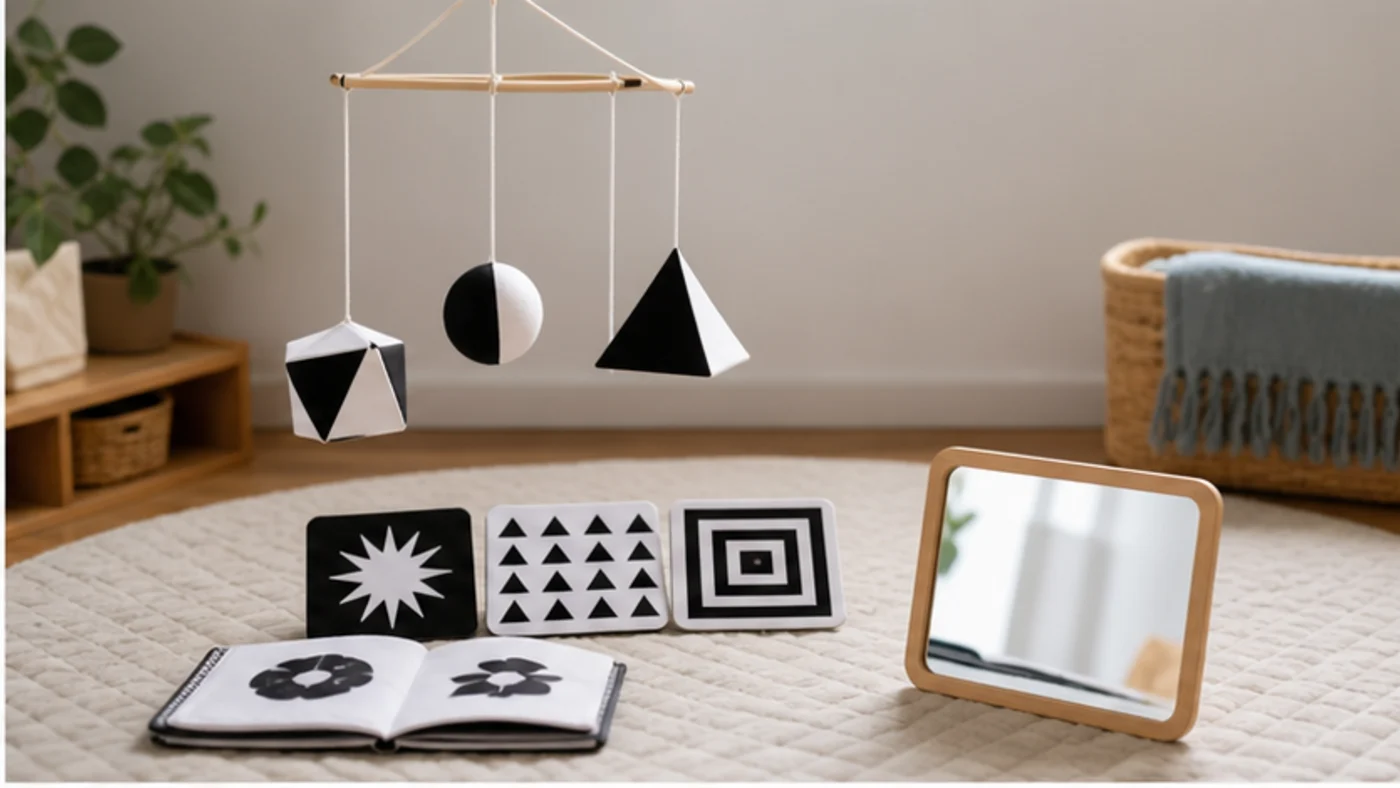
High-contrast cards or a soft black-and-white book
Newborns love contrast. A simple high-contrast black-and-white baby book gives your baby something bold and easy to focus on during tummy time or cuddles.
A visual mobile
Classic Montessori mobiles are popular for a reason. A Munari or Gobbi mobile gives your baby something beautiful and slow enough to follow with their eyes. If you want a ready-made option or inspiration, browse Montessori baby mobiles.
A safe floor mirror
A baby-safe mirror supports visual focus and later movement motivation. Look for an unbreakable baby mirror, not a heavy decorative one.
A simple rattle for later in this stage
As intentional grasping begins, a lightweight natural wooden rattle set can become genuinely useful.
What to skip at this stage
- giant toy hauls
- noisy play mats with ten hanging distractions
- toys with lights and music for newborns
- materials your baby is clearly months away from using
Your baby is not under-stimulated because they only have one strong visual object to study.
They are busy building a brain.
Takeaway: For 0-3 months, buy for visual focus and movement freedom, not entertainment value.
✋ 3-6 months: grasping, mouthing, reaching, repeating
This is the stage where toys start feeling more obviously useful.
Your baby is beginning to reach on purpose, swipe, grasp, mouth objects, and repeat movements that create interesting feedback. You may notice a shift from mostly watching to actively trying to get hold of the world.
That means the best Montessori toys now support hand development and early cause-and-effect.
Best Montessori toy ideas for 3-6 months
Wooden ring rattles and grasping toys
A simple wooden rattle works because it is easy to grip, pleasant to mouth, and light enough to move. Babies learn a lot from weight, texture, and the tiny thrill of making a sound happen.
Interlocking discs
These are one of the rare Montessori baby materials that really deserve the hype. Montessori interlocking discs encourage two-handed play and hand-to-hand transfer.
A sensory cloth or crinkle toy
Not every useful baby toy has to be wooden. A simple black-and-white crinkle sensory toy can still be a great fit if it is easy to grasp and gives clear feedback without becoming chaotic.
A minimal play gym
If you use a play gym, keep it uncluttered. One or two useful hanging items is plenty.
Why repetition matters here
At this age, your baby is doing serious work every time they:
- reach and miss
- try again
- grip
- mouth
- drop
- listen
- repeat
That repetition is not random. It is how coordination gets built.
Takeaway: For 3-6 months, the best toys are easy to grasp, interesting to mouth, and simple enough to repeat again and again.

🧺 6-9 months: transferring, banging, comparing, exploring
Around this stage, babies often become much more active in play.
They can hold one object in each hand, transfer from one hand to the other, bang things together, investigate containers, and get deeply interested in taking objects out to study them.
This is where Montessori baby play gets especially fun, because your baby now has enough control to really investigate materials.
Best Montessori toy ideas for 6-9 months
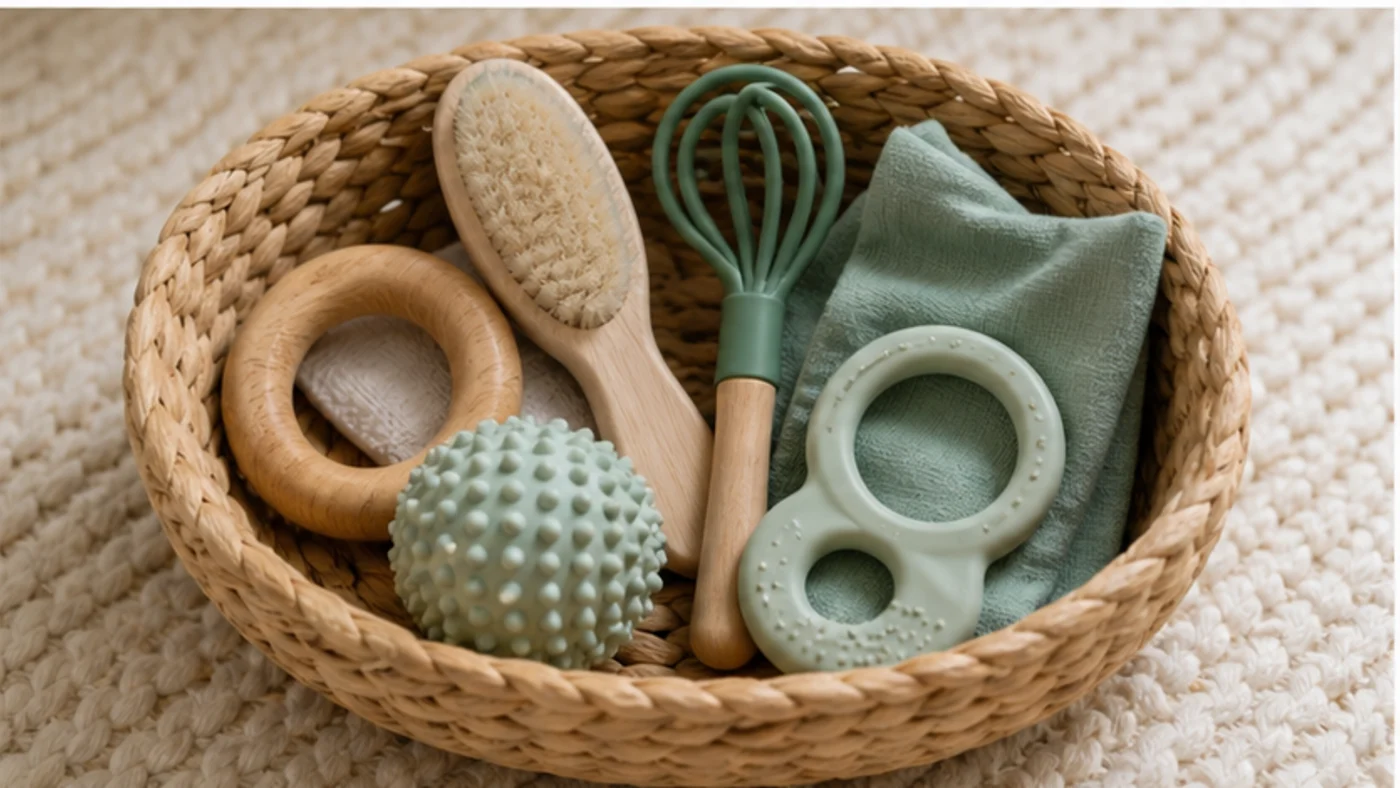
Treasure basket materials
A treasure basket is one of the best Montessori setups for babies, full stop. You do not need a fancy kit. A small woven basket plus a few safe, varied objects is enough.
Our baby treasure basket guide gives a safe starter list and explains what to rotate once your baby begins losing interest.
Good treasure basket items might include:
- a wooden ring
- a soft brush
- a large silicone whisk
- a metal spoon
- a fabric scrunchie
- a large teether
- a smooth natural sponge
Stacking cups
A set of stacking cups for babies might be the best-value baby toy on the planet. Nesting, banging, hiding, water play later, knocking down towers, container play. They just keep earning their place.
Textured balls
A simple textured ball helps with rolling, grasping, and movement motivation. Some babies will crawl for a ball far sooner than they will crawl for anything educational-looking.
Safe teethers in different materials
Wood, silicone, and fabric all give slightly different sensory feedback. That variety is useful.
A quick safety note
This is the age where babies put everything in their mouths. Treasure baskets are wonderful, but supervision matters. Check for choking hazards, loose parts, peeling finishes, or anything that splinters.
Do the toilet-roll test before offering household objects: if an item, detachable part, or broken piece can pass through a cardboard toilet-paper tube, it is too small for unsupervised baby play. Also check cords, magnets, button batteries, seams, finishes, and whether the object could become unsafe when wet from mouthing.
Takeaway: For 6-9 months, look for open-ended objects that reward handling, transferring, and sensory comparison.
🧩 9-12 months: put in, take out, drop, release, solve
By 9-12 months, many babies are moving with real purpose.
They may be crawling quickly, pulling to stand, cruising along furniture, and starting to love little problems with visible results. Put it in. Take it out. Drop it through. Watch it roll away. Retrieve it. Do it again.
That is why the best Montessori toys for older babies often look almost absurdly simple.
Best Montessori toy ideas for 9-12 months
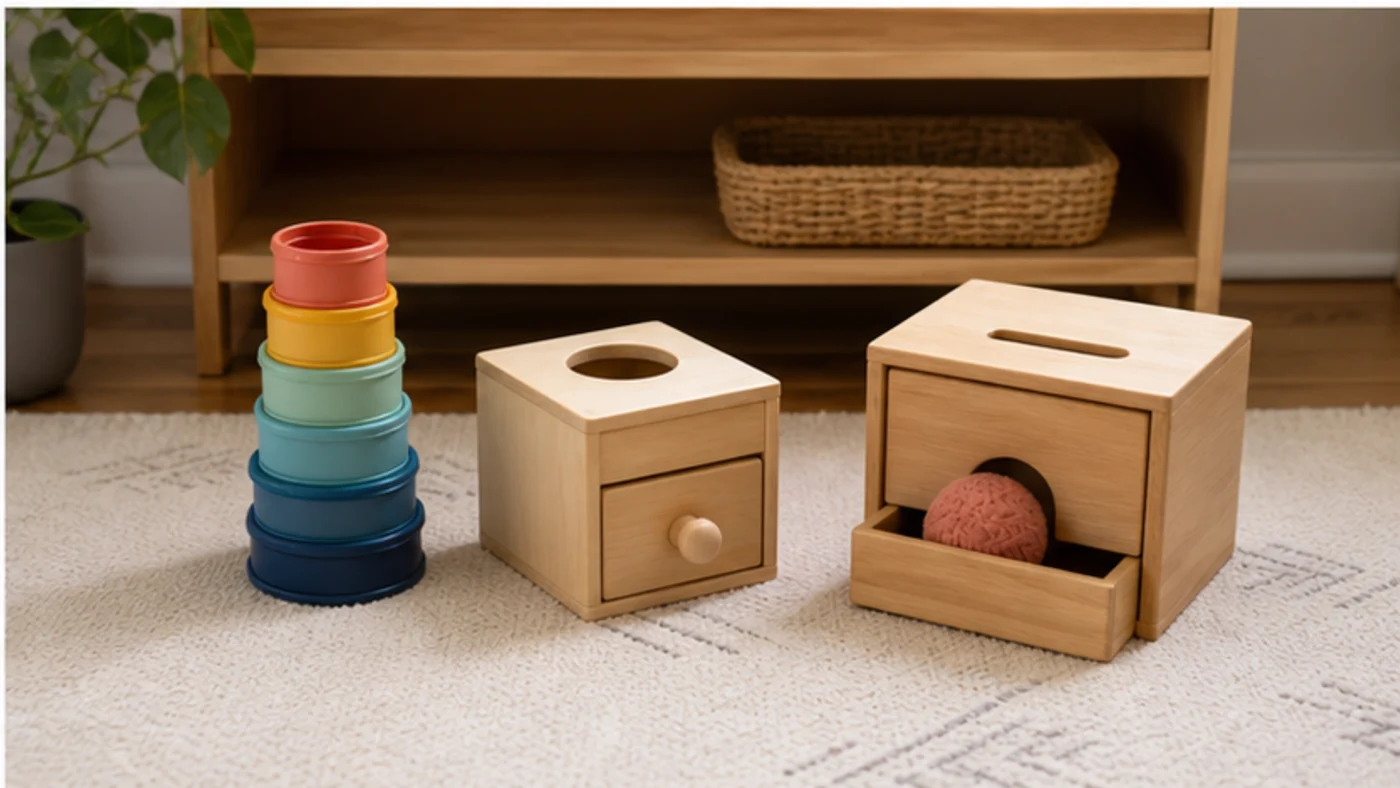
Object permanence box
The Montessori object permanence box is still one of the strongest baby materials around. Your baby drops the ball in, sees it reappear, and repeats the action with total seriousness.
Posting toys and put-in/take-out work
If you want a polished version, browse simple posting toys for babies. But a small box and a few safe objects can work just as well at home.
Ball tracker or ball ramp
A wooden ball tracker gives your baby a clear cause-and-effect loop: release, watch, anticipate, repeat.
Very simple shape-fitting work
Skip the huge shape sorter with twelve pieces. One-shape or two-shape challenges are usually a much better match here.
A low shelf or accessible basket
Strictly speaking, this is not a toy. It may still help more than buying another toy. A Montessori-style baby shelf or any low cube shelf makes choice and repetition much easier.
Takeaway: For 9-12 months, choose toys with a clear result and lots of repetition. Put in, take out, release, retrieve, repeat.
🛒 The short list: what is actually worth buying?
If you want the shortest practical shopping list, this is where I’d start.
Not the prettiest list. The one most likely to get real use.
Best buys for most families
| Toy or material | Best age window | Why it’s worth it |
|---|---|---|
| High-contrast book or cards | 0-3 months | Strong visual target for early focus |
| Wooden rattle or grasping toy | 3-6 months | Supports early hand control and mouthing |
| Interlocking discs | 3-6 months | Great for two-handed transfer |
| Stacking cups | 6-12 months and beyond | Cheap, flexible, and endlessly reusable |
| Treasure basket setup | 6-9 months | Rich sensory exploration without much cost |
| Object permanence box | 9-12 months | Clear cause-and-effect and deep concentration |
Best value picks
If budget matters, these usually give the strongest return:
1. Stacking cups
They are inexpensive, durable, and useful for much longer than most baby toys.
2. A simple wooden rattle
Still one of the best first purchases if your baby is beginning to grasp.
3. Treasure basket materials
Often better made than many toy bundles because they can include real objects from your home.
4. Object permanence box
Worth it if your baby is at the right stage and you do not want to DIY one.
A no-regret starter set
If you want to buy slowly, start with one item per job instead of one item per product category.
| Job | One paid option | Almost-free alternative |
|---|---|---|
| visual focus | high-contrast cards or soft book | printed black-and-white shapes taped near tummy-time space |
| grasping | wooden rattle or ring | clean silicone spatula handle or large wooden napkin ring, supervised |
| hand-to-hand transfer | interlocking discs | large scarf knotted into a loop |
| container play | stacking cups | nesting food containers with lids removed |
| sensory comparison | treasure basket | 5 safe household objects in a low basket |
| dropping and retrieving | object permanence box | oatmeal tub or small box with a large ball-sized opening |
That starter set is enough for many families. If a material gets daily use, upgrade later. If it gets ignored, you have not overbought.
If budget is tight
Honestly, babies are the age group where Montessori can be the cheapest.
You can do beautifully with:
- a mirror
- a basket
- stacking cups
- scarves
- a wooden spoon
- a silicone whisk
- a metal spoon
- a cardboard tissue box for pulling cloths
Some of the best infant materials are basically “normal household objects, chosen on purpose.”
Takeaway: Your baby does not need a huge toy collection. A few strong materials beat a mountain of clutter every time.
🚫 What to skip when buying Montessori toys for babies
This part matters just as much as the recommendations.
A lot of baby toy regret comes from buying too much, too early, or too noisily.
Skip toys that are over-stimulating
If a toy flashes, sings, lights up, and does a whole one-toy talent show every time your baby touches it, it is probably doing too much.
Skip toys that are far ahead of your baby
A lovely shape sorter is still the wrong toy if your baby cannot use it yet. Save the money for when the stage actually arrives.
Skip giant boxed “development kits” unless you want the convenience
Some are thoughtfully designed. But many babies need far fewer materials than those kits suggest.
Skip duplicate toys doing the same job
You probably do not need three grasping sets, two ring stackers, and four posting toys all at once. One strong version is enough.
Skip toy overload on the shelf
Most babies do better with 3 to 5 visible choices than with one big toy dump. A calmer shelf usually leads to deeper play.
Skip fake Montessori marketing
This is worth saying clearly.
A toy is not Montessori just because it is wooden, beige, expensive, or covered in words like natural, open-ended, or sensory. Look at the design. Look at the developmental match. Look at whether your baby can actually use it.
That matters more than the label.
Takeaway: When a baby toy purchase goes wrong, the problem is usually mismatch, overstimulation, or clutter.
🏡 A simple Montessori toy setup for the first year
If I were setting up a calm Montessori space for a baby from scratch, I would focus less on owning everything and more on creating a clear environment.
That usually means:
- a safe floor area for movement
- one mirror or visual focus point
- one low basket or shelf
- 3 to 5 toys out at a time
- rotation based on what your baby actually uses
Here is a realistic example for an older baby around 9-12 months:
| Area | What to include |
|---|---|
| Floor space | soft mat, open room for crawling, one mirror |
| Shelf | stacking cups, object permanence box, one basket of safe objects |
| Basket | treasure basket items or put-in/take-out materials |
| Adult rule | do not overfill just because the shelf has room |
That last rule does a lot of heavy lifting.
A big part of Montessori at home is simply learning to stop adding things.
If your baby keeps returning to one object, that is good news. Repetition means the material is doing its job.
If you want more ideas for calm spaces, our Montessori treasure basket for babies guide pairs nicely with this stage. For the wider home setup, use how to start Montessori at home and toy rotation without overwhelming your toddler as the next steps.
Takeaway: The setup matters almost as much as the toys. Calm, reachable, and uncluttered wins.
Five-minute shelf audit
Before buying anything else, look at the play space and ask:
- Can my baby reach the material without adult performance?
- Is there only one clear action, or is the toy trying to do everything?
- Is the material safe for mouthing, dropping, and banging?
- Does it support the movement my baby is already practising?
- Are there fewer than five visible choices?
- Would removing two toys make the space calmer?
If the answer to that last question is yes, remove two toys before adding one.
How we reviewed this guide
This is a practical parent guide, not a lab test of every infant toy on the market. We reviewed the recommendations against Exploritori’s Montessori-at-home criteria: developmental match, baby-led action, repeatability, safety boundaries, realistic cleanup, price usefulness, and whether a household alternative can do the same job.
Product links are included as examples where they make the material easier to identify. Some may be affiliate links, which can earn Exploritori a commission at no extra cost to you. Always follow current manufacturer age guidance, recall notices, and your pediatrician’s advice for your baby.
❓ FAQ: quick answers for tired parents
Do babies really need Montessori toys?
No. Babies need rich real-world experiences more than branded products. Montessori toys can help, but a calm environment, floor time, and a few useful materials matter much more than a shopping spree.
Are wooden toys always better for babies?
Not always. Wood often feels lovely and gives great sensory feedback, but some non-wood toys are still excellent. Stacking cups are the obvious example. The better question is whether the toy is calm, useful, and matched to your baby’s stage.
How often should I rotate baby toys?
Rotate when interest fades, not on a rigid schedule. If your baby keeps returning to the same object, leave it out. Repetition is the work.
What is the best first Montessori toy to buy?
If your baby is very young, start with a high-contrast visual. If your baby is beginning to grasp, start with a simple rattle. If your baby is sitting and exploring more actively, stacking cups are one of the safest high-value buys.
How many toys should a baby have on a Montessori shelf?
For most babies, 3 to 5 visible choices is enough. The goal is clarity, not abundance.
🤍 The bottom line
The best Montessori toys for babies are the ones that help your baby notice, reach, grasp, transfer, drop, crawl, and concentrate.
That usually means they are simpler than expected.
A high-contrast book. A wooden rattle. Interlocking discs. Stacking cups. A treasure basket. An object permanence box. A few safe real objects. Plenty of floor time.
That is already a rich first-year environment.
You do not need to buy a whole Montessori identity.
You just need a few thoughtful materials, a calm setup, and enough confidence to ignore most toy marketing.
And if you are ever unsure, start smaller.
Babies are very good at showing you what is actually worth keeping.
 Get weekly Montessori tips
Honest reviews, activity ideas, and budget-friendly picks — no spam, just what works.
Subscribe Free