Grimm's Rainbow Wooden Arch Review (2026): Is the Large Set Worth €55?
· Updated
If you are searching for a Grimm's Rainbow wooden arch review, start here: the Large Rainbow is a 12-piece nested wooden arch set that can be stacked, balanced, sorted, and turned into bridges, tunnels, fences, mountains, or small-world scenery. It is a beautiful rainbow stacker with unusually long play value — and it is still not the right first Montessori purchase for every family.
Quick verdict for "is Grimm's Rainbow worth it?": yes if your child already returns to blocks, loose parts, pretend play, cars, animals, or open-ended building and €55 is comfortable. Wait or skip if your toddler mostly throws heavy toys, mouths small pieces, needs simpler shelf work first, or you are buying it only because it looks good on Instagram.
| Question parents actually ask | Short answer |
|---|---|
| Is the Grimm's Large Rainbow worth €55? | Worth it as a multi-year open-ended material, not as a shelf decoration. |
| Who should buy the wooden arch set? | Kids who already build, nest, line up, or invent small worlds. |
| Who should wait? | Throwers, heavy mouthers, or homes that have not tested rainbow play yet. |
| Better first step on a tight budget? | A cheaper wooden rainbow, then upgrade only if the play sticks. |
The useful answer is not "yes, because it is beautiful" or "no, because it is expensive." It depends on play style, shelf setup, and whether you need one flexible material or another pretty object. This Grimm's Rainbow wooden arch review treats the Large set as a long-term open-ended material: what it does well, where it is overrated, and how to decide before spending premium-toy money.

What Is the Grimm's Rainbow Stacker?
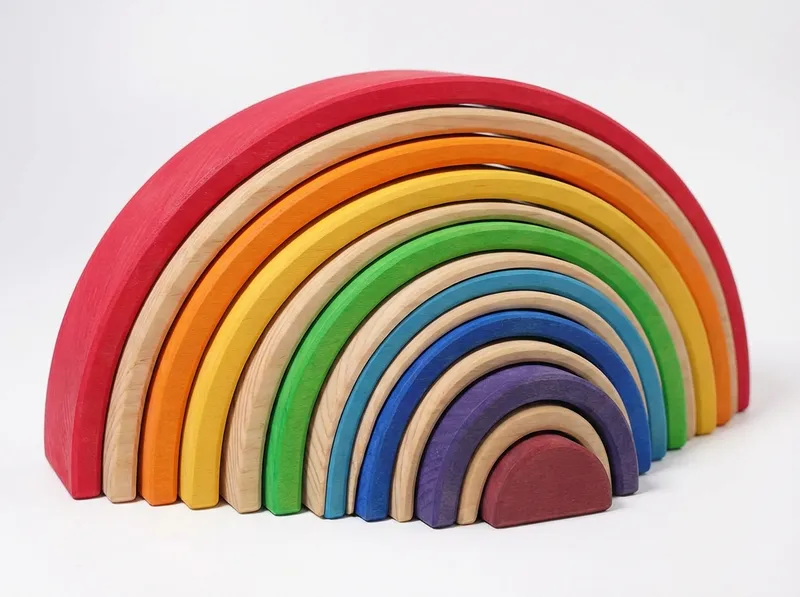
The Grimm's Large Rainbow is a set of 12 nested wooden arches, ranging from about 5 cm to 36 cm wide. Each arch is a different colour, moving through the spectrum from red on the outside to violet in the centre.
It's made in Germany by Grimm's Spiel und Holz Design, a company that's been making wooden toys since 1978. The wood is lime wood, stained with non-toxic, water-based dyes, and finished with natural oils. No lacquer, no plastic, no batteries.
Key specs:
- Ages: 1+ (manufacturer recommends 12 months and up)
- Pieces: 12 arches
- Dimensions: 36 × 18 × 7 cm (largest arch)
- Material: Lime wood, non-toxic dyes
- Made in: Germany (some elements produced in Bosnia & Herzegovina)
- Price: ~€55 (varies by retailer)
Quick Verdict: Buy, Wait, or Skip?
| If your situation looks like this | Best move | Why |
|---|---|---|
| Your child already builds, lines up, carries, nests, or turns blocks into pretend objects | Buy if the budget is comfortable | The rainbow adds flexible shapes that become bridges, tunnels, fences, beds, mountains, and sorting material. |
| Your child is 12-18 months and mostly dumps, mouths, and throws | Wait or offer 3-4 large arches only | The full 12-piece set can be too much choice and the larger arches are heavy when launched. |
| You want one beautiful toy to "make the shelf Montessori" | Skip for now | A low shelf, fewer choices, and repeatable practical-life work matter more than one iconic object. Start with the Montessori shelf setup guide. |
| You are unsure whether open-ended building will stick | Try a budget rainbow first | A cheaper wooden rainbow can test the play pattern before committing to Grimm's finish and weight. |
| You need a gift that can last across siblings | Strong candidate | It is visually special, does not depend on batteries or trends, and can serve children from toddlerhood into imaginative preschool play. |
Grimm's vs Budget Rainbows at a Glance
If the wooden arch review question is really "do I need the Grimm's premium?", compare the Large Rainbow with the two common budget stand-ins before you buy:
Wooden rainbow comparison: Grimm's Large vs budget
Grimm's Large Rainbow (12)
Lewo wooden rainbow (12)
Coogam wooden rainbow
For material and finish trade-offs beyond rainbows, pair this with Wooden vs Plastic Montessori Toys and non-toxic materials / safety labels. If you are choosing a first premium wooden set for preschoolers, also see Best Montessori Toys for 3 & 4 Year Olds.
What Makes It "Montessori"?
Let's be clear: there's no such thing as a "Montessori-certified" toy. But the Rainbow Stacker aligns beautifully with several Montessori principles.
Open-ended play. There's no "right" way to use it. A one-year-old might stack two arches. A three-year-old might build a village. A five-year-old might sort them by colour family and use them as part of an elaborate imaginary world. The toy grows with the child because it doesn't dictate what to do.
Natural materials. Montessori philosophy emphasises real, natural materials over plastic. Wood has texture, weight, warmth — qualities that engage sensorial exploration in a way that moulded plastic simply doesn't.
Isolation of difficulty. The nesting design naturally teaches size ordering. A child discovers through trial and error that the pieces only nest one way. No adult needs to explain it.
Aesthetic beauty. Montessori environments value beautiful objects. Whether or not you care about the philosophy, there's no denying this thing looks stunning on a shelf.
If you want the broader age map, pair this review with our Montessori toys by age guide and the best Montessori toys for 2-year-olds roundup. For the "is this authentically Montessori or just pretty wood?" question, read Authentic Montessori Toys vs Montessori-Inspired. The rainbow is strongest when it fits an existing rhythm, not when it is asked to solve toy clutter by itself.
Pros and Cons at a Glance
| Pros | Cons |
|---|---|
| Lasts years, from toddler stacking to small-world building | €55 is a real premium over budget rainbows |
| Stained (not painted) solid wood with excellent finish | Heavy (about 700 g): hurts when thrown |
| Genuinely open-ended: sorting, balancing, bridges, tunnels | Smallest arches need supervision with heavy mouthers |
| Makes other toys (animals, cars, figures) more useful | Natural dyes vary slightly between sets |
The Pros
It genuinely lasts years
This isn't the kind of material children usually outgrow in three months. The play can evolve dramatically from age 1 through early primary years. Younger children stack, nest, carry, and knock down. Older children build structures, sort colours, use the arches as fences for animal figures, bridges for cars, tunnels, beds for dolls, mountains, ramps, and loose parts in pretend worlds.
For a toy at this price point, longevity matters. Cost-per-year, this works out to less than €10 if it stays in rotation for six years. That's cheaper than most plastic toys that end up in a donation bag within months.
Build quality is excellent
The arches are solid, well-sanded, and feel substantial in hand. The colour is stained into the wood, not painted on top, so ordinary scuffs do not create the same peeling-paint problem you see on cheaper painted toys. That is one of the biggest real differences between Grimm's and many budget lookalikes: the premium is partly in the finish, not just the shape.
It's genuinely open-ended
Be wary of toys that claim to be "open-ended" but really only do one thing. The Rainbow Stacker actually delivers because the arches have no single correct answer. They can support colour grading, size ordering, balancing, building, small-world play, gross-motor tunnels for cars, and quiet shelf work.
It plays well with other toys
This is underrated. The arches become tunnels for trains, stables for horses, rooms for dollhouse figures, mountains for dinosaurs. It integrates into whatever world your child is building. That versatility makes it a multiplier — it makes your other toys more interesting too.
The Cons
The price is real
€55 is a lot for a toy. There's no way around that. For many families, that's a significant portion of a monthly toy budget (if there even is one). The quality justifies the price, but justification doesn't change the number on the receipt.
It's heavy
The full set weighs about 700g. That's fine for play, but when a toddler launches a large arch across the room — and they will — it can hurt. Supervision is wise with younger children, especially around babies.
The smaller arches can be a choking consideration
The smallest arches are small enough to fit in a toddler's mouth. They're too large to be a true choking hazard for most children over 12 months, but it's worth being aware of, particularly if you have a child who still mouths everything aggressively.
Colour variation between sets
Because the dyes are natural and water-based, colours can vary slightly between sets. Your rainbow might not look exactly like the one on Instagram. This is actually a feature of handmade, natural products — but if you're expecting pixel-perfect consistency, set your expectations accordingly.

How to Set It Up So It Actually Gets Used
The easiest mistake is putting all 12 arches on the shelf at once and expecting deep play. For many toddlers, the full rainbow is visually exciting but practically overwhelming.
Try this instead:
| Age/stage | Shelf setup | Adult role |
|---|---|---|
| 12-18 months | 3-4 large arches on a rug or low shelf | Model nesting, carrying with two hands, and returning pieces one at a time. |
| 18-30 months | 5-7 arches plus cars, animals, or blocks nearby | Invite bridges, tunnels, fences, and colour matching without turning it into a lesson. |
| 3-4 years | Full rainbow with blocks, scarves, peg people, or building boards | Step back. This is where pretend play and construction usually become richer. |
| 5+ years | Full set in a construction basket | Combine with loose parts, storytelling, marble runs, or room-scale building. |
If the rainbow becomes a throwing object, it is not a failure. It just means the current setup is too heavy, too exciting, or too open for that moment. Put away the largest arches, offer fewer pieces, or rotate it out for a week. The toy rotation guide is the better fix than buying more matching Grimm's pieces.

What I Would Check Before Buying
- Does your child already return to blocks, cups, scarves, cars, animals, or pretend play? If yes, the rainbow has more chances to become a multiplier.
- Do you have room to store it assembled? If it has to be packed tightly in a cupboard, it loses a lot of its invitation value.
- Are you buying it for the child or the shelf photo? No judgement — it is beautiful — but that distinction matters at €55.
- Would a cheaper rainbow answer the same question first? If the play pattern is untested, start lower-risk.
- Can you supervise the early phase? The arches are not fragile, but they are heavy enough that throwing, toe-dropping, and baby-sibling collisions matter.
Real-Home Play Examples (Not Shelf Photos)
Original home example — rainy Wednesday: Nora (2 years, 8 months) gets four large arches on a rug with two wooden cars. Her parent models one tunnel, then steps back. Nora pushes cars through, restacks the arches into a "garage," and returns pieces to the tray when snack is ready. That is the worth-it pattern: simple props, short concentration, no adult script.
Original home example — Saturday building stretch: Theo (4) already uses Kapla and animals. The full 12-piece rainbow comes out with peg people and a scarf. He builds a bridge-village for forty minutes, narrates who lives under which colour, and asks to leave it up overnight. At that stage the Grimm's finish and weight matter more — budget arches still work, but the Large set holds structures better when pretend play gets ambitious.
If those scenes do not sound like your child yet, do not force the purchase. Test the play pattern with a cheaper rainbow, fix rotation with the toy rotation guide, or choose a clearer first material from the 2-year-old Montessori toys guide.
Who This Is For
- Parents who value long-lasting, open-ended toys. If you'd rather buy fewer, better toys, this is a strong candidate.
- Families setting up a Montessori-inspired space. It's a staple for a reason.
- Gift-givers looking for something special. It's beautiful, practical, and the kind of gift that gets used for years.
- Children aged 1-6+. The sweet spot is around 18 months to 4 years, but it has legs beyond that.
- Homes with existing loose-parts or small-world play. If your child already uses blocks, animals, cars, scarves, or peg dolls creatively, the rainbow tends to plug in naturally.
Who Should Skip This
- Families on a tight budget. There are decent alternatives at a third of the price (see below). Don't stretch your finances for a toy, no matter how lovely.
- Parents who prefer structured toys. If your child thrives with puzzles that have a clear "done" state, the open-ended nature might frustrate them initially.
- Households with very young babies. Wait until your child is at least 12 months and past the stage of putting everything in their mouth.
- Homes already drowning in open-ended toys. If you have blocks, stacking cups, magnetic tiles, train tracks, and loose parts everywhere, fix the rotation first.
Budget Alternatives
Not every family can or should spend €55 on a rainbow. Here are some alternatives worth considering:
Lewo 12-Piece Wooden Rainbow (€20-25): A solid budget option. The wood is lighter, the colours are less rich, and the finish isn't as refined — but it does the same job. For a family testing whether their child will actually engage with a stacker, this is a sensible starting point.
Coogam Wooden Rainbow (€15-20): Even more budget-friendly. The arches are thinner and the colour palette leans more pastel. It works fine for younger toddlers but may not hold up as well over years of heavy use.
DIY option: If you're handy, you can cut arches from plywood and stain them with food-safe dyes. Total material cost: under €10. Time investment: a weekend afternoon. The result won't be as polished, but your child genuinely won't care.
The honest assessment: the Grimm's version is noticeably nicer in hand. The weight, the grain, the colours — they're superior. But "nicer" and "necessary" are different things. A budget rainbow still provides open-ended, imaginative play.
If you are trying to decide where to spend Montessori-toy money generally, read are Montessori toys worth it? before buying. For material and safety trade-offs, the wooden vs plastic Montessori toys guide is the useful companion.
Our Verdict
Exploritori Rating
Grimm's Rainbow StackerThe Grimm's Rainbow Stacker is one of the few toys that lives up to its reputation. It's beautiful, durable, genuinely open-ended, and grows with your child over years. The price is steep, but the cost-per-use is excellent if your family is the type to keep toys in rotation long-term.
If you can afford it without stress, buy it. If the budget is tight, start with a cheaper alternative and upgrade later if your child loves the concept.
The Rainbow Stacker also features in our best Montessori toys for 2-year-olds roundup, and it's a top pick in our Montessori gift guide under €30 (the smaller 6-piece version).
👉 Check the current price on Amazon
How We Reviewed This
This is a review-analysis article, not a lab durability test or a claim that every rainbow stacker on the market was tested side by side. We assessed the Grimm's Large Rainbow against Exploritori's Montessori-at-home criteria: developmental fit, open-ended use, shelf clarity, safety boundaries, durability signals, setup reality, and whether a lower-cost material can provide similar play value.
Product details can change by retailer and region. Always check the current manufacturer age guidance, local safety information, and the exact product listing before buying. Some links may be affiliate links, which means Exploritori may earn a small commission at no extra cost to you; that does not change the recommendation.
Frequently Asked Questions
Is the Grimm's Rainbow safe for babies?
The manufacturer recommends 12 months and up. The smallest arches are small, and the set is heavy. For children under 1, consider the Grimm's 6-piece rainbow, which has larger, easier-to-handle arches.
How do you clean the Grimm's Rainbow?
Wipe with a damp cloth. Don't soak it or put it in the dishwasher — it's untreated wood and will absorb water. If it gets food on it (it will), a damp cloth with a tiny bit of mild soap works fine. Let it dry completely before storing.
Is it worth buying the 12-piece vs the 6-piece?
For most families, the 12-piece offers significantly more play possibilities. The 6-piece is good for younger toddlers or as a travel option, but children tend to outgrow it faster. If you're only buying one, go for the 12-piece.
Do the colours fade over time?
They can lighten slightly with heavy sun exposure, but under normal use, the colours hold well. The water-based dyes penetrate the wood rather than sitting on top, so you won't see chipping or peeling.
Can you combine multiple Grimm's sets?
Absolutely. The rainbow pairs beautifully with Grimm's building boards, semicircles, and natural blocks. Combined sets unlock even more building possibilities. That said, the rainbow alone is plenty — don't feel pressured to buy the whole collection.
Is the Grimm's Rainbow worth the money?
It is worth €55 when your child already shows open-ended building or small-world play and you will keep the set in rotation for years. It is not worth stretching the budget for a shelf photo. If the play pattern is untested, buy a budget wooden rainbow first and upgrade only if the arches stay in weekly use.
What should a Grimm's Rainbow wooden arch review check before buying?
Check play pattern (builds/nests already?), storage (can it stay assembled?), supervision for heavy arches, and whether a cheaper rainbow can answer the same question. Then use the buy/wait/skip matrix above — not Instagram styling — as the decision filter.
Grimm's Large Rainbow vs a budget wooden rainbow — which first?
Start budget if money is tight or the play is unproven. Choose Grimm's Large when you already know rainbow/block play sticks and you want better finish, weight, and multi-year durability. The play idea is similar; the premium is mostly in material quality and longevity.
 Get weekly Montessori tips
Honest reviews, activity ideas, and budget-friendly picks — no spam, just what works.
Subscribe Free