Montessori Activities for 30-36 Months at Home
· Updated
Thirty to thirty-six months is a funny stage.
Your child may look almost preschool-ready one minute and very much like a toddler the next. They can remember routines, argue about socks, carry a full tray with deep seriousness, and still melt down because the banana broke in half.
That mix is normal.
The best Montessori activities for 30-36 months respect both sides of this age. They offer more responsibility and precision than baby toddler work, but they do not rush your child into worksheets, forced academics, or Pinterest-perfect projects.
This is the stage for real work with a little more sequence.
If your child has outgrown our 24-30 month activity guide but is not quite ready for a full preschool rhythm, start here.
For planning, keep this age connected to the whole shelf rhythm: the weekly shelf rotation planner helps you choose a few purposeful activities instead of filling every tray at once.
If Montessori still feels a bit fuzzy, our no-nonsense Montessori guide explains the philosophy without the Instagram noise.
For the practical-life foundation behind many of these ideas, see our Montessori practical life activities guide. If you want these activities to become part of the day instead of another thing to manage, pair them with our Montessori practical life routines guide.
Safety note: Activities for 30-36 months still need active supervision. Adapt food, water, scissors, beads, plants, cleaning tools, and small objects to your child’s age, development, mouthing stage, and current safety guidance.
Quick Guide
Use this when you want to choose one activity instead of rebuilding the whole shelf.
| If your child wants… | Try this first | Keep it easier by | Add challenge by |
|---|---|---|---|
| Real responsibility | Table setting or snack prep | setting one place only | setting two places or serving a snack |
| Fine-motor challenge | Threading, cutting strips, or tong work | using large pieces and short sessions | adding smaller pieces or a visual finish line |
| More language | Object-to-picture sorting or sound games | using familiar household objects | adding one extra object or category |
| More movement | Carrying, sweeping, outdoor walking, or obstacle paths | using a short distance and light tools | adding a marked target or two-step route |
| More independence | Dressing basket or clothing practice | choosing one movement, such as socks | practising the full routine when no one is rushing |
| More calm after big feelings | Plant care, wiping, or cloth folding | giving one small real job | adding a return-and-reset step |
What Changes at 30-36 Months?
By 30 months, many children are ready for activities with more steps.
Not complicated steps. Just a little more order.
Instead of “move this from one bowl to another”, your child might wash fruit, cut it, put it in a bowl, carry it to the table, and wipe the tray afterwards. Instead of one puzzle, they might choose a work mat, complete the puzzle, return it to the shelf, and pick the next activity.
That does not mean your home needs to become a miniature school.
It means the work can become more connected to real life.
You may notice your child:
- wants to help with routines, not just play near them
- can follow two or three simple steps
- enjoys sorting, matching, naming, and ordering
- wants tools that actually work
- becomes frustrated when tasks are either too easy or too hard
The sweet spot is practical, concrete, and just challenging enough.
Readiness Check Before You Set the Shelf
Age is useful, but readiness is better. A 31-month-old who still mouths small parts needs a different shelf from a 35-month-old who can calmly carry a tray, follow a routine, and ask for harder work.
| Readiness sign | Good activities to try | Simplify or wait on |
|---|---|---|
| Carries a tray, plate, or small bowl with care | table setting, snack serving, sweeping to a square | heavy glass, full pitchers, long routes |
| Uses both hands together | threading, dressing practice, cutting strips | tiny beads, stiff scissors, tight fasteners |
| Can follow two or three familiar steps | fruit washing and cutting, plant care, toy washing | open-ended setups with no visible finish |
| Notices categories and “same/different” | laundry sorting, object sounds, counting real objects | too many categories or abstract worksheets |
| Wants real tools | child-sized broom, small watering can, safe knife | toy tools that do not actually work |
| Gets frustrated when corrected | mystery bag, plant care, cloth wiping | activities where the adult has to rescue every step |
If the activity needs constant adult hands, make it smaller before you assume your child is not ready. Fewer pieces, one step removed, or a clearer finish point usually fixes more than a brand-new material.
How to Set Up a Shelf for 30-36 Months
Four to six choices is plenty for most children in this age band.
A balanced shelf might include:
- one practical life activity
- one fine-motor activity
- one language or matching activity
- one early maths or sorting activity
- one puzzle, construction, or open-ended material
- one art or care-of-environment option nearby
Keep the setup readable. Each activity should have a clear container, tray, or basket. If your child needs three things to complete the work, keep those three things together.
At this age, you can also start expecting a little more from the cycle of activity: choose the work, use it, tidy it, return it. Not perfectly. Not every time. But gently and consistently.
For a deeper shelf setup, the Montessori shelf ideas by age guide pairs well with this article. If you are deciding what materials are worth buying for this stage, our 2-year-old Montessori toy guide is the companion buying guide.
If your child is already asking for more complex pretend play, longer projects, or early preschool materials, compare this with our Montessori activities for 3-year-olds before you add harder work. The next stage should feel more purposeful, not more pressured.
12 Montessori Activities for 30-36 Months
1. Table Setting with Real Dishes
Give your child one placemat, one plate, one cup, one spoon, and one napkin. Show how each item has a place.

This is a beautiful activity because it combines order, movement, language, and family participation. Your child is not pretending to help. They are helping.
Start with one place setting. Add more only when that feels easy.
What it builds: sequencing, care of the environment, coordination, responsibility.
Make it easier: use a picture placemat or set the plate first.
Make it harder: ask your child to set two places or match cutlery to each person.
2. Fruit Washing and Cutting
Offer soft fruit, a small bowl of water, a towel, a child-safe knife, and a serving bowl.
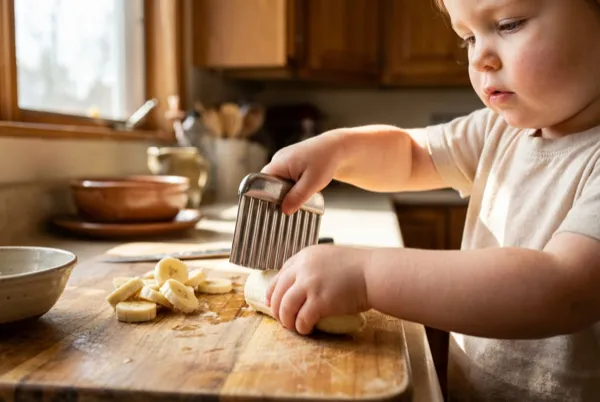
The sequence is simple: wash, dry, cut, serve. It feels important because it is important.
Choose foods that are easy to cut: banana, strawberries, soft pear, cucumber rounds, or cooked potato. Stay close, especially with cutting tools, and keep the amount small.
What it builds: bilateral coordination, hand control, sequencing, confidence.
Safety note: Use child-safe tools, supervise closely, and skip any food that creates a choking risk for your child.
3. Matching Objects by Beginning Sound
Put three familiar objects in a basket: cup, car, spoon, sock, ball, brush. Choose two that begin with the same sound and one that does not.
Say the sound slowly. “Cup. Car. Spoon. Which two start the same?”
Keep it playful. This is not a quiz. It is early language awareness with real objects.
What it builds: vocabulary, listening, sound awareness, early literacy.
Make it easier: use very different sounds.
Make it harder: add a fourth object or use objects with similar sounds.
4. Threading Large Beads or Pasta
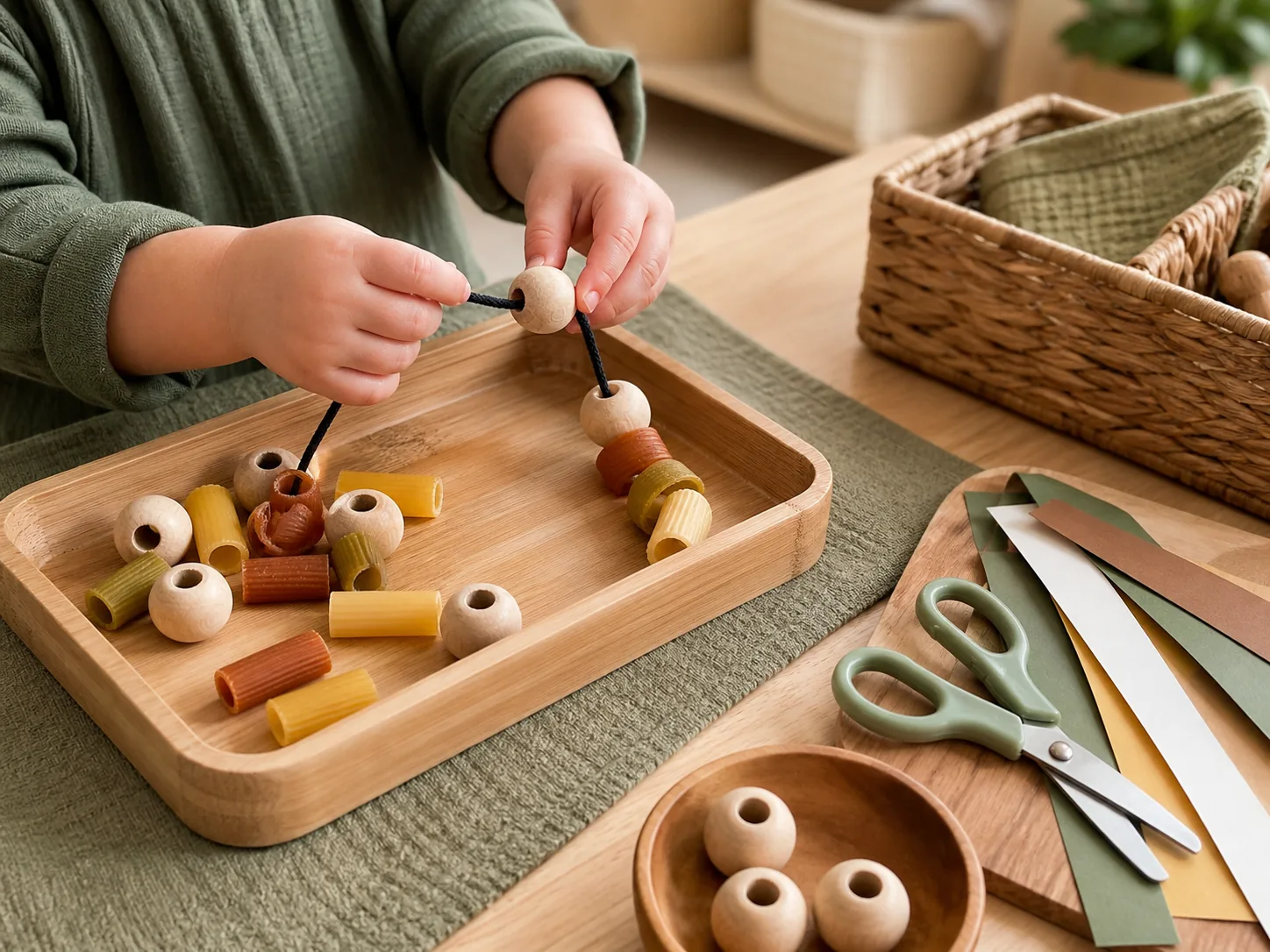
Use large wooden beads, chunky pasta, or cardboard tubes with a shoelace or pipe cleaner.
At 30-36 months, many children can handle threading if the pieces are large and the lace has a firm end. This is excellent pre-writing work because it asks both hands to cooperate.
What it builds: fine motor control, concentration, hand-eye coordination.
Safety note: Avoid small beads if your child still mouths objects.
5. Early Scissor Snipping
Offer short strips of thick paper and toddler scissors. Show one slow snip.
That is enough.
The goal is not a craft. The goal is the movement: open, close, open, close. Some children are ready closer to 30 months; others need more time. Both are fine.
For more hand-control ideas, see our Montessori practical life activities guide and Montessori shelf ideas by age guide.
What it builds: hand strength, bilateral coordination, pre-writing control.
Make it easier: use narrow strips so one squeeze cuts through.
Make it harder: draw thick straight lines to cut along.
6. Sorting Laundry by Person
Take a tiny pile of clean laundry and sort it by owner: your socks, my socks, baby towel, kitchen cloth.
This activity is more meaningful than colour sorting because it belongs to real family life. Your child has to notice details and make decisions.
What it builds: classification, observation, household participation, language.
Make it easier: use very different items.
Make it harder: sort similar socks or match folded pairs.
7. Washing a Toy Animal
Set up a small basin, sponge, towel, and one washable toy animal.
Show the sequence: wet the sponge, wash the animal, dry it, return the materials. Keep the water shallow and the setup small.
This is care-of-environment work, sensory work, and practical life in one tidy package.
What it builds: sequencing, wrist control, care, concentration.
Safety note: Water activities need active supervision, even with a small basin.
8. Simple Counting with Real Objects
Use five spoons, five stones, five blocks, or five snack pieces.
Move each object as you count it. One object, one number. Stop at three if five is too much.
At this age, counting should stay concrete. Real objects make much more sense than abstract number worksheets.
What it builds: one-to-one correspondence, early maths language, order.
Make it easier: count to three.
Make it harder: match one object to each spot on a simple card.
9. Dressing Practice Basket
Put a few clothing items in a basket: socks, a hat, a loose cardigan, a shoe with Velcro, or a zipper pouch.

Let your child practise one movement at a time. Pull sock over toes. Open Velcro. Push arm through sleeve. Zip halfway.
This is more useful than a fancy dressing frame if the real clothing is what your child actually struggles with.
What it builds: independence, body awareness, finger strength, patience.
Takeaway: Practise when no one is rushing out the door.
10. Mystery Bag with Familiar Objects
Place three familiar objects in a cloth bag. Your child reaches in, feels one object, guesses what it is, then pulls it out to check.
Start with very different shapes: spoon, pinecone, toy car. Later, use more similar objects.
This activity is quiet, simple, and surprisingly absorbing.
What it builds: stereognostic sense, vocabulary, memory, concentration.
11. Sweeping a Marked Square
Put a small square of tape on the floor. Sprinkle a tiny amount of dry material, such as large crumbs or paper scraps, near the square. Show how to sweep everything into the square, then into a dustpan.
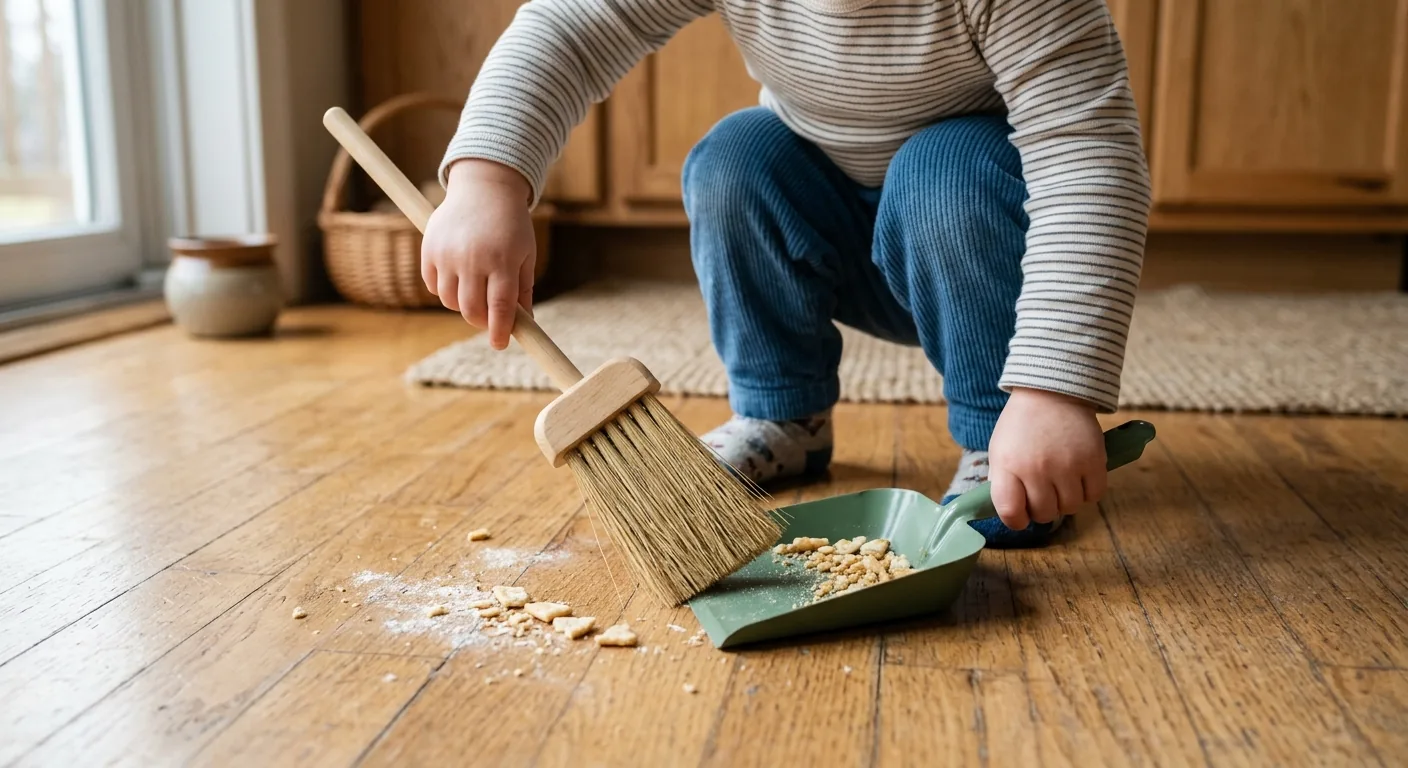
The tape gives a visual target, which makes the task easier to understand.
What it builds: coordination, control, order, care of the environment.
Make it easier: use larger paper scraps.
Make it harder: sweep from farther away.
12. Plant Care Routine

Choose one plant your child can help care for.
Offer a small watering can with only a little water, a cloth for leaves, and a clear routine: check soil, water gently, wipe one leaf, return the tools.
Children this age often love care work because it feels real and calm.
What it builds: gentleness, responsibility, sequencing, connection to nature.
Common Mistakes at 30-36 Months
Rushing into academics. Your child does not need worksheets to prepare for preschool. They need hand control, language, independence, movement, and order.
Offering too many choices. Older toddlers can handle more than younger toddlers, but a crowded shelf still creates chaos.
Expecting tidy work every time. The cycle of activity takes practice. Model it calmly and keep expectations realistic.
Using tools that do not work. A blunt knife that cannot cut, scissors that barely open, or an adult-sized broom can turn a good activity into frustration.
Forgetting movement. Three-year-old energy needs a body outlet. Carrying, sweeping, climbing, walking outside, and heavy work all matter.
If your child seems restless, try our gross motor activities for toddlers before adding more shelf work.
What to Rotate Next
Rotate when the activity no longer matches your child.
Good signs it is time to change something:
- the work is ignored for a week
- your child finishes it in seconds and wanders away
- the material is being dumped instead of used
- your child asks for more challenge
- the setup no longer fits your daily routine
Do not rotate everything at once. Keep one favourite activity, add one new challenge, and remove one thing that has gone stale.
That rhythm is calmer for everyone.
A First-Week Rotation Plan
Do not put all twelve activities out at once. Start with a small shelf and watch what your child repeats without prompting.
| Day range | Put out | Watch for | Adjust if needed |
|---|---|---|---|
| Days 1-2 | table setting, one fine-motor tray, one familiar puzzle or matching work | which activity gets repeated and which gets dumped | halve the pieces or remove the unclear activity |
| Days 3-4 | keep the favourite, add one language or counting activity | whether your child can finish and reset the work | reduce categories, objects, or steps |
| Days 5-7 | keep four to six choices total | longer concentration, careful carrying, pride after cleanup | make one favourite slightly harder instead of replacing everything |
The best evidence is not a perfect shelf photo. It is a child who can choose a job, finish it, and return to ordinary family life with a little more competence.
Troubleshooting Older-Toddler Shelf Work
| Problem | What it often means | Try this |
|---|---|---|
| Everything gets dumped | too many pieces or no clear endpoint | put out half the materials and add a return basket |
| Your child refuses the activity | the work is too easy, too hard, or badly timed | offer it after food, rest, or outdoor movement |
| Cleanup becomes a battle | cleanup was not built into the activity | add a sponge, brush, cloth, or labelled container from the start |
| They only choose one thing | they are practising mastery | leave the favourite and add one tiny variation nearby |
| Scissors, beads, or tools cause stress | the hand skill is not ready yet | step back to tearing paper, threading pasta, or dressing practice |
If the whole shelf feels chaotic, return to practical life for a few days: wiping, snack prep, laundry sorting, plant care, and sweeping. Real routines often regulate older toddlers better than more trays.
Methodology and Trust Notes
This guide is built from Montessori practical-life principles and parent-facing setup patterns that work in ordinary homes: real tools, concrete materials, visible order, movement before table work, and activities with a clear beginning, middle, and end. It favours household routines over decorative trays because 30-36 month olds usually want to contribute to family life, not just complete pretend work.
Product links are included only when a tool can make the setup easier or safer, such as child-sized cleaning tools, training scissors, or practical shelf materials. Most activities here can be done with things you already own. Any activity involving water, food, scissors, small loose parts, glass, plants, or cleaning tools should be supervised and adapted to your child’s mouthing, balance, allergies, and coordination.
Final Thought
Montessori activities for 30-36 months are not about making your child grow up faster.
They are about noticing that your older toddler is ready for more meaningful work.
Start with one real routine: setting the table, washing fruit, watering a plant, sorting laundry. Then add shelf work around that.
The point is not to fill the day with activities.
The point is to help your child feel useful, capable, and trusted.
That is the good stuff.
FAQ: Montessori Activities for 30-36 Months
What are the best Montessori activities for 30-36 months?
The best activities are practical, concrete, and slightly more sequenced than younger toddler work. Try food preparation, table setting, laundry sorting, early cutting, threading, object sound games, plant care, and simple counting with real objects.
How many activities should I put on a Montessori shelf for this age?
Four to six choices is usually enough. If your child is dumping everything or wandering without focus, reduce the number of choices before adding new materials.
Should a 30-36 month old be doing preschool worksheets?
No. Some children enjoy paper work, but it is not necessary. Concrete practical life, movement, language games, art, and hands-on maths are more useful for most children in this stage.
What if my child only repeats one activity?
That is usually fine. Repetition is how children build mastery. Leave the favourite work out while slowly introducing one new challenge nearby.
How do I know if an activity is too hard?
If your child becomes frustrated quickly, needs constant adult rescue, or starts misusing the material, simplify it. Fewer steps, larger pieces, and shorter work periods usually help.
 Get weekly Montessori tips
Honest reviews, activity ideas, and budget-friendly picks — no spam, just what works.
Subscribe Free