Montessori Activities for 24-30 Months: 12 Calm Ideas, Setup Tips, and Rotation Plan
· Updated
Twenty-four to thirty months is one of my favourite Montessori windows.
Your toddler is not a baby anymore, but they are not quite a preschooler either. They want real work. They want repetition. They want to carry things that are slightly too heavy, pour their own water, cut a banana “by myself,” and do the same shelf activity five times in a row.
This is also the age when a lot of parents accidentally offer the wrong level of challenge. Baby activities feel too easy. Preschool crafts feel too fiddly. And over-stimulating toys often create chaos instead of concentration.
The sweet spot is simple, purposeful work with a clear beginning, middle, and end.
That is exactly what Montessori activities for 24-30 months should give your child.

Quick choice guide
| Situation | Best starting point | Why it helps |
|---|---|---|
| You want the simplest option | Start with one low shelf or basket | Fewer choices make it easier for your child to focus |
| You are buying something new | Choose practical, open-ended materials first | They last longer and support real independence |
| Your space feels cluttered | Rotate materials weekly instead of adding more | Calm environments usually work better than bigger collections |
| Your child dumps everything | Reduce the shelf to three choices | Dumping often means the work cycle is unclear or too crowded |
| You only have ten minutes | Choose food prep, wiping, or sock matching | Real household work has a visible finish and easy cleanup |
🌱 Why 24-30 Months Feels Different
A broad “2-year-old” guide is helpful, but this narrower stage matters.
Between 24 and 30 months, many toddlers are moving from simple exploration into more intentional work. They still love sensory play, but now they also want order. They want to match, sort, complete, repeat, and help.
You will often notice a few patterns at this age:
- your child wants to imitate your daily routines
- they can manage a two-step task much better than a year ago
- they care more about “doing it right”
- they enjoy putting things back where they belong
- they can concentrate for longer when the task is clear
That means the best activities now are not the flashiest ones. They are the ones that feel real and manageable.
Takeaway: Think “small real jobs” more than “big entertainment.”
Is Your Toddler Ready for These Activities?
Age labels are helpful, but readiness is more useful than the calendar. A 25-month-old who loves repeating one pouring tray may be more ready than a 29-month-old who is tired, hungry, or still in a throwing phase.
Use this quick check before setting up the shelf:
| Readiness sign | Good activities to try | Wait on |
|---|---|---|
| Carries a cup, bowl, or book without dropping it every time | water pouring, sock matching, open-and-close basket | fragile glass, full pitchers |
| Copies daily routines and wants to help | table wiping, sweeping, banana slicing | long chores with no clear end |
| Can match two familiar things | object-to-picture matching, sock matching, simple category sorting | abstract colour sorting with too many pieces |
| Uses both hands together | cutting strips, food prep, puzzles | tiny beads, stiff scissors, tight lids |
| Repeats one task calmly | keep the activity out and make one small variation | replacing the whole shelf too soon |
If your child is younger or easily frustrated, step back to the 21-24 month Montessori activity guide. If practical life is the main interest, pair this with our Montessori practical life activities guide.
Takeaway: readiness shows up in the hands: carrying, matching, repeating, opening, closing, wiping, and trying again.
🧺 How to Set Up Shelf Work for This Age

Before the activity list, one thing that makes a huge difference: do not put out too much.
For 24-30 months, three to six shelf choices is usually enough. More than that often creates wandering, dumping, and that chaotic feeling where nothing gets used well.
A good shelf at this age usually includes:
- one practical life activity
- one fine motor activity
- one language or matching activity
- one open-ended option like blocks, puzzles, or art
- one movement or heavy-work option elsewhere in the room
For a first 24-30 month shelf, I would choose:
| Shelf spot | Simple setup | Why this earns its place |
|---|---|---|
| Practical life | small pitcher, cup, cloth, and tray | real independence with built-in cleanup |
| Fine motor | tongs plus 6-8 felt balls or cotton pads | hand strength without tiny choking-risk pieces |
| Language | 4 real objects with matching picture cards | vocabulary and symbolic thinking |
| Household order | 3-4 pairs of socks to match | matching with a real family purpose |
| Problem-solving | one 4-8 piece puzzle | concentration without a complicated setup |
Keep each activity complete on its own tray or basket. If your child needs scissors, paper, and a small bowl, keep them together. If they need two matching sets, present both sets neatly from the start.
And rotate based on interest, not guilt. If an activity is ignored for a week, change it. If your child repeats one activity every day, leave it out.
If your child is mostly seeking smaller hand challenges, the Montessori fine motor activities guide gives you a deeper list of pouring, threading, squeezing, and tong work. If your child wants more words, naming, and matching, use the Montessori language activities guide for the language basket. When the whole shelf starts feeling too easy, the next step is our 30-36 month Montessori activities guide.
If you want a simple shelf or tray setup, a low open shelf plus a few lightweight trays works beautifully. A basic Montessori-style toy shelf and small wooden activity trays can make home setup easier, but you absolutely do not need anything fancy.
Takeaway: Fewer choices, clearer presentation, more repetition.
✋ 12 Montessori Activities for 24-30 Months
1. Tong Transfer with Real Objects
Give your child child-sized tongs, two bowls, and a material to move from one bowl to the other. Start with easy objects like felt balls, cotton pads, or large pom-poms.
At this age, tongs feel wonderfully serious. They are harder than spoon work, but still achievable. Your toddler has to open, grip, lift, and release with control.
A sturdy pair of child-friendly learning tongs can be worth having if kitchen tongs feel too big.
What it builds: hand strength, coordination, concentration, early writing muscles.
Make it easier: use larger objects and shallow bowls.
Make it harder: use smaller objects or sort by colour while transferring.

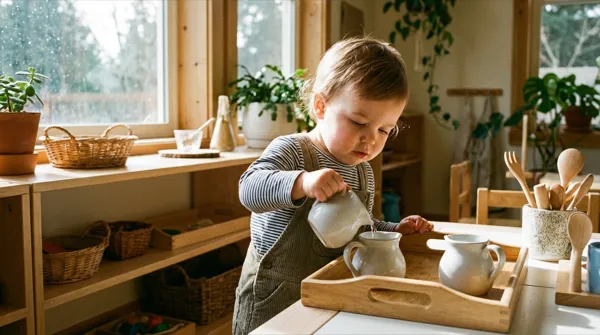
2. Water Pouring from Pitcher to Glass
This is classic Montessori for a reason.
Put a small pitcher with a little water on a tray next to an empty glass. Show your child how to hold the handle, pour slowly, then stop before the glass overflows. Add a sponge or cloth for cleanup.
For 24-30 months, this feels like real life, not pretend life. That matters. Your toddler is not just practising pouring. They are practising competence.
A small Montessori pouring pitcher or even a tiny milk jug works well.
What it builds: bilateral coordination, wrist control, independence, confidence.
Takeaway: Let spills be part of the activity. Cleanup is not failure. Cleanup is the lesson too.

3. Banana Slicing or Soft Food Prep
This is one of the best practical life activities at this stage.
Offer a banana, soft strawberries, cucumber rounds, or a peeled boiled egg with a child-safe knife. Show your child how to hold the food steady with one hand and slice with the other.
Children this age love food preparation because it ends in something visible and useful. They did real work, and now everyone can eat it.
A toddler-safe crinkle cutter or child-safe Montessori knife set is often easier than a standard butter knife.
What it builds: coordination, sequencing, hand control, food confidence, participation in family life.
Takeaway: Activities are stickier when they lead to a real result.

4. Sock Matching from the Laundry Basket
This one is gloriously ordinary, and that is why it works.
Take three or four clearly different pairs of socks. Mix them in a basket and invite your child to find the matches. Start with high contrast colours or patterns.
This feels like a game to you, but to your child it is order-making work. Montessori children love helping create order from mild chaos.
What it builds: visual discrimination, matching, attention to detail, household participation.
Make it harder: use similar colours, like navy and black, or striped pairs with small differences.
Takeaway: Real chores often make the best Montessori work.
5. Simple Shelf Sorting by Category
Use tiny baskets or bowls and offer a mixed set to sort. You could sort animals vs vehicles, red vs blue counters, wooden vs metal objects, or kitchen tools by type.
At 24-30 months, category sorting is often more engaging than abstract worksheet-style learning because the objects are real and touchable. Your child gets to make visible decisions.
You do not need special materials, but small sorting bowls or wooden loose parts trays can make setup easier.
What it builds: early maths, language, classification, concentration.
Takeaway: If your toddler is dumping instead of sorting, the task may be too abstract. Use fewer items and more obvious categories.
6. Posting Work with Real-Life Variation
Posting work still works at this age, but it should evolve.
Instead of one large hole and one obvious object, try a coin slot with oversized tokens, craft sticks into a narrow slit, or large buttons into a container opening. The challenge should feel just slightly more precise than it did at 18 months.
You can buy a dedicated Montessori posting toy, but a repurposed container often works just as well.
What it builds: wrist rotation, visual-motor coordination, persistence, problem-solving.
Takeaway: The activity should ask for control, not frustration.
7. Practical Sweeping or Table Wiping
Two-year-olds often adore cleaning when no one turns it into a lecture.
Offer a child-sized brush and dustpan, or a small spray bottle with water and a cloth for wiping a low table. Show the movement slowly, then step back.
A real child-sized cleaning set can be useful here because the proportions matter. Adult tools are awkward and make success harder.
What it builds: coordination, left-to-right hand movement, responsibility, pride.
For a fuller cleaning setup, the Montessori cleaning tools guide explains which child-sized tools are worth it and which ones usually just add clutter.
Takeaway: If your child resists, check whether the tool is too big, the target is unclear, or the task is too long.
8. Puzzle Work with 4-8 Pieces
This is a lovely moment for puzzles, especially realistic wooden ones with clear images and knobs or chunky pieces.
At 24-30 months, many toddlers are ready for simple inset puzzles, shape puzzles, or first jigsaws with just a handful of pieces. The goal is not maximum difficulty. The goal is just enough challenge to hold concentration.
A good wooden toddler puzzle is often more useful than a noisy toy that claims to teach everything.
What it builds: spatial reasoning, visual memory, confidence, problem-solving.
Takeaway: Rotate puzzles when mastery is too easy, not when your child still loves them.
9. Object-to-Picture Matching
Print or draw a few simple picture cards, then match them with the real objects. A spoon to a spoon card. A brush to a brush card. A toy animal to its picture.
This is one of the most useful pre-language and language-boosting activities at this stage. It bridges the concrete world and symbolic representation, which is a big developmental step.
If you want ready-made materials, simple matching card sets for toddlers are easy to find, but homemade versions are often better because they use familiar objects from your own home.
What it builds: vocabulary, visual discrimination, symbolic thinking, early reading foundations.
Takeaway: Use real objects your child already knows well.
10. Open-and-Close Basket
Gather a few containers with different closures: a small tin, a zip pouch, a screw-top jar, a box with a lid, and a snap container. Put one interesting object inside each.
Your child opens the container, finds the object, and closes it again. That is the whole work, and it is usually more compelling than adults expect.
This activity is brilliant because it gives repeated practice with real hand movements your child actually needs in daily life.
What it builds: finger strength, wrist rotation, patience, independence.
Takeaway: Variety matters more than quantity here. Three good closures beat a huge basket of junk.
11. First Cutting Strips with Scissors
Some children in this age band are ready for very early scissor work, especially closer to 30 months.
Offer short strips of sturdy paper and small toddler scissors. Show how to hold the paper with one hand and squeeze with the other. Keep expectations low. The first win is often just one snip.
A pair of toddler training scissors can make this much less frustrating than standard school scissors.
What it builds: bilateral coordination, hand strength, attention, pre-writing control.
Important: stay close and keep the setup simple.
Takeaway: If scissors create only stress, pause for a month and revisit later.
12. Flower Arranging or Simple Nature Tray
This is such an underrated activity for 24-30 months.
Put a few short flower stems, a tiny pitcher of water, and a small vase on a tray. Your child pours a little water into the vase and places the flowers inside. If flowers are not practical, use leaves, pinecones, shells, or stones for a simple nature-arranging tray.
This kind of work brings together movement, beauty, care, and order. It slows the room down.
A small bud vase set or tiny flower arranging tools for kids can be lovely if this becomes a favourite ritual.
What it builds: fine motor control, aesthetic sense, gentleness, sequencing.
Takeaway: Not every Montessori activity needs to be loudly educational. Beauty matters too.
🔄 When to Rotate Activities
Parents often ask when shelf work should change.
The honest answer: not on a fixed schedule.
Rotate when:
- your child ignores an activity for several days
- the activity is now too easy and finished in seconds
- the materials are being misused because the challenge is off
- your child is clearly ready for the next step
Do not rotate just because you are bored. Adults get bored much faster than toddlers do.
If your child repeats pouring every morning for ten days, that is not a rut. That is deep practice.
A good rule of thumb is to change one or two activities at a time, not the whole shelf. That keeps the room familiar while still offering novelty.
Here is a low-effort one-week rhythm:
| Day | What to observe | What to change |
|---|---|---|
| Monday | Which activity gets chosen first? | Leave the shelf alone |
| Tuesday | Does your child complete the work or abandon it halfway? | Make only the abandoned activity easier |
| Wednesday | Is one activity being repeated with focus? | Keep it exactly as it is |
| Thursday | Is anything being dumped or thrown? | Remove pieces or simplify the tray |
| Friday | What real household job did your child try to join? | Add one related practical-life activity |
| Weekend | Which two activities were ignored? | Rotate one or both out for next week |
If you like planning on paper, the weekly shelf rotation planner gives you a simple way to track what was chosen, repeated, ignored, and simplified.
Takeaway: Repetition is not stagnation. Repetition is how toddlers build mastery.
🚫 Common Mistakes at This Age
A few things tend to derail 24-30 month activity time.
Too many choices. A crowded shelf looks generous to adults and overwhelming to toddlers.
Too much help. If you jump in every time your child hesitates, the activity stops belonging to them.
Too much talking. Show slowly. Use fewer words. Let the material do more of the teaching.
Activities that are all setup and no purpose. Toddlers this age often prefer real work over “cute” crafts.
Tools that do not fit their hands. Small child-sized pitchers, brushes, and knives are not extras. They are what make success possible.
If you are not sure what to buy, focus on a few basics you will actually reuse: a small pitcher, learning tongs, a child-safe knife, and a small cleaning set. Those four tools cover a surprising amount of Montessori work at home.
Troubleshooting the Shelf
| What you see | Likely cause | Try this |
|---|---|---|
| Your child carries the tray away and dumps it | Too many pieces or no clear endpoint | Present 4-6 objects, not a full bowl, and show where “finished” goes |
| Pouring becomes splash play | Too much water or the wrong time of day | Use 2-3 tablespoons of water and offer it when your child is regulated |
| Cutting causes frustration | The paper is floppy or the scissors are stiff | Use short cardstock strips and spring-assisted toddler scissors |
| Matching is ignored | The categories are too abstract | Use familiar household objects before colour cards or themed sets |
| Your child asks for help immediately | The first step is hidden | Reset the tray so the start point is obvious |
| The shelf feels stale but one tray is loved | Adult boredom is driving the rotation | Keep the loved tray and change only one supporting activity |
For bigger behaviour questions, the Montessori toddler tantrums guide helps separate normal frustration from a setup that is asking too much. For observation notes, the observation template is useful if you want to spot patterns over a week.
Takeaway: most shelf problems are setup information. Simplify before you replace.
💛 The Real Goal
The goal is not to keep your toddler busy.
The goal is to help your child feel capable.
That is why Montessori activities for 24-30 months work so well when they are practical, calm, and real. Your child is not just transferring pom-poms or wiping a table. They are building the quiet inner belief that says, “I can do things myself.”
That belief matters more than any fancy toy.
If you want to start tomorrow, begin with just three things:
- one pouring activity
- one food prep activity
- one matching or sorting tray
That is enough to create a beautiful little shelf for this stage.
And if your child only does one of them? Fine. Follow that spark. Montessori at home is not about forcing the full Pinterest shelf. It is about noticing what kind of work your child is ready for, then making it possible.
For the surrounding age ladder, use the 21-24 month guide if these ideas still feel too hard, or move into the 30-36 month guide when your child is ready for longer sequences, more precise hand work, and more independent shelf choices.
How We Chose These Activities
This guide prioritises activities that fit the 24-30 month window: real household purpose, a visible beginning and end, manageable hand challenge, and easy adjustment when the activity is too hard or too easy. We favour materials families can assemble from normal home supplies, with optional links only where child-sized tools materially reduce frustration.
The recommendations are Montessori-inspired home guidance, not a claim that every child needs the same shelf or the same timing. Supervise water, food prep, scissors, small objects, and anything breakable. Some Exploritori links are affiliate links, but the core setup here is intentionally simple: fewer choices, better observation, and real work your child can repeat.
Takeaway: the best shelf for this stage is the one your actual child can choose, complete, repeat, and reset.
❓FAQ: Montessori Activities for 24-30 Months
What are the best Montessori activities for 24-30 months?
The best activities at this age are practical, simple, and purposeful. Good options include pouring, tong transfer, banana slicing, sock matching, simple puzzles, sorting trays, and wiping tables.
How many Montessori activities should I put on a shelf for a 2-year-old?
Usually three to six choices is plenty. Too many options can lead to overstimulation and less meaningful concentration.
How often should I rotate Montessori shelf work?
Rotate when an activity is being ignored, has become too easy, or no longer matches your child’s current interest. Do not rotate just because you are bored with it.
Do I need special Montessori toys for 24-30 months?
No. Many of the best activities use household materials. A few child-sized tools can help, but you do not need an expensive setup.
What if my toddler only wants to repeat one activity?
That is usually a good sign. Repetition is how toddlers build skill, confidence, and concentration.
 Get weekly Montessori tips
Honest reviews, activity ideas, and budget-friendly picks — no spam, just what works.
Subscribe Free