Montessori Practical Life Routines for Toddlers
· Updated
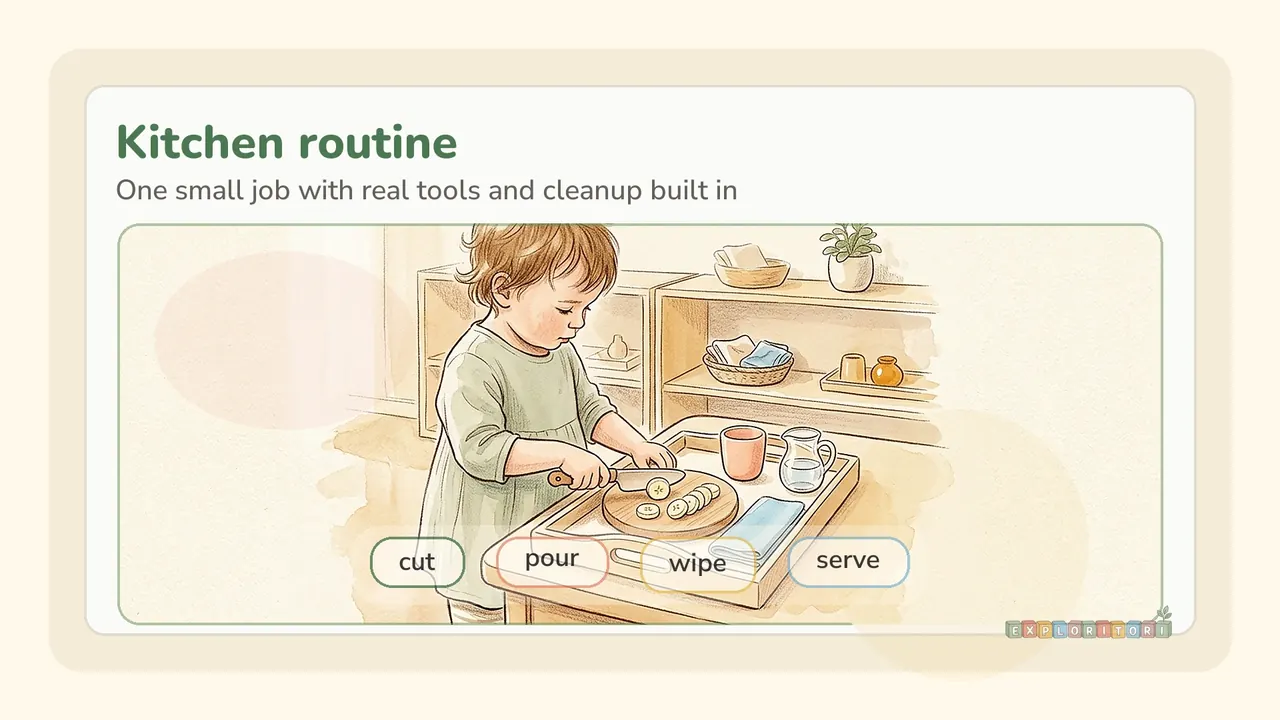
Montessori practical life is not a tray on a shelf pretending to be real work.
It is real work made small enough for a child.
For toddlers, that means washing hands, wiping spills, carrying socks to the laundry basket, pouring water, setting out napkins, putting shoes in the same place, and helping with snack.
These routines look ordinary. That is exactly why they work.
Toddlers want to belong to the life of the home. Practical life gives them a way in.
This guide is about building Montessori practical life routines that survive real mornings, real meals, real mess, and real tired parents.
Safety note: Practical life activities still need supervision. Adapt all kitchen, bathroom, dressing, water, glass, food, and cleaning routines to your child’s age, development, and safety needs.
Choose one routine to start this week
Do not start with the routine that sounds most impressive. Start where the day already creates a small, repeatable need.
| If this part of the day feels hardest | Start with this one job | Set up before your child arrives | Make it easier if it fails | Helpful next read |
|---|---|---|---|---|
| Getting dressed takes forever | Put pyjamas in the basket | Basket beside the bed; choose two outfits the night before | You hold the basket; they put in one item | Toddler dressing skills |
| Meals create lots of adult-only work | Carry napkins or wipe one place | Napkins and a small cloth at child height | Give one napkin, not a full place setting | Montessori kitchen activities |
| Spills turn into a stand-off | Fetch and use a small cloth | Keep one folded cloth where spills happen | Cover the spill with the cloth together, then let them press | Water practical-life activities |
| Leaving home is chaotic | Bring shoes to one mat | Mat, shoes, and hat in the same visible spot | Ask for one shoe first | Montessori routine cards |
| Bedtime gets more stimulating, not calmer | Put clothes in the basket | Basket and book basket beside the bed | Offer one book and do the clothing job together | Montessori floor bed guide |
A useful rule: choose a task with a visible finish. A basket receives pyjamas; a cloth covers a spill; shoes reach the mat. That clear ending matters more than completing a whole grown-up sequence.
The practical life rule: one real job
The easiest mistake is giving a toddler a whole routine and expecting independence.
“Get dressed, brush your teeth, put your shoes on, and come to the door” is not one job. It is a chain of hard jobs.
Start with one real job:
- put pyjamas in the basket
- carry one plate
- wipe one spill
- choose between two shirts
- put shoes on the mat
- pour a tiny amount of water
One job done daily becomes a routine. A routine repeated calmly becomes independence.
That is the Montessori rhythm.

If you want individual activity ideas before building a whole rhythm, start with our Montessori practical life activities guide and then choose one task to repeat daily.
Morning routine: reduce the number of decisions
Mornings are usually too rushed for big independence experiments. Keep the routine narrow.
Good toddler jobs:
- pull off pyjamas with help
- put pyjamas in the laundry basket
- choose between two outfits
- push arms into sleeves
- pull socks from a small basket
- carry a hairbrush to the bathroom
- put a sleep item back on the bed
The Montessori trick is preparing the environment before your child is expected to cooperate.
Try:
- two outfit choices, not an open wardrobe
- a low basket for dirty clothes
- a hook at child height
- shoes in the same place every day
- a mirror your child can see
- enough time for one small job
If your toddler struggles with clothing choice, make it smaller: “blue shirt or green shirt?” If that still creates drama, choose the clothes yourself and let them do one physical step.
Our Montessori toddler wardrobe guide has a fuller setup if mornings are a recurring pain point.
Bathroom routine: make the sequence visible
Bathroom routines are powerful because they repeat many times a day.
Start with handwashing.
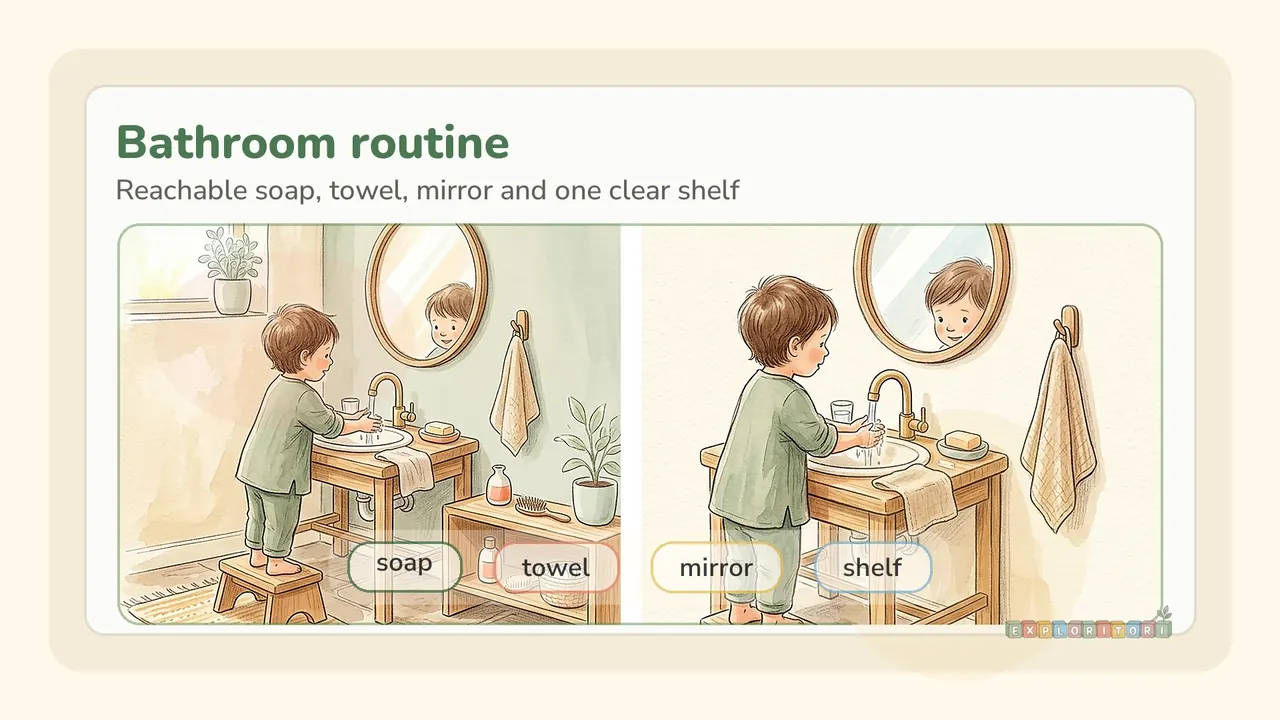
Your toddler needs:
- a stable step stool
- soap they can reach
- a towel at child height
- a clear place to stand
- adult supervision
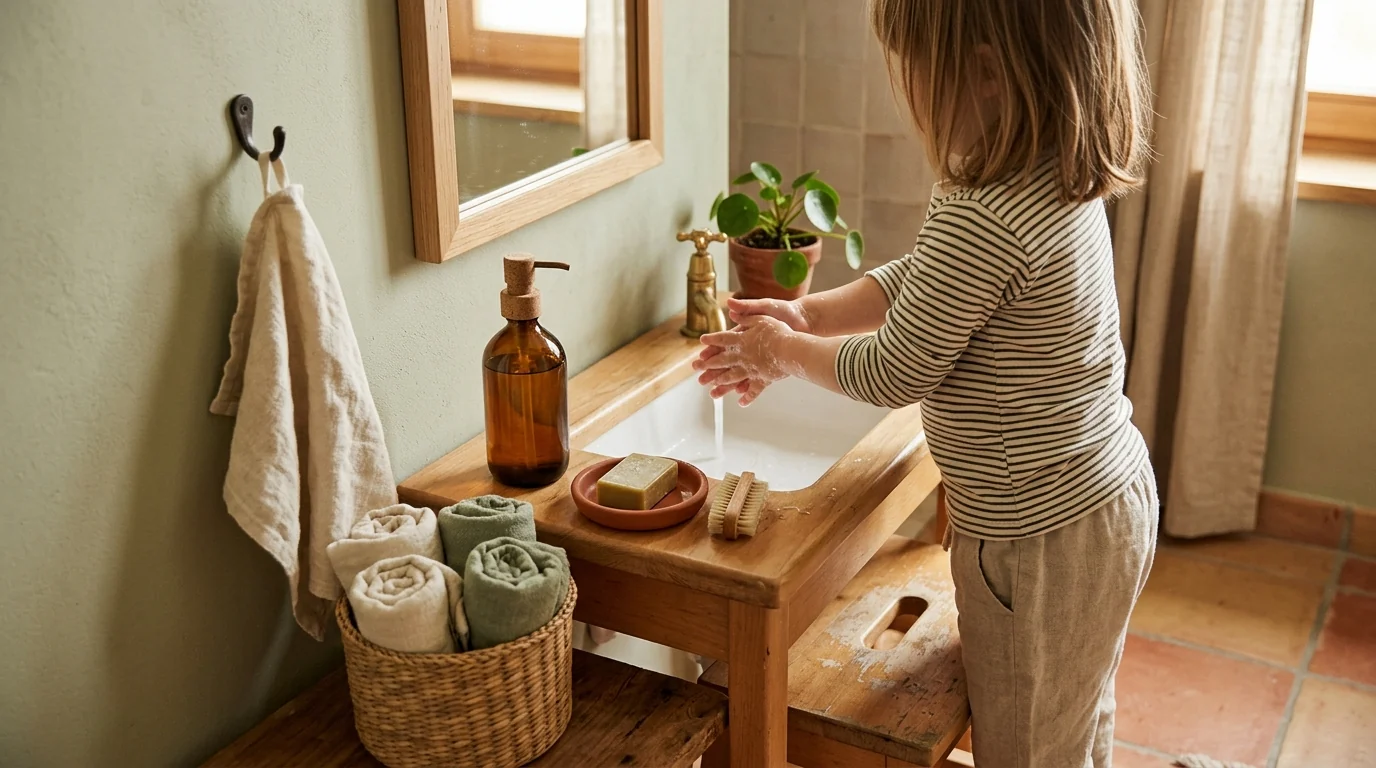
The sequence can be very simple:
- Turn on water with help.
- Wet hands.
- Add soap.
- Rub.
- Rinse.
- Turn off water with help.
- Dry hands.
You do not need to narrate every time. Show slowly, use the same order, and let the routine carry the work.
If your child is in the toilet-learning stage, our Montessori toilet learning guide explains how to prepare the bathroom without turning the process into a power struggle.
Meal routine: give the child a real role
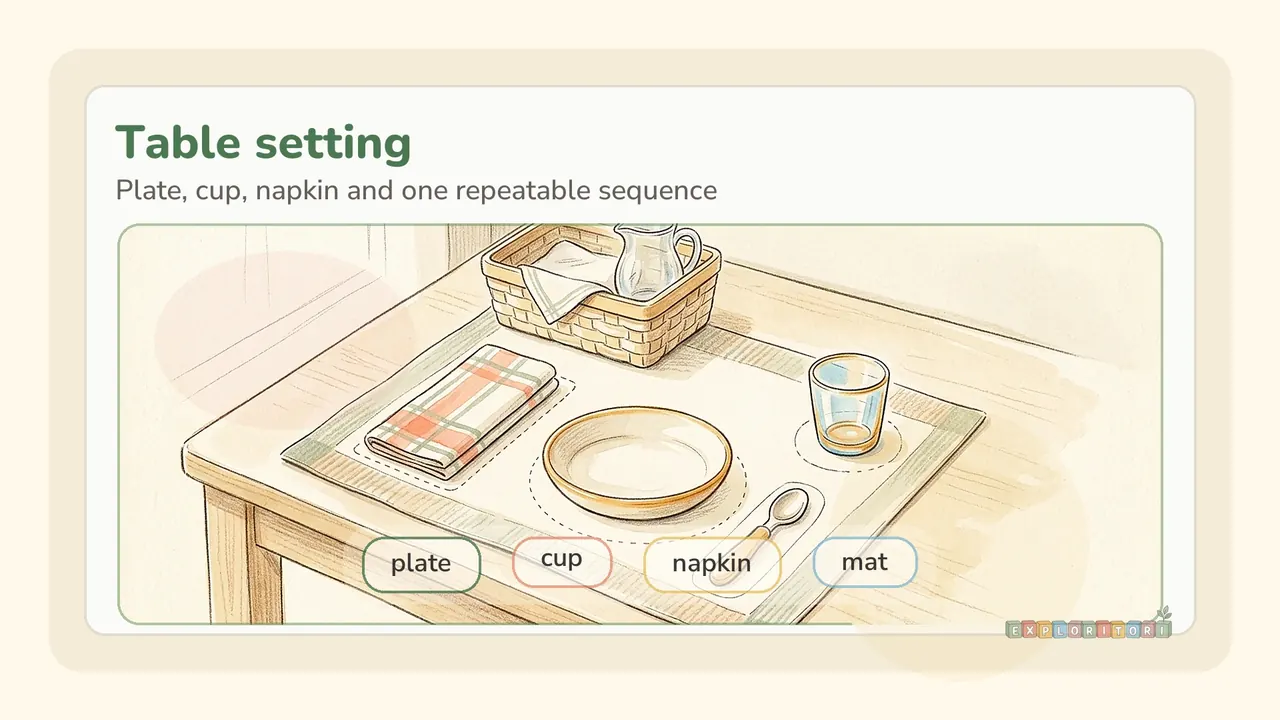
Meals are full of practical life opportunities.
Choose one or two toddler jobs:
- carry napkins
- put spoons on the table
- place a cup on a mat
- pour water from a tiny jug
- wash berries
- peel a banana
- spread soft cheese
- clear their own plate with help
- wipe the table after eating
The job should be useful. Toddlers can tell when they are being given busywork.
If you want a calm meal rhythm, keep the setup predictable:
- same drawer for napkins
- same low place for plates or cups
- same cloth for wiping
- same phrase to begin cleanup

For snack independence, our Montessori snack station guide gives a more detailed setup.
Cleanup routine: make returning easier than dumping
Cleanup works best when the environment is already organized.
A toddler cannot return work if every item has a vague home. “Clean up” is too abstract. “Blocks go in this basket” is much clearer.
Useful cleanup supports:
- one basket per activity
- low shelves
- picture labels if needed
- a small cloth for spills
- a child-size broom or hand brush
- fewer toys available at once
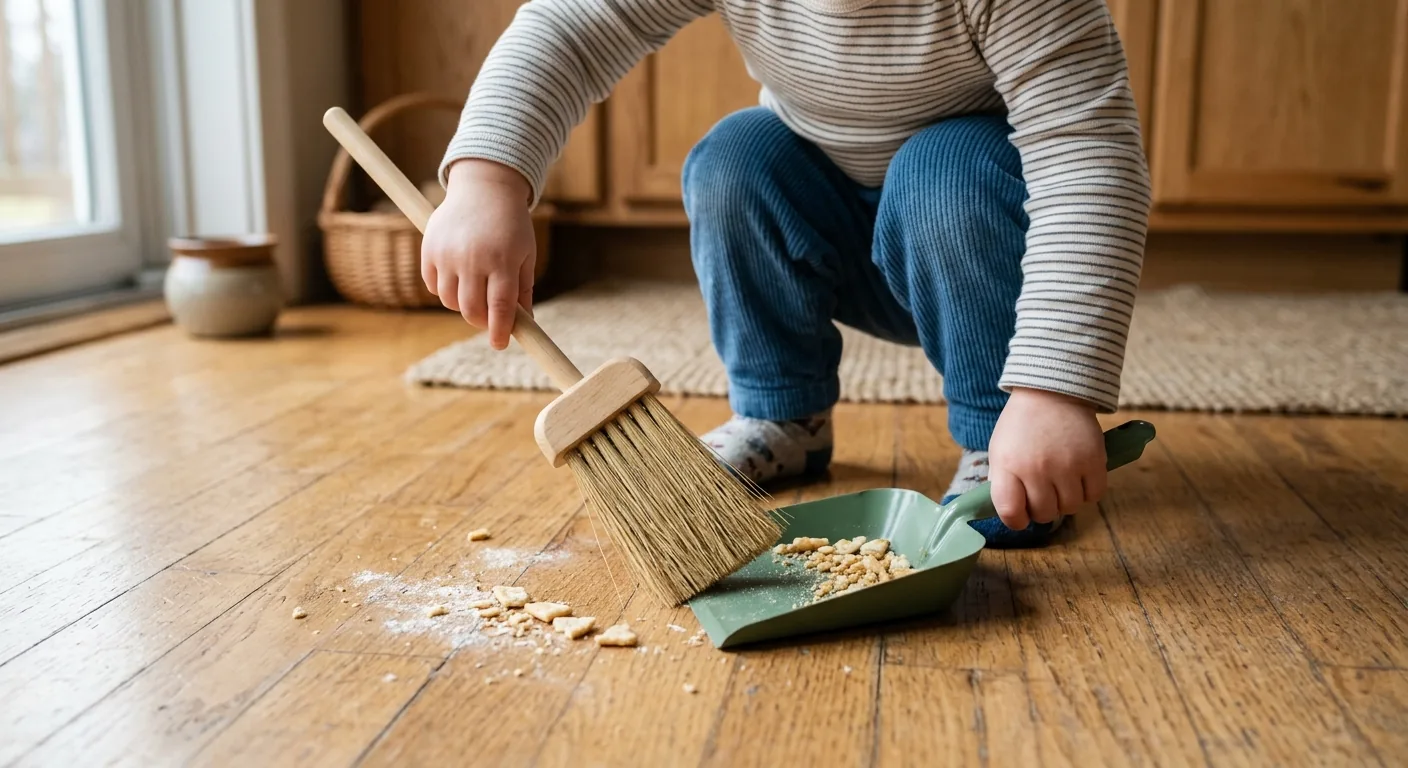
A child-size broom and a dustpan that sits flat are the cleaning supplies that make this routine real. The Montessori cleaning tools for toddlers guide shows what to buy first and what to leave on the shelf.
If cleanup always becomes a battle, the shelf probably has too much on it.
Pair cleanup with toy rotation. A small number of complete activities is much easier to return than a crowded room.
Do cleanup with your child at first. Montessori independence is not “go do it alone.” It is “I show you, we do it together, then you gradually take more of the work.”
Leaving-the-house routine: one launch pad
Leaving the house is where many toddler routines collapse because the adult is trying to manage everything at once.
Create one launch pad.
It can be a small mat, basket, shelf, or entryway corner.
Keep there:
- shoes
- socks if needed
- hat
- small bag
- coat hook
- wipeable cloth for muddy shoes
Your toddler’s job might be:
- bring shoes to the mat
- put hat in the basket
- sit on the same stool
- place coat on the hook after returning
- put shoes together when home
For Montessori homes in small flats, this is one of the highest-impact routines. A consistent entryway reduces the repeated “where are the shoes?” chaos.
Our IKEA Montessori hacks guide includes budget-friendly entryway and child-height setup ideas.
Bedtime routine: fewer steps, same order
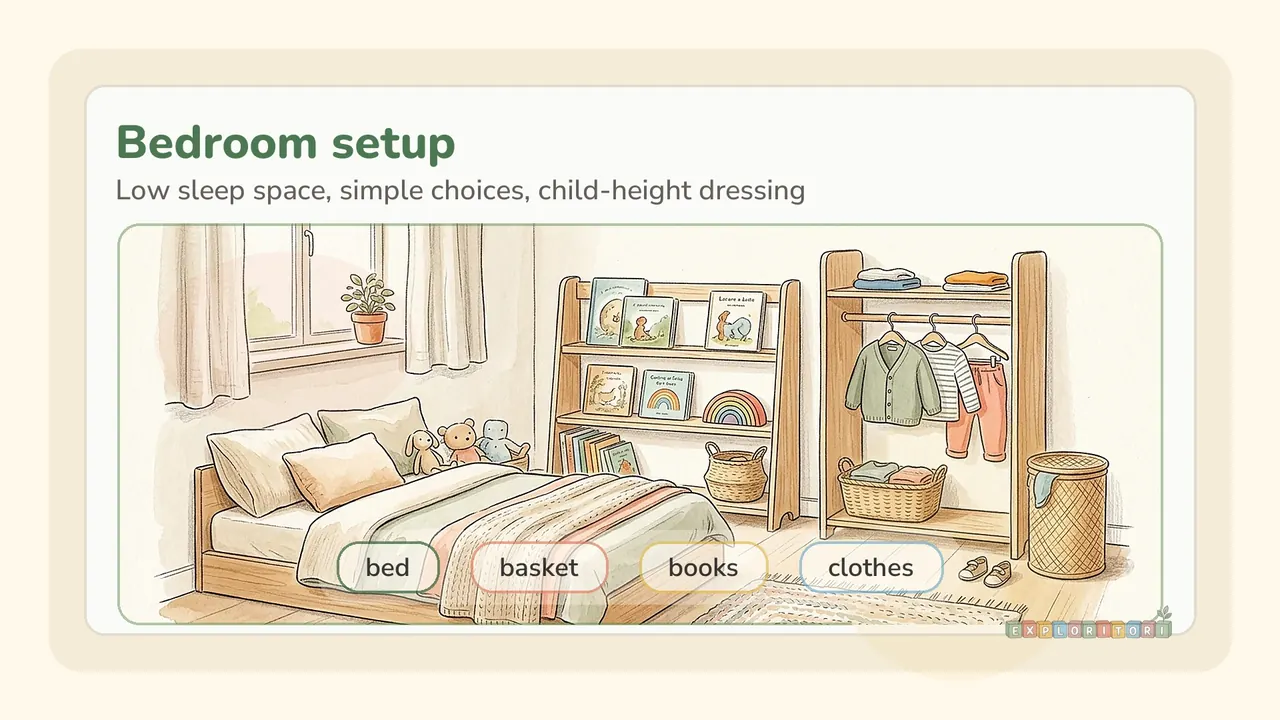
Bedtime works best when the order is boring.
That does not mean rigid. It means predictable.
Simple toddler jobs:
- put dirty clothes in basket
- choose one book from two options
- place slippers by the bed
- put water cup on a small table
- turn off a lamp with help
- return book to a basket
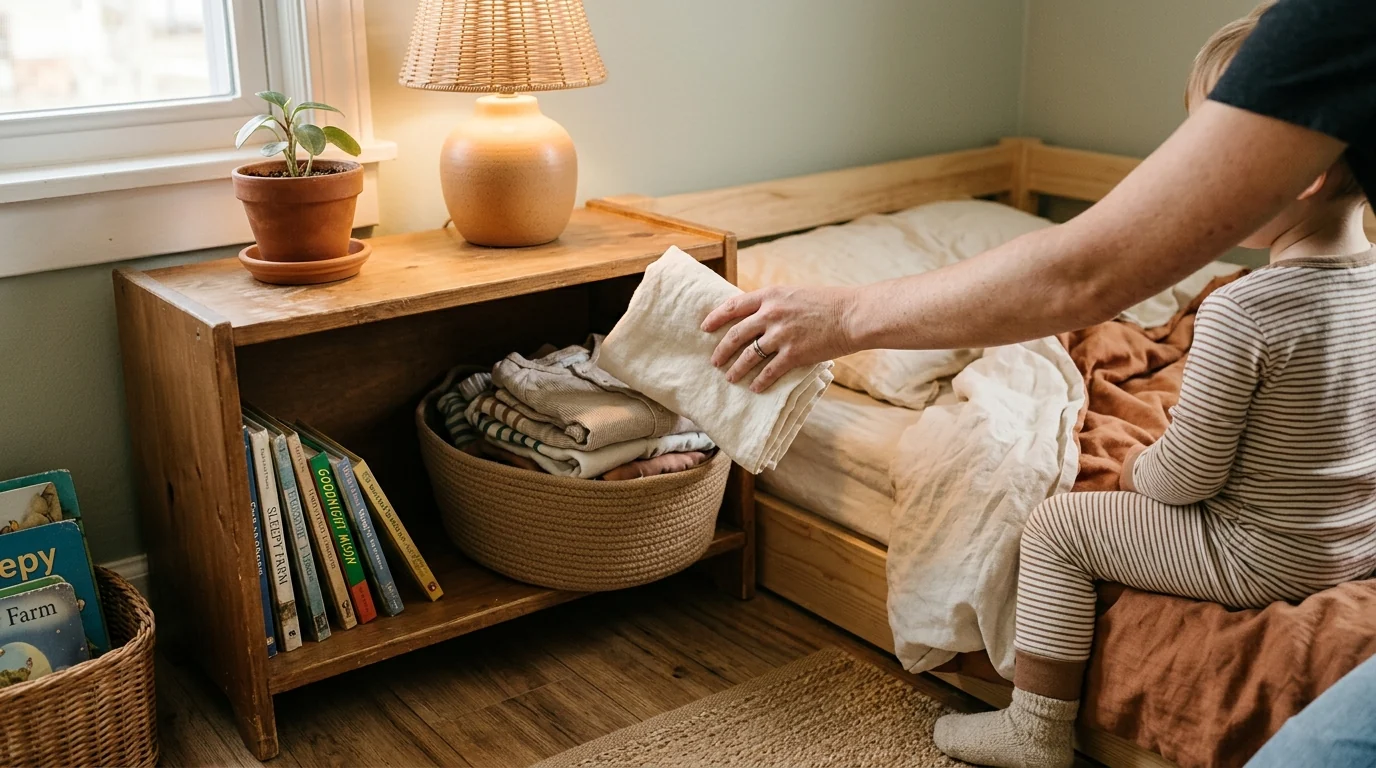
If bedtime is already difficult, do not add five new independence steps. Add one.
For example:
“After pyjamas, you put your clothes in the basket.”
Repeat until it becomes automatic. Then add another step.
A Montessori floor bed can support independence for some families, but the routine matters more than the furniture.
A practical life rhythm for the whole day
Here is a simple rhythm you can adapt.
| Time | Toddler job |
|---|---|
| Morning | Put pyjamas in basket |
| Breakfast | Carry napkins |
| Mid-morning | Wipe table after activity |
| Lunch | Pour a tiny amount of water |
| Afternoon | Put shoes on mat after walk |
| Dinner | Carry spoon or cup |
| Bedtime | Choose one book |
This is enough.
You do not need practical life in every spare moment. The point is not to turn your toddler into a tiny housekeeper. The point is belonging, coordination, independence, and respect.
A seven-day routine reset (without a chart on the fridge)
Use this small reset when a routine is technically in place but nobody is enjoying it. Keep the same job for the week; change the environment or your level of help, not the expectation every morning.
| Day | Adult move | Toddler-sized goal | Stop there when… |
|---|---|---|---|
| 1 | Watch the current routine without correcting | Notice the point where it becomes hard | You can name one obstacle: reach, choice, timing, or fatigue |
| 2 | Prepare one visible home for the job | Find the basket, mat, or cloth | The material is reachable without asking |
| 3 | Demonstrate slowly once | Watch or copy one movement | Your child has seen the beginning and end |
| 4 | Do it together | Complete one small step with you nearby | The task stays cooperative |
| 5 | Pause before helping | Attempt the same step | Waiting would create frustration, risk, or a rushed departure |
| 6 | Repeat in the same place and order | Recognise what comes next | The child begins before the prompt, even occasionally |
| 7 | Keep, shrink, or park the routine | Decide what is genuinely working | You have one routine worth repeating next week |
A routine that needs more adult help than expected is not a failed routine. It may simply need a lower hook, less water, fewer choices, or a time of day when nobody is racing the clock.
What to do when routines trigger tantrums
Sometimes a Montessori routine becomes a fight. That does not mean Montessori failed.
It usually means one of these things:
- the step is too big
- there are too many choices
- the adult is rushing
- the child is tired or hungry
- the routine changed without warning
- the child wants connection before cooperation
Make the job smaller.
Instead of “get dressed,” try “push one arm through.”
Instead of “clean the playroom,” try “put these three blocks in this basket.”
Instead of “choose your snack,” try “banana or crackers?”
Our Montessori toddler tantrums guide goes deeper on responding without turning every routine into a negotiation.
Useful materials, but not too many
You do not need a huge practical-life kit.
Useful basics:
- small cloths
- low basket
- child-height hook
- tiny pitcher
- stable step stool
- tray with handles
- child-safe spreader
- small broom or hand brush
If you add shelf-friendly materials alongside real household work, keep them optional and limited. A puzzle, sorter, or stacker can support fine motor work, but they are not the routine.
Practical life should not become shopping.
The most important materials are already in your home.
How we assess practical-life routines
We favour tasks that are real, repeatable, and adjustable in an ordinary home: a child can see the purpose, reach the materials with appropriate support, and participate without needing a specialist kit. We cross-check ideas against Montessori practical-life principles and child-development safety basics, then stress-test them against everyday constraints such as rushed mornings, mess, shared kitchens, and small spaces.
This is general parenting guidance, not a developmental or medical assessment. Supervise water, food preparation, climbing, glass, cleaning products, and anything that may be unsafe for your child. Exploritori may use affiliate links where products are mentioned, but this guide deliberately starts with household materials rather than shopping recommendations.
FAQ
What is a Montessori practical life routine?
A Montessori practical life routine is an everyday family task made accessible to the child, such as dressing, wiping spills, preparing snack, washing hands, setting the table, or putting shoes away.
How do I start Montessori routines with a toddler?
Start with one predictable routine and one small job your toddler can do successfully. Make the materials accessible, show the steps slowly, and repeat the same rhythm daily.
What practical life skills can a two-year-old do?
Many two-year-olds can wipe spills, put laundry in a basket, carry napkins, peel a banana, pour a small amount of water, wash hands with help, put shoes on a low shelf, and choose between two outfits.
Are Montessori routines strict?
No. A Montessori routine should create calm and independence, not pressure. The rhythm should be predictable enough to help the child participate but flexible enough for real family life.
What if my toddler refuses the routine?
Make the job smaller, reduce choices, slow down, or offer connection first. Refusal often means the task is too hard, the adult is rushing, or the child needs help returning to the rhythm.
The bottom line
Montessori practical life routines work because they make everyday life accessible.
Give your toddler one real job. Put the materials where they can use them. Show the steps slowly. Repeat the same rhythm. Let the work be allowed to look human.
That is how independence grows.
Not from a flawless routine chart.
From a child who knows where the cloth is, wipes the spill, and feels like they belong.
 Get weekly Montessori tips
Honest reviews, activity ideas, and budget-friendly picks — no spam, just what works.
Subscribe Free