Montessori Activities for 21-24 Months: 12 Calm Ideas, Shelf Plan, and Troubleshooting
· Updated

If 18 months felt like pure exploration, 21 to 24 months feels more intentional.
Your toddler still wants movement and mess, but now there is a stronger pull toward doing things properly. They want to carry the tray without spilling. They want to match the right object to the right place. They want to wipe the table because you wiped the table.
That is why this age is so satisfying.
You can offer more challenge than you could a few months ago, but you still do not need a complicated setup. In fact, the best Montessori activities for 21-24 months are usually simple, repeatable, and very grounded in real life.
This stage sits right between our 12-18 month activity ideas, 18-month activity ideas, and our 24-30 month guide. If your child is in that in-between window where baby work feels too easy but many “2-year-old activities” still feel a bit much, this is the sweet spot.
Choose by age: if this guide is too simple, try 24-30 month Montessori activities or the more sequenced 30-36 month activity guide. If it feels too hard, step back to 18-month activity ideas. For a broader preschool bridge, use the 3-year-old Montessori activity guide.
Want to plan the week instead of picking randomly? Use the printable weekly shelf rotation planner after you choose 3-5 activities from this page. If practical life is the main interest, the 12-week practical life lesson plan gives the same pouring, wiping, transferring, and care work a longer sequence.
🌱 Why 21-24 Months Is Its Own Stage
This is a small age band, but it matters.
At 21-24 months, many toddlers are doing something interesting at the same time:
- they still need simple, concrete work
- they can handle a bit more precision than before
- they want more independence in everyday routines
- they often care more about order and repetition
- they can stay with a clear task longer than they could at 18 months
That means you do not need to leap straight into preschool-style activities.
You just need to make the work slightly more exact.
Instead of random scooping, you offer pouring with a real pitcher. Instead of general toy play, you offer one tray with one clear purpose. Instead of a huge pile of options, you offer a few calm choices your child can understand at a glance.
Takeaway: this age does best with simple work that feels real, not flashy work that looks impressive.
✅ Quick Readiness Check for 21-24 Month Activities
Use this table to decide whether to simplify, offer the activity as written, or make it more precise.
| What you see | What it usually means | What to offer next |
|---|---|---|
| Your child dumps every tray within a minute | The setup is too busy or the work cycle is unclear | Put out 2-3 choices, use fewer pieces, and model one tray slowly |
| They repeat one motion over and over | The activity is meeting a real need | Leave it out for several days before rotating |
| They ask to help with washing, snack, or laundry | Practical life is ready | Offer wiping, banana slicing, sock matching, or watering plants |
| They get angry when a lid, puzzle, or pour fails | The challenge is close but slightly too hard | Loosen lids, use wider openings, reduce water, or choose chunkier pieces |
| They carry items carefully from room to room | The full Montessori work cycle is emerging | Practice tray carrying from shelf to table and back |
Takeaway: readiness is not about age labels alone. Watch the hands, the repetition, and the frustration level.
🧺 How to Set Up Activities Without Overdoing It
Before the activity list, one important thing: do less.
For 21-24 months, three to five choices on a low shelf is plenty. More than that can create that familiar toddler chaos where everything comes out and nothing really gets used.
A balanced setup at this age might include:
- one practical life activity
- one fine motor or hand-strength activity
- one language or matching activity
- one puzzle or posting activity
- one movement or care task somewhere else in the room or kitchen
Presentation matters here. A tray helps your child see the beginning and end of the work. A small basket makes the choice feel readable. A cloth or sponge turns spills into part of the routine instead of a disaster.
If you want a few tools that genuinely help, a set of small wooden trays makes shelf work easier because each activity has its own clear boundary. And if your child loves joining you at the counter, a simple toddler learning tower or a sturdier Guidecraft Kitchen Helper can unlock more real practical life than almost any toy purchase.
If your shelf still feels messy, our Montessori shelf setup guide will help you simplify it.
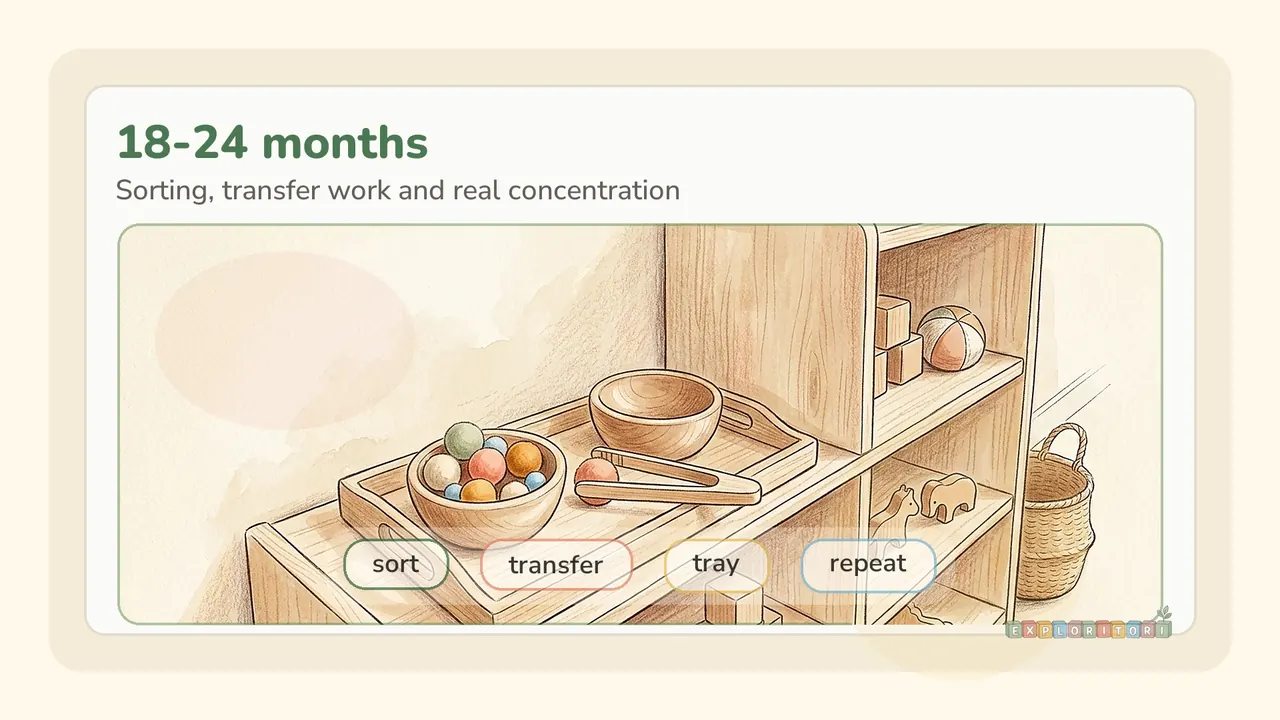
Takeaway: the secret is not more activities. It is fewer activities, presented more clearly.
🗓️ A Simple 5-Day Shelf Rhythm
You do not need a new shelf every morning. For this age, a small rhythm is easier to maintain and easier for your toddler to understand.
| Day | Keep visible | Tiny change to make |
|---|---|---|
| Monday | Pouring, puzzle, sock matching, wiping cloth | Model each activity once and stop talking after the invitation |
| Tuesday | Same shelf | Add a cloth next to pouring so cleanup is expected, not dramatic |
| Wednesday | Same shelf | Swap only one item: object-picture matching replaces sock matching |
| Thursday | Same shelf | Make one activity slightly harder, such as pouring to a tape line |
| Friday | Same shelf | Watch what gets repeated and use that to plan next week |
This rhythm pairs well with the broader Montessori toy rotation guide if your shelves tend to drift into clutter.
If you want this as a quick paper plan, print the weekly shelf rotation planner and copy only the Monday-Friday shelf choices from the table above. Keep one practical-life tray, one matching or language tray, one puzzle or posting work, and one familiar easy win. That is enough for most 21-24 month olds.
Takeaway: rotate less than you think. Observation beats novelty.
✋ 12 Montessori Activities for 21-24 Months
1. Pouring Water from Pitcher to Glass
This is one of the best activities for this age because it feels serious.
Put a small pitcher with a little water on a tray next to an empty glass. Show your child how to hold the handle, pour slowly, stop, and wipe any spills with a cloth.
This is harder than early spoon transferring, but still very achievable. It also gives immediate feedback. Too fast, and the water spills. Slower hands work better.
Setup reality: start with 2-3 tablespoons of water, not a full pitcher. If the tray floods every time, the activity is telling you the pitcher is too heavy, the cup opening is too narrow, or the pour line is too ambitious.

What it builds: coordination, wrist control, concentration, independence.
Make it easier: use very little water and a wider cup.
Make it harder: pour to a fill line marked with tape.
Takeaway: cleanup is part of the lesson, not proof the activity went wrong.
2. Matching Real Objects to Pictures
This is a lovely bridge between concrete objects and early symbolic thinking.
Print or draw a few simple picture cards and match them with real objects from your home: spoon to spoon, brush to brush, cup to cup, toy animal to picture of that animal.
At 21-24 months, many toddlers love the feeling of getting a match exactly right. It is language work, visual work, and order-making work all at once.
If you want a ready-made support material, the Melissa & Doug Farm Animals Jumbo Knob Puzzle pulls double duty here because it gives you both sturdy animal pieces and easy vocabulary prompts.
What it builds: vocabulary, visual discrimination, concentration, early abstraction.
Takeaway: use familiar objects first. Recognition comes before novelty.
3. Opening and Closing Basket
Gather three or four containers with different closures: a screw-top jar, a snap container, a zip pouch, a box with a lid.
Put one interesting safe object inside each. Your child opens the container, sees what is inside, and closes it again.
This sounds almost too simple, but toddlers take it very seriously. The hand work is real. Each closure asks for a different movement, and that is exactly the point.
What it builds: finger strength, wrist rotation, persistence, problem-solving.
Make it easier: loosen lids slightly before presenting them.
Takeaway: variety matters more than quantity here. Three good containers beat a giant random basket.
4. Banana Slicing or Soft Food Prep
Food preparation is gold at this age.
Offer a banana, peeled boiled egg, soft strawberry, or cucumber with a child-safe knife. Show your child how to hold the food still with one hand and cut with the other.
The magic is not just the cutting. It is the fact that the work leads to something real. Your child made snack. That feels important, because it is.
A Guidecraft Kitchen Helper is especially useful here if counter access is the thing blocking daily participation.
Setup reality: place only one food, one tool, and one small plate in front of your child. Too many pieces turns food prep into tray clearing. For more kitchen-specific setup ideas, use the Montessori learning tower guide alongside this activity.
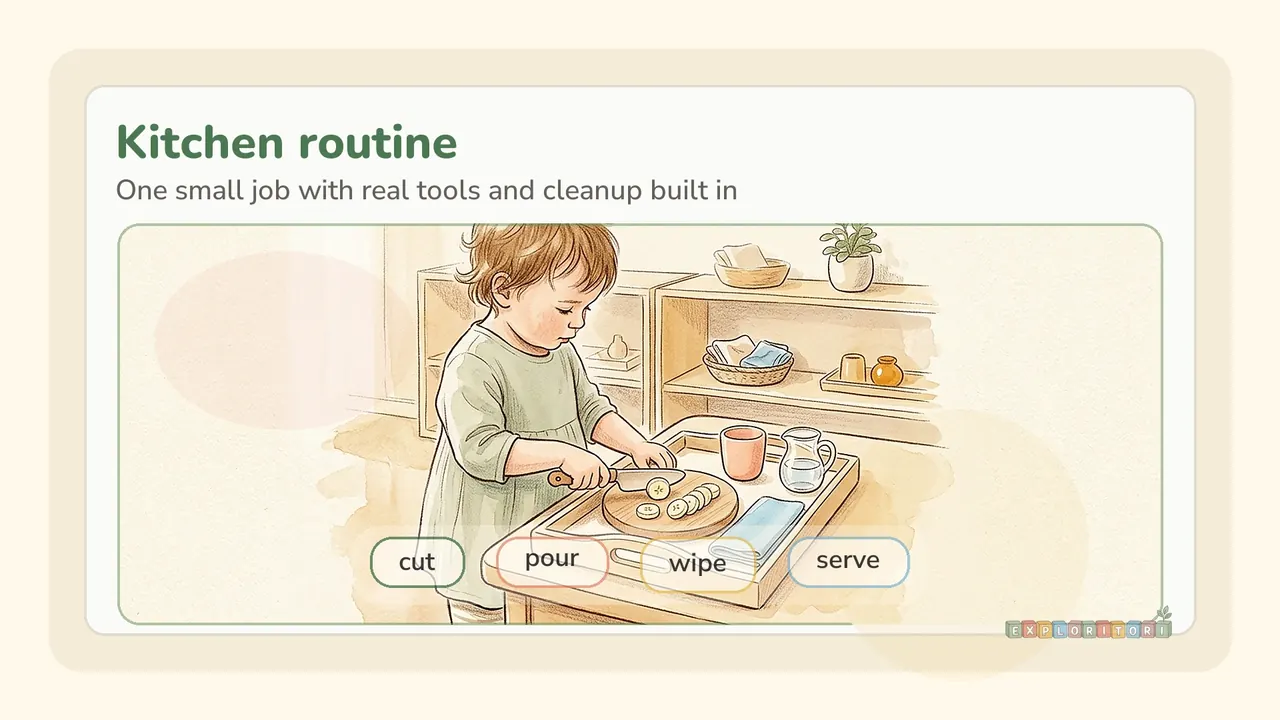
What it builds: bilateral coordination, hand control, sequencing, confidence, participation in family life.
Takeaway: toddlers work longer when the result actually matters.
5. Sock Matching from Real Laundry
This is wonderfully ordinary, and that is why it works.
Take three or four pairs of clearly different socks. Mix them in a basket and invite your child to find the matching pairs. Start with easy contrasts. Red and blue. Stripes and plain. Big differences win first.
This activity feels like a game to you, but it feels like meaningful order-making to your child.
What it builds: matching, attention to detail, visual discrimination, household participation.
Make it harder: use more similar colours or patterns.
Takeaway: real chores often make better Montessori work than “educational” toys.
6. Simple Puzzle Work
This is a great puzzle age, as long as the puzzle is not trying to prove anything.
Go for simple inset or chunky-piece puzzles with clear images and just enough challenge. The goal is concentration, not frustration.
The Melissa & Doug Farm Animals Jumbo Knob Puzzle is still one of the easiest solid options at this stage. If your child is ready for shape-based problem solving, the Melissa & Doug Shape Sorting Cube adds a nice control-of-error element too.
What it builds: visual-motor coordination, spatial reasoning, confidence, persistence.
Takeaway: rotate puzzles when they feel stale, not just because your child mastered them.
7. Table Wiping with a Small Cloth
Give your toddler a small sponge or cloth and a low table. Spray a little water yourself or let them help with one gentle spray, then show how to wipe from one side to the other.
Children this age often love cleaning because it is visible and grown-up. You are not inventing fake work for them. You are letting them join real life.
This is also one of the easiest ways to support independence without buying anything new.
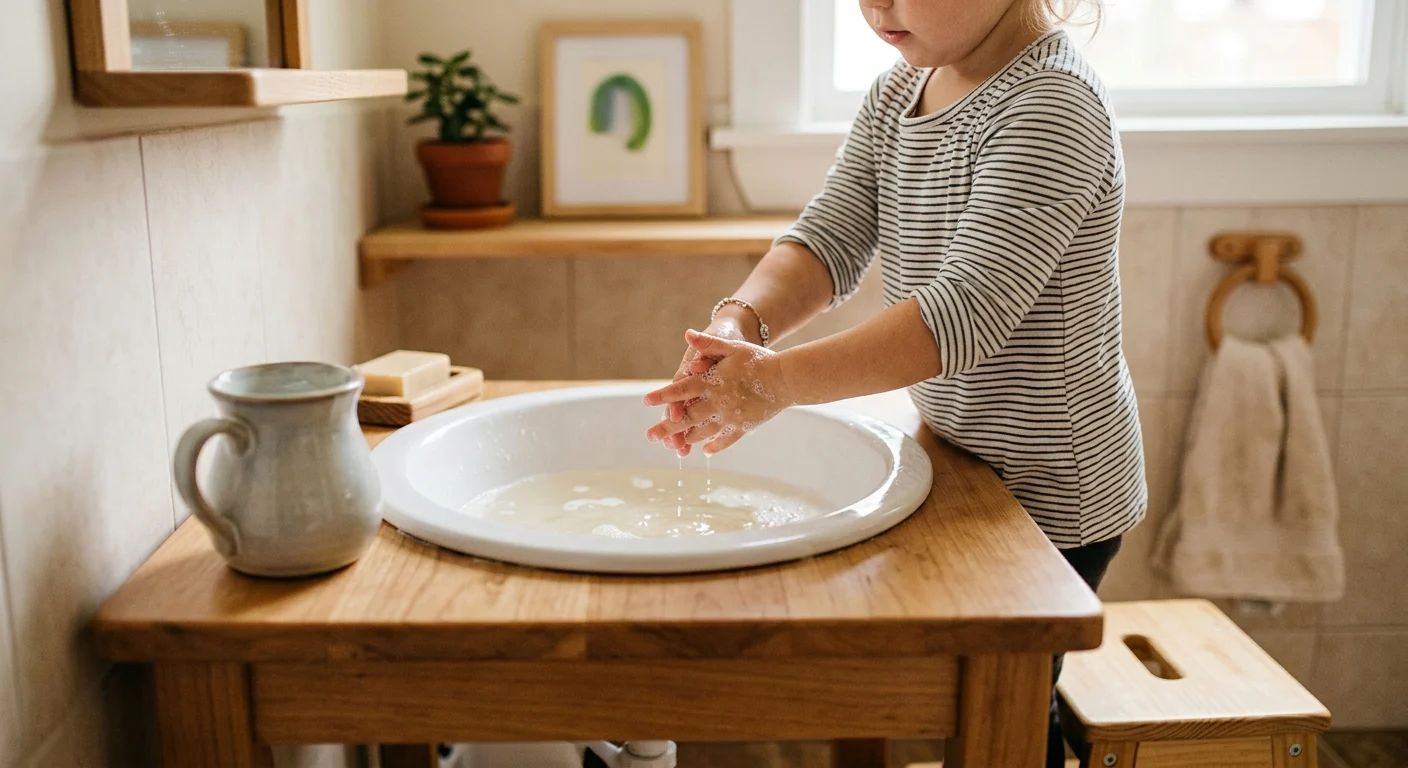
If your child loves this kind of work, the bigger Montessori practical life activities guide gives you more care-of-self and care-of-home ideas.
What it builds: hand strength, coordination, left-to-right movement, responsibility.
Takeaway: a short real task usually works better than a long pretend one.
8. Posting Work with Slightly More Precision
Posting work still belongs here, but now you can make it a bit more exact.
Try oversized tokens into a coin slot, craft sticks into a slit, or large buttons into a narrow opening. The challenge should ask for control, not guesswork.
If you want a sturdy classic version of this kind of hand-and-eye problem solving, the Melissa & Doug Shape Sorting Cube works well because the shapes give immediate feedback.
What it builds: hand-eye coordination, problem-solving, visual discrimination, persistence.
Takeaway: increase precision gradually. Do not jump from easy success to fiddly frustration.
9. Watering Plants
This age loves caring work.
Put a small amount of water in a child-sized watering can and show your child how to water one plant slowly, then stop. Keep a small cloth nearby for drips.
A Green Toys watering can is a nice size for small hands and tends to get used for much longer than one-stage novelty toys.
This is one of those Montessori activities that does not look fancy in photos but feels extremely meaningful in real life.

What it builds: control, gentleness, care, routine, connection to the environment.
Takeaway: one living thing to care for can do more than a whole shelf of random materials.
10. Simple Category Sorting
Offer a small mixed set to sort into two bowls or sections of a tray.
You might sort spoons and forks, red and blue counters, animals and vehicles, or wooden and metal objects. Keep the categories obvious at first.
At this age, sorting works best when the items are concrete and touchable. Abstract worksheets can wait.
What it builds: early maths thinking, classification, language, attention.
Make it easier: use fewer items and stronger visual differences.
Takeaway: if your child dumps the whole tray, simplify the categories before assuming they are “not interested.”
11. First Pouring to the Line
If basic pouring is going well, this is a nice next step.
Use a small glass or jug with a visible line marked using a little tape. Show your child how to pour just to that line, then stop.
This tiny adjustment changes the activity from simple transfer to measured control. It is still practical life, just with a little more precision.
A tray with a lip helps here. The Learning Resources serving tray is useful because it catches small spills without turning the whole thing into a puddle on your floor.
What it builds: control, focus, visual judgment, patience.
Takeaway: when you want to make an activity harder, add precision before adding complexity.
12. Carrying a Tray from Shelf to Table
This sounds almost too basic to count, but it absolutely counts.
Set up one complete activity on a tray and show your child how to carry it with two hands from the shelf to the table, then return it when finished.
This action is pure Montessori. It gives shape to the whole work cycle: choose, carry, do, tidy, return.
The small wooden trays are useful for exactly this reason. The tray is not decoration. It is the structure.
What it builds: coordination, order, care of the environment, independence.
Takeaway: sometimes the activity around the activity is the deeper lesson.
🏡 What to Buy, and What to Skip
This age can tempt you into buying too much.
You see one good toddler activity online, then another, then another, and suddenly you are halfway to building a tiny classroom in your living room.
You do not need that.
If I were keeping purchases lean for 21-24 months, I would prioritise:
- one good tray setup
- one way for your child to reach the kitchen safely
- one or two durable puzzle or sorting materials
- one child-sized tool for care work, like a watering can or cloth basket
That is enough.
A toddler learning tower, small wooden trays, the Melissa & Doug Farm Animals Jumbo Knob Puzzle, and a Green Toys watering can would cover a lot of ground without cluttering your house.
Skip giant toy bundles, noisy “learning systems,” and anything that does the action for your child.
If you are trying to keep your shelf calm, our guides to Montessori toy rotation and Montessori on a budget in small spaces can help.
Takeaway: buy tools that unlock real life, not toys that replace it.
💛 How to Know an Activity Is Working
A successful Montessori activity does not always look dramatic.
Sometimes success looks like:
- your child repeating the same motion five times
- a serious face and very slow hands
- a spill, then an attempt to wipe it
- carrying a tray carefully with both hands
- returning to the same puzzle every morning for a week
That is not boredom. That is construction.
At 21-24 months, repetition is one of the clearest signs that the activity is meeting a real developmental need. Try not to interrupt too quickly just because you are ready to move on.
And if something flops, do not over-interpret it.
Often the issue is simple:
- the activity was too hard
- the tray had too many pieces
- the timing was bad
- the tool was awkward for small hands
- the setup was less clear than it seemed
Small changes matter a lot at this age.
Takeaway: when an activity fails, simplify before you replace.
🔧 Troubleshooting Common Problems
| Problem | Likely cause | Better next move |
|---|---|---|
| The shelf gets emptied in five minutes | Too many choices or no clear work cycle | Keep only 2-3 activities out for a few days and model taking one tray at a time |
| Pouring becomes puddle play | Too much water or no cleanup role | Use a tiny amount of water and put the cloth on the tray from the start |
| Matching feels too easy | The objects are too familiar or too few | Add one more pair, use similar objects, or move from object-object to object-picture matching |
| Puzzle work causes instant frustration | Pieces are too small or the image is too busy | Return to chunky knobs, fewer pieces, or a puzzle with a clearer control of error |
| Your child refuses the tray but wants chores | The real-life task is more meaningful right now | Follow that interest with laundry, wiping, watering plants, or snack prep |
If the main problem is too much stuff, start with Montessori shelf ideas by age before buying anything new. If the main problem is daily rhythm, the Montessori routine cards guide can help make transitions more visible.
Takeaway: a failed activity is useful information. It tells you what to simplify.
How We Chose These Activities
This guide is built from review analysis of toddler Montessori materials, common home setup patterns, and the developmental fit between 18-month exploration and more structured 2-year-old practical life. We prioritise activities that use household materials, have a visible purpose, can be made easier or harder without buying a new toy, and give toddlers a real role in family life.
Product links are included only where a tool can make the setup easier, such as trays, a sturdy kitchen helper, a simple puzzle, or a child-sized watering can. You can still do most of this guide with bowls, cloths, food, socks, containers, and a low shelf.
If you are planning for a classroom, homeschool co-op, or a more formal weekly rhythm, use this article as the parent-facing activity bank and pair it with the printable shelf rotation planner or the practical life lesson plan. The printable resources give you the planning page; this guide gives you the age fit and home setup details.
Takeaway: the method is practical usefulness first, shopping second.
Frequently Asked Questions
What are the best Montessori activities for 21-24 months?
The best ones are practical, simple, and slightly more precise than early toddler work. Good examples include pouring water, matching objects to pictures, opening and closing containers, simple puzzles, watering plants, and food preparation.
How many activities should I offer at once?
Usually three to five is enough. More can feel exciting to adults, but it often feels noisy to toddlers.
Do I need special Montessori toys for this age?
No. Household materials do a lot of the heavy lifting. Bowls, trays, cloths, socks, pitchers, fruit, and containers are often more useful than specialty toys.
My toddler only wants to repeat one activity. Should I change it?
Usually no. Repetition is a good sign. If the activity is safe, purposeful, and still engaging, let it stay.
What comes after 21-24 month activities?
Once your child handles these with ease, you can move into more layered matching, stronger practical life tasks, beginner scissor work, tong transfers, and the fuller shelf work ideas in our 24-30 month Montessori activities guide. If that starts feeling too easy, the next step is the 30-36 month activity guide, where the work becomes more sequenced and preschool-like. If pouring, wiping, and sponge work are the current obsession, our Montessori water activities guide gives that practical-life work more structure.
 Get weekly Montessori tips
Honest reviews, activity ideas, and budget-friendly picks — no spam, just what works.
Subscribe Free