Montessori Activities for 3-Year-Olds: 15 Calm Ideas, Setup Tips, and Shelf Plan
· Updated

Three is a lovely Montessori age.
Your child is still playful and curious, but now there is often a stronger urge to do things properly. They want to pour the water themselves. They want to cut the banana themselves. They want to wipe the spill because they made it and they know it matters.
That changes what works at home.
The best Montessori activities for 3-year-olds are usually not the loudest or most complicated ones. They are the ones that feel real, clear, and just challenging enough. At this age, your child often wants a beginning, a middle, and an end. They want work they can understand and repeat.
That is why a tray with two pitchers can hold more attention than a toy with lights and buttons. A sponge, a small broom, a bowl of strawberries, or a sorting tray can feel powerful because your child is doing something meaningful with it. If your child wants more pouring, squeezing, and scrubbing, our Montessori water activities guide has a calmer progression.
Quick activity chooser
| What you are seeing at home | Start with | Why it fits |
|---|---|---|
| ”I do it myself” around meals | fruit cutting or snack prep | real purpose, clear finish, high motivation |
| Constant pouring, spilling, or bath-cup play | water pouring with a cloth | turns water interest into controlled practical life |
| Short attention span at the shelf | one familiar tray plus one new challenge | protects confidence while adding novelty |
| Big feelings after mistakes | table washing or plant care | mistakes become part of the work instead of failure |
| Strong counting or naming interest | counting bowls, sound games, or object-picture matching | adds language and math without worksheets |
| Dumping every basket | reduce to three choices and use larger materials | dumping often means too much choice or unclear work |
| Wanting to help with housework | sweeping, wiping, or laundry sorting | useful work usually lands better than pretend chores |
🌿 Why Montessori works so well at age 3
At 3, many children are more coordinated, more verbal, and more intentional than they were six months ago.
That usually means your child can:
-
follow a short sequence
-
carry a tray more carefully
-
notice when something is out of place
-
repeat an activity without constant prompting
-
enjoy work that feels useful instead of random

This is also the age when the phrase “I do it” becomes a daily soundtrack.
That is not a problem to manage. It is a clue.
Montessori works well here because it channels that drive toward real tasks your child can actually succeed with. Washing a table. Cutting a snack. Matching objects. Watering a plant. Folding a cloth. These are small jobs, but they feel serious to your child.
And that feeling matters.
When an activity helps your child feel capable, trusted, and useful, it usually lands better than something designed only to entertain them.
Takeaway: at 3, Montessori tends to work best when the activity is purposeful, repeatable, and just a little bit challenging.
Is your 3-year-old ready for these activities?
Age is a rough map. Readiness is the better guide.
Use this quick check before you set up a tray:
| Readiness sign | Good activities to try | Wait on or simplify |
|---|---|---|
| Carries a tray, cup, or bowl with some care | pouring, table washing, snack prep | full pitchers, fragile glass, long sequences |
| Wants to help with real jobs | wiping, sweeping, plant care, laundry sorting | pretend versions that feel like busywork |
| Can use both hands together | cutting strips, tong transfer, button practice | tiny beads, stiff scissors, tight fasteners |
| Notices categories or patterns | object sorting, picture matching, simple pattern work | abstract sorting with too many rules |
| Repeats a task after a spill or mistake | water work, spoon transfer, flower arranging | activities where adults have to rescue every step |
If your child is newly 3 and still prefers simpler work, step back to the 30-36 month Montessori activity guide or the 24-30 month activity guide. If your child is closer to 4 and wants more complex materials, pair this with the 3-4 year old Montessori toy and activity guide.
Takeaway: choose activities by what your child can carry, repeat, sort, clean up, and try again.
🧺 How to set up Montessori activities without turning your house into a classroom
Even a good activity will flop if your child cannot use it easily.
If every material lives in a giant toy bin, your child still depends on you to find things, explain them, and reset them. That friction adds up fast.
A better setup is much simpler:
- one activity per tray or basket
- complete and ready to use
- visible on a low shelf
- easy to carry
- easy to put back

You do not need a perfect Pinterest playroom.
You need enough order that your child can look at one tray and understand what it is, what belongs with it, and what finished looks like. That clarity is calming. It also makes repetition much more likely, and repetition is where a lot of Montessori growth happens.
If you want a few basics that actually help, I would start with practical tools instead of decorative materials:
- a low Montessori bookshelf so activities stay visible and reachable
- a set of small wooden trays so each activity has a clear boundary
- a simple learning tower or the sturdier Guidecraft Kitchen Helper if your child always wants to work at the counter
Those tools unlock a lot more real-life activity than another toy usually does.
If your broader setup still feels messy, our guides to How to Start Montessori at Home, Montessori shelf setup, and Montessori toy rotation can help you simplify it.
Takeaway: the prepared environment comes first. The activity works better when the setup is clear.
The five-minute setup test
Before you put an activity out, ask:
| Question | Good sign | Change if not |
|---|---|---|
| Can my child see what belongs on this tray? | every tool has an obvious place | remove extra pieces |
| Can they carry it safely? | tray is light and not overfilled | split into two smaller setups |
| Is there a clear finish? | bowl filled, table dry, flower arranged | add a basket, cloth, or return spot |
| Can cleanup be part of the work? | cloth, brush, or scrap bowl is included | add the cleanup tool before presenting |
| Can I step back after showing it once? | child can repeat the sequence | simplify the sequence |
This is the difference between a Montessori activity and a pile of nice materials. The activity should tell your child what to do next without constant adult narration.
👀 What makes a good Montessori activity at age 3
You do not need a shelf full of special Montessori materials to do this well.
A strong Montessori activity at this age usually has four things going for it:
- It is real. Your child is pouring, cutting, wiping, sorting, matching, or caring for something that makes sense.
- It has one clear job. A tray should not ask your child to do five things at once.
- It can be repeated. The activity feels satisfying enough to revisit tomorrow.
- It builds independence. Even tiny gains count.
This is why ordinary home objects often outperform expensive toy bundles. A small pitcher, a sponge, a child-safe knife, a watering can, or a button pouch can do more developmental work than a flashy “educational” toy.
If you are deciding whether to buy anything new, prioritize tools that unlock daily life. A child-safe knife set, a simple tray, and a safe way to reach the counter will usually get far more real use than another shelf filler.
Takeaway: the best Montessori activity is the one your child can understand, repeat, and increasingly own.
✂️ 15 Montessori activities for 3-year-olds that actually work
These activities work well at age 3 because they combine real purpose with repeatable challenge. You do not need all of them at once. Pick a few that match your child right now.
1. Pouring water between two pitchers
Put two small pitchers on a tray, one with a little water and one empty.
Show your child how to hold the handle, pour slowly, stop, and wipe drips with a cloth. Then step back and let them repeat.

Why it works: It builds wrist control, concentration, and care of the environment. If spills instantly become chaos, a tray with a lip like this serving tray helps contain the work.
Make it easier: use dry beans first, then move to a very small amount of water.
Make it harder: pour into a narrower glass or add a second cup to fill evenly.
2. Fruit cutting and snack prep
Many 3-year-olds are ready for simple supervised food prep.
Try slicing banana, strawberries, boiled egg, or soft cucumber with a Montessori kitchen knife set. Add a small board and let your child prepare part of their own snack.
Why it works: It combines practical life and fine motor work, has an obvious purpose, and builds confidence quickly. Few activities feel more meaningful than making your own food.
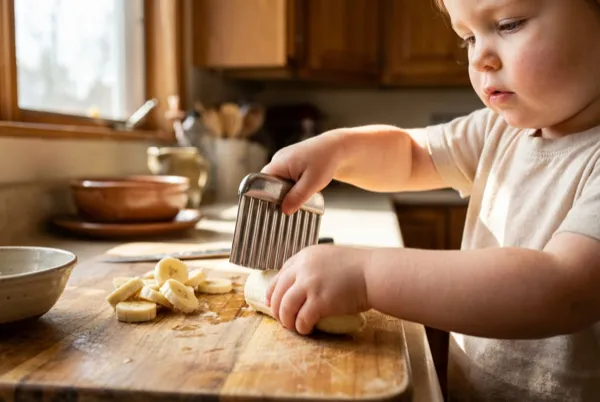
For more kitchen-specific progression, use the Montessori kitchen activities guide. If your child is ready for a small snack routine, the Montessori snack station guide is the next practical step.
3. Table washing
This is a Montessori classic because it is physical, orderly, and visibly effective.
Set out a small bowl of water, sponge, soap dish, scrub brush, and towel. Show the sequence slowly: wet, scrub, rinse, dry.
Why it works: It strengthens hands and arms, teaches sequence, and gives a very satisfying sense of completion.

If table washing becomes a favorite, keep one small cleaning basket nearby rather than scattering tools around the house. The Montessori cleaning tools guide explains when a broom, dustpan, cloth set, or small mop is actually worth adding.
4. Tong transfer with smaller objects
If transfer work felt easy at 2, make it more precise now.
Use child-sized tongs to move pom poms, felt balls, or large beads into an ice cube tray or muffin tin. If your child wants more challenge, sort by colour while transferring.
Why it works: It refines hand strength, develops precision, and creates a clear control of error. It looks tiny, but it often leads to serious focus.

For a child who loves this kind of precision, the fine motor activities guide gives you more ways to vary pouring, squeezing, threading, and transfer work without buying a new toy each week.
5. Cutting paper strips with spring scissors
Age 3 is a very good time for early scissor work.
Start with narrow paper strips and a small basket for scraps. Demonstrate how to hold the paper, open and close the scissors, and place the cut pieces into the basket when finished. Spring-open scissors like Fiskars Easy Action Kids Scissors make the first attempts much less frustrating.
Why it works: It builds bilateral coordination, strengthens the hands for later writing work, and gives a visible result your child can understand.
6. Spoon transfer with dry materials
Use two bowls, one spoon, and a dry material like lentils, chickpeas, or rice.
At 3, your child can usually pay more attention to neatness than a younger toddler can. Add a small cloth so cleanup becomes part of the work instead of an adult rescue mission.
Why it works: It improves steadiness and control, supports order and responsibility, and teaches that mistakes are manageable.
7. Buttoning or zipping practice
You do not need a formal dressing frame for this.
An old cardigan, apron, pouch, or shirt with large buttons works beautifully. Show one movement slowly, then let your child repeat without rushing.
Why it works: It supports self-dressing, builds patience and finger strength, and turns a frustrating life skill into calm practice.
8. Object sorting by category
At 3, sorting can move beyond simple colours.
Try sorting by category instead: animals and vehicles, kitchen tools and art tools, things from nature and things from indoors, buttons and beads.
Why it works: It strengthens early logic, supports vocabulary, and prepares the mind for later classification work.
9. Counting objects into bowls
Place number cards from 1 to 5 beside small bowls. Add buttons, pebbles, pom poms, or wooden counters.
Show your child how to place the correct number of objects into each bowl, touching each object as they count.
Why it works: It makes early math concrete, connects quantity to symbol, and builds one-to-one correspondence. At this age, hands-on counting matters more than performance.
10. Sound games with real objects
This is one of the easiest Montessori-style language activities to do at home.
Place a few real objects on a tray, like a ball, key, spoon, cup, or leaf. Pick one sound and ask, “Which one starts with bbbb?”
Why it works: It builds phonological awareness, supports later reading readiness, and feels playful instead of academic.
11. Matching objects to pictures
Print or draw simple picture cards and match them to real objects.
At 3, you can raise the challenge by using less obvious categories, more objects, or items from around the house instead of toy sets.
Why it works: It bridges real objects and symbolic representation, supports vocabulary, and strengthens visual discrimination.
12. Flower arranging
This looks fancy and is actually very simple.
Set out a small vase, a little water pitcher, child-safe scissors, and a few flowers or leafy stems. Show your child how to trim stems, pour water, and arrange them slowly.
Why it works: It blends beauty with practical life, strengthens precision, and lets your child contribute something lovely to the room.
13. Sweeping with a child-sized broom
Many 3-year-olds are desperate to sweep.
Give your child one clear target like paper scraps, dry rice, leaves near the door, or crumbs under the table. Show how to sweep into one small pile rather than chasing bits in circles.
Why it works: It supports coordination across the whole body, teaches responsibility after messy work, and channels the “I do it” instinct into something useful.
14. Simple pattern building
Lay out a short pattern with blocks, beads, stickers, or counters: red-blue-red-blue.
Invite your child to continue it. Later, move to more complex patterns like big-small-big-small or leaf-stone-leaf-stone.
Why it works: It develops early math thinking, strengthens observation and sequencing, and adds puzzle energy without overwhelm.
15. Plant care
Set up one small plant with a cloth, spray bottle, or tiny watering can.
Show your child how to check whether the soil is dry, water carefully, wipe a leaf, and return the tools when finished. A Green Toys watering can is a good size for small hands and tends to stay useful for a long time.
Why it works: It teaches gentleness and responsibility, creates a repeatable daily rhythm, and connects your child to a real living thing.

Takeaway: the best Montessori activities at 3 usually combine movement, order, and real purpose.
🔄 How to rotate activities without constant shelf churn
One of the easiest mistakes at this age is changing everything too fast.
Adults get bored before children do.
If your child keeps returning to pouring, matching, or sweeping, that does not mean the shelf needs a makeover. It means the work is working.
A simple rhythm is usually enough:
- keep six to ten choices visible
- rotate only one or two activities at a time
- leave favourites out longer than you think
- increase challenge slowly instead of replacing the whole tray
That last point matters. You do not always need a new activity. Sometimes you only need a slightly harder version:
- spoon transfer becomes tong transfer and other fine motor work
- matching three objects becomes matching five
- pouring beans becomes pouring water
- counting to three becomes counting to five
This preserves familiarity while still giving your child fresh work to master.
If your shelf feels stale, ask two questions before rotating:
- Is the activity truly ignored?
- Or is it still being used, just not by me?
Montessori at home gets easier when you stop performing shelf novelty for adults and start protecting concentration for your child.
Takeaway: rotate for genuine loss of interest, not because the shelf no longer looks new.
🚫 What usually does not work as well at this age
A 3-year-old can absolutely enjoy open-ended toys, pretend play, and messy art.
But if your goal is Montessori-style concentration and independence, a few things tend to backfire:
- shelves with too many choices
- activities with too many loose parts
- crafts that depend on adult correction
- work that is too easy and finished in ten seconds
- work that is too hard and immediately frustrating
If your child dumps the tray, ignores the shelf, or bounces away after thirty seconds, that does not automatically mean Montessori is not for them.
Usually one of three things is happening:
- the shelf is overloaded
- the activity is mismatched
- the setup still depends too much on adult help
Complicated does not mean better.
Most 3-year-olds do best with clear materials, a visible sequence, and a result they can understand.
Takeaway: calm, clear, purposeful work usually beats clever, complicated setups.
🪴 A simple shelf plan for a 3-year-old
You do not need to offer all fifteen ideas at once.
For most 3-year-olds, six to ten visible choices is plenty. A balanced shelf might include:
- one practical life activity
- one fine motor activity
- one language activity
- one early math activity
- one care-of-environment activity
- one familiar activity your child already knows well
That last one matters more than people think.
Not every shelf item needs to be new. Repetition is not a sign the shelf is failing. Repetition is often where the deepest work happens.
If you want a simple starter setup, I would prioritize:
- a low Montessori bookshelf
- a few small wooden trays
- a learning tower if kitchen participation is constant
- a Montessori knife set for supervised snack prep
- a watering can for plant care
That is enough to support a lot of real work without turning your home into a pretend classroom.
If your child enjoys age-labeled activity lists, you can also pair this post with our guides to Montessori activities for 18-month-olds, Montessori activities for 21-24 months, and Montessori activities for 24-30 months.
Takeaway: fewer, clearer choices almost always work better than a crowded shelf.
A simple first-week shelf plan
Use this as a starting point, then adjust based on what your child actually repeats.
| Day range | Keep out | Add or change | Watch for |
|---|---|---|---|
| Days 1-2 | one known favorite, one practical life tray, one fine motor tray | water pouring or snack prep | can they complete the work without constant rescue? |
| Days 3-4 | the favorite and whichever tray got repeated | one language or matching activity | are they naming, sorting, or matching with interest? |
| Days 5-7 | three to six total choices | one care-of-environment job like plant care or sweeping | does cleanup become part of the routine? |
If the shelf gets chaotic, remove choices before adding new ones. If one activity gets repeated every day, leave it alone. Repetition is the point.
Methodology and trust notes
This guide is based on Montessori practical-life and early-childhood principles, plus parent-facing setup patterns that are realistic in a home rather than a classroom. The recommendations favour activities with a clear purpose, visible sequence, built-in cleanup, and ordinary materials families can repeat without turning the house into a preschool shelf catalogue.
Product links are included only where a tool can make setup easier, such as trays, child-safe knives, shelves, or watering cans. You can do most of these activities with household items. Any kitchen, scissors, water, or plant-care activity should be supervised and adjusted for your child’s coordination, temperament, and safety needs.
💛 The real goal of Montessori activities at age 3
The point of Montessori activities for 3-year-olds is not to recreate a miniature classroom in your living room.
The point is to help your child feel capable, calm, trusted, useful, and increasingly independent.
That is why the best activities often look almost suspiciously simple. Pouring. Wiping. Cutting. Sorting. Matching. Watering.
To an adult, those can look small.
To your child, they are not small at all.
They are proof that they can do real things in the real world. And that is exactly the kind of confidence worth building at home.
If you only take one thing from this post, let it be this: you do not need more complexity. You need more opportunities for your child to do meaningful work well.
That usually looks quieter than people expect. But it is often where the biggest developmental leaps happen.
❓FAQ: Montessori activities for 3-year-olds
What are the best Montessori activities for a 3-year-old?
The best activities are calm, purposeful tasks your child can repeat independently. Good examples include pouring, snack prep, table washing, tong transfer, counting bowls, sound games, flower arranging, and plant care.
Do I need special Montessori toys for these activities?
No. A lot of the best work at this age uses ordinary household materials. A tray, pitcher, sponge, child-safe knife, small broom, and watering can will usually take you further than a shelf full of specialist toys.
How many Montessori activities should I put out at once?
Six to ten visible choices is usually enough. Too many options can make the shelf feel noisy and harder to use well.
How long should a 3-year-old do Montessori activities?
Follow concentration rather than forcing a timer. Some activities last three minutes. Others hold attention much longer when the challenge is a good match.
What skills should Montessori activities build at age 3?
At this age, the big goals are independence, coordination, sequencing, vocabulary, early math understanding, care of the environment, and concentration.
 Get weekly Montessori tips
Honest reviews, activity ideas, and budget-friendly picks — no spam, just what works.
Subscribe Free