Montessori Terms Parents Should Know: Plain-English Guide
· Updated

Montessori can feel strangely hard to read at first.
You start with a simple question like “How do I set up a shelf for my toddler?” and five minutes later you are staring at phrases like prepared environment, work cycle, normalization, and control of error as if you accidentally opened a philosophy textbook.
That is not your fault.
A lot of Montessori language is useful. It is also very easy to make it sound more mysterious than it really is.
So let’s make it practical.
This glossary is for parents who want the plain-English version. Not the academic version. Not the aesthetic version. The version that helps you understand what the words mean, why they matter, and what they actually look like in your home.
Quick translation: term to next step
| If you hear… | Think of it as… | Try this today |
|---|---|---|
| Prepared environment | A space your child can read and use | Put one everyday item within reach and give it a clear home. |
| Sensitive period | A skill or interest your child is practising intensely | Offer a safe repeatable version rather than rushing them on. |
| Practical life | A real contribution to family life | Invite your child to pour, wipe, carry, or help prepare snack. |
| Freedom within limits | A genuine choice inside a clear boundary | Offer two acceptable activities, then name the safety or cleanup limit. |
| Control of error | Feedback built into the task, not constant correction from you | Use a tray, small pitcher, or fitted puzzle and pause before stepping in. |
A useful rule: pick one row, keep it available for a week, and watch whether your child returns to it. A calm repeat is more valuable than a new activity every day.
Why Montessori terms matter at all
The point of Montessori vocabulary is not to make you sound impressive on Instagram.
The point is to help you notice what your child needs.
When a Montessori term is useful, it usually points to one of three things:
- how your child learns
- how you set up the environment
- how you respond as the adult
That is it.
If a term does not help you do one of those things better, you do not need to treat it like sacred knowledge.
For example, prepared environment is not really a decorating phrase. It is a question: can your child use this space with more independence?
Work cycle is not just classroom jargon. It is a reminder that children need time to choose, do, repeat, and put away their work without constant interruption.
Sensitive periods is not a mystical phase. It is a practical clue that your child may be unusually drawn to order, language, movement, or tiny details right now.
Takeaway: Montessori terms matter when they make your home and your parenting easier to understand.
11 Montessori terms parents should actually know
You do not need a hundred words.
These are the ones worth keeping.
1. Prepared environment
A prepared environment is a space arranged for your child’s size, stage, and independence.
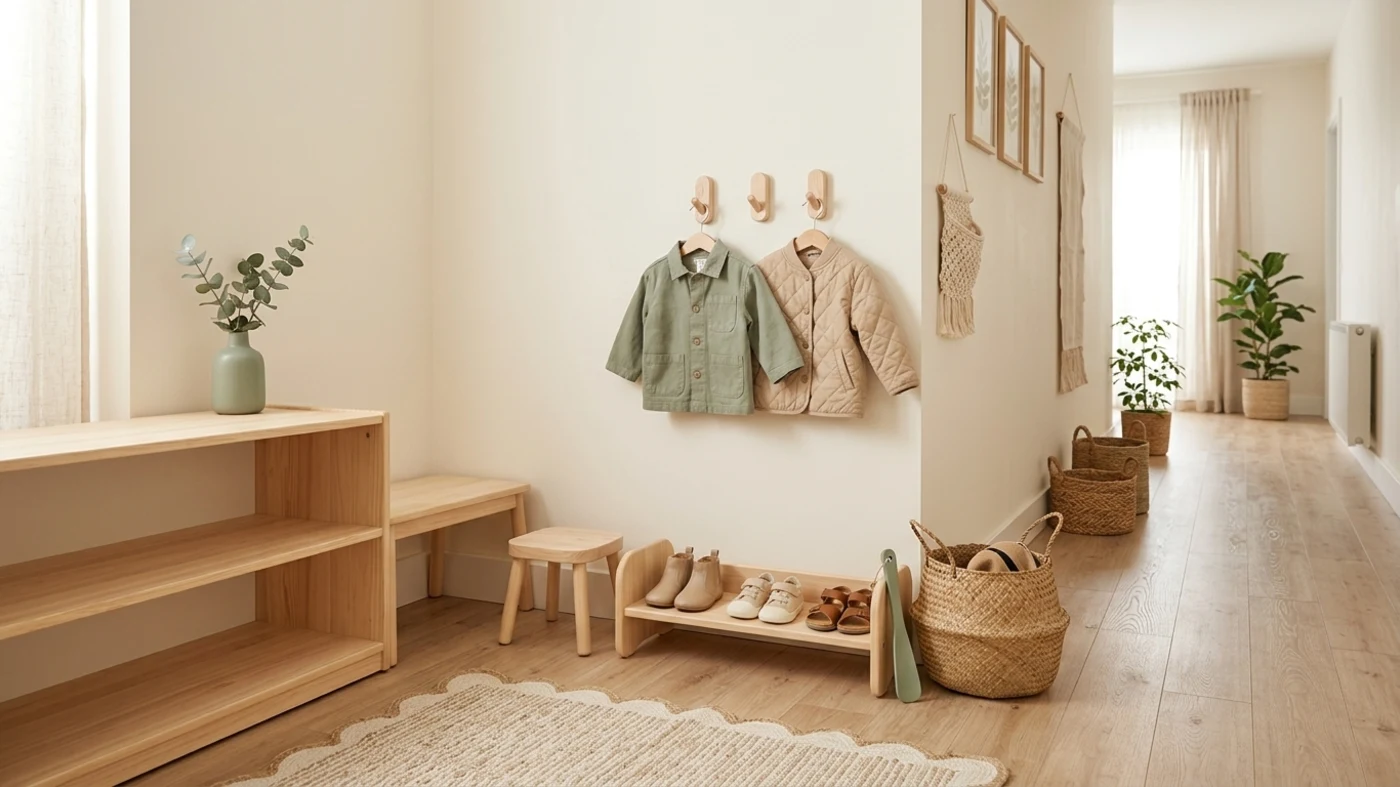
That means the room is doing some of the teaching.
A low shelf, a reachable hook, a child-sized table, a small pitcher, a floor bed, or a calm snack setup all count more than expensive decor. If you are building this at home, our guides to how to start Montessori at home, Montessori shelf setup, and a Montessori floor bed will help.
A prepared environment asks: can your child get what they need, use it well, and put it back?
2. Sensitive periods
Sensitive periods are windows when your child is especially hungry for a certain kind of learning.
You might notice a sudden obsession with order, pouring, climbing, naming objects, carrying things, or repeating the same action again and again. That is not random. It often means a skill is under construction.
Your job is not to force the interest. Your job is to support it while it is alive.
3. Practical life
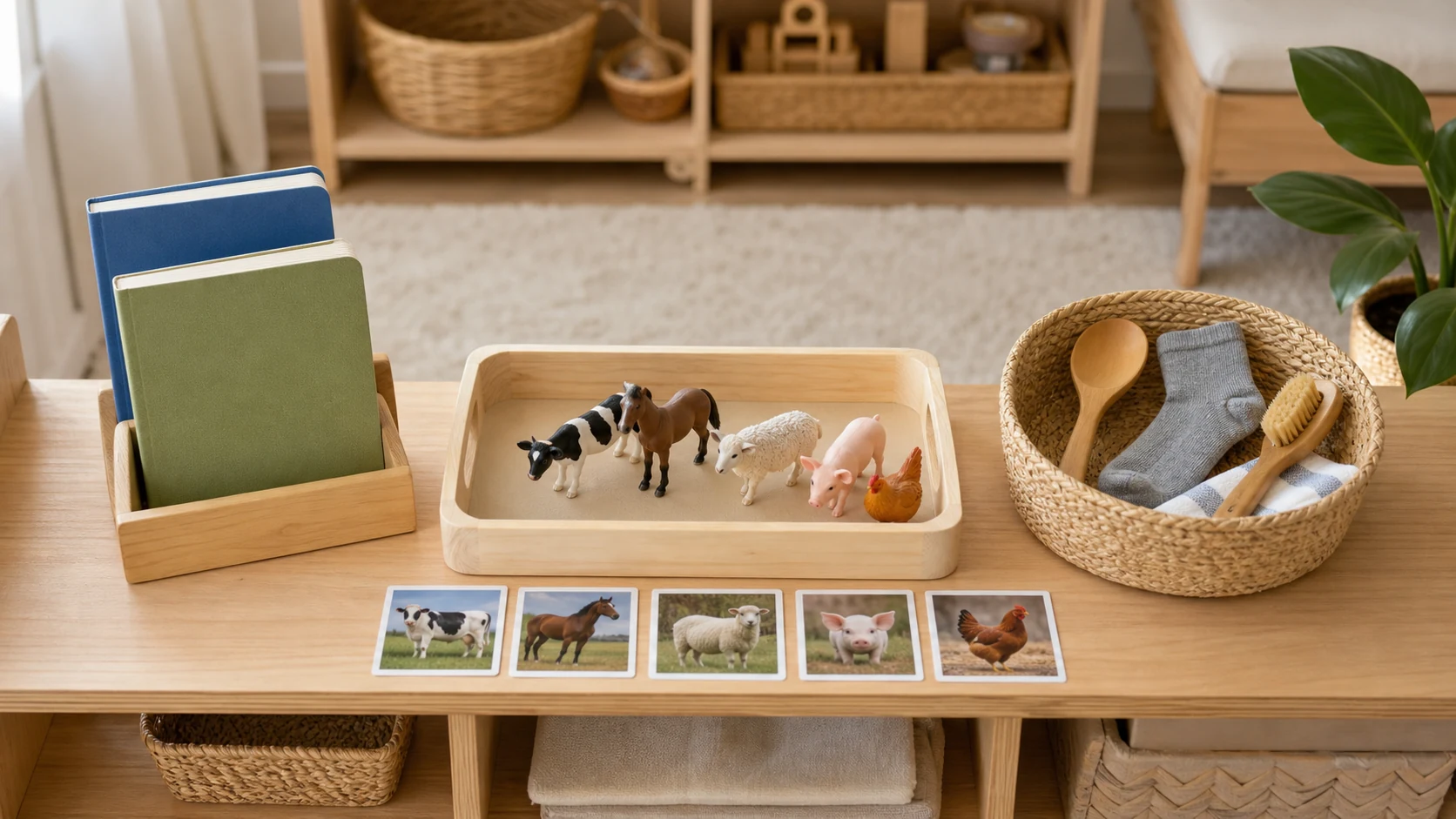
Practical life is one of the most useful Montessori ideas for home.

It means real everyday work like pouring water, wiping a table, washing fruit, sweeping crumbs, buttoning a shirt, or watering a plant. These tasks build coordination, focus, and confidence because they have a real purpose.
If you want to make this easier, a sturdy Guidecraft Kitchen Helper can be one of the most useful Montessori-style purchases you make. It brings your child safely up to counter height so practical life can happen inside normal family routines, not as a separate performance.
4. Guide
In Montessori, the adult is often called a guide rather than a teacher.
This does not mean you stop teaching.
It means you do less nonstop directing. You observe more, prepare more thoughtfully, show the skill clearly, and then step back enough for your child to do the real work.
That shift is small in wording and huge in practice.
5. Presentation
A presentation is the way you show your child how to do something.
In Montessori, it is usually brief, slow, and very clear. You do not over-explain. You let the movement do the talking.
Think of showing how to pour from one small jug to another, how to carry a tray with two hands, or how to wipe a spill from left to right.
The goal is not to entertain. The goal is to make the next independent attempt possible.
6. Work cycle
Work cycle means the full loop of choosing work, doing it, repeating it if needed, and putting it back.
That last part matters.
Montessori is not only interested in the exciting middle. It values the whole sequence. The child chooses, carries, concentrates, finishes, and restores. That is why toy rotation and shelf clarity matter so much. A child works better when the beginning and the end are readable.
7. Control of error
Control of error means the activity itself helps your child notice mistakes.
Instead of you constantly correcting them, the material gives feedback.
If water spills, they can see it. If a puzzle piece does not fit, they feel it. If a tray is overloaded, they notice the problem while carrying it.
That is a deeply respectful idea. It lets your child learn through reality, not just adult commentary.
A simple example is a spill-catching tray. The Learning Resources serving tray is a nice practical size for flower arranging, pouring work, or snack prep because the edge helps contain small mistakes without turning the activity into a rescue mission.
8. Grace and courtesy
Grace and courtesy is Montessori language for social skills.
How do we greet someone? How do we wait? How do we offer help? How do we interrupt politely? How do we carry a chair without banging it into the wall?
It sounds formal, but at home it is just the everyday social layer of family life.
Montessori treats these things as teachable, not automatic.
9. Freedom within limits
This is one of the healthiest Montessori phrases to understand.
Your child gets real choice, but inside boundaries that protect safety, order, and other people.
You can choose which puzzle to do. You cannot throw the puzzle. You can pour your own water. You still wipe it up if it spills. You can move around the room. You do not climb the bookshelf.
That is Montessori in one sentence: freedom, but not chaos.
10. Normalization
This is probably the most misunderstood Montessori term.
Normalization does not mean making your child obedient, quiet, or robotically compliant.
It means the calm, deeply engaged state that appears when your child has meaningful work, enough repetition, and an environment that supports concentration. You have probably seen it already: your child gets absorbed in wiping, sorting, pouring, building, or arranging and suddenly feels more settled in their whole body.
That is the state Montessori protects.
11. Absorbent mind
The absorbent mind is Montessori’s way of describing how young children learn from their environment.
They take in language, routine, movement, tone, order, and culture constantly. They do not need a lecture to learn what life in your home feels like.
That is why environment matters so much in the early years. Your child is always reading it.
Takeaway: if you understand these 11 terms, most Montessori articles become much easier to decode.
What these terms look like in real life at home
This is where Montessori gets better.
Not when it sounds refined. When it becomes visible.
A prepared environment might be:
- one low shelf instead of six overflowing bins
- a reachable cup and plate for snack
- a floor bed or low bed your child can enter independently
- hooks low enough for your child’s bag or coat
- one quiet puzzle instead of a noisy mountain of plastic
Sensitive periods might look like:
- your toddler wanting to pour water fifty times in a row
- your preschooler insisting things go back in the same place
- your child asking for the same words, stories, or naming games again and again
Practical life might look like:
- slicing bananas
- wiping the table after snack
- watering herbs on the balcony
- peeling eggs
- hanging up a small towel

If you want a few simple tools that make this easier, a Green Toys watering can works well for plant care, and a plain magnifying glass can turn a walk into the kind of slow observation Montessori loves.
Notice what is happening here.
The terms only matter because they point you back to action.
Takeaway: when Montessori vocabulary is working properly, it makes your home simpler, calmer, and more usable.
The Montessori words that get misused most online
This is worth saying clearly.
A lot of brands borrow Montessori language because parents trust it.
That does not mean the product, toy, or room actually reflects Montessori principles.
Here are the most common drifts:
“Montessori” meaning beige
Wood can be lovely. Neutral colours can be calm.
But Montessori is not a colour palette.
A cluttered beige room is still cluttered.
“Follow the child” meaning no boundaries
This one creates a lot of confusion.
Following the child does not mean your child runs the whole house. It means you pay attention to developmental needs and offer the right support. It still includes limits, routines, and safety.
“Practical life” meaning fake chores
Children know when the work is real.
Wiping a real spill matters. Washing one already-clean toy for the sake of an aesthetic tray usually matters less.
“Montessori toy” meaning any wooden toy
This is a big one.
Some wooden toys are excellent. Some are just expensive clutter in softer colours.
If you want help thinking through that difference, our guide to Montessori toys vs regular toys breaks it down in a much more honest way.
Takeaway: a Montessori word is only useful if the function underneath it is real.
How to learn Montessori without getting overwhelmed
You do not need to memorise a glossary and redecorate your house by Friday.
Start smaller.
Pick one term and make it visible.
A good order is:
- Prepared environment — make one space easier for your child to use
- Practical life — add one real task your child can repeat daily
- Freedom within limits — decide what your child may do independently and what still needs support
- Observation — watch what your child returns to without rushing to rotate everything
- Work cycle — leave enough time for the full loop, including putting it back
That is already a strong Montessori foundation.
If you want a calm starting point, begin in the kitchen, the entryway, or one shelf. Those three areas usually give you the fastest return.
And if you have a newly 3-year-old, this matters even more. That age often wants more real contribution, more sequence, and more independence than adults expect.
Takeaway: Montessori gets easier when you treat it as a set of practical home decisions, not a perfect identity.
FAQ: Montessori glossary for parents
What is the most important Montessori term to understand first?
If you only learn one term, start with prepared environment.
It changes how you see the whole house. Instead of asking whether your child is “being cooperative,” you start asking whether the space is helping them succeed.
Is Montessori language necessary to do Montessori at home?
Not really.
You can absolutely create a calm, respectful, independence-friendly home without using the formal terms. But learning a few key words can help you understand the logic behind what works.
What does “follow the child” really mean?
It means observe what your child is ready for, interested in, and struggling with.
Then adjust the environment, the invitation, or your support. It does not mean saying yes to every impulse.
Why do Montessori articles talk so much about work?
Because Montessori uses the word work more broadly than adults usually do.
For a child, work means purposeful activity. Pouring, washing, building, matching, dressing, and preparing snack all count. The point is not productivity. The point is concentration and development.
What if Montessori terms still feel intimidating?
That usually means the language is outrunning the practice.
Come back to real life. Can your child pour a drink? Reach a book? Wipe a spill? Put shoes away? That is Montessori becoming real.
The simple way to remember all this
If you forget every definition in this post, remember this instead:
Montessori language should make your next decision at home clearer.
It should help you notice what your child can do, what the environment is communicating, and where you can step back without disappearing.
That is the whole game.
Not perfect shelves. Not pretty jargon. Not buying a hundred “Montessori” products.
Just clearer support, better observation, and a home your child can actually use.
If you want to keep going, what Montessori really is, how to start Montessori at home, and practical life activities are the best next reads.
Methodology and trust notes
This is a plain-language interpretation of commonly used Montessori terms for family life, not a replacement for an AMI/AMS training programme, a school’s own approach, or developmental advice from your child’s clinician. The examples are deliberately small and home-based: observe what your child can safely do, adapt for your household, and keep close supervision around water, food preparation, climbing, and small parts. Product links are optional affiliate links that may support Exploritori at no extra cost; they are examples rather than hands-on product tests, and ordinary household items can often do the same job.
 Get weekly Montessori tips
Honest reviews, activity ideas, and budget-friendly picks — no spam, just what works.
Subscribe Free