The Complete Pikler Triangle Guide: What It Is, Why It Matters, and Our Top Picks
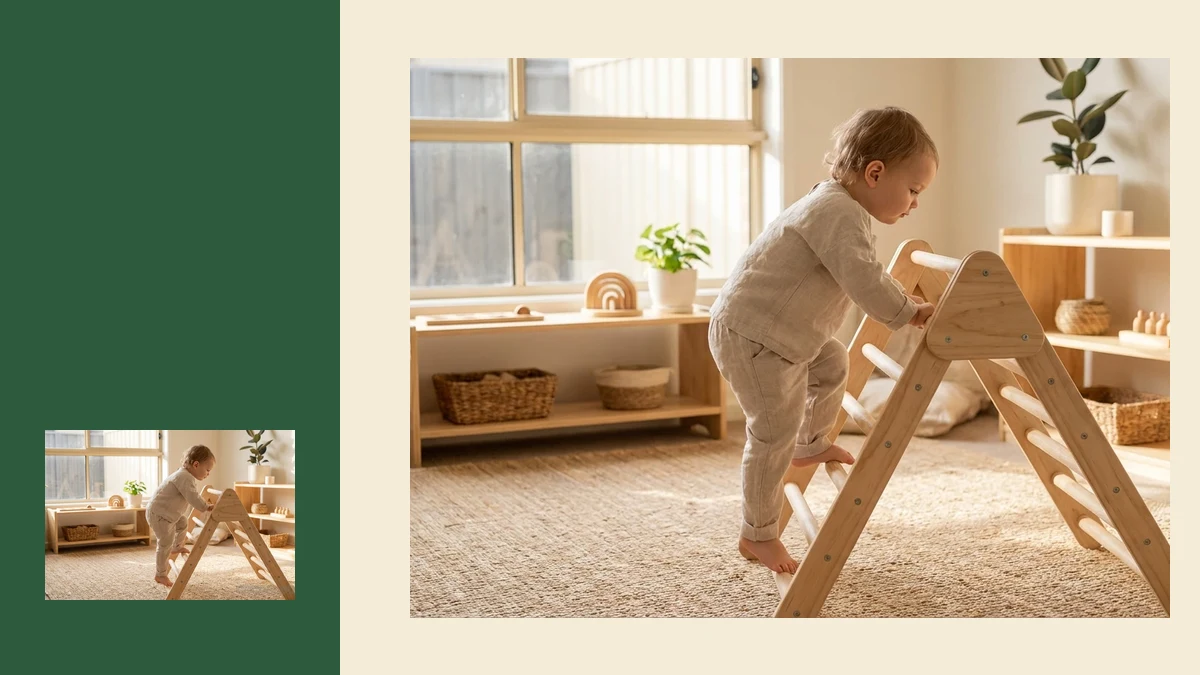
If you've spent any time in Montessori parenting circles — online or off — you've seen pictures of children scaling wooden triangles in sun-dappled playrooms. It looks beautiful. It also looks expensive. And maybe you've wondered: is this actually worth it, or is it an aesthetics purchase dressed up in developmental language?
It's a fair question. The Pikler triangle is one of the more significant investments you'll make in your child's play environment. We're talking €150–400 depending on size and quality. That demands a real answer, not just vibes.
This guide covers everything: who invented it, what it actually does for your child's development, how to choose one, our honest product picks, and when you probably don't need one.
Reviewed August 2026: We added a quick height-and-age guide alongside the room-fit, foldable-versus-fixed, ramp, and safety decisions parents make before buying. The product notes are review-analysis guidance, not a claim that we have lab-tested every model.
Quick answer: Pikler triangle height and age range
For most families, a 75-90cm Pikler triangle is the practical starting size: it suits a child who is confidently pulling to stand through roughly age 3, while still being manageable in a shared living space. A 90-110cm frame gives more room for confident climbers and longer use with siblings, but needs a larger clear landing area and a child who can climb down without being lifted off.
| Your child or room | A sensible starting point | Why |
|---|---|---|
| Pulling to stand or climbing only the first rungs | Wait for steady, self-initiated movement; choose a low 75-85cm frame when ready | The first job is learning to approach and descend at their own pace, not reaching the top. |
| 10-18 months, with close supervision | 75-90cm, stable base, no ramp at first | A lower frame gives repeatable practice without making the descent feel overwhelming. |
| 18 months-3 years and climbing confidently | 80-90cm, optionally with a ramp | This is the common sweet spot for full climbing and varied play. |
| Age 3+ or several children will use it | 90-110cm if the room has space | The extra height can extend its useful life, provided the child can descend calmly. |
| Small flat or narrow living room | Foldable 75-85cm frame | A smaller triangle that stays safely accessible is more useful than a taller one that must be packed away. |
Use the maker's stated age and weight limits as the final check. Age labels are only a guide: readiness looks like a child choosing the bottom rungs, moving slowly, and finding their own way down while you remain close enough to supervise.
Quick Answer: Should You Buy One?
| Family situation | Best call | Why |
|---|---|---|
| Baby is pulling to stand and you have no easy daily climbing space | Consider a small foldable triangle | It gives low, repeatable gross-motor practice without turning the living room into a playground. |
| Toddler is 18 months-3 years and climbs furniture constantly | Strong yes if budget allows | This is the peak window for independent climbing, descent practice, and controlled risk. |
| You live in a small flat | Choose foldable, 75-85cm high, with a stowable ramp | The triangle only works if it can stay accessible without blocking the room. |
| You already have a safe garden or excellent playground nearby | Nice-to-have, not essential | The developmental need is climbing, not owning this exact object. |
| Child is already 4+ and confident on playground structures | Buy only if siblings will use it too | The value window is shorter unless it becomes part of obstacle-course play. |
If you are still setting up the room around it, start with our Montessori shelf setup guide and how to start Montessori at home first. A triangle is useful only when the surrounding environment gives the child space to approach, pause, climb, and get down independently.
Who Was Emmi Pikler?
Before we get to the triangles, it helps to know where they come from — because this isn't a product invented by a toy company to sell to anxious parents. It came from decades of careful observation.
Emmi Pikler (1902–1984) was a Hungarian paediatrician who spent her career studying how children develop gross motor skills. In 1946, she founded the Lóczy Institute in Budapest, a residential nursery for orphaned and abandoned infants. What she observed there — and what she documented rigorously — fundamentally changed how we understand infant and toddler movement.
Pikler's central insight: children develop motor skills in a natural sequence when given freedom to move, safe space to explore, and an adult who trusts the process. Her research showed that babies who were not propped, bounced, or placed into positions they couldn't achieve independently had better long-term motor coordination than those who were "helped" prematurely.
The climbing frame — the structure we now call the Pikler triangle — was a tool she designed to give toddlers an appropriate gross motor challenge: something they could master incrementally at their own pace, without adult intervention.
It's not branded. It's not a trend. It's the result of decades of child development research.
What a Pikler Triangle Actually Does
The Pikler triangle is a wooden A-frame with horizontal rungs — essentially a very sturdy ladder in triangle form. That's it. The magic is what a child does with it.
Gross motor development
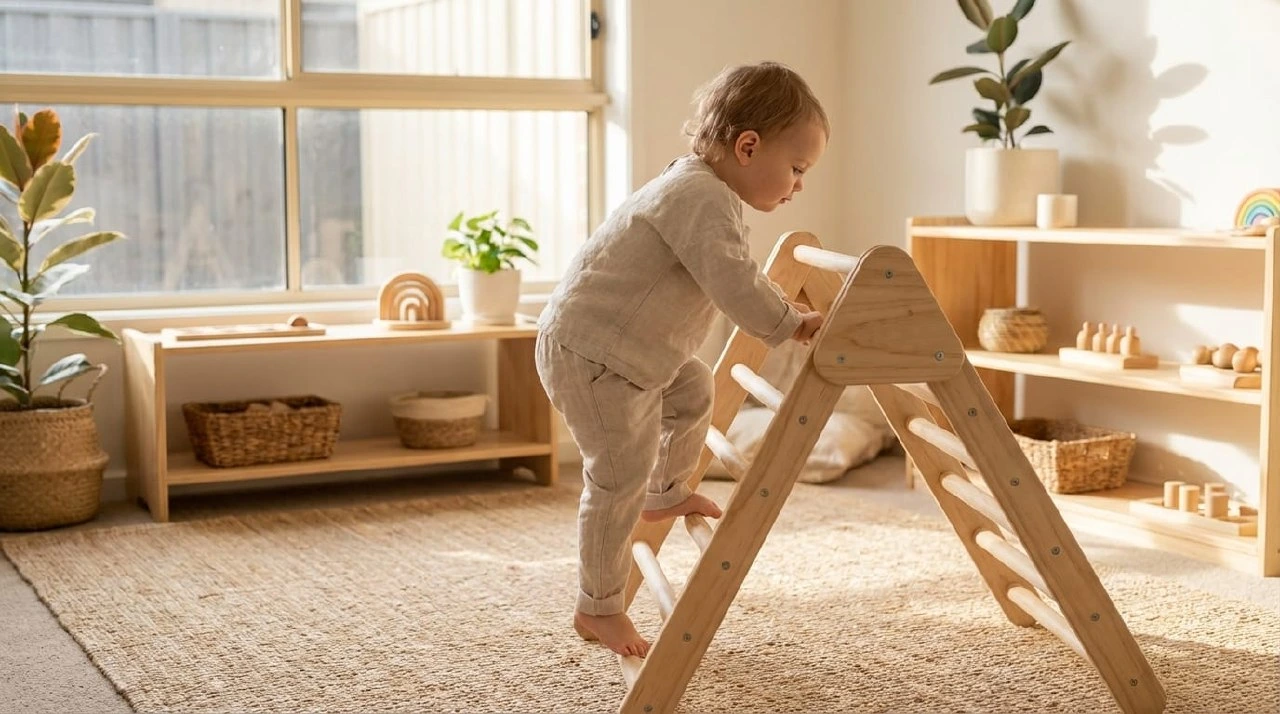
Climbing requires full-body coordination: planning (where do I put my foot?), execution (can my arms hold my weight?), and adaptation (what if this rung is further than I thought?). Unlike a slide or a swing, which are single-action, a Pikler triangle demands continuous problem-solving.
For children aged 10 months to 5 years, this offers age-appropriate challenge at every stage. A 12-month-old pulls to stand and climbs the first two rungs. A 2-year-old climbs to the top and peers over. A 4-year-old hangs upside down. The triangle doesn't change — the child's capability does.
For more on why gross motor development matters in Montessori, see our guide to Montessori Activities for 2-Year-Olds and the age-specific ideas in Montessori Activities for 12-18 Months.
Risk calibration
This is something Pikler and later researchers like Peter Gray have emphasised: children need to experience manageable risk. Falls from a Pikler triangle are almost always minor — the structure is low, the child is the one who chose to climb, and their body has learned where their limits are.
Compare that to a child who never climbs, then suddenly encounters a real staircase or a playground structure. The Pikler triangle is essentially practice — controlled risk that develops genuine competence.
Proprioception and body awareness
Knowing where your body is in space is a fundamental developmental skill. Climbing on an irregular structure (as opposed to flat floor play) challenges the vestibular and proprioceptive systems in ways that matter for everything from balance to handwriting.
Independence and self-confidence
Pikler's approach was explicitly about allowing children to discover their own capabilities. The triangle doesn't require you to hold your child. It doesn't have a "correct" way to use it. When a toddler climbs to the top and gets themselves back down, they did that. No assistance required.
That experience of genuine competence is qualitatively different from praise or encouragement. It's the thing itself.
What Age Can They Use It?
This is probably the most common question, and the honest answer is: earlier than you think, and for much longer than you'd expect.
| Age | What they typically do |
|---|---|
| 6–10 months | Pull to stand against the base rungs; supported sitting against the frame |
| 10–18 months | Climb the first 2–3 rungs; begin to understand descent |
| 18 months–2 years | Full climbing, top to bottom; begin to use it creatively (as a tent with a blanket, as a ramp with a board) |
| 2–4 years | Confident climbing, hanging, inventive play; combine with ramp/slide attachment |
| 4–6 years | Complex play, obstacle courses, continued use but less focused on the climb itself |
Most quality Pikler triangles are rated for children up to 44kg/100lbs. A well-made triangle will genuinely last into primary school age — which is part of why the upfront cost is easier to justify.
The age range matters less than the movement stage. A cautious 14-month-old who is just pulling to stand may use the bottom rungs for months. A confident 20-month-old may climb to the top on day two. The useful adult job is not to rush either child; it is to make the space predictable and stay close enough to supervise without turning the climb into a performance.
What to Look For When Buying
Not all Pikler triangles are equal. Here's what actually matters:
1. Rung spacing
Rungs should be spaced evenly and not too far apart for small children. Approximately 10–12cm between rungs is standard. Too wide and a young climber's leg can slip through uncomfortably; too narrow and there's less grip variety.
2. Weight capacity and construction
Look for solid wood joints (not just glued), stainless steel screws (not plastic fasteners), and a weight limit of at least 50kg. Cheaper models cut corners on joint construction — this matters when a toddler is at the top and throwing their weight around.
3. Finish
Non-toxic, water-based finishes only. Many parents choose unfinished or lightly oiled wood — Pikler herself preferred minimal finishing. Avoid any product that doesn't clearly disclose what's on the wood.
4. Foldability
Some Pikler triangles fold flat for storage, which matters if you're in a flat or want to move it room to room. Foldable models add some complexity to the joint design — check reviews specifically for joint stability on these.
5. Compatible accessories
A ramp or slide board is the most common accessory and genuinely extends the toy's play life. Some brands sell triangle + ramp combos; others use standard rung sizing so third-party boards fit. Worth checking before you buy.
6. Room footprint
Measure the triangle open, the ramp fully extended, and the landing area. A triangle that technically fits but leaves no safe descent zone will get folded away. As a rule of thumb, leave at least 60cm of clear space around the sides and a softer landing surface wherever the ramp or top descent points.
7. Repairability
Prefer visible bolts, replaceable hardware, and a brand that publishes basic care guidance. Wooden climbing frames loosen over time. That is normal. What matters is whether you can tighten the frame, inspect the joints, and replace a worn bolt instead of treating the whole structure as disposable.
Size and Setup Checklist
Use this before you buy, especially if you live in a flat:
| Check | Good sign | Red flag |
|---|---|---|
| Open footprint | Fits with 60cm+ clear space on at least two sides | Blocks a doorway, radiator, balcony door, or main walkway |
| Height | 75-90cm for younger toddlers; 90-110cm for longer use | Too tall for the child to descend calmly |
| Surface | Rug, play mat, or carpet under the climbing zone | Tile or hard floor directly under likely landing points |
| Storage | Folds flat or can stay out safely | Needs adult setup every time, so it rarely gets used |
| Supervision spot | Adult can sit nearby without hovering | You need to stand behind the child to feel safe |
For small homes, the best upgrade is often not a bigger triangle; it is a clearer movement zone. Our IKEA Montessori hacks guide has practical examples of low shelves, playroom layouts, and storage choices that keep floor space usable.
Our Picks
Best Overall: Lily & River Little Climber Pikler Triangle
Price: ~$165 | Ages: 6 months–6 years | Weight limit: 150lbs (68kg) | Foldable: Yes
Lily & River has built a strong reputation in the Montessori climbing toy space, and the Little Climber earns it. Solid birch construction, non-toxic natural oil finish, sturdy folding joints that don't wobble after extended use. Rung spacing is well-calibrated for children in the 12-month to 4-year range.
What we like:
- Folds flat in under a minute — genuinely useful for smaller homes
- Ramp attachment sold separately and fits well (no adapter needed)
- Noticeably well-finished — smooth rungs, no rough edges
- Multiple colour/finish options (natural, white, grey wash)
What we don't:
- White and grey versions use paint rather than stain — fine, but worth knowing
- The ramp costs extra; you'll want it, so factor ~$60 into the total
Who it's for: Families who want a quality first Pikler triangle that will last through multiple children. Especially good in smaller spaces due to the fold.
Best Budget Pick: TOPBRIGHT Montessori Climbing Triangle
Price: ~$95 | Ages: 10 months–5 years | Weight limit: 110lbs (50kg) | Foldable: Yes
TOPBRIGHT makes the most affordable solid-wood Pikler triangle we'd actually recommend. It's not in the same build tier as Lily & River, but it's a genuine hardwood frame with non-toxic finish, adequate weight capacity, and a foldable design. For families who aren't ready to spend $150+ on their first climbing frame, this is the entry point.
What we like:
- Real solid wood — not MDF, not hollow core
- Foldable with a reasonably stable joint
- Good rung spacing for younger climbers
- Ships assembled (minor detail, but nice)
What we don't:
- At the top end of weight capacity, there's some frame flex — not unsafe, but noticeable
- Finish is adequate rather than excellent; lightly sand if your child has sensitive skin
- No first-party ramp — third-party boards are available but require checking fit
Who it's for: Families who want to try a Pikler triangle without the full premium investment, or those buying for a specific age range rather than expecting multi-year use.
Best for Smaller Spaces: Arkmiido Montessori Climbing Frame
Price: ~$120 | Ages: 10 months–4 years | Weight limit: 100lbs (45kg) | Foldable: Yes
The Arkmiido is slightly smaller in footprint than the standard triangle format, which makes it a better fit for compact living rooms and apartments. Build quality sits between TOPBRIGHT and Lily & River — solidly made, not exceptional. The ramp/slide board is included in the main package, which makes the overall value decent.
What we like:
- Ramp included — no extra purchase needed
- Compact footprint works in smaller rooms
- Non-toxic paint/oil finish (clearly documented)
- Folds with the ramp stored inside the triangle — efficient
What we don't:
- Lower weight limit means less longevity for heavier children or multi-child use
- Slightly narrower rungs than competitors — fine for small hands, a snugger fit for larger toddlers
- Fewer colour options
Who it's for: Urban families in smaller flats who still want the Pikler triangle experience. Good if you have one child under 3 and limited storage.
The DIY Option
Worth mentioning: Pikler triangle plans are freely available online, and a reasonably competent woodworker can build one for €40–60 in materials. If you or your partner enjoy woodworking, this is a legitimate route. The critical requirements:
- Birch or beech hardwood (not pine — too soft for joint pressure over time)
- Dowel rungs with tight-fitting joints (glued + screwed)
- Rounding all edges — a router pass or thorough sanding to 220 grit minimum
- Non-toxic finish (raw linseed oil works well)
A homemade Pikler triangle can absolutely outperform a cheap commercial one. If you go this route, look for plans that specify adult weight testing — you want to know the frame holds before your child climbs it.
How to Set It Up at Home
A few practical notes from experience:
Floor surface matters. Carpet or a play mat under the triangle gives grip and padding for the inevitable short falls. Hardwood or tile directly under the triangle is fine for the frame but less forgiving for landing.
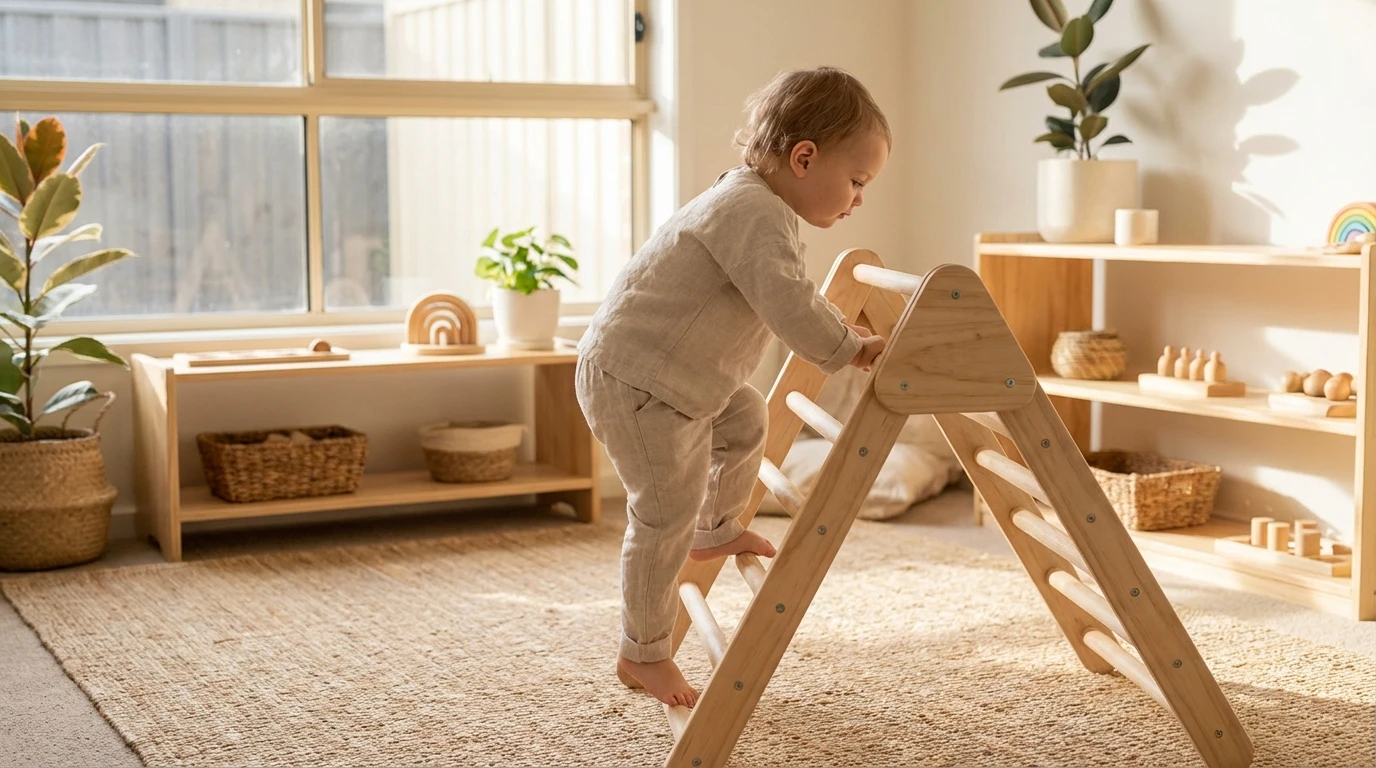
Leave it out. The value of the Pikler triangle comes from incidental, self-initiated climbing throughout the day — not structured "climbing time." If it's in a cupboard, it doesn't get used. Set it up somewhere accessible and let your child decide when to approach it.
Don't intervene too quickly. This is harder than it sounds. When your child gets partway up and pauses, resist the urge to lift them. Wait. They're thinking. Most of the time, they'll figure out the next move. The pause is the learning.
Blankets + slide board = years of play. Drape a blanket over the top for a den. Lean a board against it for a slide. These simple additions massively extend the play life of the structure and connect it to imaginative play as children get older.
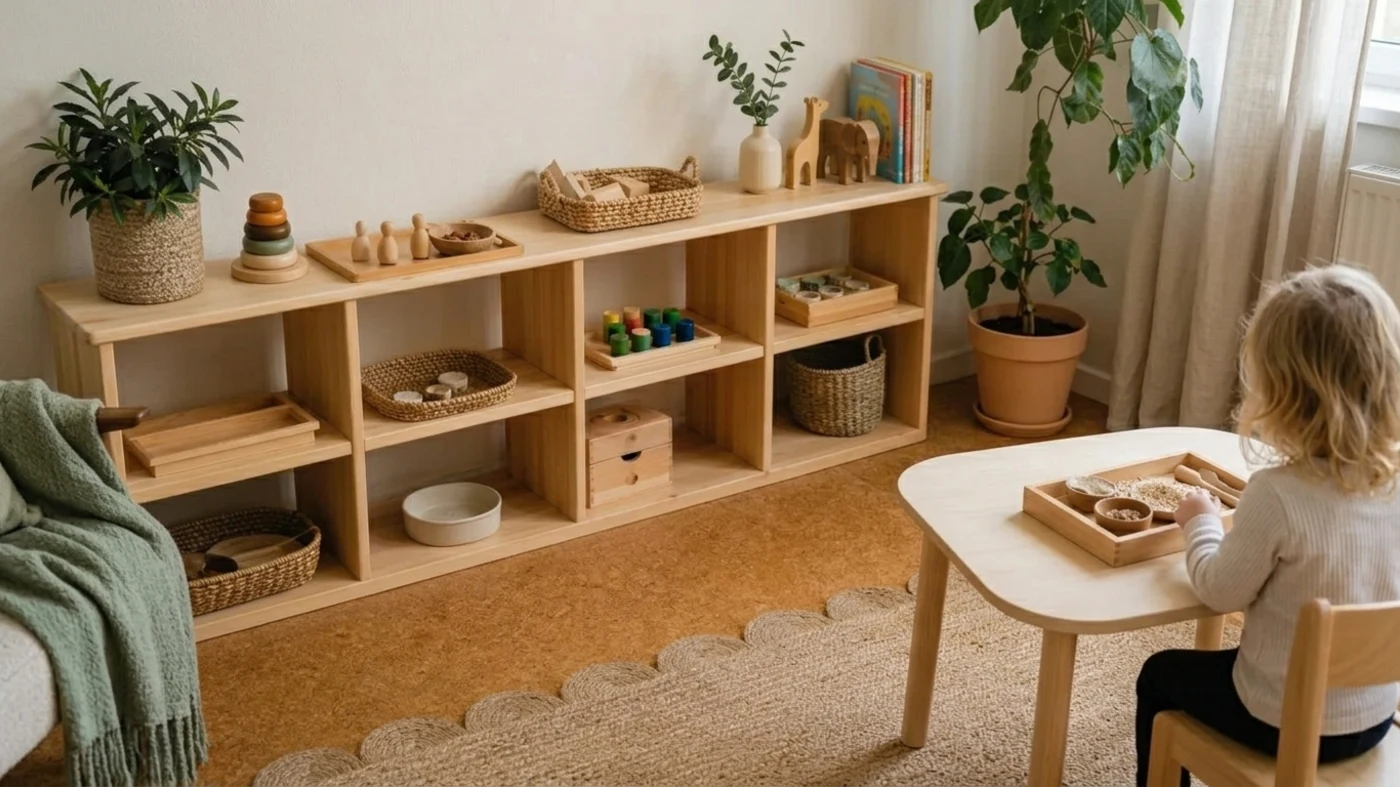
See our Montessori Shelf Setup Guide for how to think about placing the triangle within a broader prepared environment.
The 10-minute safety check
Do this when the triangle arrives, then repeat weekly while it is in heavy use:
- Press down on the top hinge and side joints; there should be no wobble or shifting.
- Twist each rung by hand; it should not rotate freely.
- Check the locking mechanism if the frame folds.
- Remove loose scarves, cords, or long necklaces before climbing.
- Keep the ramp angle shallow at first, then raise it only when descent is calm.
- Step back from coaching unless the child is stuck or unsafe.
This is also where a prepared environment matters. If the child has to climb over toy baskets to reach the frame, the risk is not the triangle; it is the clutter around it. Keep the movement zone boring and clear, and put smaller hand-work back on the shelf.
When You Don't Need One
Honest caveat time.
If your child has reliable access to outdoor climbing structures — a well-designed playground nearby, a garden with climbing opportunities — a Pikler triangle is a nice-to-have rather than an essential. The developmental value comes from climbing itself, not this specific object.

The triangle is most valuable when:
- You're in an urban flat without easy outdoor access
- Your child is under 2 and needs appropriate indoor gross motor challenge
- You're building a deliberately prepared environment where indoor and outdoor play balance
It's less essential when:
- You already have a good outdoor climbing structure
- Your child is over 4 (they'll still use it, but the peak developmental value window has mostly passed)
- Budget is genuinely tight — there are other ways to provide gross motor challenge indoors
How We Reviewed This Guide
This is a parent buying and setup guide, not a medical recommendation or a lab safety test. We reviewed the article against Exploritori's Montessori-at-home criteria: independent child access, realistic room fit, manageable risk, material transparency, multi-year usefulness, and whether the purchase solves a real family problem. Product links are included as practical examples; some may be affiliate links, which can earn Exploritori a commission at no extra cost to you.
For adjacent setup decisions, see Montessori Toys by Age 0-6, Best Montessori Toys for 1-Year-Olds, and Outdoor Montessori Nature Activities.
FAQ
What's the difference between a Pikler triangle and a regular climbing frame?
A Pikler triangle is specifically designed around Emmi Pikler's developmental philosophy: low to the ground, freestanding, with even horizontal rungs a young child can assess and climb independently. Regular climbing frames are usually taller, require more space, and are designed for older children. The Pikler triangle is specifically suited to the 6 months–4 year developmental window.
Is a Pikler triangle safe indoors?
Yes, when used appropriately. The standard frame height (around 80–90cm) means falls are short, and children who have developed their gross motor skills through the triangle tend to have good body awareness. Place it on a soft surface, ensure joints are tight, and check the weight limit. Never leave very young children (under 12 months) unsupervised on the frame.
Can a Pikler triangle be left outdoors?
Some are rated for outdoor use, but most manufacturers recommend indoor storage. Extended outdoor exposure degrades even sealed wood over time. If you want to use it outdoors, choose a model with exterior-grade finish and store it inside when not in use.
What size should I get?
Standard small frames (around 80cm tall, 85cm wide) work well for children from crawling to approximately 3 years. Larger frames (100cm+ tall) extend the upper age range significantly and are worth the investment if you have multiple children or want maximum longevity. Most foldable models are in the standard size range.
Do I need the ramp/slide attachment?
Not immediately. The bare triangle offers significant play value on its own. But most families end up wanting the ramp within six months of buying the triangle — it opens up sliding, incline climbing, and dramatic play that children love. If budget allows, buy the combination from the start. If not, buy the triangle first and add the ramp when you can.
What's the Verdict?
The Pikler triangle earns its reputation. For children in the 10-month to 4-year window, it's one of the most developmentally rich pieces of play equipment you can invest in — not because it's Montessori-branded or aesthetically pleasing, but because it provides genuine gross motor challenge that respects the child's pace and capability.
Is it worth $150–400? For families building a deliberate play environment without easy outdoor climbing access: yes. For families with a well-equipped playground nearby: probably not your top priority.
If you're going to buy one, buy quality. A well-made triangle lasts through multiple children, which makes the per-use cost over five years remarkably reasonable.
Our first recommendation: Lily & River Little Climber — solidly built, folds flat, lasts for years.
Budget-conscious: TOPBRIGHT Climbing Triangle — real wood, adequate quality, does the job.
For related guides, see:
- Montessori Activities for 2-Year-Olds
- Outdoor Montessori Nature Activities
- Montessori Shelf Setup Guide
- Best Montessori Toys for 2-Year-Olds
 Get weekly Montessori tips
Honest reviews, activity ideas, and budget-friendly picks — no spam, just what works.
Subscribe Free