Montessori Learning Tower Guide: When to Start, Safety Features, and Best Picks
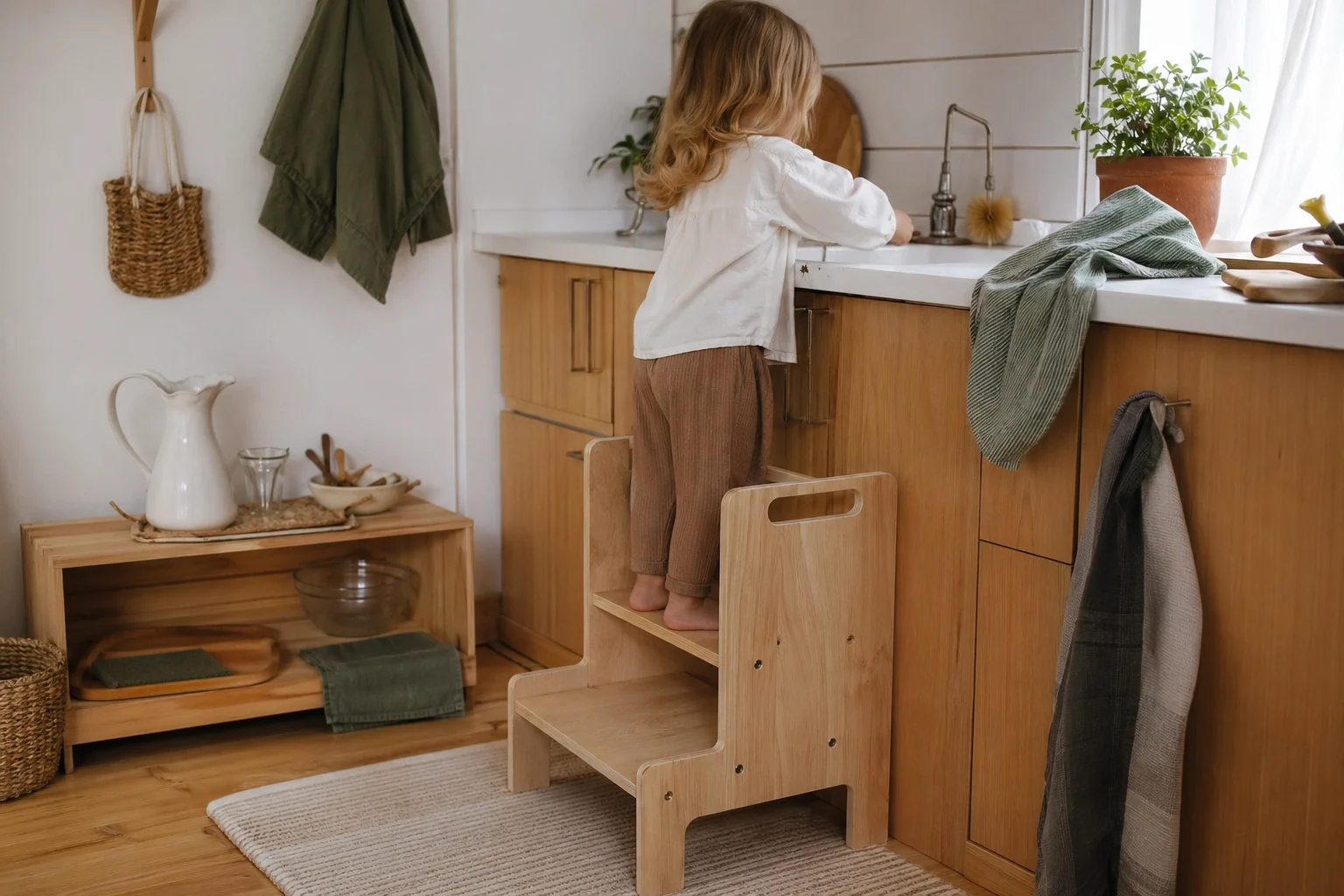
A Montessori learning tower can be one of the most useful things you buy for toddler life.
It can also be one of the most annoying.
Useful, if your child wants to help every time you cook, wash produce, or wash hands. Annoying, if it takes over a tiny kitchen and turns into an expensive climbing frame that nobody actually uses.
That is why the real question is not “Are learning towers Montessori?”
The real question is: will this make daily life calmer, safer, and more independent in your home?
For many families, the answer is yes. A good helper tower can turn constant requests to be picked up into real participation. Your child can rinse strawberries, stir batter, spread toast, wash hands, or wipe a spill without hanging off your leg the whole time.
But not every toddler is ready at the same age. Not every kitchen has room for one. And not every tower deserves a place in your house.
So let’s make this practical.
Affiliate disclosure: Some links in this post are affiliate links. If you buy through them, we may earn a small commission at no extra cost to you. We only include products we’d genuinely consider for a calm, practical Montessori-style home.
🪜 What a Montessori learning tower actually does
A learning tower, sometimes called a helper tower or kitchen helper stool, is a raised platform with rails that brings your child up to counter height.
That is the whole idea.
It is not mainly a toy. It is not magical because a product listing says Montessori. It is useful because it changes the environment so your child can join real life.
Instead of asking to be lifted every thirty seconds, your toddler can stand in one secure spot and take part in everyday work like:
- washing fruit
- stirring pancake batter
- peeling a banana
- pumping soap at the sink
- rinsing a cup
- spreading soft cheese on toast
- wiping the counter afterwards
That matters because Montessori is not really about owning special gear. It is about making real participation possible.
If your home only works for adults, your child stays dependent on adult lifting, adult setup, and adult rescue. A learning tower removes one of those bottlenecks.
That is why it often ends up being more useful than another toy. It does not create fake activities. It opens the activities that already exist in your home.
If you are still building the bigger picture, this pairs well with How to Start Montessori at Home and Montessori Practical Life Activities.
Takeaway: a learning tower matters because it makes real participation physically possible.
👶 When is a toddler ready for a learning tower?
Most children start using a learning tower somewhere between 18 months and 2 years.
But readiness matters more than the birthday.
Your child is more likely ready if they can:
- stand steadily without constant wobbling
- climb with support
- follow simple limits like “feet stay here”
- stay with one task for a few minutes
- use new equipment without turning it into immediate chaos
That last point matters more than people admit.
A learning tower is not only about gross motor ability. It is also about impulse control. Some toddlers are physically capable long before they are behaviourally ready to use one safely.
If your child is a fearless climber with no respect for edges, that does not mean never. It usually means not yet or start smaller.
Good first routines are short and boring in the best possible way:
- rinsing berries for two minutes
- stirring one bowl
- washing hands at the sink
- watching you prep dinner beside them
- wiping one small spill with a cloth
That is enough.
You do not need to launch straight into cookies from scratch.
If your child is younger, less steady, or only needs quick sink access, a non-slip step stool may be a better first step than a full tower. Some families do that first, then upgrade later if the child wants longer counter routines.
Takeaway: ask “Is my child ready for this routine?” not just “How old is my child?”
🌿 Why learning towers fit Montessori so well
A lot of toddler gear is adult convenience dressed up as child development.
A learning tower is different.
Used well, it supports the exact kind of work Montessori values most:
- independence — your child can reach the counter without being held
- concentration — they can stay with one task instead of hovering below it
- coordination — pouring, washing, spreading, and transferring become possible
- belonging — your child joins family life instead of being parked nearby
- care of the environment — they can wipe, clean, prepare, and reset
This is why a tower often earns its keep faster than another “educational” toy.
A toddler helping you slice a banana or rinse cucumbers is doing richer work than a toy that flashes and sings about food. The kitchen gives real feedback. The work matters. Your child can see the purpose immediately.
A tower also fits beautifully with other Montessori home systems. If you already use a low shelf, snack station, accessible bathroom setup, or toy rotation, the tower extends the same principle into the kitchen: make meaningful work easier than passive entertainment.
A few genuinely useful extras can support that routine:
- a sturdy Guidecraft Kitchen Helper if you want the classic heavy-duty style
- a compact toddler learning tower if you want a simpler Amazon-style option
- a Montessori kitchen knife set with crinkle cutter for supervised soft-food prep
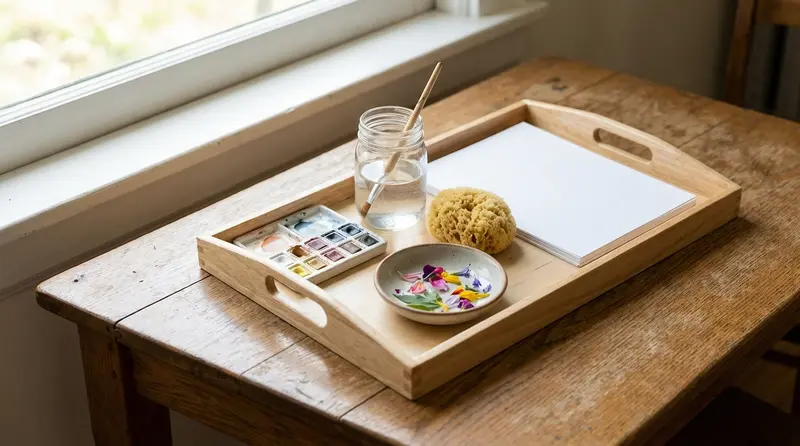
- small wooden trays to define one clear task at a time
None of those products are magical on their own. They help only if they support a calmer, more accessible routine.
Takeaway: the tower fits Montessori because it supports real work, not because the marketing sounds nice.
🛠️ What to look for before you buy
Not every helper tower is a good one.
Some look lovely online and feel flimsy in real life. Some are solid but enormous. Some are technically safe enough, but so awkward to move that they become permanent kitchen furniture.
Here is what actually matters.
1. Stability first

You want the tower to feel planted.
If you can imagine it rocking when your child leans, climbs, or shifts their weight, keep looking. A wide base and solid construction matter more than a beautiful finish.
2. Rails that genuinely support your child
The point is supported height, not just extra height.
You want enough side and back support that your child feels secure, especially during the early months of use. Too little support defeats the purpose. Too much bulk makes access awkward.
3. A platform height that works with your counters
Counter heights vary. Towers vary too.
If the platform is too low, your child still cannot comfortably participate. If it is too high, posture and safety get worse. Adjustable platforms are useful if you want the tower to last through more than one stage.
4. A wipeable, practical surface
This thing is going into your kitchen. It will meet yogurt, soap, oats, batter, and sticky fingers.
A practical finish matters more than a precious one.
5. The real footprint in your kitchen
This part is boring and extremely important.
Measure the kitchen.
A tower that technically fits but blocks adult movement will become irritating fast, especially at dinner time. If your kitchen is tiny, a slimmer tower, a foldable option, or a step stool may be the smarter choice.
6. Easy enough to move
You do not want feather-light instability.
But you also do not want a small wooden monument that nobody wants to reposition. Real life matters more than the showroom photo.
Here is the simplest buying lens:
| What matters most to you | Better fit |
|---|---|
| maximum stability and long daily use | Guidecraft Kitchen Helper |
| lower cost and decent everyday use | toddler learning tower |
| tiny kitchen or limited storage | foldable tower or step stool |
| older steady toddler with short tasks | sturdy step stool may be enough |
Takeaway: buy for your real kitchen and your real child, not for the prettiest product photo.
⚖️ Learning tower vs step stool
You do not automatically need a learning tower.
A sturdy step stool can absolutely be enough in some homes.
If your child is older, steadier, and mostly using the kitchen for short supervised tasks, a stool may be the more practical choice. It costs less, takes less space, and still supports plenty of independence.
But for younger toddlers, the extra containment of a tower often changes everything.
A child who feels secure usually stays calmer and works longer. A child balancing nervously on a basic stool often needs much more adult hovering.
The easiest way to think about it is this:
| If your child is… | Better choice |
|---|---|
| just starting counter routines | learning tower |
| under 2 and still a bit wobbly | learning tower |
| older, steady, and helping briefly | step stool can work |
| in a very small kitchen | step stool may be more practical |
| eager to pour, wash, and stay longer | learning tower |
You can also think in phases.
Many families use a learning tower during the heavy practical-life years, then switch to a simple stool later when the extra support is no longer necessary. That is often the most sensible long-term path.
And if you already have an IKEA step stool or similar at home, try it during low-stakes sink routines first. You may discover it is enough for your child right now. Or you may discover you are hovering so much that the tower would clearly be worth it.
Takeaway: a step stool is smaller and cheaper, but a learning tower usually gives younger toddlers a better chance at calm participation.
🍓 The best ways to use a helper tower at home
A tower gets its value from use.
Not from ownership.
The best routines are usually the least glamorous ones. They are the ordinary jobs that happen every day.
In the kitchen
- washing berries or grapes
- stirring batter or pancake mix
- peeling bananas or boiled eggs
- spreading yogurt, butter, or hummus
- transferring chopped fruit into a bowl
- cutting soft foods with a child-safe knife
At the sink
- washing hands independently
- rinsing vegetables
- scrubbing one cup or plate
- filling a little watering can
- wiping the counter afterwards
In wider home life
- flower arranging at the counter
- simple baking projects
- polishing a mirror
- helping pour pet water
- art or clay when counter height works better than the floor
The trick is not to invent impressive Montessori activities.
It is to let your child join the work that is already happening.
That is why a tower works best when it lives close to real routines, not when it becomes a special-event object you remember twice a month.
A few support tools can help keep tower work calmer:
- small wooden trays for one defined task
- a Montessori kitchen knife set with crinkle cutter for careful supervised prep
- the Guidecraft Kitchen Helper if you know your child will use the kitchen daily
If you want more age-specific ideas, Montessori Activities for 21-24 Months and Montessori Activities for 24-30 Months are good next reads.
Takeaway: the best tower activities are the real jobs your child can help with every day.
🚫 Why some parents regret buying a learning tower
When a parent says a learning tower “didn’t work,” the problem is often not the tower itself.
It is usually one of these.
Expecting too much too fast
You buy the tower and imagine your toddler calmly baking muffins for forty minutes.
Your toddler has other plans.
Start with short, predictable tasks. Two successful minutes matter more than one chaotic half hour.
Using it only during high-stress moments
If the tower only appears during dinner prep, it may feel like a disaster.
Start in calmer windows instead. Mid-morning fruit washing is usually easier than hungry evening chaos.
Offering work that is too hard
A child who cannot yet pour from a small pitcher does not need a complicated recipe.
Match the work to the stage.
Buying for aesthetics instead of function
A tower that matches your kitchen but feels awkward, tippy, or badly sized will not stay lovable for long.
Treating the tower like a parking spot
A learning tower is not a place to contain your child while you do the real work.
It works best when your child has an actual role. The role can be tiny, but it needs to be real.
Forgetting that supervision still matters
A learning tower supports independence. It does not replace supervision. Heat, knives, slippery floors, and impulsive toddlers still exist.
You are not trying to create independence by walking away. You are trying to create supported independence.
Takeaway: a tower feels overrated when it is used as furniture or fantasy instead of as a tool for short, real routines.
💸 Is a Montessori learning tower worth it?
Usually, yes.
But only under the right conditions.
A learning tower is often worth it if:
- your child genuinely wants to help in the kitchen often
- you have room to keep it accessible
- you are willing to invite your child into real routines regularly
- your child is ready enough to use it safely
It is less worth it if:
- your kitchen is extremely cramped
- your child has little interest in counter-level participation yet
- you mostly want it because Montessori internet says you should
- a simple stool already solves the problem well enough
The easiest way to think about value is cost per use.
If your child uses the tower once or twice a day for snack prep, handwashing, baking, or helping at the sink, the cost per use drops quickly. That is why a tower often becomes a better buy than another toy that loses its appeal in a week.
And if a full tower feels too expensive, you still have options. A cheaper tower, a foldable model, or a good step stool may solve the same problem well enough for your stage.
If you are trying to stay practical about spending, IKEA Montessori Hacks and Montessori on a Budget are worth reading next.
Takeaway: a learning tower is worth the money when it solves a daily problem, not when it is bought as a symbol of the parent you hope to become.
🧾 Our honest buying recommendation
If you cook often and your toddler constantly wants “up,” a learning tower is one of the highest-value Montessori-style purchases you can make.
Not because it is trendy. Because it changes a daily friction point.
Here is the practical version:
- Choose the Guidecraft Kitchen Helper if you want the classic sturdy option and know it will get heavy daily use.
- Choose a simpler toddler learning tower if you want a more budget-friendly all-rounder.
- Add a Montessori kitchen knife set only after the standing routine already works.
- Keep a pair of small wooden trays nearby so the work stays contained and readable.
If your child is still wobbly, impulsive, or barely interested in counter work, wait a bit. You are not failing Montessori by not buying the tower this week.
And if your kitchen is truly tiny, a step stool plus simpler sink routines may be the more elegant answer.
That is the thing with Montessori at home. The best setup is not the one that looks most convincing online. It is the one your child can actually use, safely and repeatedly, in ordinary life.
❓FAQ: Montessori learning tower
What is the difference between a helper tower and a learning tower?
Usually not much. Parents and brands use the terms interchangeably. Both refer to a raised child-safe platform that helps your toddler reach counter height.
Can a 1-year-old use a learning tower?
Some children around 12 to 18 months can use one with very close supervision, but many families find it becomes much easier and calmer closer to 18 months or later. Readiness matters more than the exact age.
Do I need a wooden Montessori tower specifically?
No. What matters is stability, safe design, and real usability in your kitchen. A product does not become better just because the listing says Montessori.
Is a foldable learning tower better?
Sometimes. A foldable design can be great in a small kitchen, but only if it still feels stable and you will realistically fold and unfold it often enough.
What if my toddler just climbs on it?
That usually means one of three things: your child is not fully ready yet, the routine is too long, or they do not have a clear job to do. Shorter routines, stronger limits, and simpler tasks usually help.
A learning tower will not turn your toddler into a calm little sous-chef overnight.
But the right tower, at the right stage, can turn “Up, up, up!” into “I can do it.”
And that is exactly the kind of shift Montessori is aiming for.
 Get weekly Montessori tips
Honest reviews, activity ideas, and budget-friendly picks — no spam, just what works.
Subscribe Free