Montessori Toilet Learning: A Calm, Practical Guide for Toddlers
· Updated
 Toilet learning is one of those parenting topics that can make otherwise calm adults lose the plot.
One person tells you to wait until your child asks. Another says start at 18 months. Someone on Instagram claims their toddler was fully independent in a weekend. Meanwhile, your actual child is either hiding behind the sofa to poop, refusing to sit on the potty, or proudly flushing the toilet twelve times without using it once.
So let’s make this simpler.
Montessori toilet learning is not a bootcamp. It is not a sticker chart arms race. It is not forcing, bribing, or turning every wee into a performance review. It is a practical life skill, taught the same way Montessori teaches every other meaningful skill: with preparation, observation, repetition, and respect.
That doesn’t make it magic. It does make it calmer.
If you’re feeling late, early, or just confused, take a breath. Your goal is not a perfect potty timeline. Your goal is helping your child build body awareness, confidence, and increasing independence.
Quick decision guide
| If this is your situation | Start here | Keep the expectation realistic |
|---|---|---|
| Your child notices wet or dirty nappies and wants to copy bathroom routines | Prepare the bathroom, name body signals, and offer predictable sits | You are building awareness before consistency |
| Your child hates sitting or says “no” every time | Pause the pressure and fix the physical setup first | Refusal often means the routine feels unsafe, rushed, or too adult-controlled |
| Your child can wee in the potty but withholds poop | Prioritise comfort, soft stools, and calm post-meal opportunities | Poop learning often needs more time than wee learning |
| You need nursery or outings to work too | Practise an at-home rhythm first, then add a small wet bag and spare clothes | Public toilets and transitions are advanced steps, not day-one proof |
| You are tempted to buy a full potty system | Buy only the friction-removers: stable potty or reducer, stool, easy clothes, spare underwear | Tools help only if they make independence physically easier |
🚽 What Montessori Toilet Learning Actually Means
Montessori toilet learning starts from one simple idea: your child is capable of participating in their own care.
That means toileting is not treated like a battle between a powerful adult and a stubborn toddler. It is treated like dressing, handwashing, pouring water, or setting the table. A real life skill. One that takes time, practice, and a prepared environment.
In practical terms, Montessori toilet learning usually means:
- using clear, matter-of-fact language
- helping your child notice their body’s signals
- making the bathroom physically accessible
- building predictable routines
- allowing mistakes without shame
- moving toward independence step by step
It also means not waiting for mythical perfect readiness.
There is no moment when a trumpet sounds and your toddler announces, “Mother, I am now developmentally ready for elimination independence.” There are only signs, patterns, interest, resistance, regressions, and a lot of laundry.
Montessori asks you to observe what is true, not what an expert on the internet promised.
Actionable takeaway: Think of toilet learning as a months-long skill-building process, not a three-day test.
👀 Signs Your Toddler May Be Ready
Readiness in Montessori is less about age and more about a cluster of signals.
Some children show interest around 15 to 18 months. Some are more ready closer to 2.5 or 3. A child can be physically ready before they are emotionally willing, or interested before they can manage the clothing. That’s normal.
Here are the signs that matter most:
Physical signs
- staying dry for longer stretches
- having more predictable bowel movements
- pausing during play when they are about to wee or poop
- disliking a wet or dirty nappy
- being able to walk steadily to the bathroom
Cognitive and language signs
- understanding simple routines
- following one- or two-step instructions
- recognising words like wee, poo, toilet, wet, dry
- noticing when elimination is happening or has just happened
Emotional and behavioural signs
- wanting to copy bathroom routines
- showing curiosity about the toilet, flushing, paper, handwashing
- wanting more control over dressing and undressing
- tolerating short transitions without falling apart
None of these need to be perfect before you begin. You’re looking for enough signs that the process makes sense, not proof that success is guaranteed.
One more thing: resistance is not always lack of readiness. Sometimes it is about timing, pressure, a new sibling, constipation, a scary flush, or feeling micromanaged. The child matters more than the checklist.
Actionable takeaway: If your child is showing body awareness, interest, and some desire for independence, you probably have enough to begin gently.
🪑 Set Up the Bathroom So Your Child Can Succeed
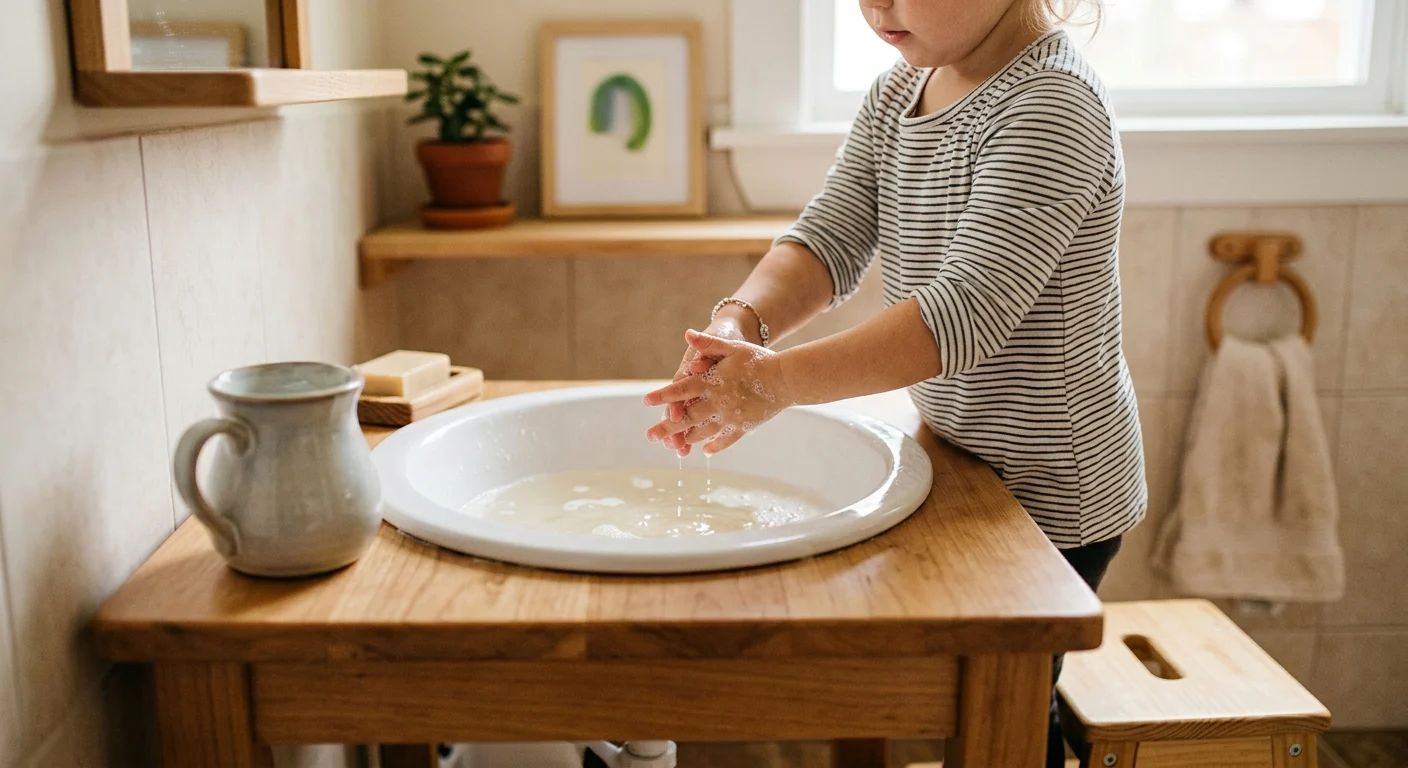

This is where Montessori shines.
A lot of toilet learning frustration is really environment frustration. We ask tiny children to use an adult-sized toilet, climb onto it while unstable, wipe with paper they cannot reach, wash hands at a sink that is practically in another postcode, and then wonder why they don’t feel confident.
A prepared environment removes unnecessary difficulty.
The essentials
1. A child-sized potty or a toilet reducer
Some children do best starting with a small floor potty because it feels stable and easy to reach. Others are happy with the regular toilet if you add the right support.
If you want the simplest possible start, a floor potty like the BabyBjörn Smart Potty is sturdy, low, and easy for toddlers to use independently.
If your child strongly prefers the real toilet, a reducer seat like the Munchkin Sturdy Potty Training Seat gives them a smaller, more secure opening.
2. A stable step stool
This is not optional. Your child needs to get on and off safely, plant their feet, and reach the sink for handwashing. The Boon Pivot Toddler Step Stool is a solid example, but any non-slip stool with a wide base works.
3. Easy clothing
For a while, toileting is as much a trouser-management skill as anything else. Favour elastic waists, simple leggings, soft trousers, and dresses. Avoid fiddly dungarees, tight jeans, and twelve impossible buttons.
4. A small basket with bathroom essentials
Include spare underwear, clean clothes, wipes for accidents if you use them, and maybe a tiny hamper for wet clothes. Order helps. Chaos makes accidents feel bigger.
5. Handwashing access
A stool at the sink, soap they can press, a towel they can reach. If the process ends with you carrying them around for each step, it still feels like your routine, not theirs.
Five-minute setup audit
Before you decide your child is “not ready,” stand in the bathroom at toddler height and check the routine as if you had short legs, small hands, and very little patience.
| Check | What good enough looks like | What usually causes friction |
|---|---|---|
| Getting there | The potty or toilet path is clear and visible | Bathroom is far away, door is closed, or the potty moves around |
| Sitting | Feet feel supported and the child can get down safely | Dangling legs, wobbly reducer, adult lifting every time |
| Clothing | Waistband can go down quickly with light help | Tight jeans, dungarees, belts, stiff buttons |
| Cleanup | Dry clothes, cloths, and a small laundry spot are ready | Adult has to hunt for everything while the child stands wet |
| Handwashing | Soap, towel, and stool are reachable | Sink routine requires lifting, grabbing, or too many adult steps |
This audit often solves more than another article about readiness. A child who has to depend on you for every tiny part of the routine is not really practising independence yet.
For the wider room setup, pair this guide with the Montessori bathroom setup guide. If clothing is the bottleneck, the Montessori dressing skills guide is the more useful next fix.
Nice but genuinely useful extras
- a few pairs of absorbent training underwear, such as MooMoo Baby training pants
- a basket of simple books for toilet sits, especially if poop anxiety is involved
- a second potty if your home has more than one floor
The goal is not to buy a whole potty empire. The goal is to remove friction.
Actionable takeaway: Before you focus on your child’s behaviour, make sure the environment is not making the task harder than it needs to be.
🧠 The Montessori Approach, Step by Step
There is no single Montessori toilet learning script, but there is a sensible rhythm.
Step 1: Name what is happening
Use simple, neutral language.
“Your nappy is wet.”
“You are doing a poo.”
“Let’s change into dry clothes.”
This sounds small, but it matters. Body awareness grows through repetition and language. You are helping your child connect sensation, action, and words.
No disgust. No teasing. No “ew, stinky bum” routine. Keep it calm.
Step 2: Invite participation before expecting independence
Even before your child is consistently using the potty, they can:
- walk to the bathroom with you
- sit on the potty before bath or after waking
- help pull trousers up and down
- put wet clothes in the hamper
- flush
- wash hands
This matters because independence is built in layers. A child who can do the routine with support is already learning.
Step 3: Build predictable toilet moments into the day
Rather than asking every six minutes, “Do you need the potty?” create consistent opportunities:
- after waking
- before leaving the house
- before bath
- before nap or bed
- after meals if your child tends to poop then
This gives structure without pressure. It also helps your observation. You start seeing patterns instead of guessing wildly.
Step 4: Move to underwear when the routine is established enough
This does not have to happen on some dramatic launch day.
For some families, it starts with short periods at home. For others, it is a cleaner switch once the child clearly understands the routine. Either can work.
The Montessori lens is simple: if nappies are hiding the body’s feedback entirely, they can slow awareness. Underwear makes the experience clearer. But if switching creates total chaos and panic, you may need a slower ramp.
Step 5: Treat accidents like information

Accidents are not proof that it is all failing. They are data.
Maybe the child waited too long. Maybe the bathroom was too far. Maybe the clothing was too hard. Maybe they were deeply busy building a tower and ignored every signal. Maybe you started during a week when life was already upside down.
Respond like this:
- “You are wet. Let’s change.”
- help clean up together, without drama
- adjust the environment or routine if a pattern appears
That’s it. Calm beats commentary.
Actionable takeaway: The fastest route is usually not more pressure. It is better observation.
📅 A Realistic Daily Rhythm That Works
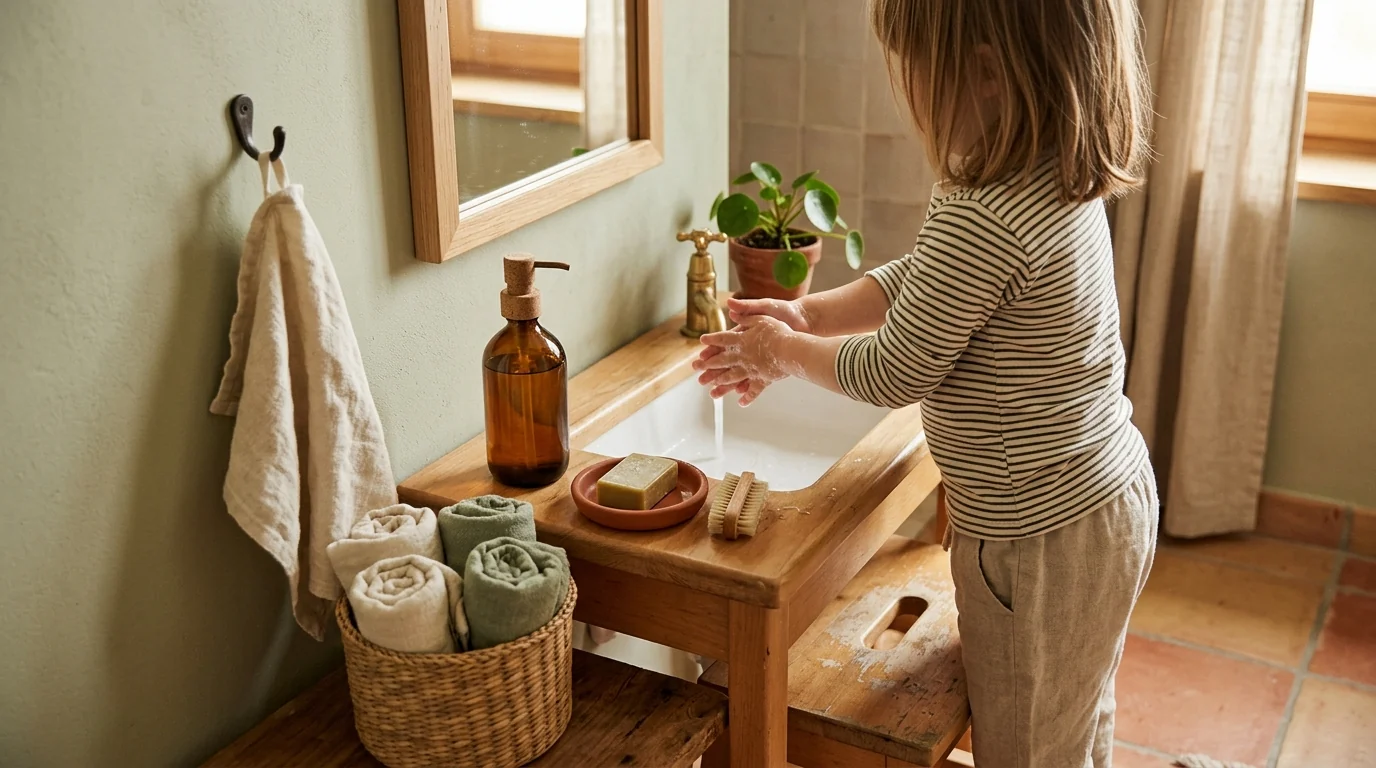
Parents often want to know, “Yes, but what do I actually do tomorrow?”
Fair enough. Here’s a realistic Montessori-style rhythm for a toddler who is beginning toilet learning at home.
Morning
After waking, go straight to the bathroom. Keep the routine quiet and predictable. Sit for a minute or two, not a hostage negotiation.
Then do underwear or easy clothes, wash hands, and move on with the day.
Mid-morning
Offer another toilet visit before going outside or before a snack if that fits your child’s pattern.
Lunch and early afternoon
Many toddlers poop after a meal. If that seems to be your child, quietly build in a toilet opportunity after lunch. Not because you are forcing a result, but because the pattern is there.
Late afternoon
If accidents tend to happen when your child is deeply absorbed, this can be a useful check-in point.
Before bath and before bed
These are natural anchors. The transition is already happening, so the toilet fits smoothly.
A note on asking: try replacing constant questions with calm statements.
Instead of: “Do you need to go?”
Try: “It’s toilet time before we go out.”
A lot of toddlers hear questions as invitations to say no. A simple routine statement removes the power struggle.
This is not rigid scheduling. It is scaffolding.
If your child resists every single sit, pull back. If they happily use the potty at two regular times a day, that is progress. You are building trust in the process.
First-week rhythm without the drama
This is a gentle starting rhythm, not a strict training plan.
| Day | Parent focus | Child’s job | What counts as progress |
|---|---|---|---|
| 1 | Prepare the bathroom and use neutral language | Visit the bathroom with you | They see the routine without pressure |
| 2 | Offer sits at natural anchors: wake, before leaving, before bath | Sit briefly or decline calmly | No battle around the potty |
| 3 | Notice patterns after meals and long play periods | Help push trousers down or up | One part of the routine becomes more familiar |
| 4 | Try short underwear time at home if your child is curious | Notice wetness and help change | Awareness improves, even with accidents |
| 5 | Add a cleanup script: “You are wet. Let’s change.” | Put wet clothes in the basket | Accidents become routine, not shame |
| 6 | Practise one outing with spare clothes and a wet bag | Use the home routine before leaving | Leaving the house feels less chaotic |
| 7 | Review what actually worked | Repeat the easiest successful moment | You know what to keep, pause, or simplify |
If day three looks like day one, that is not failure. Stay with the routine that your child can tolerate. Toilet learning is still care-of-self work, and self-care gets stronger through many ordinary repetitions.
😬 Common Problems, and What Usually Helps

No toilet learning guide is complete without the messy bit.
”My child refuses to sit”
Sometimes the refusal is about pressure, not the potty itself. Try making the sit shorter, more predictable, and less emotionally loaded. A neutral routine works better than intense encouragement.
Also check the physical setup. A dangling child on a big toilet feels unsafe.
”My child will wee in the potty but won’t poop”
This is incredibly common.
Pooping asks for more relaxation, more body trust, and often more emotional security. Constipation can also create a bad loop fast. If poop is painful, your child may start withholding. Then the problem snowballs.
What helps:
- prioritise soft stools through hydration and fibre
- keep toileting time calm, never force sitting
- use books and routine to reduce tension
- speak to your paediatrician if constipation is a pattern
”My child was doing well, then regressed”
Regression is not weird. Travel, illness, a new nursery routine, a new sibling, stress, constipation, tiredness, or simply developmental wobble can all knock things off course.
Go back to basics:
- simplify the clothing
- increase routine opportunities
- reduce pressure
- support the cleanup matter-of-factly
Don’t frame it as failure. Your child is not manipulating you. They are having a hard time with a complex skill.
”Should I use rewards?”
Montessori generally avoids external rewards for self-care skills.
Why? Because the real goal is internal awareness and capability. If every toilet visit becomes about earning a chocolate button or sticker, the focus shifts from body signals to adult approval.
That said, warmth and celebration are fine. “You listened to your body.” “You got your trousers down by yourself.” That’s encouragement, not bribery.
”What about nighttime?”
Daytime and nighttime dryness are different skills. Nighttime dryness is heavily biological and often arrives later. You are not failing because your child uses the toilet during the day and still needs protection at night.
Actionable takeaway: If things get weird, check constipation, pressure, and physical setup before assuming your child is just being difficult.
Outings, Nursery, and Other Real-Life Complications
Home toilet learning is one skill. Using unfamiliar bathrooms while tired, excited, or wearing shoes and a coat is another.
Keep the outside-world version simple:
- use the toilet or potty before leaving, even if nothing happens
- pack two full clothing changes, not just spare underwear
- carry a small wet bag for damp clothes
- choose easy shoes and trousers on toilet-learning days
- tell nursery or caregivers the exact words and routine you use
- expect public toilets to feel louder, colder, and less predictable
For nursery, ask about the practical details before you need them. Where is the child toilet? Do they use a reducer? Can your child keep spare clothes there? Will an adult offer routine opportunities, or only respond when the child asks?
That last question matters. Many toddlers who are doing well at home still need an adult to notice timing and transitions elsewhere.
If your child is also working on handwashing, shoe changes, and leaving-the-house routines, Montessori routine cards for toddlers can make the sequence more visible. Use cards as prompts, not as a reward chart.
Actionable takeaway: Treat outings and nursery as the next layer of independence, not the final exam.
🧺 What to Buy, and What You Can Skip
You do not need a themed potty playlist, a talking toilet, or seventeen reward charts.
If you buy anything, keep it boring and functional.
Worth it
A stable potty or reducer A low potty like the BabyBjörn Smart Potty or a secure reducer such as the Munchkin Sturdy Potty Training Seat.
A non-slip stool Your child needs stable feet for both toileting and handwashing. The Boon Pivot Toddler Step Stool is a good example.
Simple absorbent training pants A few pairs can reduce total disasters while still letting your child feel what happened. MooMoo Baby training pants are the kind of thing to look for.
A small waterproof wet bag Very useful for accidents when you are out of the house. Search for a simple toddler wet bag rather than something heavily marketed as a potty miracle.
Usually skippable
- musical potties that turn every wee into a nightclub event
- huge toilet learning toy bundles
- complicated charts that make you the prize dispenser
- clothing your child cannot realistically manage
Montessori tends to work better when the tools are simple and the routine is clear.
❤️ What Success Actually Looks Like
Success does not mean zero accidents by Sunday.
Real progress looks more like this:
- your child notices they are wet
- they walk to the bathroom willingly
- they sit without panic
- they start using the potty at one or two predictable times
- they can push trousers down with less help
- they help clean up after accidents
- they begin to trust their own body a little more
That is real development. That is Montessori.
And yes, eventually that often becomes full daytime toilet independence. But if you focus only on the final outcome, you miss the deeper thing your child is learning: “I can care for myself.”
That lesson spills into everything else.
If you want to support the same independence in other parts of the day, our guides on Montessori Practical Life, Montessori dressing skills, and How to Start Montessori at Home are the best next reads.
How we reviewed this guide
This guide was refreshed to focus on the parts parents can actually change at home: bathroom access, clothing, predictable routine anchors, accident response, and the difference between daytime toilet learning and nighttime dryness. Product mentions are limited to categories that remove real friction, such as a stable potty, secure reducer, non-slip stool, simple training underwear, and a wet bag.
We do not claim a single method will toilet-train every child quickly. Constipation, stress, nursery routines, language development, mobility, sensory preferences, and temperament can all change the pace. If your child has painful stools, repeated withholding, urinary pain, or sudden major regression, use this guide as setup support and speak with your paediatrician.
Some links may be affiliate links, which means Exploritori may earn a small commission if you buy through them. Recommendations are based on practical fit for toddler independence rather than brand sponsorship.
Frequently Asked Questions
What age does Montessori toilet learning start?
Some Montessori families begin offering potty awareness in the second year of life, often around 15 to 18 months, but there is no single mandatory age. The better question is whether your child is showing body awareness, interest, and enough stability to participate in the routine.
Is Montessori toilet learning the same as potty training?
Not quite. Montessori toilet learning is usually less reward-based and less intensive. It focuses on observation, independence, accessible setup, and calm repetition rather than a short, high-pressure training event.
Should I use a potty or the regular toilet?
Either can work. A floor potty is often easier for early independence because it is physically accessible and feels secure. A regular toilet can work well if you use a reducer seat and a solid step stool so your child feels stable.
What if my toddler keeps having accidents?
Accidents are normal and expected. Look for patterns instead of treating each accident like a setback. Check timing, clothing, physical access, constipation, and whether the process has started to feel pressured.
Should I use rewards for toilet learning?
Montessori usually avoids rewards like sweets or sticker charts for toileting. Encouragement is helpful, but the aim is for your child to connect toileting with body awareness and growing independence, not with earning a prize.
How long does toilet learning usually take?
Usually longer than parents hope and less neatly than social media suggests. Some children move quickly once the setup is right. Others need a slower, steadier process with regressions along the way. Calm consistency matters more than speed.
 Get weekly Montessori tips
Honest reviews, activity ideas, and budget-friendly picks — no spam, just what works.
Subscribe Free