Montessori Bathroom Setup for Toddlers: A Simple Guide to Real Independence
· Updated
 If your bathroom routine feels harder than it should, the problem is often not your toddler.
It is the room.
We ask small children to wash hands at sinks they cannot reach, dry off with towels hung miles above their heads, and sit on adult toilets with dangling legs. Then we call them resistant when they stall, whine, or ask for help every single time.
A Montessori bathroom setup changes that by changing the environment first.
Instead of relying on constant lifting, reminding, and rescuing, you make the room readable and usable for your child. A steady stool. A towel they can reach. Soap they can press. A small place for toothbrush, brush, and toilet-learning basics. Tiny changes, but they can shift the whole mood of the day.
That is the heart of Montessori at home: make independence possible, then let your child practice it.
And no, you do not need a dreamy Pinterest bathroom or a full renovation to get there.
Quick audit: what is blocking independence?
Before buying anything, watch one normal bathroom routine and find the first point where your child gets stuck.
| If your child gets stuck at… | Change this first | Skip for now |
|---|---|---|
| Reaching the sink | a stable non-slip stool with the right height | a full child-size sink renovation |
| Getting soap | an easy-press pump or foaming dispenser | decorative glass bottles |
| Drying hands | one low towel hook or lower rail | a matching towel set |
| Brushing teeth | a tiny tray with brush, cup, and adult-portioned toothpaste | several grooming products within reach |
| Toileting | foot support, easy clothes, and predictable spare clothes | pressure-heavy reward charts |
| Cleaning splashes | one small cloth beside the sink | expecting dry counters from a learning toddler |
If you only change one thing this weekend, choose the row that matches the first daily failure point. A prepared bathroom should remove friction before it adds more equipment.
Takeaway: the best Montessori bathroom setup starts with observation, not shopping.
🚿 What a Montessori bathroom actually is
A Montessori bathroom is not a styled corner for photos. It is a prepared environment for real self-care.
That includes:
- washing hands
- brushing teeth
- wiping the face
- combing hair
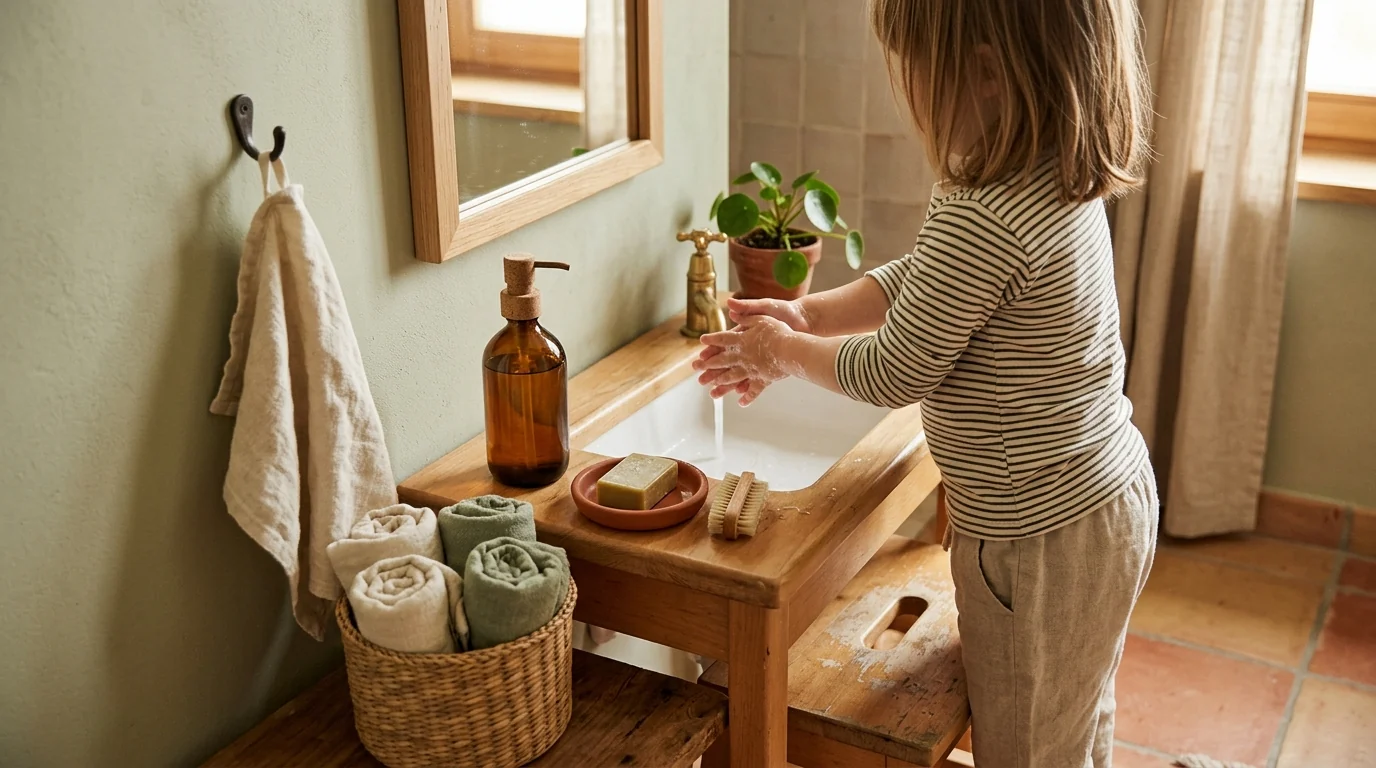
- using the toilet or potty
- hanging up a towel
- putting dirty clothes in the hamper
- helping clean up small splashes
In Montessori, these are practical life skills. That matters because practical life is not filler before the “real learning” starts. It is real learning.
When your child climbs up safely, pumps soap, washes, rinses, dries, and puts the towel back, they are building coordination, sequencing, concentration, and confidence. They are also learning something bigger: I can do this myself.
That same logic is why prepared spaces work so well in other parts of the home too, like a Montessori toddler wardrobe, dressing skills setup, or a Montessori shelf setup. Children do better when the room supports the routine instead of blocking it.
Actionable takeaway: If your child needs adult help at every step, the routine is probably not truly child-accessible yet.
🪜 The five changes that matter most
You do not need ten products. You need the right friction removers.
1. A stable step stool
If you buy one thing, make it this.
A stool unlocks handwashing, toothbrushing, mirror access, and more confident toilet use. It is one of the highest-value practical-life purchases in the whole house because your child will use it every day.
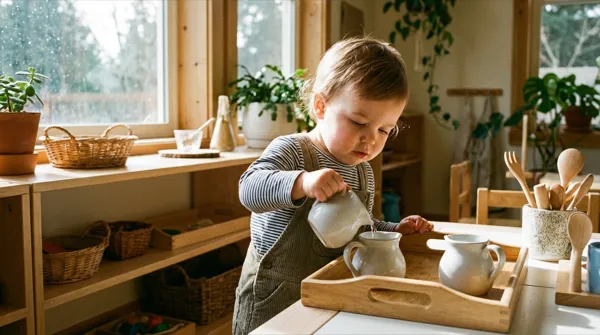
Look for:
- a wide base
- non-slip feet or surface
- enough height to reach the sink without dangerous stretching
- something sturdy enough that you are not wincing every time they climb
If your child also helps at the kitchen counter, a sturdier helper like the Guidecraft Kitchen Helper can earn its keep far beyond the bathroom.
2. Soap your child can actually use
Many toddlers can reach the sink and still get stuck because the dispenser is too stiff.
A simple child-friendly soap dispenser or any easy-press foaming pump can remove a surprising amount of frustration.
Test it yourself with one finger. If you need your palm or two hands to press it cleanly, your toddler will probably need help every time. A foaming pump is often easier because children can see the soap spread quickly and do not need as much product.
Place the soap where your child can reach it from the stool without leaning over the basin. Reaching too far is when the routine starts becoming unsafe.
3. A reachable hand towel
This sounds almost too obvious to mention, but it is one of the biggest fixes.
If the towel lives on an adult-height rail, the handwashing cycle is incomplete. Add one low hook, one lower rail, or even a removable adhesive hook at your child’s level.
Use a towel that is small enough for your child to manage. A heavy adult towel can drag on the floor, pull off the hook, and make the whole cycle feel clumsy.
4. A safe mirror
A mirror helps with much more than toothbrushing. It gives your child visual feedback while washing, wiping, brushing, and learning where their own body is in space.
An acrylic safety mirror is often a better choice than glass in a toddler bathroom zone.
5. Toileting support that feels secure
If your child is toilet learning, the bathroom needs to feel physically manageable.
That usually means:
- a stable potty or reducer seat
- feet supported, not dangling
- easy clothes they can pull up and down
- toilet paper or wipes within reach, when appropriate
If you want the full toileting rhythm, our Montessori toilet learning guide goes deeper. If clothing is the hard part, the Montessori dressing skills guide will help with elastic waists, shoes, coats, and fasteners. This post is about the room itself.
Actionable takeaway: Fix the physical blockers first. A lot of bathroom resistance melts when the setup gets easier.
🧺 What to include in your Montessori bathroom setup
Think in zones, not shopping lists.
Handwashing zone
This is usually the best place to start.
A solid handwashing zone includes:
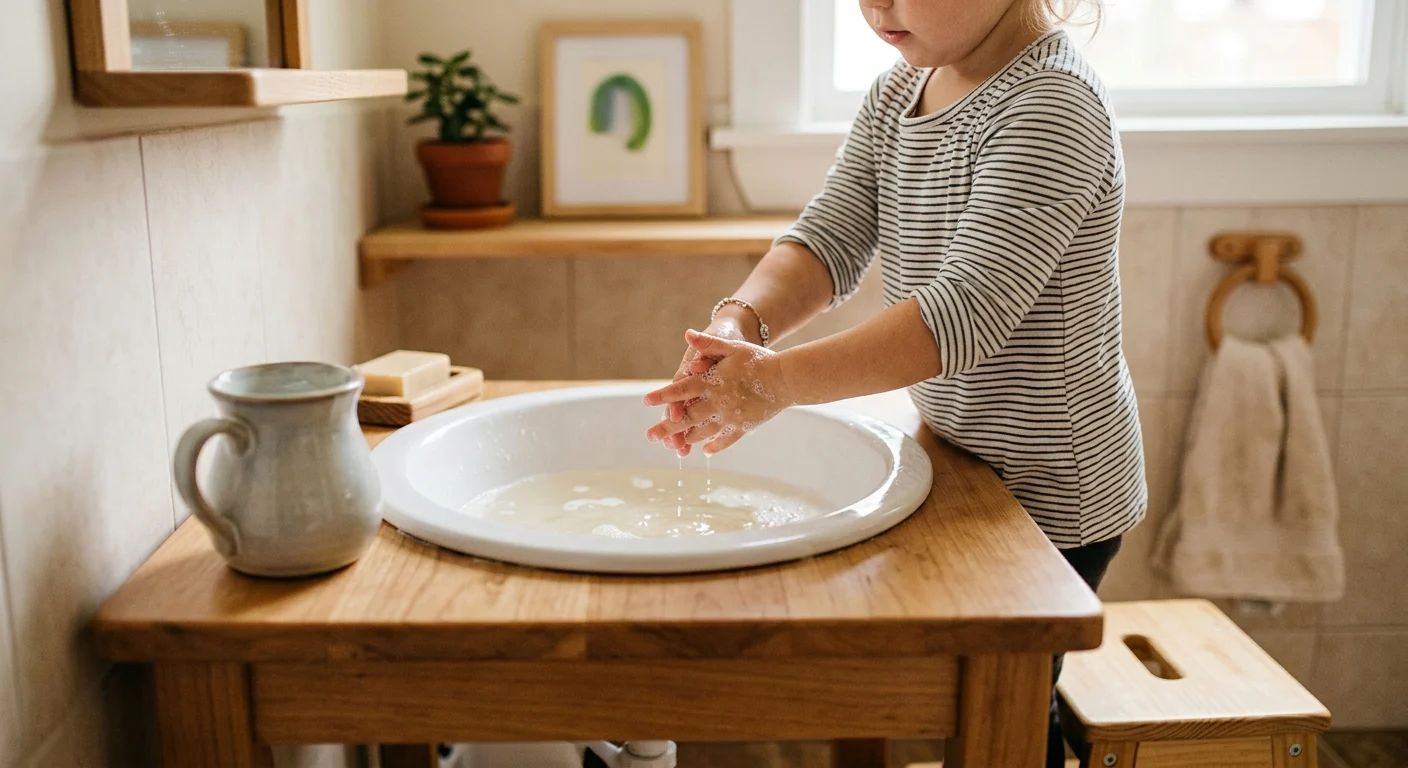
- step stool
- easy soap
- reachable towel
- a nail brush if your child enjoys “real work”
- a small cloth or sponge for wiping drips
You do not need a child-size sink. You need an adult sink that your child can actually use.
For younger toddlers, start with the same short sequence every time: climb, wet, soap, rub, rinse, dry, towel back. If your child treats the sink like water play, make the water shallow and predictable, then offer separate water work through a tray or basin. Our Montessori water practical life activities guide has calmer ways to practise pouring, squeezing, and cleanup away from the main bathroom routine.
Toothbrushing zone
Keep this as simple as possible.
Your child needs:
- toothbrush
- small cup if you use one
- toothpaste you can portion or supervise
- one predictable home for each item
A tray helps here because it makes the routine feel finite instead of chaotic. Even a plain small wooden tray can make the setup easier to read.
Toileting zone
This might include:
- potty or reducer seat
- stool
- spare underwear or training pants nearby
- small hamper or wet bag
- simple wipes or cloths, depending on your routine
For many toddlers, just seeing everything in one predictable place lowers anxiety.
Self-care zone
This is the quiet magic part.
A small basket with a hairbrush, washcloth, and one or two simple care items can turn “stand still while I fix you” into “let’s do your care routine together.”
Keep this tiny. Too many products create clutter, not independence.
If your child is also learning to choose clothes, connect this basket with a simple Montessori toddler wardrobe or low dressing area. Bathroom independence works better when clothes, toilet learning, washing, and cleanup are treated as one care-of-self rhythm instead of isolated battles.
Cleanup zone
Montessori works best when your child can see the full cycle.
That means they can:
- wipe a small splash
- hang the towel back up
- put dirty clothes in the hamper
- return brush or cup to its place
That is how order becomes calming instead of fussy.
| Zone | What your child needs | Why it matters |
|---|---|---|
| Handwashing | Stool, soap, towel | Builds daily independence fast |
| Toothbrushing | Brush, cup, tray | Keeps the routine simple and visible |
| Toileting | Potty/reducer, stool, spare clothes | Reduces stress during toilet learning |
| Self-care | Brush, cloth, mirror | Supports body awareness and care of self |
| Cleanup | Sponge, hamper, hook | Helps your child complete the whole cycle |
Actionable takeaway: If a routine keeps falling apart, check whether every step has a physical home.
👶 What bathroom independence looks like by age
A Montessori bathroom should meet your child where they are, not where social media says they should be.
12–18 months
At this stage, participation matters more than independence.
Your child may:
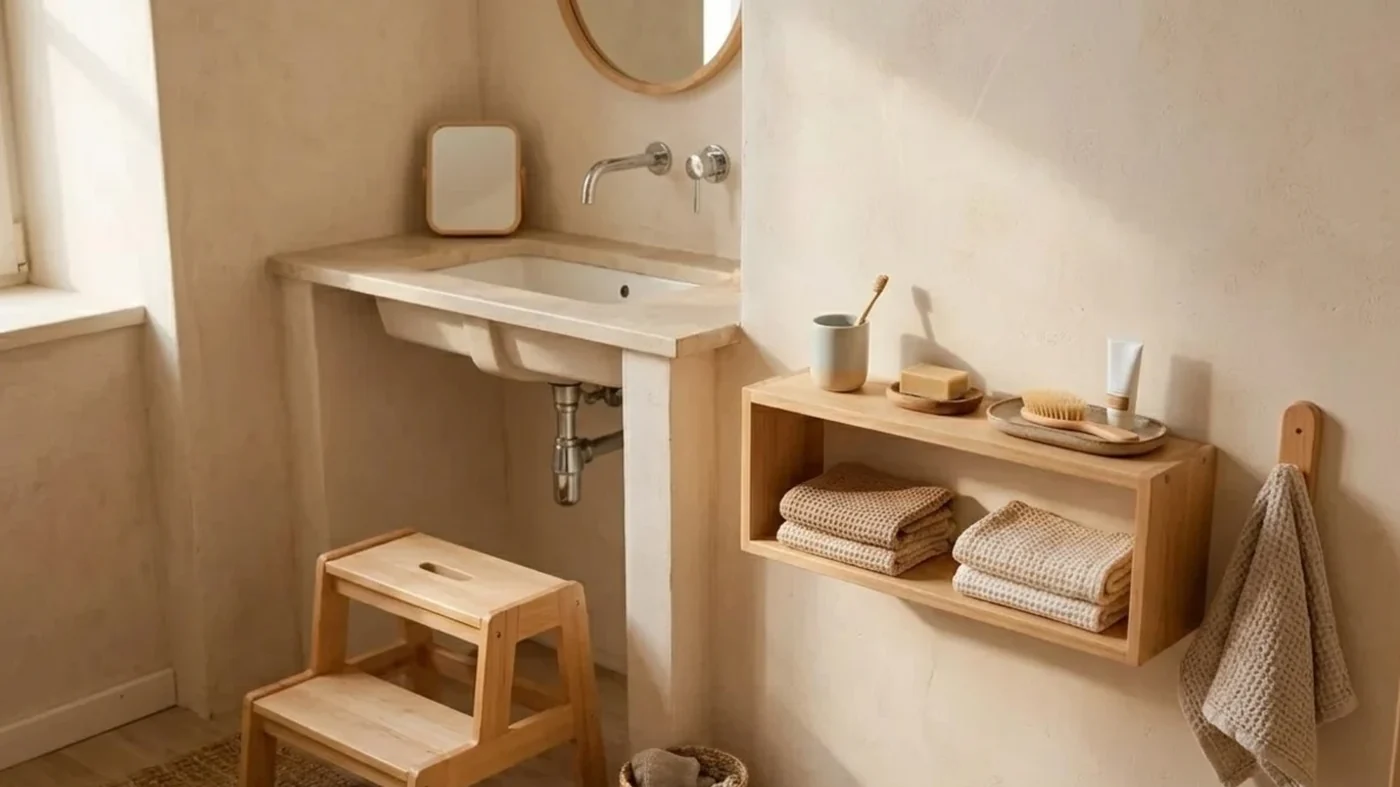
- climb onto the stool with help
- rub hands together under water
- help put the toothbrush away
- carry a towel to the hook
- sit on the potty briefly as part of routine
That still counts. The goal is familiarity and cooperation.
18–24 months
This is often when bathroom routines become a real practical-life arena.
Your child may want to:
- pump soap independently
- rinse hands with less help
- dry hands alone
- help pull clothing up and down
- brush teeth after you model it
This is also a great age for wider home independence. Our Montessori practical life activities guide and Montessori activities for 24-30 months both fit this stage well.
2–3 years
Many children can now manage much more of the sequence.
They may be able to:
- go to the bathroom on cue
- wash hands start to finish
- brush teeth with supervision
- use the mirror to wipe their face
- manage simple clothes during toileting
The lesson here is not “add more stuff.” It is “give more responsibility inside a clear structure.”
3–6 years
Older preschoolers can usually handle fuller self-care routines, but they still benefit from order. Too many bottles, too many choices, and too much clutter can make the process messy again.
Keep expanding only when the current system works.
| Age | Realistic bathroom goal |
|---|---|
| 12–18 months | participate in handwashing and simple routines |
| 18–24 months | complete parts of the sequence independently |
| 2–3 years | manage handwashing and parts of toileting with minimal help |
| 3–6 years | handle most self-care routines with reminders, not rescue |
Actionable takeaway: Independence grows best through small wins, not giant leaps.
🚽 How this supports toilet learning without making the whole room about potty training
A lot of bathroom content jumps straight to potty training. Fair enough. That is the dramatic part.
But one reason Montessori toilet learning often feels calmer in a prepared space is that it is supported by many smaller routines around it.
A child who can:
- get onto the stool safely
- pull elastic-waist trousers down
- access toilet paper or wipes
- wash hands after
- hang the towel back up
is not just “using the toilet.” They are completing a whole care sequence.
That matters because toddlers often resist the parts they cannot control. If the bathroom feels too adult-sized, too slippery, or too dependent on you, the whole experience becomes heavier.
You can make it lighter by simplifying the environment:
- choose easy clothes instead of fiddly fastenings
- keep spare clothes nearby
- reduce what is visible
- create one consistent flow from toilet to sink to towel

If your child is in the thick of toilet learning, this is also where prepared spaces connect beautifully with other practical-life routines. Dressing, washing, and cleanup all reinforce each other.
For a toilet-learning child, check the whole loop before assuming the toilet itself is the problem:
| Step | What helps | Why it matters |
|---|---|---|
| Getting there | clear path, no clutter around the stool or potty | fewer bumps and delays when the need is urgent |
| Clothes down | elastic waists, no tight overalls, no complicated snaps | lowers the chance of accidents caused by clothing |
| Sitting | stable feet, potty or reducer that does not wobble | children relax more when they feel physically secure |
| Wiping/help | wipes or paper where you can supervise access | keeps the step visible without handing over everything |
| Washing after | stool, soap, towel, cloth for drips | makes toileting part of a complete hygiene sequence |
Actionable takeaway: Bathroom independence is not one skill. It is a chain of tiny skills that support each other.
🛁 Small-space Montessori bathroom ideas that actually help
Most families are not working with a gorgeous oversized bathroom. They are working with one sink, limited floor space, and storage choices made by some mysterious builder who never met a toddler.
That is fine.
Here are the small-space fixes that usually matter most.
Use one tray instead of a full station
A single tray for toothbrush, cup, and washcloth is enough. You do not need to turn the bathroom into a mini classroom.
Add one low hook
One hook can solve towel access, pajamas, tomorrow’s clothes, or a bathrobe. Cheap, boring, powerful.
Keep only active items visible
Do not leave every lotion, medicine, razor, and hair tool in your child’s zone. Montessori likes order because order is easier to decode.
Use vertical space strategically
Adult items can go high. Child items should stay low and obvious.
Make cleanup easy
A small sponge or cloth near the sink is one of those tiny upgrades that pays for itself immediately. Toddlers spill. If they can help wipe it up, the spill stops feeling like a crisis. The same idea works across the house with a simple toddler cleaning setup.
If floor space is tight, keep cleanup vertical: a low hook for the towel, one cloth on the tray, a slim hamper, and child items in a single basket. The goal is not to display more. It is to make the next action obvious.
Borrow ideas from other prepared spaces
The same logic behind our Montessori storage solutions for small spaces and IKEA Montessori hacks applies here too: fewer visible things, clearer homes, better access.
Actionable takeaway: In a small bathroom, simplicity is not a compromise. It is the strategy.
⚠️ Common mistakes that make bathroom routines harder
A setup can look lovely and still fail in real life. These are the mistakes that show up most often.
1. Buying before observing
You do not need a “Montessori bathroom kit.” You need to notice where your child gets stuck.
Is it reaching the sink? Pumping soap? Climbing safely? Pulling trousers down? Start there.
2. Leaving too many items out
If your child opens a drawer and finds seventeen unrelated objects, the room stops being readable.
3. Expecting independence without showing the sequence
If you have never modeled the routine slowly, your child is not refusing independence. They are still learning it.
4. Using adult-scale tools
Heavy towels, stiff pumps, slippery stools, high rails, complicated clothes. These are setup mistakes, not character flaws.
5. Jumping in too fast
It can feel painful to watch a toddler spend ninety seconds trying to hang a towel badly. But that awkward struggle is often the actual learning.
Step in for safety. Step back for practice.
6. Making the room visually noisy
Montessori spaces work better when your child can clearly see what matters. Calm beats crowded.
Actionable takeaway: If the routine feels chaotic, remove friction before you add more teaching.
A five-minute bathroom reset checklist
Use this when the routine has become messy, rushed, or overcomplicated.
- Remove adult items from the child-accessible zone.
- Check that the stool does not slide on the actual bathroom floor.
- Put soap, towel, and cloth within reach from the stool.
- Leave only the toothbrush, cup, and one care item visible.
- Put spare underwear or training pants in one predictable place if toilet learning is active.
- Practise the full routine once when nobody is in a hurry.
- Watch for the first step that still needs adult rescue.
This is also a good time to connect the bathroom with your wider practical-life setup. A child who can wipe a sink drip can also help with table wiping, snack cleanup, and care of materials. For next steps, see Montessori practical life activities, Montessori routine cards, and how to start Montessori at home.
🌱 A simple weekend reset you can do in 20 minutes
If your current bathroom setup is annoying everyone, do not try to redesign the whole room at once.
Try this instead:
- add a stable stool
- lower one towel
- move soap where your child can use it
- clear one small child-only zone
- add one cloth for wiping drips
- simplify toileting clothes if needed
That is enough to change the feel of the room.
If you want two genuinely useful add-ons beyond the stool, I would start with:
- a child-friendly soap dispenser
- an acrylic safety mirror
And if your bigger independence bottleneck is sink access across the house, not just in the bathroom, a Guidecraft Kitchen Helper can help in the kitchen, bathroom, and practical-life routines more broadly.
A Montessori bathroom does not need to be fancy. It just needs to make sense to your child.
That is often where calmer mornings begin.
How we reviewed this guide
This is a Montessori-at-home prepared-environment guide, not medical advice, toilet-training diagnosis, or a claim that every toddler should manage bathroom routines independently. We reviewed it in July 2026 against Exploritori’s toilet learning, dressing skills, practical life, water work, routine cards, and small-space setup guides, then prioritised changes parents can test in ordinary bathrooms: access, stability, sequence, cleanup, and fewer visible choices.
Some links may be affiliate links, which can earn Exploritori a commission at no extra cost to you. The core setup here does not require a remodel or a full Montessori product set. Buy only when an item solves a clear size, safety, reach, or repeat-use problem in your home.
❓Frequently asked questions
What should be in a Montessori bathroom setup?
At minimum, most families do well with a stable stool, reachable towel, easy soap, simple toileting support, and one small basket or tray for child items. You are aiming for access, not a full redesign.
Do I need to remodel my bathroom to make it Montessori?
No. Most Montessori bathroom setups are just thoughtful tweaks to a normal bathroom: lower what your child needs, reduce clutter, add one stool, and make the routine easier to complete independently.
What age can I start a Montessori bathroom setup?
You can begin as early as 12 to 18 months with handwashing support, a low towel, and a safe stool. The setup becomes more useful as your child’s desire for independence grows.
Is a Montessori bathroom the same as toilet learning?
Not exactly. Toilet learning is one part of it, but a Montessori bathroom also supports washing, brushing, grooming, cleanup, and care of self more broadly.
What is the best first purchase for a Montessori bathroom?
For most families, it is a sturdy non-slip stool. That single change unlocks sink access, mirror use, more confident handwashing, and better toileting support.
 Get weekly Montessori tips
Honest reviews, activity ideas, and budget-friendly picks — no spam, just what works.
Subscribe Free