Authentic Montessori Toys vs Montessori-Inspired Toys: What Actually Matters
· Updated
Montessori has a branding problem.
The word now gets pasted onto almost anything made of wood, painted beige, or sold with the promise that it will turn your toddler into a tiny philosopher.
That leaves a lot of parents stuck in the same loop:
Is this actually Montessori? Does “Montessori-inspired” mean “not good enough”? Am I paying for a useful material or just a nicer font?
Here is the short answer.
A toy does not need to be “authentic Montessori” in a pure, museum-piece sense to be worth buying. But if you want a calmer shelf, better concentration, and less clutter, you do need to know what the label is hiding.
Because some Montessori-inspired toys are genuinely useful.
And some “authentic Montessori” claims are just marketing wearing linen trousers.
Quick choice guide
| If you are wondering… | Short answer | What to do |
|---|---|---|
| “Does it need to be wooden?” | No | Judge the function before the material |
| “Are wooden toys better than electronic, light-up toys?” | Often, but not because of the wood | Pick toys your child has to move, build or solve, not ones that perform for them (wooden vs plastic guide) |
| “Is Montessori-inspired automatically worse?” | No | Check whether it still supports real child activity |
| “How do I avoid being fooled by branding?” | Look for one clear purpose | Skip toys doing ten things at once |
| “What is usually worth spending on?” | Tools for independence | Prioritize shelves, trays, practical life, and a few high-use materials |
The parent decision matrix
Use this before you buy, especially when two products both look “Montessori.”
| Product claim | Usually a good sign when… | Step back when… |
|---|---|---|
| “Authentic Montessori material” | It isolates one skill, uses clear feedback, and matches your child’s current stage | The listing leans on tradition but gives no age-fit, safety, or setup details |
| “Montessori-inspired” | The child still has to sort, post, pour, carry, match, build, or repeat something real | It mainly borrows beige styling, wood, or shelf-photo language |
| “Educational activity toy” | The skill is named plainly: matching, grading, posting, threading, pouring, sweeping | The claims are broad: genius, advanced learning, STEM boost, sensory development, all-in-one |
| “Premium wooden toy” | The material improves weight, feel, durability, or self-correction | The wood is the whole argument and the activity itself is muddled |
The best purchase is the one that passes the practical test in your home: your child can reach it, understand the work, repeat it, and put it away with gradually less help.

🌱 First: “authentic” should mean aligned, not precious
When most parents say “authentic Montessori toy,” they usually mean one of three things:
- it follows Montessori principles more closely
- it looks simpler and less flashy
- it feels safer or more trustworthy than random marketplace junk
Those are not the same thing.
Montessori is an educational approach, not a trademark for a wood finish.
So the better standard is this:
An authentic Montessori-aligned material helps your child do meaningful work with focus, repetition, and growing independence.
That might be a knob puzzle.
It might be a pouring setup.
It might be a small broom, a mirror-polishing tray, or a learning tower that lets your child join real kitchen work.
What matters is not whether the product feels exclusive. What matters is whether your child stays in the active role.
That is the piece a lot of online roundups skip.
Takeaway: “Authentic” is useful only if it points to real Montessori logic, not just a calmer aesthetic.
🧸 What “Montessori-inspired” usually means in real life
Montessori-inspired is a broad bucket.
Sometimes it means:
- simple design
- neutral colours
- fewer moving parts
- natural materials
- a toy that loosely supports a Montessori-style skill

That can be completely fine.
A Montessori-inspired product may not match classroom materials closely, but it can still work beautifully at home if it is clear, manageable, and genuinely engaging for your child.
For example:
- a Melissa & Doug Shape Sorting Cube is not a formal Montessori classroom material, but it gives clear hand-and-eye problem solving
- a Montessori Object Permanence Box is closer to classic Montessori infant work and has a more specific developmental purpose
- a child-sized cleaning set is not glamorous, but it often supports more real Montessori life than another “educational toy” ever will
So no, “inspired” is not a dirty word.
The problem is that many brands stop at inspired-looking.
They borrow the vibe and skip the function.
Takeaway: Montessori-inspired can be useful. Inspired-looking without clear purpose is where the trouble starts.
🚩 The red flags that usually mean “marketing first”
You do not need a perfect checklist for every toy.
You do need a decent nonsense detector.
I would get suspicious fast when a product leans on these:
1. The listing says Montessori five times but never explains the actual skill

If the product page cannot tell you what your child is supposed to practise, that is a bad sign.
“Develops cognitive abilities” means very little.
“Supports posting, matching, hand control, or pouring” means much more.
2. The toy does too many things at once
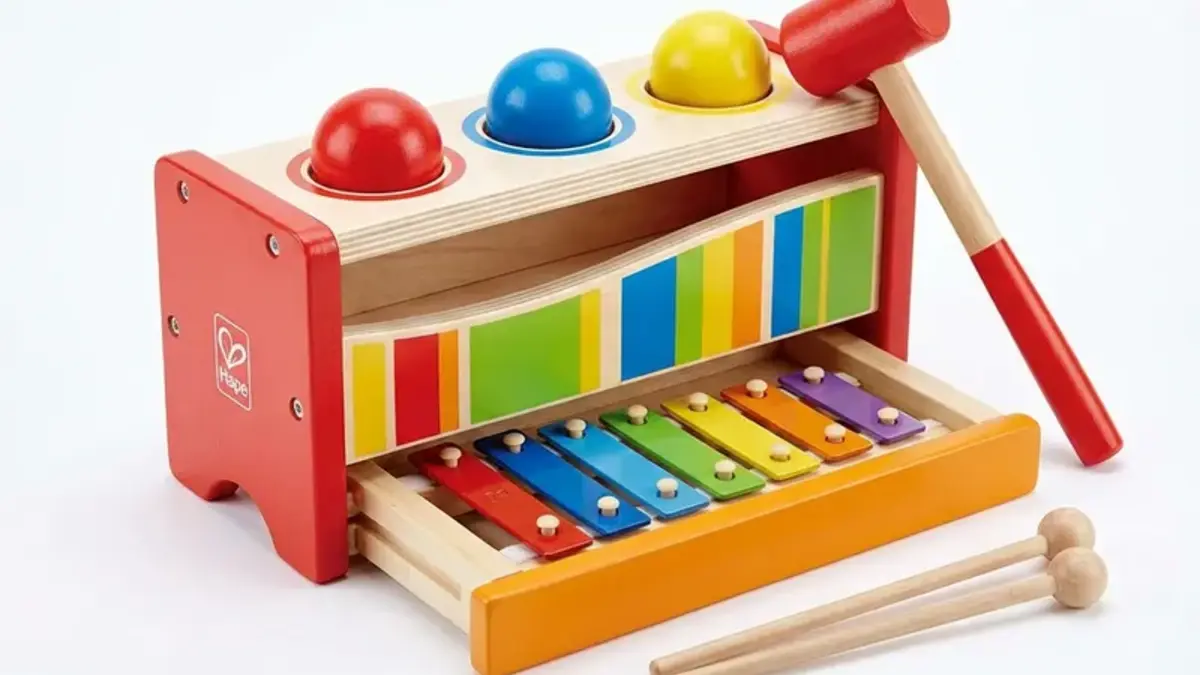
Busy boards, activity cubes, and giant all-in-one “learning toys” are often sold as Montessori because they look wooden and educational.
But if one toy includes zips, beads, gears, numbers, bells, shapes, latches, letters, and a xylophone, your child is not getting one clear challenge.
They are getting a buffet.
Montessori usually works better when the task is simpler.
3. The design rewards button pressing more than effort
If the toy lights up, talks back, or creates most of the entertainment on its own, your child is not doing much of the developmental work.
That does not make it evil.
It just makes it less Montessori-aligned.
4. The whole sales pitch is wood, beige, and Scandinavian calm
Wood can be lovely.
Beige can be nice.
Neither one teaches anything by itself.
We already covered this in our guide to wooden vs plastic Montessori toys, but it is worth repeating: material is not the method.
5. The price seems to reflect branding more than use
If you are paying premium money for something your child will use twice, the problem is not that it is Montessori-inspired.
The problem is that it is a bad buy.
Takeaway: when the label is louder than the developmental purpose, step back.
👀 The five questions that matter more than the label
If you want one practical filter, use these questions every time you shop.
Keep the answer boring and concrete. If you cannot name the child action in one short phrase, the toy probably needs more scrutiny.
1. Does it have one clear job?
A good Montessori-style material usually isolates one main challenge.
A puzzle asks where the piece fits.
A posting box asks how the object goes in.
A tonging tray asks your child to transfer with control.
That clarity helps concentration.
2. Is your child doing the work?
The material should wait for your child.
It should not sing, blink, celebrate, or perform the whole experience for them.
That is why simple things often work so well.
The Melissa & Doug Farm Animals Jumbo Knob Puzzle is not fancy, but your child has to grasp, place, notice, and try again.
3. Can your child see whether it worked?
This is the classic Montessori idea of control of error, minus the jargon.
The piece fits or it does not.
The water spills or it does not.
The lid closes or it does not.
Clear feedback builds confidence.
4. Is it a good fit for your child’s stage right now?
A beautiful material can still be wrong for this week, this month, or this child.
When the fit is right, your child repeats.
When it is off, they ignore it, throw it, or ask for help every ten seconds.
5. Will it support more independence in your actual home?
This is where practical life often beats toy shopping.
A low Montessori bookshelf, a few small trays, or a child-safe knife set may change your child’s daily life more than another decorative shelf toy.
Takeaway: if a material passes these five questions, the exact label matters a lot less.
Five-minute shelf audit
Before buying an “authentic” replacement for a toy you already own, try this quick audit:
| Check | What to look for | If the answer is no |
|---|---|---|
| Can my child reach it alone? | It sits on a low shelf, tray, or basket with visible boundaries | Fix access before buying a new material |
| Is the job obvious? | One main action: post, match, pour, carry, stack, sweep, open, close | Remove extra pieces or choose a simpler activity |
| Can my child reset it? | The pieces have a clear home and cleanup is realistic | Use fewer pieces, a smaller tray, or adult-prepped rotation |
| Does it get repeated use? | Your child returns to it across several days | Rotate it out and observe what kind of work is actually attractive |
| Does it solve a real routine? | It supports eating, dressing, cleaning, plant care, shelf work, or calm independent play | Treat it as optional decoration, not a priority purchase |
If this audit exposes a shelf problem, start with Montessori shelf setup or toy rotation before buying another labelled toy.
🪵 So do authentic Montessori toys have to be wooden?
No.
And this is one of the most expensive myths in the whole category.
Wood is common in Montessori spaces for good reasons:
- it has texture and weight
- it tends to feel calmer on a shelf
- it often lasts well
- it gives satisfying sensory feedback
But some excellent Montessori-style materials are metal, glass, cotton, ceramic, or mixed-material tools used in real life.
A small metal watering can can be more Montessori than a wooden pretend gardening set.
A glass pitcher for supervised pouring can be more useful than a “Montessori cup set” designed mainly for photos.
Even plastic is not automatically disqualified.
A simple set of stacking cups can support nesting, pouring, filling, bath play, and open-ended repetition. That is more useful than a badly designed wooden toy with six unrelated gimmicks.
If you want the longer version of this argument, read What Makes a Toy Montessori? and Are Montessori Toys Worth It?.
Takeaway: wood is often nice. It is not the test.
🧺 What is usually worth buying first
If you are trying to make your home feel more Montessori, do not start by hunting the most “authentic” toy on the internet.
Start with the purchases that increase independence and reduce clutter.
This is where I would put money first:
1. A low shelf or accessible toy display
If your child cannot see or reach their materials, the shelf is working against you.
A simple front-facing bookshelf or low shelf is often more useful than adding more toys.
2. Trays, baskets, and clear boundaries
Good setups make the activity obvious.
A few small activity trays can make ordinary objects feel complete and usable.
3. Practical life tools
This is where Montessori gets very real very quickly.
Think:
- child-safe knife
- small pitcher
- sponge
- dustpan
- little brush
- watering can
- stool or learning tower
If your child wants to help in the kitchen daily, a simple learning tower or sturdier Guidecraft Kitchen Helper is often a far better purchase than another boxed “Montessori” toy.
4. A few high-repeat materials, not a giant haul
For many toddlers, that might be:
- one good shape sorter
- one realistic knob puzzle
- one posting or object permanence activity
- one open-ended stacking or building material
That is enough to start well.
Takeaway: spend on access, order, and daily-life tools before chasing a showroom shelf.
🤝 When brand trust matters, and when it does not
Parents often use “authentic” as shorthand for “I do not want to buy junk.”
That part is fair.
Brand trust can matter for:
- finish quality
- paint and material standards
- durability
- customer service
- whether the product photos match reality
- clear age grading and small-parts information
- current safety documentation or recall visibility
But brand trust is not the same thing as Montessori fidelity.
This is why comparisons like Hape vs PlanToys can be helpful. They tell you something about quality, sustainability, and value.
They do not automatically tell you whether every toy in the catalogue deserves shelf space in your home.
A respected brand can still sell a toy that is too busy, too advanced, or too redundant for your child.
And a simpler, cheaper item can still be the better Montessori choice if it supports one clear job and gets repeated use.
For safety-sensitive purchases, especially mouthing-stage baby toys, painted wood, rattles, stacking toys, and second-hand marketplace finds, also check current age guidance and material details. The label “Montessori” does not replace normal toy-safety checks. Our guide to non-toxic Montessori toys and material red flags is the better next step if paint, finishes, plastics, or certifications are your main concern.
That is also why I prefer the question:
Would I still want this if the product title did not use the word Montessori?
If the answer is yes, good.
If the answer is no, that is useful information too.
Takeaway: a strong brand can reduce risk, but it should not do your thinking for you.
🛒 A calmer way to shop without becoming a toy detective
You do not need to investigate every listing like a crime scene.
Use this simple order instead:
- Ask what skill or kind of independence your child needs right now.
- Check whether you already own something that does that job.
- If not, look for the simplest material with one clear purpose.
- Prefer products that will live easily on your shelf and get repeated use.
- Ignore most of the aesthetic theatre.
That last one matters.
The internet is full of toys made to impress adults.
Montessori works better when the material is there to serve your child.
Sometimes the best “authentic” Montessori move is not buying a new toy at all.
It is setting out a sponge, a tray, a little pitcher, and a reason to use them.
Or clearing the shelf so the good materials you already own can actually breathe.
If your home feels crowded, our guides to Montessori toy rotation, Montessori shelf setup, Montessori toys by age, and Montessori on a budget for small spaces are good next reads.
Takeaway: the goal is not to win the authenticity contest. The goal is to choose materials your child will use well.
❓ Final answer: authentic or inspired?
If I had to give the simplest honest answer, it would be this:
Choose authentic Montessori logic over authentic Montessori branding.
That means:
- one clear purpose
- active child use
- simple feedback
- developmental fit
- room for repetition
- more independence in daily life
When a Montessori-inspired toy delivers those things, I am happy.
When an “authentic Montessori” product does not, I am not impressed.
Your child does not need a perfect shelf.
They need a few calm, useful materials that make real work possible.
That is where the good stuff happens.
How we reviewed this comparison
This is a Montessori-at-home buying guide, not a lab test of every product that uses the word Montessori. We reviewed it in July 2026 against Exploritori’s toy, shelf, practical-life, safety, and brand-comparison guides, then strengthened the parts parents need before spending: child action, age fit, repetition, independence, safety checks, and whether a cheaper household setup would do the same job.
Product links are included only where they make a material easier to identify. Some may be affiliate links, which can earn Exploritori a commission at no extra cost to you. The recommendation stays the same either way: buy the simplest material that solves a real developmental or home-routine problem, and skip the label when the function is weak.
 Get weekly Montessori tips
Honest reviews, activity ideas, and budget-friendly picks — no spam, just what works.
Subscribe Free